
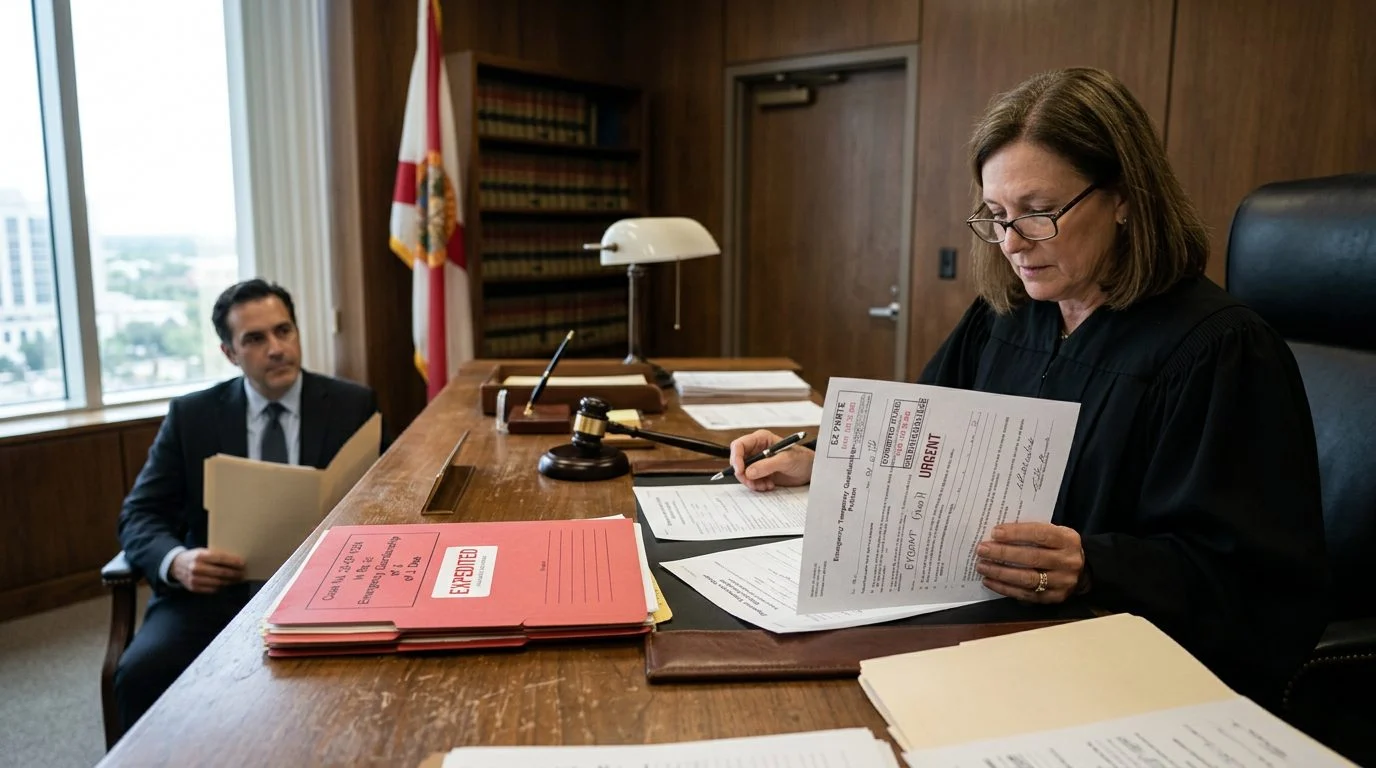
Emergency Temporary Guardianship | Florida
Immediate Legal Protection When Time is Critical
Robinson & Casey helps families secure emergency temporary guardianship orders to protect vulnerable adults and minors in crisis situations.
By Richard J. Casey III, Esq. · Published October 02, 2026
Emergency Temporary Guardianship Attorney: What It Is, How It Works & When You Need One
When an adult or minor faces imminent danger and no legal arrangement exists to protect them, an emergency temporary guardianship attorney can file an urgent petition to grant you immediate decision-making authority through the courts. Unlike standard guardianship, which can take months, emergency temporary guardianship is designed to move fast—sometimes within days—to stabilize a crisis and keep a vulnerable person safe.
Robinson & Casey handles emergency temporary guardianship petitions exclusively across South Florida and statewide. We understand that these situations don’t follow business hours, and we’re structured to respond to urgent filings without delay.

Not sure what your next step is?
Talk it through with our team — the first consultation is free, confidential, and carries no obligation.
What Is Emergency Temporary Guardianship?
Emergency temporary guardianship is a court order that grants you immediate legal authority to make decisions for an incapacitated or vulnerable person when standard guardianship proceedings would take too long.
Under Florida Statutes Chapter 744, a court may appoint an emergency temporary guardian after a petition to determine incapacity has been filed. This arrangement is temporary—it typically lasts 60 to 90 days—and serves as a bridge to either a permanent guardianship or termination if the crisis resolves.
What an emergency temporary guardian can do: – Consent to medical treatment, hospitalization, and medication – Decide where the person lives (home, facility, hospital) – Arrange for daily care and social services – Pay bills and manage certain financial matters (within the scope of the court order) – Make personal decisions about education and welfare
What it does not cover: – Selling or disposing of major property without additional court authority – Making decisions outside the scope granted by the judge – Overriding the person’s rights without legal process
The key distinction from standard guardianship is speed and scope. Emergency temporary guardianship moves fast because the court recognizes imminent danger. Standard guardianship is more thorough but slower. Emergency temporary guardianship is narrower—it addresses the immediate crisis. Standard guardianship (plenary or limited) is broader and longer-lasting.
Who Qualifies for Emergency Temporary Guardianship?
Emergency temporary guardianship is available for incapacitated adults, vulnerable adults, and minors in crisis situations when imminent danger exists.
Grounds for emergency appointment include: – Medical crisis (sudden hospitalization, inability to consent to treatment) – Abandonment by a caregiver or loss of support system – Physical abuse, neglect, or exploitation – Financial exploitation or fraud – Inability to care for oneself (food, shelter, hygiene, safety) – Substance use-related incapacity requiring immediate intervention
Who can file: – Family members (spouse, adult children, parents, siblings) – Healthcare providers or hospitals – Social services agencies or Adult Protective Services – Any interested party who can demonstrate the person’s need for protection
What evidence is required: The court needs proof that the person is incapacitated and in imminent danger. This typically includes: – Medical records or physician affidavits – Incident reports or police records – Affidavits from family, caregivers, or witnesses – Documentation of the specific threat or crisis
Can I Get Temporary Guardianship Without Going to Court?
No—court involvement is required for legal authority to make decisions for another adult.
Some families ask whether they can arrange temporary guardianship privately or through agreement. The answer is that no private arrangement gives you legal standing to make medical, financial, or personal decisions for another adult. Only a court order grants that authority.
Why court is necessary: – Legal standing: Without a court order, healthcare providers and financial institutions won’t recognize your authority. – Judicial oversight: The court protects the incapacitated person’s rights and ensures decisions are in their best interest. – Enforceability: A court order is binding; a private agreement is not.
What “emergency” means in court context: “Emergency” does not mean the court process disappears. It means the court moves fast. The judge may hold an ex parte hearing (without the incapacitated person present) if imminent danger exists, and the order can be issued within hours or days. But the person still has the right to notice and a full hearing within the statutory timeframe.
Alternatives that may be sufficient (without guardianship): – Power of attorney: Allows someone to make financial and legal decisions on your behalf, but only if you’re competent to sign it. – Healthcare proxy: Lets you designate someone to make medical decisions if you become unable to do so. – HIPAA authorization: Allows a family member to access medical information.
These tools work well for planned situations (aging, known illness). In a crisis—sudden incapacity, abuse, abandonment—they’re often insufficient because the person can’t sign them or no one has authority to act immediately. That’s when emergency temporary guardianship becomes necessary.
Have questions about what happened?
Ask our team directly. The first conversation is free, confidential, and there is no obligation to continue.
What Qualifies as an Emergency Guardianship Situation?
Courts recognize several scenarios that justify emergency temporary guardianship:
Medical crisis: A person is hospitalized, has suffered a stroke or accident, or is suddenly unable to make treatment decisions. The hospital needs someone with legal authority to consent to surgery or ongoing care.
Abuse or exploitation: Active harm, financial exploitation, or neglect is occurring. A family member or social worker files to remove the person from danger.
Abandonment: A caregiver disappears, leaving the person without support. A family member steps in to provide care and legal authority.
Substance use crisis: A person’s addiction has rendered them unable to care for themselves or make safe decisions. This often intersects with involuntary commitment for addiction, where emergency temporary guardianship may accompany a Marchman Act petition.
Cognitive decline: Dementia or mental illness progresses rapidly, and the person lacks capacity. No existing power of attorney or healthcare proxy is in place.
Minor in danger: A child’s parents are incapacitated, abusive, or absent. A relative or social services agency seeks emergency custody.
How Emergency Temporary Guardianship Works: Step-by-Step Process
Step 1 – Initial consultation: You contact an attorney and describe the situation. The attorney assesses whether emergency temporary guardianship is the right tool, whether you have standing to file, and how urgent the matter is. You’ll be asked to gather medical records, incident reports, and background information.
Step 2 – Petition preparation: The attorney drafts a detailed petition for emergency temporary guardianship. It includes facts showing incapacity, imminent danger, and why you’re the appropriate guardian. Supporting documents (medical records, affidavits, police reports) are attached.
Step 3 – Filing with the court: The petition is filed in the appropriate Florida county court. Court fees apply. The filing can often be expedited if danger is imminent.
Step 4 – Ex parte hearing (if applicable): If the court finds that imminent danger exists and waiting for a full hearing would risk harm, the judge may hold an ex parte hearing—without the incapacitated person present. The judge reviews the petition and evidence and may issue a temporary order on the spot.
Step 5 – Appointment and authority: Once the court approves, you receive “letters of guardianship”—the official document showing you have legal authority. You can now make decisions on behalf of the incapacitated person.
Step 6 – Notice and hearing: The incapacitated person and interested parties (other family members, the person’s attorney if appointed) are notified. A full hearing is scheduled, typically within days or weeks. At this hearing, the person can contest the guardianship, and the court decides whether to continue it.
Step 7 – Conversion or termination: If the emergency temporary guardianship should continue, the court converts it to plenary guardianship (broad, ongoing authority) or limited guardianship (authority over specific matters only). If the crisis resolves or the person regains capacity, the guardianship is terminated.
Timeline: How Long Does Emergency Temporary Guardianship Last?
Initial emergency order: Can be granted within hours to days of filing, depending on court availability and how complete your petition is.
Duration of emergency status: Typically 60 to 90 days under Florida law, though the exact timeframe depends on the statute and court. During this period, you have full authority to act as guardian.
Full hearing requirement: The incapacitated person must be notified and given the opportunity to be heard within the statutory window. This hearing is not optional—it’s a constitutional protection.
Conversion timeline: If emergency temporary guardianship is to continue as permanent guardianship, the conversion process takes additional weeks. The court may require additional evidence, a guardian ad litem (a person appointed to represent the incapacitated person’s interests), or a physician’s affidavit.
Factors affecting speed: – Court docket and judge availability – Completeness of your petition and supporting documents – Whether the incapacitated person or other parties contest the guardianship – Complexity of the case (e.g., significant assets, multiple interested parties)
In our experience handling urgent guardianship matters across South Florida, a well-prepared petition can result in an emergency order within 48 to 72 hours. Delays typically stem from incomplete documentation or court scheduling, not legal obstacles.
What Emergency Temporary Guardianship Covers
An emergency temporary guardian’s authority is defined by the court order. The order specifies what decisions you can make.
Typically included: – Medical and healthcare decisions: Consent to treatment, medication, hospitalization, diagnostic testing, end-of-life care decisions – Living arrangements: Choice of residence (home, assisted living, nursing facility, hospital) – Daily care: Arrangement for food, hygiene, transportation, social services – Financial decisions: Payment of bills, rent, medical expenses (scope varies; major asset sales usually require separate court approval) – Personal decisions: Enrollment in education or rehabilitation programs, social services, welfare matters
Typically excluded or limited: – Sale or disposition of real property without additional court order – Gifts or transfers of assets beyond routine expenses – Marriage or divorce (guardianship does not grant this authority) – Decisions that conflict with the incapacitated person’s expressed wishes (the court may limit your authority)
Your attorney will ensure the court order grants the authority you need to address the crisis. If circumstances change and you need broader or different authority, you can petition the court to modify the order.
Want to know where you stand?
Tell us what happened and our team will walk you through the options available to you, at no cost.
Why Robinson & Casey for Emergency Temporary Guardianship
Robinson & Casey handles guardianship and Marchman Act matters exclusively—not a general practice. This focus means we understand the urgency of these cases and are structured to respond immediately.
Our differentiators:
- Exclusive focus: We don’t juggle guardianship cases alongside divorce, real estate, or criminal defense. Guardianship is all we do.
- Routine handling of urgent filings: We file emergency temporary guardianship petitions regularly across South Florida and statewide. We know the courts, the judges, and the expedited protocols.
- Integrated understanding: We understand how emergency temporary guardianship intersects with Marchman Act involuntary commitment for addiction. If a loved one’s substance use crisis requires both protective custody and treatment intervention, we can coordinate both.
- Immediate availability: Our practice is structured for urgent situations. We don’t have the delays typical of larger firms managing multiple practice areas.
- Transparent process: We explain what emergency temporary guardianship actually covers, what it doesn’t, and what to expect at each step. This removes guesswork and helps you make informed decisions.
- Comprehensive support: From your first call through petition filing, court representation, and transition to ongoing guardianship, we handle it all.

Frequently Asked Questions
Q: How much does emergency temporary guardianship cost?
A: Costs vary based on petition complexity, court fees, and whether the case is contested. Discuss pricing during your consultation.
Q: Can I file the petition myself without an attorney?
A: You can attempt it, but procedural errors often delay or deny emergency relief. Attorney representation significantly increases the likelihood of swift approval.
Q: What happens if the incapacitated person objects?
A: They have the right to contest the guardianship. The court will hold a hearing, and both sides can present evidence. Your attorney will represent your position and protect the order.
Q: Can emergency temporary guardianship be terminated early?
A: Yes. If circumstances change or the person regains capacity, either you or the incapacitated person can petition the court to end the guardianship.
Q: Do I need emergency temporary guardianship or a Marchman Act petition?
A: These are different tools. A Marchman Act petition addresses involuntary commitment for addiction and substance use treatment. Emergency temporary guardianship addresses broader incapacity and decision-making authority. Your attorney can advise which applies or whether both are needed.
Q: How do I know if someone qualifies as incapacitated?
A: [Legal incapacity is
Why Choose Robinson & Casey
Fast Action When Seconds Count
Emergency temporary guardianship requires immediate filing. We understand the urgency and move quickly to protect your loved one.
Focused on Marchman Act & Guardianship
Robinson & Casey focuses exclusively on Marchman Act petitions and guardianship matters—this is all we do.
Proper Petition Preparation
Procedural errors can delay or deny emergency relief. We handle the complex paperwork and court filings correctly the first time.
Available for South Florida & Statewide Cases
Serving Miami-Dade, South Florida, and families across Florida who need emergency temporary guardianship protection.
What Emergency Temporary Guardianship Covers
Immediate Court Authority
Emergency temporary guardianship gives you legal authority to make urgent decisions for a minor or incapacitated adult without waiting for a full guardianship hearing.
Crisis Situations
Used when a child or vulnerable adult faces immediate danger, medical crisis, or urgent need for protective intervention—including addiction-related emergencies.
Short-Term Protection
Provides temporary court-ordered guardianship while a full plenary or limited guardianship petition is being processed.
Medical & Personal Decisions
Authorizes you to consent to medical treatment, mental health care, and other essential decisions during the emergency period.
Don't Delay in a Crisis
Attempting to file an emergency temporary guardianship petition without legal representation often results in procedural errors that delay or deny the relief your family needs. Attorney guidance ensures your petition meets all court requirements and maximizes the chance of immediate approval.
The Emergency Temporary Guardianship Process
Initial Consultation
Discuss your situation with a Robinson & Casey attorney. We assess whether emergency temporary guardianship is the right tool and explain your options.
Petition Preparation
We prepare and file your emergency petition with the court, including all required documentation, medical evidence, and legal arguments for immediate relief.
Court Hearing or Ex Parte Review
Depending on the urgency, the court may grant temporary guardianship without a full hearing (ex parte) or schedule a brief emergency hearing.
Temporary Authority Granted
Once approved, you receive court-ordered authority to make urgent decisions. We guide you through your new responsibilities and next steps.