
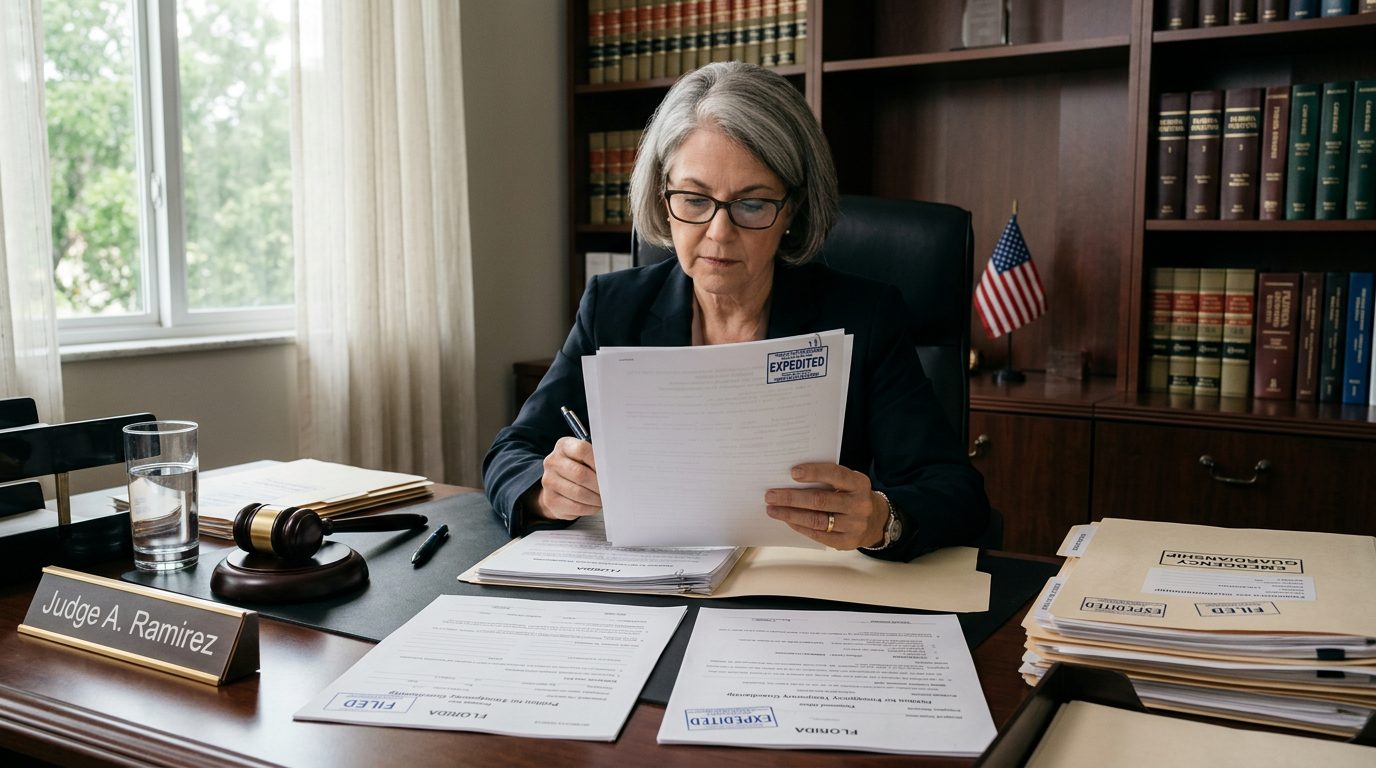
Emergency Guardianship
Emergency Temporary Guardianship Petition Filing in Florida
When a family member needs immediate protection, Robinson & Casey handles the urgent filing and court process to establish guardianship fast.
By Richard J. Casey III, Esq. · Published September 25, 2026
Emergency Temporary Guardianship Petition Filing in Florida
An emergency temporary guardianship petition is a court filing that gives you immediate, short-term legal authority to make decisions for an incapacitated adult or a minor in immediate danger—without waiting months for standard guardianship proceedings. In Florida, this process can move from filing to court order in as little as 1–3 business days.
If you’re facing a family emergency—a parent with sudden cognitive decline, a loved one in acute mental health crisis, a teenager in immediate danger, or a family member spiraling into active addiction—emergency temporary guardianship is a tool designed for exactly that situation. Robinson & Casey handles the entire filing process, from drafting documents to representing you at court, so you can focus on protecting your family member.
Not sure what your next step is?
Talk it through with our team — the first consultation is free, confidential, and carries no obligation.

What Is an Emergency Temporary Guardianship Petition?
An emergency temporary guardianship petition is a request to the court for immediate, short-term guardianship authority when an adult or minor cannot care for themselves and the situation cannot wait for standard guardianship proceedings.
Under Florida Statutes § 744.331, emergency temporary guardianship is designed for situations where:
- An incapacitated person faces immediate danger or urgent need
- No time exists for a full guardianship hearing
- A physician confirms that the person cannot make or communicate decisions about their care
The key distinction: temporary guardianship is not permanent. It lasts up to 60 days (renewable once for another 60 days), and it’s expedited—the court reviews and may grant it within days, not months.
Who Needs to File an Emergency Temporary Guardianship Petition?
You may need to file if you are:
- A family member concerned about an incapacitated relative’s immediate safety or welfare
- A caregiver unable to access medical, financial, or personal decisions without court authority
- A parent or guardian protecting a minor from immediate harm or neglect
- Someone seeking intervention for a family member in acute mental health crisis or active addiction
- A healthcare provider or social worker identifying an urgent need for decision-making authority
Common scenarios Robinson & Casey handles include:
- A parent with sudden stroke or dementia unable to communicate or consent to treatment
- An adult child with untreated bipolar disorder or schizophrenia in acute crisis, refusing hospitalization
- A teenager with severe substance use disorder in immediate danger
- An elderly relative with no advance directives, hospitalized and unable to make medical decisions
- A family member with addiction actively harming themselves, requiring involuntary placement in treatment
What Does an Emergency Temporary Guardianship Petition Cover?
Once granted, emergency temporary guardianship gives you authority over:
- Medical decisions: consent to treatment, hospitalization, medication, surgery, and medical testing
- Personal care: living arrangements, daily needs, safety measures, and placement in residential or treatment facilities
- Financial authority: paying bills and accessing accounts (scope depends on petition language and court order)
- Educational or welfare decisions for minors
- Protective measures: temporary restraining orders or restrictions if needed to ensure safety
- Treatment placement: authority to place the ward in a psychiatric hospital, addiction treatment facility, or assisted living
The specific scope depends on what you request in the petition and what the judge grants.
The Emergency Temporary Guardianship Petition Filing Process: Step by Step
Step 1: Initial Consultation
We meet with you to understand the situation, the person needing protection, and the urgency. We assess whether emergency temporary guardianship is the right legal tool or whether another approach—like a Marchman Act petition for addiction intervention—better fits your case.
Step 2: Document Preparation
We draft all required documents:
- Petition for Emergency Temporary Guardianship: your sworn statement of facts and grounds for emergency
- Physician’s Affidavit: signed by a licensed physician confirming that the person is incapacitated
- Affidavit of Petitioner: your sworn statement about your relationship to the person and the emergency
- Proposed Order: for the judge to sign
- Certificate of Service: proof that notice was given to required parties
We identify the correct court and judge and ensure all language meets Florida Statutes Chapter 744 requirements.
Step 3: Filing
We file the petition with the court, pay the filing fee (typically $200–$400, varies by county), and serve notice on all required parties: the alleged incapacitated person, family members, and in some cases the state attorney.
Step 4: Ex Parte Review or Expedited Hearing
The judge reviews the petition, often without a full hearing. If the petition shows clear grounds for emergency, the judge may grant temporary guardianship ex parte—meaning immediately, without waiting for a full hearing. You receive a temporary order and letters of temporary guardianship authorizing you to act.
Step 5: Full Hearing (Within 14 Days)
Within 14 days of filing, a full hearing is held. The alleged incapacitated person has the right to be present and represented by an attorney. Both sides present evidence. We represent your position and present the facts supporting incapacity.
Step 6: Court Order and Letters
The judge issues an order granting, modifying, or denying temporary guardianship. If granted, you receive letters of temporary guardianship—a court document that hospitals, banks, schools, and treatment facilities recognize as proof of your authority to make decisions.
Timeline: How Long Does Emergency Temporary Guardianship Filing Take?
- Filing to temporary order: 1–3 business days (ex parte review)
- Full hearing: typically within 14 days of filing
- Letters of temporary guardianship issued: same day as court order, or within 1–2 business days
- Duration of temporary guardianship: up to 60 days (renewable once for an additional 60 days)
- Conversion to plenary (permanent) guardianship: requires a separate petition and full hearing, typically 2–4 months
The speed depends on court workload and whether the judge grants the petition ex parte.
Not sure what your next step is?
Talk it through with our team — the first consultation is free, confidential, and carries no obligation.
What Documents and Information Do You Need to File?
Before we draft and file, gather:
- Full legal name, date of birth, and Social Security number of the person needing protection
- Their current address
- Medical or behavioral documentation (hospital records, psychiatric evaluations, addiction treatment records—if available)
- Names and contact information of family members and interested parties
- Court filing fee (typically $200–$400)
We prepare:
- Petition for Emergency Temporary Guardianship
- Physician’s Affidavit (we coordinate with the person’s doctor to obtain this)
- Affidavit of Petitioner
- Proposed Order
- Certificate of Service
What Happens After the Petition Is Filed?
Court clerk review: The clerk reviews the petition for completeness and assigns it to a judge.
Judge’s decision: The judge may grant temporary guardianship ex parte if the petition shows clear grounds for emergency. If so, you receive a temporary order immediately.
Notice to interested parties: The alleged incapacitated person and other interested parties are notified and have the right to contest at the full hearing.
Full hearing: Within 14 days, both sides present evidence. The judge decides whether to continue, modify, or terminate temporary guardianship.
Next steps: If temporary guardianship is continued, you may file for plenary (permanent) guardianship before the 60-day period expires, or the temporary order expires and you lose authority.
Why Robinson & Casey for Emergency Temporary Guardianship Petition Filing?
Focused practice: We handle only guardianship and Marchman Act matters. Emergency temporary guardianship filing is core to our work—not one service among many.
Speed and availability: We understand the urgency of emergency filings. We prioritize rapid response and can often file within 24–48 hours of your call.
Statewide experience: We file emergency temporary guardianship petitions across Florida—Miami-Dade, Broward, Palm Beach, and beyond—in multiple county court systems.
Complete handling: We prepare all documents, file with the court, manage service of process, represent you at hearings, and explain your duties as temporary guardian.
Compliance and accuracy: We ensure every petition meets statutory and procedural requirements. Errors can delay approval or result in dismissal. We get it right the first time.
Ongoing support: If temporary guardianship is granted, we advise you on your responsibilities and help you plan for transition to plenary guardianship if needed.
Frequently Asked Questions About Emergency Temporary Guardianship Petition Filing
Q: Can I file an emergency temporary guardianship petition myself?
Yes, but the process is complex, deadlines are tight, and errors can delay or derail approval. An attorney ensures compliance and speeds the process.
Q: Do I need a physician’s affidavit?
In most cases, yes. Florida law requires a licensed physician to confirm that the person is incapacitated. We coordinate with medical providers to obtain this.
Q: What if the person I’m petitioning for contests the guardianship?
They have the right to do so at the full hearing. The judge hears both sides and decides. We represent your position and present evidence of incapacity.
Q: How much does emergency temporary guardianship cost?
Court filing fees are typically $200–$400. Attorney fees vary; we discuss costs during your consultation.
Q: Can emergency temporary guardianship be extended?
Yes, it can be renewed once for an additional 60 days. After that, you must file for plenary guardianship or the temporary order expires.
Q: What’s the difference between emergency temporary guardianship and plenary guardianship?
Q: Can I use emergency temporary guardianship for addiction intervention?
Yes. If a family member is in acute addiction crisis and poses danger to themselves, emergency temporary guardianship can authorize treatment and placement. You may also consider a Marchman Act petition for involuntary addiction treatment.
Common Concerns and How We Address Them
“Will this harm my relationship with the person?” Emergency temporary guardianship is a legal tool to protect someone in crisis. Many families find that intervention prevents worse outcomes and, over time, strengthens trust and safety.
“What if I’m not sure it’s necessary?” We help you assess whether emergency temporary guardianship is the right step or whether another approach—like a Marchman Act petition for addiction or mental health crisis intervention—is better suited.
“How do I know if the person is truly incapacitated?” A physician’s affidavit and the facts you present to the court establish incapacity. We guide you through gathering the evidence needed.
“What if the court denies the petition?” If denied, we discuss next steps, which may include filing a standard guardianship petition, pursuing a Marchman Act petition, or exploring other legal remedies.
Not sure what your next step is?
Talk it through with our team — the first consultation is free, confidential, and carries no obligation.
What Robinson & Casey Handles for You
- Initial assessment of your situation and legal options
- Drafting all required petition documents and affidavits
- Coordinating with physicians to obtain required medical affidavits
- Filing the petition with the correct court and managing court procedures
- Serving notice on all required parties
- Representing you at the ex parte review and full hearing
- Obtaining and explaining your letters of temporary guardianship
- Advising you on your duties and responsibilities as temporary guardian
- Planning for transition to plenary guardianship if needed

Ready to Protect Your Family Member?
If you’re facing a family crisis—a relative in acute mental health decline, active addiction, or incapacity—and need court authority to protect them within days, people in your situation reach out to us every week. We handle the legal complexity so you can focus on your family member’s safety and care.
Call us today at (561) 849-4149 or schedule a consultation to discuss your situation. We’ll explain the emergency temporary guardianship process, answer your questions, and outline next steps specific to your case. The sooner you reach out, the sooner we can file and get you the authority you need.
Time Matters in Emergency Situations
Emergency temporary guardianship petitions operate under compressed timelines. Procedural errors, missing documentation, or incomplete filings can delay approval when every day counts. An attorney ensures your petition meets all statutory requirements and is filed correctly the first time.
What the Emergency Temporary Guardianship Process Involves
Petition Preparation & Filing
We prepare your emergency petition with all required documentation, including medical affidavits and supporting evidence of incapacity, and file it with the court immediately.
Physician's Affidavit & Medical Evidence
Florida law requires a licensed physician to confirm incapacity. We coordinate with medical providers to obtain the necessary affidavits and medical documentation.
Court Hearing & Temporary Order
We represent you at the emergency hearing and work to secure a temporary guardianship order that takes effect while the full guardianship case proceeds.
Transition to Plenary Guardianship
Emergency temporary guardianship is a bridge. We guide you through the next steps toward establishing a full plenary or limited guardianship as appropriate.
Why Work With Robinson & Casey
Fast Action on Urgent Deadlines
We understand that emergency situations demand immediate attention. Our firm prioritizes rapid petition preparation and filing to move your case forward.
Comprehensive Petition Preparation
We handle all documentation, from medical affidavits to court filings, ensuring nothing is overlooked and your petition meets statutory requirements.
Court Representation
We represent you before the judge, present your case clearly, and advocate for the temporary guardianship order your family needs.
Direct Attorney Access
You work with an attorney who focuses on guardianship and Marchman Act matters, not a general practice. We're available when you need guidance.
Frequently Asked Questions
Can I file an emergency temporary guardianship petition myself?
Yes, but the process is complex, deadlines are tight, and errors can delay or derail approval. An attorney ensures compliance with all statutory requirements and speeds the process.
Do I need a physician's affidavit?
In most cases, yes. Florida law requires a licensed physician to confirm that the person is incapacitated. We work with medical providers to obtain the necessary documentation.
How long does emergency temporary guardianship last?
The statute sets specific time limits. We ensure your petition is filed and heard promptly, and we advise you on the next steps toward a permanent guardianship arrangement.
What's the difference between emergency temporary and plenary guardianship?
Emergency temporary guardianship is a short-term court order that takes effect immediately while a full guardianship case proceeds. Plenary guardianship is the permanent arrangement. We handle both.