
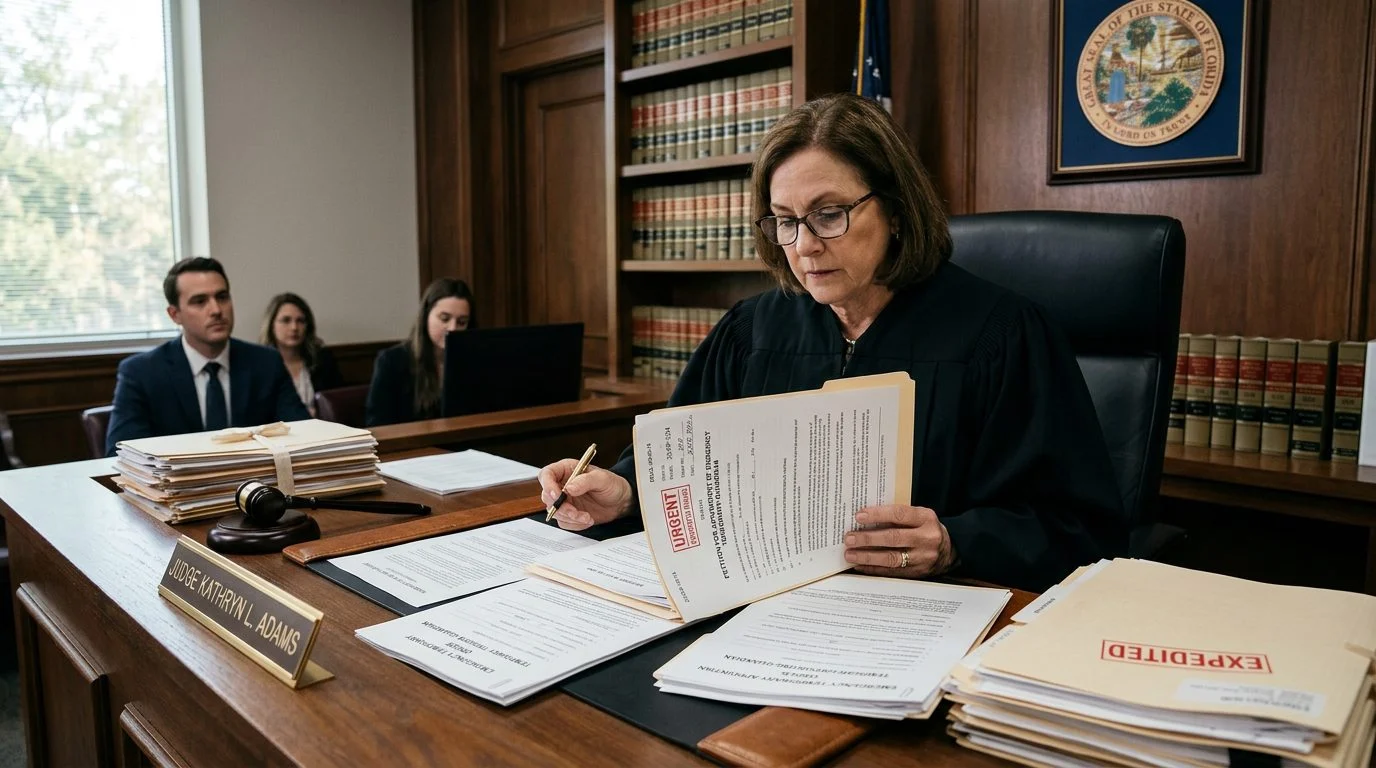
Emergency Temporary Guardianship
Immediate Legal Protection When Time Is Critical
Robinson & Casey helps Florida families secure emergency temporary guardianship fast—when a loved one needs protection now.
By Richard J. Casey III, Esq. · Published October 02, 2026
Emergency Temporary Guardianship in Florida: What It Is and How It Works
Emergency temporary guardianship is a court-ordered arrangement that grants you immediate legal authority to make medical, financial, and personal decisions for an incapacitated adult or minor when standard guardianship cannot wait. In Florida, this process is expedited: hearings can be scheduled within days, and a court can grant temporary guardianship the same day if imminent danger is shown.
If a loved one has suddenly become incapacitated—by stroke, accident, acute illness, mental health crisis, or active addiction—and no power of attorney or healthcare proxy exists, emergency temporary guardianship may be the fastest legal path to protect them and coordinate their care. This guide explains what it covers, who qualifies, how the court process works, and why speed and experience matter when your family is in crisis.

Not sure what your next step is?
Talk it through with our team — the first consultation is free, confidential, and carries no obligation.
What Is Emergency Temporary Guardianship?
Emergency temporary guardianship is a court-ordered arrangement that grants you immediate legal authority to make decisions for an incapacitated person when delay poses imminent risk.
Under Florida Statutes Chapter 744, a court can appoint an emergency temporary guardian when imminent danger to a person or their property exists if guardianship is delayed. This is not a full or permanent guardianship; it is a bridge—a temporary legal status that lets you act immediately while a full guardianship hearing is prepared or the crisis resolves.
What it covers: – Medical decisions: consent to treatment, surgery, hospitalization, medication, and end-of-life care – Financial decisions: paying bills, accessing bank accounts, and managing property (within court-approved limits) – Personal decisions: residence, education, social services, and daily care arrangements
Duration: A maximum of 90 days under Florida law, with the possibility of one extension for an additional 90 days if a full guardianship petition is pending.
Legal basis: The court must find reasonable grounds that the person is incapacitated (unable to manage their affairs or make safe decisions) or that a minor is in need of protection, and that no less-restrictive alternative is available.
Who Needs Emergency Temporary Guardianship?
Emergency temporary guardianship is appropriate when a sudden crisis leaves a person unable to make decisions and no existing legal arrangement—such as a power of attorney or healthcare proxy—is in place.
Common situations include:
- Sudden adult incapacity: A stroke, heart attack, accident, or acute illness renders an adult unconscious or unable to communicate, and immediate medical decisions are needed.
- Rapid cognitive decline: An elderly parent’s dementia or Alzheimer’s worsens suddenly, and they no longer recognize family or understand their condition.
- Acute mental health crisis: A loved one is experiencing severe depression, psychosis, or suicidal ideation and poses a danger to themselves or others.
- Active addiction emergency: A family member is in acute withdrawal, overdose risk, or behavioral crisis requiring immediate intervention and protective decisions.
- Child welfare emergency: A minor’s parents are unavailable, incapacitated, or unfit, and the child needs immediate protective care.
- Financial exploitation: An elderly or vulnerable adult is being financially abused, and immediate legal authority is needed to stop the harm and protect their assets.
In each case, delay creates real risk: medical decisions go unmade, bills pile up unpaid, the person’s condition worsens, or harm continues.
What Qualifies for Emergency Guardianship in Florida?
The court will grant emergency temporary guardianship only if specific legal grounds are met.
To qualify, you must show:
- Imminent danger: The person or their property faces immediate risk if guardianship is delayed. This is the key threshold—the danger must be real and urgent, not merely inconvenient.
- Incapacity or need for protection: Clear evidence that the person cannot manage their own affairs, make safe decisions, or (for a minor) is in need of protection.
- No existing legal arrangement: No power of attorney, healthcare proxy, HIPAA authorization, or other surrogate decision-maker is in place or willing and able to act.
- No existing guardianship: Another guardianship is not already in effect.
- Court finds reasonable grounds: Based on the petition, affidavits, and any medical or clinical evidence, the judge determines that emergency temporary guardianship is necessary and in the person’s best interest.
The burden is on you (the petitioner) to demonstrate these grounds in writing and, if necessary, at a hearing.
Can I Get Temporary Guardianship Without Going to Court?
No—emergency temporary guardianship requires a court petition and a judicial order. However, the process is expedited in ways that standard guardianship is not.
What you must do:
- File a petition with the circuit court in the county where the person resides.
- Provide affidavits or medical evidence supporting imminent danger and incapacity.
- Serve notice on the person and their family (though the court may waive notice in a true emergency).
What may happen quickly:
- Ex parte hearing: If imminent danger is clear, the court may grant temporary guardianship ex parte—meaning without the person present—sometimes the same day or within hours. This is rare but possible in severe emergencies.
- Expedited full hearing: Within 14 days, a full hearing is held where the person has the right to an attorney, to present evidence, and to contest the guardianship. If temporary guardianship is granted despite their objection, they retain the right to challenge it at this hearing.
What you cannot avoid:
- Court filing and fees.
- Service of process (notifying the person and family).
- Judicial review and a hearing.
Alternatives that do not require guardianship:
If the person is still capable of understanding and consenting, less-restrictive options may work: a power of attorney (for financial decisions), a healthcare proxy or HIPAA authorization (for medical decisions), or a durable power of attorney (for ongoing authority). These avoid guardianship entirely. However, if the person is already incapacitated or unwilling to sign, guardianship is the only legal path.
How Long Does Emergency Temporary Guardianship Last in Florida?
Emergency temporary guardianship has a strict time limit: a maximum of 90 days under Florida Statutes § 744.331.
Timeline:
- Initial 90 days: The temporary guardianship order lasts up to 90 days from the date it is entered.
- One extension: If a full guardianship petition is pending and ready to proceed, the temporary guardianship can be extended once for an additional 90 days.
- Automatic termination: If no full guardianship petition is filed or if the emergency resolves, the temporary guardianship ends automatically when the 90-day period expires.
- Conversion to permanent guardianship: If a full guardianship hearing is held and the court finds the person is incapacitated, temporary guardianship converts to plenary (full) guardianship or limited guardianship, depending on the court’s findings.
The 90-day window is designed to give you time to gather evidence, prepare for a full guardianship hearing, and stabilize the person’s immediate situation. It is not a permanent solution.
Have questions about what happened?
Ask our team directly. The first conversation is free, confidential, and there is no obligation to continue.
The Emergency Temporary Guardianship Process: Step-by-Step
The process moves fast, but it follows a clear legal path. Here is what to expect from initial consultation to court order.
Step 1 – Initial Consultation
You meet with an attorney to describe the situation: who the person is, what happened, why they cannot make decisions, and what immediate decisions need to be made. The attorney assesses whether emergency temporary guardianship is appropriate or whether a less-restrictive alternative might work.
Step 2 – Petition Preparation
The attorney drafts the emergency petition (a formal legal document requesting the court to appoint you as temporary guardian), affidavits (sworn statements from you and others with knowledge of the situation), and any supporting medical or clinical documentation (physician’s affidavit, hospital records, psychiatric evaluation, etc.).
Step 3 – Court Filing
The petition is filed with the circuit court in the county where the person resides. Court filing fees apply (typically $200–$500, depending on the county).
Step 4 – Ex Parte Hearing (if applicable)
If the situation is truly emergent, the court may grant temporary guardianship ex parte—without the person present—based on the petition and evidence alone. This can happen the same day or within hours. The judge must find imminent danger and reasonable grounds for temporary guardianship.
Step 5 – Notice and Service
The person and their family are notified of the guardianship petition and the temporary order (if one was entered). The person has the right to hire an attorney and to contest the guardianship.
Step 6 – Full Hearing
Within 14 days, a hearing is held in open court. You (the petitioner), the person, their attorney or a guardian ad litem (a court-appointed representative), and any other interested parties present evidence. The judge decides whether to continue temporary guardianship, convert it to permanent guardianship, or deny it.
Step 7 – Guardianship Powers
Once appointed, you (the temporary guardian) can make medical, financial, and personal decisions on behalf of the person, as defined by the court order. You must keep records, act in the person’s best interest, and follow Florida guardianship law.
What Does Emergency Temporary Guardianship Cover?
The scope of authority granted by the court order defines what decisions you can make. Typically, emergency temporary guardianship covers three areas:
Medical decisions: – Consent to surgery, hospitalization, and emergency treatment – Medication and pain management – Mental health or addiction treatment – End-of-life decisions (in consultation with family and medical professionals) – Placement in a facility or care setting
Financial decisions: – Paying medical bills, utilities, and living expenses from the person’s funds – Accessing bank accounts and managing cash flow – Protecting assets from exploitation or mismanagement – Paying an attorney’s fees or guardian fees from the person’s estate (with court approval)
Personal decisions: – Choosing where the person lives (home, facility, family member’s residence) – Arranging education, training, or social services – Making decisions about daily care, diet, and activities – Consenting to travel or relocation
The court order will specify whether your authority is broad (comprehensive guardianship) or limited to specific decisions (limited guardianship). You must act within the scope of the order and in the person’s best interest.
Why Robinson & Casey for Emergency Temporary Guardianship
Robinson & Casey handles Marchman Act petitions and guardianship matters exclusively. This focused practice—not a sideline within a general law firm—means the firm’s entire operation, experience, and attention is built around urgent guardianship and involuntary commitment cases.
What this means for you:
- No dilution: Your case is not competing for attention with divorce, personal injury, or real estate matters. Guardianship is all we do.
- Speed and availability: We understand true urgency. We can move from your first call to a court filing within days, not weeks.
- Statewide service: We serve South Florida and families throughout Florida, so geography is not a barrier. We know the local courts, judges, procedures, and filing requirements across the circuits where we practice.
- Integrated experience: If your emergency involves addiction (Marchman Act involuntary commitment), mental health crisis (mental health guardianship), or both, we handle the full legal strategy. You do not get referred elsewhere; we coordinate everything.
- Experience with complex situations: Our attorneys regularly handle emergency guardianships involving sudden incapacity, acute mental health crisis, active addiction, financial exploitation, and child welfare emergencies.
- Transparent guidance: During your consultation, we discuss timeline, costs, court fees, and what to expect—no hidden surprises or vague promises.
- Ethical approach: We explain the person’s rights, the role of the guardian ad litem, and less-restrictive alternatives before pursuing guardianship. We position ourselves as counsel for the family, not just an advocate for the petitioner.
What to Expect: Timeline and Costs
Timeline:
- Consultation to filing: 1–3 days in a true emergency; longer if you need time to gather medical records or family input.
- Filing to ex parte order: Same day to 2 days (if the court grants temporary guardianship without a hearing).
- Filing to full hearing: 7–14 days (the court must hold a hearing within 14 days of the emergency order or within a reasonable time).
- Full hearing to permanent guardianship: Same day (if the judge converts temporary to permanent) or additional time if the case is contested.
Costs:
- Attorney fees: Vary based on complexity, urgency, and whether medical evaluations or expert testimony is needed. Discuss fees during your consultation.
- Court filing fees: $200–$500, depending on the county.
- Service of process: $50–$150 (notifying the person and family).
- Guardian ad litem fees: $300–$1,000+ (the court-appointed representative’s fee, typically paid from the person’s estate if they have assets).
- Medical evaluations: If the court requires a physician’s affidavit or psychiatric evaluation, $200–$500+.
- Ongoing costs: Once appointed, a guardian may incur costs for care, medical appointments, or property management. The court may require an annual accounting of these expenses.
Want to know where you stand?
Tell us what happened and our team will walk you through the options available to you, at no cost.
Frequently Asked Questions
Q: Do I need a lawyer to file for emergency temporary guardianship?
A: You can file pro se (without a lawyer), but the process is complex, deadlines are tight, and mistakes can delay or derail your petition. An attorney ensures proper filing, increases the likelihood of approval, and protects you from liability.
Q: What if the person objects to the guardianship?
A: They have the right to contest it at the full hearing. The court will consider their objection and their attorney’s or guardian ad litem’s recommendation. If temporary guardianship is granted despite their objection, they retain the right to challenge it at the full hearing and to appeal.
Q: Can a non-family member be appointed as emergency temporary guardian?
A: Yes. The court appoints whoever it finds is suitable and acting in the person’s best interest. Family members are often preferred, but friends, professionals, or corporate guardians can be appointed.
Q: What happens after the 90-day temporary period ends?
A: If a full guardianship petition is pending, the temporary guardianship can be extended for another 90 days. If no full petition is filed, the temporary guardianship terminates and your authority ends.
Q: Can emergency temporary guardianship be used for addiction or mental health crisis?
A: Yes. If the person is in acute crisis and poses a danger to themselves or others, emergency temporary guardianship can be paired with a Marchman Act petition (involuntary commitment for addiction) or mental health guardianship to ensure both protective authority and treatment access.
Q: Will the person be represented by a lawyer?
A: Yes. The court will appoint a guardian ad litem or attorney to represent the person’s interests, especially if they contest the guardianship. This protects their rights and ensures the judge hears their voice.

When to Act
If a family member has suddenly become incapacitated and you need immediate medical decision-making authority—or if a loved one is in acute mental health or addiction crisis and you need protective legal power—emergency temporary guardianship may be the answer. Families in your exact situation reach out to Robinson & Casey every week. The sooner you call, the sooner we can assess your case, explain your options, and move toward a court filing if emergency temporary guardianship is right for you.
Call (561) 849-4700 to schedule a consultation today. We are ready to move fast.
Why Work With Robinson & Casey
Rapid Response
We understand that emergency situations demand immediate action. Our team moves quickly to file and present your petition when every day matters.
Proper Filings & Compliance
Court procedures are strict and deadlines unforgiving. We handle all paperwork correctly, reducing delays and the risk of dismissal.
Protection From Liability
Filing without legal guidance exposes you to procedural errors and personal liability. We ensure your petition meets all statutory requirements.
Direct Attorney Access
You work with a lawyer who focuses on guardianship and Marchman Act matters—not a general practice handling dozens of unrelated cases.
What Emergency Temporary Guardianship Covers
Immediate Authority
Emergency temporary guardianship grants you urgent decision-making power over medical care, living arrangements, and immediate welfare when standard guardianship would take too long.
Limited Duration
This form of guardianship is temporary by design, typically lasting until a full plenary or limited guardianship can be established through the regular court process.
Mental Health & Addiction Situations
Emergency temporary guardianship is often used when a loved one faces a mental health crisis or requires involuntary commitment for addiction—situations where delay creates serious risk.
Court-Ordered Protection
A judge must approve your petition. Our role is to present your case clearly and persuasively so the court grants the protection your family needs.
Pro Se Filing Carries Real Risk
You can file for emergency temporary guardianship without a lawyer, but the process is complex, court deadlines are strict, and mistakes—missing signatures, incomplete forms, procedural missteps—can delay approval or result in dismissal. An attorney ensures your petition is filed correctly and increases the likelihood the court will grant your request.
Common Questions
What if the person objects to the guardianship?
The person named in your petition has the right to object and to be heard by the court. We prepare your case to address objections and present evidence supporting why emergency temporary guardianship is necessary.
How long does emergency temporary guardianship last?
Emergency temporary guardianship is designed to be short-term—typically lasting until a full guardianship (plenary or limited) can be established. The exact duration depends on court order and the circumstances of your case.
What situations qualify for emergency temporary guardianship?
Common situations include mental health crises, addiction requiring involuntary commitment, incapacity due to illness or injury, and other urgent circumstances where immediate decision-making authority is necessary to protect the person's welfare.
Do I need an attorney to file?
You are not required to hire a lawyer, but doing so significantly reduces the risk of errors, delays, and denial. An attorney ensures compliance with Florida law and court procedures, protecting both your interests and the person you seek to protect.