
Marchman Act & Guardianship | South Florida
Help for a Homeless Adult Son Under the Marchman Act
Robinson Casey focuses on Marchman Act petitions and guardianship matters for families in Miami-Dade, South Florida and across Florida. Learn your options and talk with us about your son's situation.
Casey III, Esq. · Published November 4, 2026
Where You Are Right Now With Your Son
Yes, a Florida parent can ask a court for help. Under the Marchman Act, a parent can file a petition asking a judge to order assessment and treatment for an adult son who is impaired by substance use. Fla. Stat. § 397.68112 sets out who may file.
You have probably tried a lot already. You may have paid for treatment more than once. You may have held interventions and set boundaries that did not hold. Then a recent overdose, relapse, hospital stay, arrest, or disappearance made you look for another way.
Right now you may feel like you are holding everything alone. Your son is homeless, and each day brings a new fear. This page explains the legal options in Florida. It does not promise any result, and each case turns on its own facts.
If your son is homeless and using drugs, and you have been carrying this alone, we can talk through his situation and what the Marchman Act may mean for your family. Talk it through with our team — the first consultation is free, confidential, and carries no obligation.

What You Are Afraid Will Happen to Your Son
The Marchman Act is a court process for assessment and treatment. It is not a promise of recovery.
Your fears are real. You may fear an overdose, jail, a son living on the street, or that nothing will work. The law is built around treatment, so a petition aims to get your son assessed and into care. It does not, by itself, remove the risks he faces every day.
A court order is not a cure. Treatment success depends on the person and the program he enters. Being honest about that now can help you plan what comes after a hearing.
Can Florida Act When Your Adult Son Lives in Another State or Moves Often?
A Marchman Act petition is filed in the county where your son is physically located. Fla. Stat. § 397.681 requires filing with the clerk of that county, and the clerk may not charge a filing fee.
However, the filing of the petition in the wrong county did not divest the circuit court in Putnam County of jurisdiction (J.P. v. J.N.). In J.P. v. J.N., the petition was filed in a county where the person was not physically located at filing. The Fifth District held that the wrong county did not take away the circuit court’s jurisdiction.
For a son who moves between counties or states, the key question is where he is when you file. Whether Florida can act for a son who is outside the state depends on the facts, and a lawyer should review that with you. Your knowledge of his whereabouts and recent conduct matters too.
Can You Petition for Your Adult Son? Your Legal Standing
Yes. For an adult, Florida law allows a spouse or legal guardian, any relative, a service provider, or an adult who has direct personal knowledge of the respondent’s substance abuse impairment and his or her prior course of assessment and treatment to file. As his parent, you are a relative, so you can file. A guardianship is one path the statute lists, not the only one.
Those facts must show why you believe he is impaired and that he has lost power of self-control. They must also show a reason to believe he has inflicted or is likely to inflict physical harm on himself or others unless the court orders services, or that his refusal of care is based on judgment so impaired by substance abuse that he is incapable of appreciating his need for care and of making a rational decision about that care (Fla. Stat. § 397.68141).
A petition may include a report from a qualified professional who examined him within 30 days before filing. If he was never assessed or refused an evaluation, the petition must say so.
How a Marchman Act Petition Works, Step by Step
The court must set a hearing within 10 court working days unless it grants a continuance (Fla. Stat. § 397.68151). Here is the general path:
- You file the petition with the clerk, with facts about his impairment.
- The court decides whether he needs a lawyer and appoints one if needed.
- He receives a copy of the petition and the hearing notice, and the clerk sends the summons for service.
- When the petitioner asserts that emergency circumstances exist, or the court decides from the petition that an emergency exists, the court may enter an ex parte order for involuntary assessment and stabilization on the petition alone and without appointing an attorney, and that order must be carried out while the hearing on the petition is still pending.
A provider may hold him for no more than 72 hours of observation, with listed exceptions (Fla. Stat. § 397.6818).
For a fuller guide, see the Marchman Act process guide and the evidence guide.
The Baker Act is a different law. It covers involuntary examination for mental illness under Fla. Stat. § 394.463. Read the Baker Act comparison to see how they differ.
What the Court Decides and What Protections Your Son Keeps
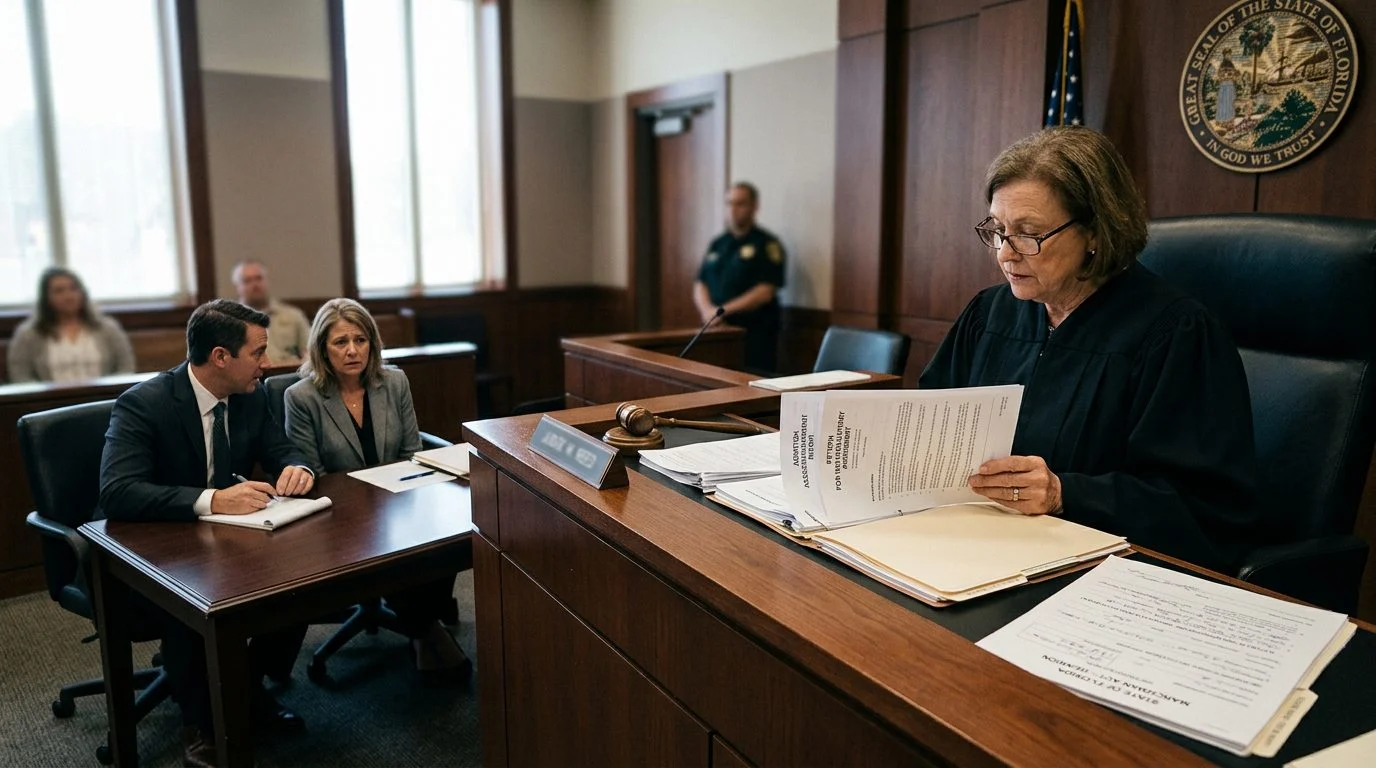
After a hearing, the judge decides whether the conditions are proved by clear and convincing evidence. If they are, the court may order involuntary treatment services for a period not to exceed 90 days, and a renewal of the order may be requested before that 90-day period ends.
Your son has real protections. He must attend the hearing unless he waives that right or the court finds his presence is not in his best interests. He may refuse to testify. Testimony at the hearing must be taken under oath, and the proceedings must be recorded. A court cannot order treatment without a clinical assessment unless he is present and expressly waives it. He also has the right to counsel at every stage, which he may waive only if he is present and the court finds the waiver is knowing, intelligent, and voluntary (Fla. Stat. § 397.681).
Florida appeals courts have also addressed who must carry the case. In J.C. v. State, the court failed to follow the applicable statute by essentially functioning as the absent petitioner. A Fourth District court later disagreed and certified a conflict with that line of cases. In C.W.R.K. v. Stewart Marchman Act Behavioral Healthcare, the trial court failed to follow the governing statute when, in the absence of the petitioner, it called and questioned the health care professional who executed the involuntary services certificate.
Not sure what your next step is?
Talk it through with our team — the first consultation is free, confidential, and carries no obligation.
Quick Answers
Can a parent file a Marchman Act petition in Florida?
Yes.
Does it cost money to file?
The clerk may not charge a fee to file the petition. Service fees may be waived for a petitioner found indigent.
Does my adult son get a lawyer?
Yes. He has the right to counsel at every stage, which he may waive if he is present and the court finds the waiver knowing, intelligent, and voluntary; if he cannot afford a lawyer, he has the right to court-appointed counsel, and the court shall appoint counsel when it believes he needs it, without regard to his wishes.

Talk With Robinson Casey About Your Son’s Situation
If your son is homeless and using drugs, you do not have to figure out the legal path alone. A short, confidential conversation can show whether a Marchman Act petition fits his facts. You have tried hard already, and you deserve a clear answer.
Robinson Casey offers a free, confidential first consultation with no obligation to continue. Call (561) 849-4149 or reach us through our contact page.
Related guides: Marchman Act process guide · Marchman Act evidence guide · Baker Act vs. Marchman Act · involuntary commitment for addiction
How Robinson Casey Supports Families
Confidential First Consultation
Your initial consultation is free, confidential and carries no obligation to continue.
Plain-Language Guidance
We explain the Marchman Act process, court steps and guardianship options in clear terms.
Built Around Families
Our team works with parents, siblings and relatives facing a loved one's crisis.
South Florida and Statewide
We serve families in Miami-Dade and across South Florida, and we handle matters throughout Florida.
Don't Wait for a Crisis to Get Worse
Homelessness, addiction and untreated mental health needs can change quickly. Contacting a lawyer early gives you more time to understand the options and prepare for what comes next.
Matters We Handle
Marchman Act Petitions
Petitions asking the court to order assessment and treatment for an adult struggling with substance use.
Involuntary Commitment for Addiction
Guidance on court-ordered treatment when a loved one's substance use puts their safety and health at risk.
Guardianship Matters
Plenary, limited and mental health guardianship petitions tailored to the needs of the adult and the family.
Emergency Temporary Guardianship
Requests for short-term court protection when an adult faces immediate risk and urgent action is needed.