
Marchman Act Attorney · Miami-Dade & South Florida
Helping Miami-Dade Families Navigate Marchman Act Petitions
Robinson Casey focuses on Marchman Act petitions and guardianship matters for families across South Florida and statewide. Learn how court-ordered treatment works and what your options may be.
By Richard J. Casey III, Esq. · Published October 27, 2026
Short Answer: Can a Court Order Treatment for a Homeless Relative in Florida?
Yes, in some cases. Florida’s Marchman Act lets a court order treatment for an adult with substance use impairment, even when that adult refuses help. The court applies specific legal criteria to the person’s condition, and not every situation qualifies.
This happens through a court process. A family member can’t simply decide to send someone to treatment against their will. For the full picture, read our involuntary commitment for addiction guide.
Talk it through with our team — the first consultation is free, confidential, and carries no obligation.

What the Marchman Act Is and Who It Covers
The Marchman Act is Florida’s law for involuntary assessment, stabilization, and treatment of adults with substance use impairment. It is found in Chapter 397 of the Florida Statutes. Some involuntary admissions can begin without a court order.
The law also names who may start the process. For an adult, a petition may be filed by a spouse or legal guardian, any relative, a service provider, or an adult with direct personal knowledge of the person’s impairment and past treatment. So a parent, sibling, or adult child can often take that first step.
The Marchman Act covers substance use impairment. Mental health crises without substance use fall under a different Florida law. Knowing which law fits your relative’s situation is an early and important question.
Why Homelessness Alone Is Not the Legal Test
The court looks at the person’s condition, not only where they sleep.
The petitioner must also show one of two things. Either the person’s refusal to voluntarily receive care is based on judgment so impaired by substance abuse that the person is incapable of appreciating the need for care and of making a rational decision about it. Or, without care, the person is likely to neglect themselves or refuse to care for themselves in a way that poses a real and present threat of substantial harm, and it is not apparent that such harm may be avoided through the help of willing family members or friends or other services. A substantial likelihood that without services the person will cause serious bodily harm to self or another in the near future, as evidenced by recent behavior, is one ground, but the petitioner must also prove the person is substance abuse impaired with a history of lack of compliance with treatment, and that the person is unlikely to voluntarily participate or unable to determine whether services are needed.
That matters, because a refusal is often the first thing families hear.
Exposure to weather, untreated medical problems, or unsafe conditions may support the neglect or harm criteria. How much weight it gets depends on the facts. Specific, dated examples help more than general worry. Write down a fall, a medical emergency, a threat, or repeated exposure to danger, with dates where you can.
How the Petition and Emergency Admission Process Works
A petition is filed with the clerk of court in the county where the person is located. The clerk may not charge a fee to file it, under Fla. Stat. § 397.681. The petition names the alleged impaired person as the respondent.
Filing in the wrong county is a venue problem, not a loss of court power. A Florida appeals court reached that result in J.P. v. J.N., 225 So. 3d 410 (Fla. 5th DCA 2017).
In an emergency, the process can begin with a professional’s certificate and an application for emergency admission. Under Fla. Stat. § 397.679, a person who meets the criteria may be admitted to a hospital, detox facility, or addictions receiving facility. That step requires a professional’s certificate specific to substance use impairment and a completed application.
It is valid for 7 days after issuance, under Fla. Stat. § 397.6793. If less restrictive options are not available, a law enforcement officer must take the person into custody and deliver them to the facility. Under Fla. Stat. § 397.6795, an applicant, a spouse or guardian, or an officer may do the delivery. The person’s dignity must be respected during admission and transport, under Fla. Stat. § 397.501.
The Court Hearing, Testimony, and What Happens Next
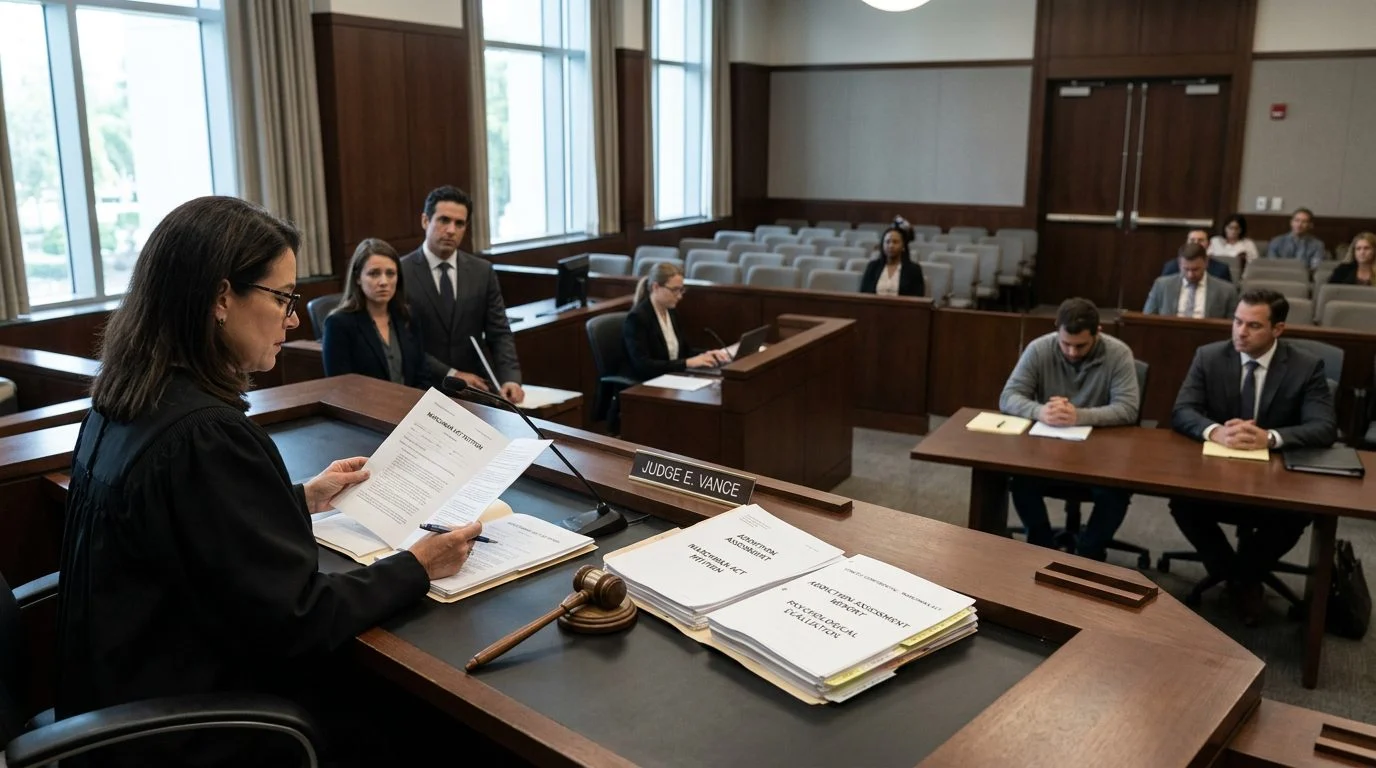
The court must schedule a hearing within 10 court working days, unless a continuance is granted. The respondent receives a copy of the petition and the hearing notice, and a summons is issued.
The person has a right to a lawyer at every stage. A person who cannot afford private counsel can receive court-appointed counsel. In Hillsborough County v. Albrechta, the court stated: “Because due process is implicated, we conclude that a defendant has a constitutional right to be represented by counsel in Marchman Act proceedings.”
At the hearing, the person generally must be present. The court hears relevant evidence, including testimony from family members who know the person’s history, under Fla. Stat. § 397.6957. Testimony is taken under oath.
If the petitioner proves the required conditions by clear and convincing evidence, the court must either dismiss the petition or order the respondent to receive involuntary treatment services from his or her chosen licensed service provider if possible and appropriate, with findings on the need for treatment and less restrictive alternatives. What follows depends on the facts of the case and the court’s order.
Common Objections and How the Marchman Act Differs From Guardianship
The court still weighs the full set of criteria.
Another objection is, “They’ll just leave treatment.” The court keeps jurisdiction after an order. It can monitor compliance and start contempt proceedings for violating a valid order, as stated in Fla. Stat. § 397.697.
Guardianship is a different legal path. It focuses on a person’s overall decision-making and daily affairs, not on one treatment order. Which path fits depends on the facts.
Does the person get a lawyer?
Yes. The respondent has the right to counsel at every stage of the case.
Can a relative start the process?
Yes, if the relative fits the categories in the statute.
Not sure what your next step is?
Talk it through with our team — the first consultation is free, confidential, and carries no obligation.

Talk With a Florida Marchman Act Attorney About Your Relative’s Situation
If you are watching a relative sleep outdoors or in unsafe places, you may feel stuck. You may not know what the law allows. You may be facing a choice you never expected to make, and you don’t have to work through it alone.
Richard J. Casey III, Esq. is the lawyer responsible for this page. Robinson & Casey focuses on Marchman Act petitions and guardianship matters for families across South Florida, including Miami-Dade, and statewide. The first consultation is free, confidential, and carries no obligation to continue.
To talk about your relative’s situation, call (561) 849-4149 or use our contact page.
Why Families Contact Robinson Casey
Focused Practice
The firm limits its practice to Marchman Act petitions and guardianship matters, so each case is handled by lawyers who work in these areas every day.
Guardianship and Commitment Matters
From emergency temporary guardianship to involuntary commitment for addiction, the firm helps families understand the court process and the filings involved.
Confidential First Consultation
Your first consultation is free, confidential and comes with no obligation to continue.
Support Throughout the Process
Our team keeps families informed at each stage, from the initial petition through the hearing.
Don't Wait Until the Crisis Peaks
When a loved one's safety or health is at risk, questions about the court process can't always wait. Call Robinson Casey at (561) 849-4149 to talk through your situation.
Matters Robinson Casey Handles
Marchman Act Petitions
Help preparing and filing petitions seeking court-ordered assessment and treatment for a family member struggling with substance use.
Emergency Temporary Guardianship
Guidance for families who need a court to act quickly when a person cannot make or communicate safe decisions.
Plenary and Limited Guardianship
Representation in guardianship proceedings, from full guardianship to more tailored arrangements that limit the court's authority.
Mental Health and Addiction Commitment
Assistance with mental health guardianship and involuntary commitment for addiction under Florida law.