
Marchman Act Petitions | Miami-Dade, South Florida & Statewide
When Drinking at Home Puts Your Family at Risk, You Need a Clear Plan
Robinson Casey focuses on Marchman Act petitions and guardianship matters for families in Miami-Dade and across South Florida. Your first consultation is free, confidential, and comes with no obligation to continue.
Casey III, Esq. · Published November 4, 2026
My husband drinks at home, and the kids are seeing it: what the Marchman Act is
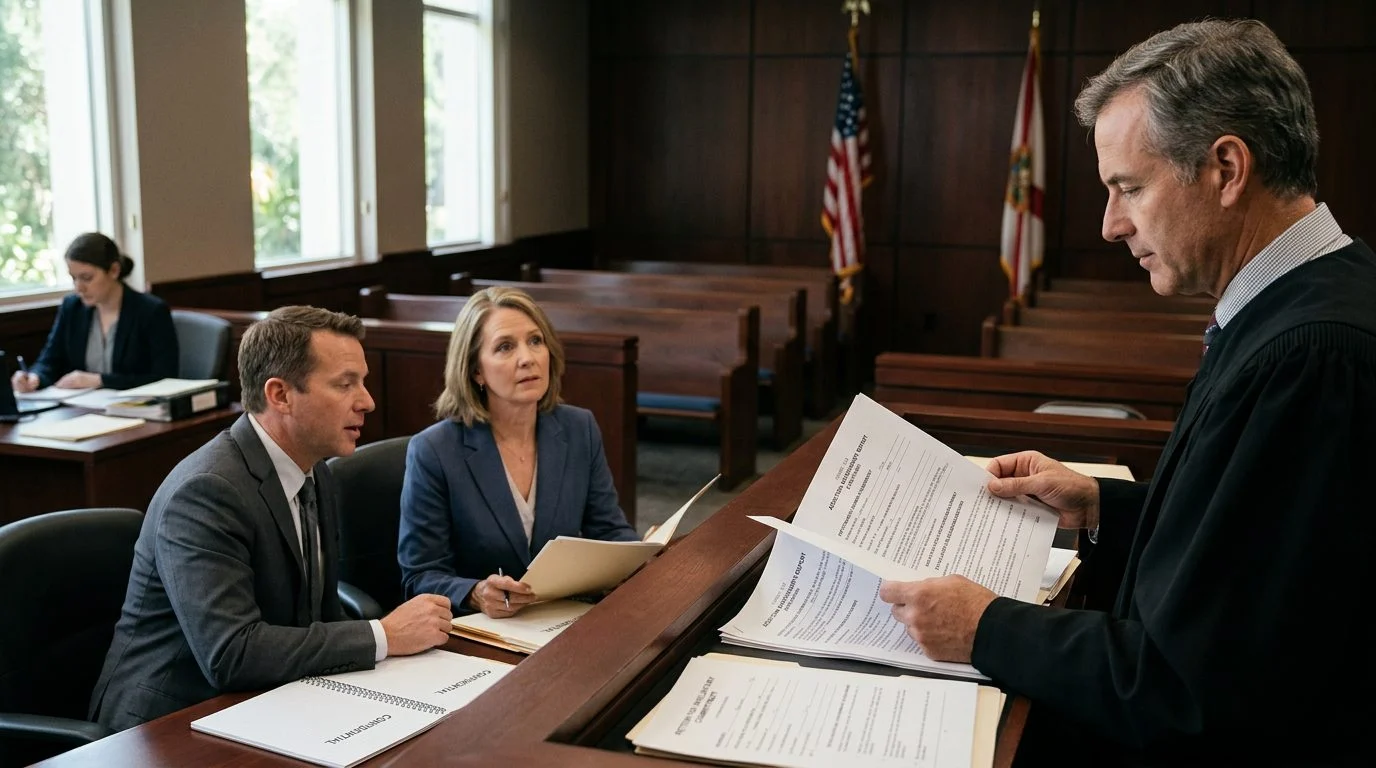
The Marchman Act is a Florida court process that lets a family ask a judge to order an adult with a substance abuse problem into assessment and treatment. It starts with a written petition filed in court, not with an arrest.
If your husband drinks at home, you already know how it feels. The mood shifts by evening. The kids go quiet or act out. Money disappears, and you spend your days guessing what comes next. You may feel that nothing you say changes anything.
The core test is found in Fla. Stat. § 397.675.
If your husband's drinking has your home on edge, you don't have to work out the Marchman Act alone, and a free, confidential first consultation can help you see your options. Talk it through with our team — the first consultation is free, confidential, and carries no obligation.

Can I file a Marchman Act petition as his wife?
Yes, a spouse may file a petition if the person named is an adult. Fla. Stat. § 397.68112 also allows a legal guardian, any relative, a service provider, or an adult with direct personal knowledge of the impairment and of the person’s prior course of assessment and treatment to file.
Location matters for filing. Petitions go to the clerk of the court in the county where the person is located, and the clerk may not charge a filing fee (Fla. Stat. § 397.681). A Florida appeals court has treated a petition filed in the wrong county as a venue problem, not a loss of the court’s power to act (J.P. v. J.N.).
What a petition needs: documenting what happens at home
A petition must name both of you, state your relationship, and set out facts that show why the court should act. Fla. Stat. § 397.68141 lists what the petition must include.
- Why you believe he is substance abuse impaired
- Why you believe he has lost the power of self-control with respect to drinking
- Whether he has been assessed, and whether he refused an evaluation
Keep a running log. Write each event as a fact: the date, the time, what you saw or heard, and who was present. For example, write “On March 3, he drove to the store after drinking, and I saw the car leave the driveway.” Avoid writing “he is always drunk.”
Police reports, emergency room or detox records, and written statements from people who saw events all help. A report from a qualified professional who examined him within 30 days before filing can go with the petition.
Do not ask the children to be witnesses. Keep them out of the process as much as you can.
How the process works, step by step, with a realistic timeline
The case moves from petition to hearing, and the court may order an assessment before it decides on treatment. Chapter 397 sets the timing for each step.
- Consultation and fact review. You bring your log and records. The facts are checked against the statute’s requirements.
- Petition filed with the clerk. The petition must name the respondent and the petitioner, state their relationship, and set out the facts showing the need for services. It goes to the clerk in the county where he is located (Fla. Stat. § 397.681).
- Hearing scheduled. The court must set a hearing within 10 court working days unless a continuance is granted (Fla. Stat. § 397.68151).
- Assessment. A qualified professional’s clinical assessment must be filed with the court no later than the close of business the day before the hearing, and a report without a treatment recommendation, or with a recommendation of no treatment, results in the petition’s dismissal (Fla. Stat. § 397.6957).
- Hearing and order. The court must find the conditions proved by clear and convincing evidence. It may then order treatment for up to 90 days (Fla. Stat. § 397.697).
In an emergency, the court may enter an assessment order based on the petition alone, without an attorney at that stage. The provider generally may not hold him for more than 72 hours of observation, unless a listed exception applies (Fla. Stat. § 397.6818).
Each case moves on its own schedule. The statute sets these windows, but it does not set a fixed date for your family.
Protecting the children, the finances and the home while this unfolds
If a child is in immediate danger, call 911 first, then focus on records and daily routines.
- Keep the log going every day while the case is pending.
- Secure car keys and medications where the law allows.
- Make a plan for school pickup, meals and a trusted adult who can step in.
- Gather household bills, bank and card statements, and records of money spent on drinking.
Court filings bring some privacy. Petitions for involuntary assessment and stabilization and the court orders that follow are handled through the court process set out in Florida law.
That is the test a judge applies. It is not a forecast of how your household will end up.
Marchman Act or Baker Act? Is it involuntary?
The petition route can lead to an assessment and treatment that he did not choose, and a judge makes that decision. The Marchman Act addresses substance use. Mental health concerns can fall under a different Florida law, the Baker Act, so mention both if they apply.
A person who wants help can apply to a service provider for voluntary admission (Fla. Stat. § 397.601). Involuntary treatment is different. It requires a court order after a hearing.
The petitioner carries the burden of proof. A Fifth District Court of Appeal decision reversed an order where the court questioned the only witness after the petitioner was absent (J.C. v. State). Your side of the case must be presented with care.
Not sure what your next step is?
Talk it through with our team — the first consultation is free, confidential, and carries no obligation.
Frequently asked questions
How do I start a Marchman Act in Florida?
Start by writing dated facts and gathering records. The petition is then filed with the clerk of the court in the county where he is located.
Do I need a lawyer to file?
A petition is a court filing, and you can review it with a lawyer before it goes in. He has the right to counsel at every stage, though he may waive that right if he is present and the court finds the waiver is made knowingly, intelligently, and voluntarily, so the case is formal.
Will my husband know I filed?
Yes. He must receive a copy of the petition and notice of the hearing (Fla. Stat. § 397.68151).
What if he agrees to get help on his own?
Voluntary admission is an option, and a person can apply to a service provider. That path is worth discussing at your consultation.

Why Robinson Casey, and taking the first step
Robinson Casey focuses on Marchman Act petitions and guardianship matters for families across South Florida and statewide. Richard J. Casey III, Esq. is the responsible lawyer for this page. Our team supports families through each step of the process.
The first consultation is free, confidential, and carries no obligation to continue.
If your husband’s drinking has your home on edge and the kids are watching, you don’t have to figure out the Marchman Act alone. Call (561) 849-4700 or request a consultation.
How Robinson Casey Supports Families
Clear Petition Preparation
We help you organize dated facts, observations, and records so the petition reflects what your family has actually experienced.
Guidance for Family Members
Our team explains each step in plain language, so you know what to expect while a difficult situation is unfolding at home.
Focus on Protection
Our work centers on Marchman Act petitions and guardianship matters, with attention to the safety of your loved one and your household.
Confidential Conversations
Your first consultation is free and confidential, and you are under no obligation to continue after it.
Do Not Wait to Gather Information
Write down dated incidents, keep copies of any relevant records, and note who was present. Clear, organized information helps your attorney understand the situation quickly.
Matters We Handle
Marchman Act Attorney
Guidance on Marchman Act petitions for a family member struggling with substance use at home.
Involuntary Commitment for Addiction
Representation for families seeking court-ordered treatment when a loved one cannot make safe decisions about addiction.
Emergency Temporary Guardianship
Help with urgent court requests when a person needs immediate protection while the court considers the matter.
Guardianship Matters
Plenary, limited, and mental health guardianship petitions, reviewed carefully against each family's circumstances.