
Marchman Act Petitions | Miami-Dade and South Florida
Marchman Act Consultation for Parents in Florida
Robinson Casey focuses on Marchman Act petitions and guardianship matters for families across South Florida and statewide. Your first consultation is free, confidential, and comes with no obligation to continue.
What to Expect When You Call
Free
Initial consultation
Confidential
Your conversation stays private
No obligation
To continue after your consultation
Statewide
Serving families across South Florida and Florida
By Richard J. Casey III, Esq. · Published October 28, 2026
When Your Adult Child Is Getting Worse and Nothing Has Worked
You’ve paid for treatment, tried interventions, and held firm on boundaries. Still, your child keeps getting worse. Maybe it was the overdose call, the hospital discharge, or the day your child stopped answering the phone. A Marchman Act consultation is a private meeting where a Florida attorney reviews your facts and explains whether a court petition may help.
Robinson Casey focuses on Marchman Act petitions and guardianship matters. The firm serves families in Miami-Dade, across South Florida, and statewide. This page explains what a consultation covers, how the process works, and how to reach our team.
You may be asking whether a court can really step in. Florida law lets certain family members ask a judge to order assessment and treatment. The sections below explain who may file, what the court looks for, and what to expect.
If your adult child has overdosed, been hospitalized, or disappeared, and you're ready to ask a court for help, talk with our team. You don't have to handle the next step alone. Talk it through with our team — the first consultation is free, confidential, and carries no obligation.

What a Marchman Act Consultation Is and Who It Is For
A Marchman Act consultation is a first meeting to see whether Florida’s Marchman Act fits your family.
Florida law lets certain people file. For an adult, a petition may come from a spouse or legal guardian, any relative, a service provider, or an adult with direct personal knowledge of the substance use problem and past treatment (Fla. Stat. § 397.68112). A parent is a relative, so a parent may file.
This fits parents of adult children, typically between 18 and 40, whose substance use puts them or others at risk.
A consultation is not a hearing. It is where we learn the facts and explain the options. Whether to file depends on those facts.
What the Consultation Covers and What to Bring
The consultation covers the facts a court will weigh. Florida’s criteria ask whether there is good faith reason to believe your child is substance abuse impaired, or has a substance use disorder and a co-occurring mental health disorder, and because of that has lost the power of self-control with respect to substance abuse and also either needs services and has judgment so impaired that he or she is incapable of appreciating that need and of making a rational decision about it (mere refusal of services is not evidence of impaired judgment), or, without care or treatment, is likely to neglect himself or herself in a way that poses a real and present threat of substantial harm, and it is not apparent that such harm may be avoided through willing family or friends or other services, or there is a substantial likelihood he or she has inflicted, threatened, or attempted physical harm on himself, herself, or another, or, unless admitted, is likely to inflict it. We review these points with you:
- Immediate safety: recent overdoses, medical emergencies, threats, unsafe housing, or disappearances
- Treatment history: past programs, detox stays, outpatient care, and interventions
- Other routes: how a Marchman petition compares with guardianship, since the two fit different situations
- Family protection: how to talk with your child about a filing and protect your household during the process
Bring these items if you have them:
- Hospital discharge papers or police reports
- Treatment records from past programs
- A dated timeline of incidents
- Names of witnesses and treating providers
A petition may include a report from a qualified professional who examined your child within 30 days before filing (Fla. Stat. § 397.68141). Our first consultation is free, confidential, and comes with no obligation to continue.
How the Marchman Act Process Works, Step by Step
The process moves from consultation to petition, filing, hearing, and court-ordered treatment. Timing depends on each court’s calendar and the facts of your case.
- Consultation. We gather your facts and explain your options.
- Petition. The petition must name your child and you, state your relationship, and set out the facts showing why help is needed (§ 397.68141). Our team supports drafting, document gathering, and scheduling.
- Filing. The petition goes to the clerk of the court in the county where your child is physically located (Fla. Stat. § 397.681). However, the filing of the petition in the wrong county did not divest the circuit court in Putnam County of jurisdiction (J.P. v. J.N.).
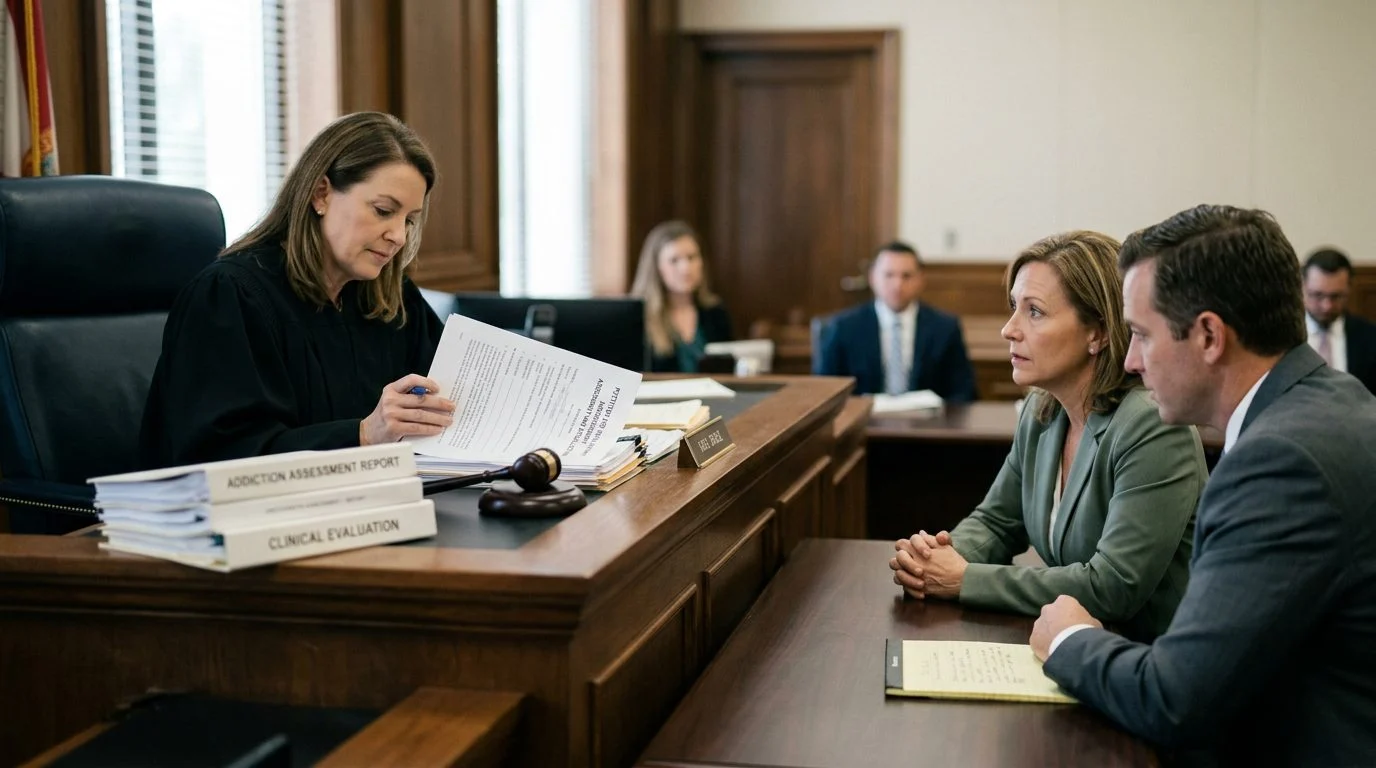
- Hearing. The court must schedule a hearing within 10 court working days unless a continuance is granted (§ 397.68151). The judge reviews relevant evidence, including testimony from family members who know your child’s history (§ 397.6957).
- Updates. We keep you informed about case status and next steps.
In J.C. v. State, the Fifth District reversed an order after the trial judge questioned the only witness while the petitioner was absent. A 2024 Fourth District decision certified conflict with it, so it is not settled statewide.
Your Fears About Overdose, Jail, Homelessness and Losing Hope
The Marchman Act targets people whose substance use puts them or others at serious risk. It aims to move them into assessment and treatment.
A court order can direct treatment rather than waiting for the next crisis. A court order can direct treatment rather than waiting for the next crisis.
Jail. The Marchman Act focuses on assessment and treatment. Your child’s current custody status, including any arrest, is one of the first facts we review.
The criteria also cover a person who, without care or treatment, is likely to neglect themselves in a way that poses a real and present threat of substantial harm, and where it is not apparent that such harm may be avoided through the help of willing, able, and responsible family members or friends or other services (§ 397.675). Fla. Stat. § 397.675 reads: “(b) Without care or treatment, is likely to suffer from neglect or refuse to care for himself or herself; that such neglect or refusal poses a real and present threat of substantial harm to his or her well-being; and that it is not apparent that such harm may be avoided through the help of willing, able, and responsible family members or friends or the provision of other services, or there is substantial likelihood that the person has inflicted, or threatened to or attempted to inflict, or, unless admitted, is likely to inflict, physical harm on himself, herself, or another.” Describe housing and whereabouts at the consultation so we can assess options.
Losing hope. A court treatment order is time-limited. It can last up to 90 days, and the person is discharged at the end unless a renewal is filed (§ 397.697; § 397.6977). Plan for what comes after. Discharge planning must, at a minimum, address follow-up behavioral health appointments, medications, living arrangements and transportation, and referral to recovery support opportunities, and must be documented under § 397.6977. Under § 397.697, the individual must be released when the conditions justifying involuntary treatment no longer exist. We cannot promise recovery or any result. Our aim is to help you get your child into proper treatment with people who understand addiction.
Why Families Bring Their Case to Robinson Casey
Robinson Casey focuses on Marchman Act petitions and guardianship matters, and its work is limited to those areas. Keeping the practice narrow keeps the work centered on the court procedures these cases require.
The practice covers:
- Marchman Act attorney services and involuntary commitment for addiction
- Emergency temporary guardianship, which a court may order, after a petition to determine incapacity is filed, on a finding of imminent danger to the person’s health or safety or that the person’s property is in danger of being wasted, misappropriated, or lost (Fla. Stat. § 744.3031)
- Plenary and limited guardianship
- Mental health guardianship
For emergency guardianship, authority ends 90 days after appointment or when a guardian is appointed, whichever comes first, though it may be extended for an additional 90 days upon a showing that the emergency conditions still exist (§ 744.3031).
The firm serves families in Miami-Dade, across South Florida, and statewide. Support staff handle intake and scheduling. Richard J. Casey III, Esq. is the lawyer responsible for this page.
Not sure what your next step is?
Talk it through with our team — the first consultation is free, confidential, and carries no obligation.
Questions Parents Ask Before a Marchman Act Consultation
Most questions come down to privacy, where your child is, and whether other options exist.
Will my adult child find out I called a lawyer?
Our consultation is confidential. Marchman court records are confidential, but the clerk may disclose them on request to listed persons, including the petitioner, the respondent’s attorney, and a parent or guardian of a minor respondent, and the clerk may not publish personal identifying information on a court docket or in a publicly accessible file (§ 397.6760). Your child will still receive a copy of the petition and hearing notice (§ 397.68151).
Does my child get a lawyer?
Yes. A respondent has the right to counsel at every stage, which the respondent may waive only if present and the court finds the waiver is made knowingly, intelligently, and voluntarily; a respondent who wants counsel but cannot afford it has the right to court-appointed counsel (§ 397.681).
Do I need to be certain before I call?
No. The consultation exists to help you sort out the facts and options.
Can I file if my child is not in my county?
The petition goes to the county where your child is physically located when it is filed (§ 397.681). Bring the exact location to the consultation.
What if my child is already in the hospital or jail?
Current custody is one of the first facts we review. Bring the facility name and contact details if you have them.
Is the Marchman Act my only option?
No. Guardianship and other routes may fit some situations, and we compare them during the consultation.

Call (561) 849-4149 or Schedule Your Consultation Today
If your adult child has overdosed, been hospitalized, been arrested, or disappeared, and you want a court path to treatment, the next step is one conversation. Call (561) 849-4149 or use our contact page to schedule your consultation. Our team serves families in Miami-Dade, across South Florida, and statewide.
Why Parents Contact Robinson Casey
Confidential Consultation
Speaking with our office is confidential. You can share the details of your family's situation in a private setting.
Focused Practice
Robinson Casey limits practice to Marchman Act petitions and guardianship matters, so your family's case is handled by lawyers who work in these areas every day.
Support for Families
Our team works with parents, guardians, and loved ones who are facing a difficult decision about a family member's addiction or mental health.
Clear Next Steps
We explain the process in plain language and outline the options that may be available, so you can decide how to move forward.
Don't Wait Until the Situation Becomes a Crisis
If your adult child's substance use is putting them or others at risk, speaking with a lawyer early can help you understand your options. Call (561) 849-4149 to schedule your free, confidential consultation.
Matters We Handle
Marchman Act Petitions
Guidance for parents and family members who are considering a petition for an involuntary assessment or treatment for substance use.
Involuntary Commitment for Addiction
Help understanding the court process for involuntary commitment and what it may involve for your family.
Guardianship Matters
Representation in plenary, limited, and mental health guardianship matters for families across Florida.
Emergency Temporary Guardianship
Assistance with urgent guardianship requests when a family member needs immediate court-supervised protection.