
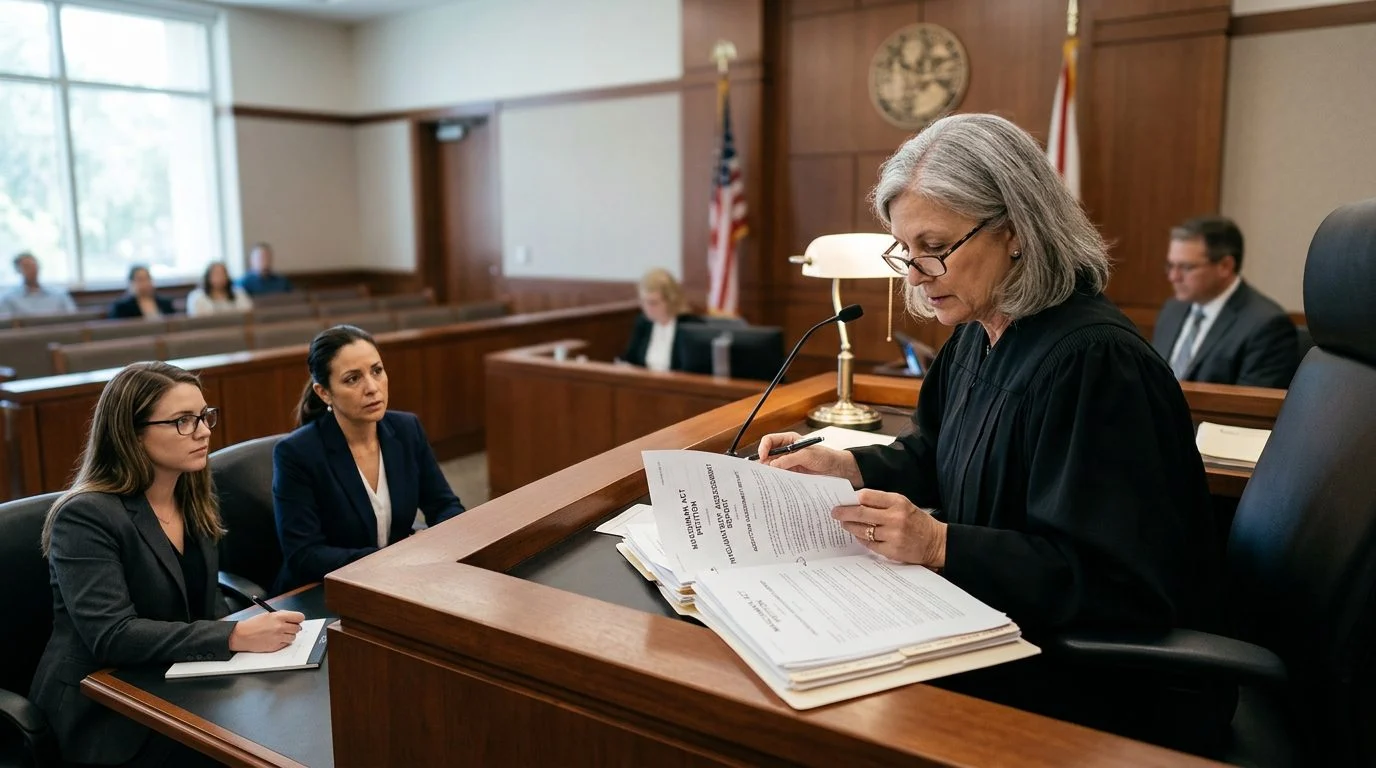
Marchman Act Petitions | South Florida & Statewide
Helping Your Family Navigate a Marchman Act Petition for a Teenager
Robinson Casey limits its practice to Marchman Act petitions and guardianship matters. Learn how the process works for a minor teen, and speak with a lawyer who can explain your options.
By Richard J. Casey III, Esq. · Published October 26, 2026
A Marchman Act petition for a minor teenager in Florida is a court filing. It asks a judge to order involuntary assessment and, if the legal criteria are met, treatment for a young person’s substance use. A parent, legal guardian, or service provider can file it. If you’re looking into a Marchman Act for minor teenager Florida case, you may be worried and short on time. This guide explains who can file, what the court reviews, and what to expect.
What a Marchman Act Petition for a Teenager Is and Who It Is For
A Marchman Act petition is a request to a Florida court for involuntary help with substance use. For a minor, the statute names who may file it.
For a minor, Fla. Stat. § 397.68112 lets a parent, legal guardian, or service provider file the petition.
That list is short. The adult rule names other relatives, such as grandparents or aunts, but the minor rule does not. If you’re a relative, your role may be more limited, so think about that early.
Most families who ask about this are parents, guardians, and relatives watching a teen’s drinking, pill use, or other drug use get worse. Many are still gathering facts. Many haven’t picked a treatment provider yet. That’s normal. A petition is a court filing, so questions often come first.
For the broader framework, read our involuntary commitment for addiction overview.
If your teen's substance use has your family facing a hard decision, you don't have to work through the Marchman Act alone. We're here to talk through your teen's situation with you. Talk it through with our team — the first consultation is free, confidential, and carries no obligation.

Criteria a Court Looks at for a Minor
A court looks at whether there is good faith reason to believe the teen has a substance problem and has lost self-control over that use. The rule comes from Fla. Stat. § 397.675.
The teen must be believed in good faith to be substance abuse impaired, or to have a substance use disorder and a co-occurring mental health disorder, and because of that impairment or disorder have lost the power of self-control with respect to substance use. The court then looks at one of these paths:
- The teen needs substance abuse services and, because of impairment, can’t appreciate that need or make a rational decision about it.
- Without care, the teen is likely to neglect self-care in a way that poses a real and present threat of substantial harm, and help from willing family or services is not apparent.
- There is a substantial likelihood the teen has inflicted, threatened, or attempted physical harm on self or others, or, unless admitted, is likely to inflict physical harm on self or others.
Refusal alone is not enough. The statute says mere refusal to receive services is not evidence of lack of judgment about the need for services. Fla. Stat. § 397.675 reads: “(b) Without care or treatment, is likely to suffer from neglect or refuse to care for himself or herself; that such neglect or refusal poses a real and present threat of substantial harm to his or her well-being; and that it is not apparent that such harm may be avoided through the help of willing, able, and responsible family members or friends or the provision of other services, or there is substantial likelihood that the person has inflicted, or threatened to or attempted to inflict, or, unless admitted, is likely to inflict, physical harm on himself, herself, or another.”
The petition has its own rules. Fla. Stat. § 397.68141 requires the teen’s name, the petitioner’s name, the relationship between them, the name of the teen’s attorney if known, and facts showing impairment, loss of self-control, and harm or impaired judgment.
Examples families often describe include missed school, sudden changes in behavior, or an overdose or near-overdose. Specific, dated facts give the court more to review.
Facts matter. In D.H. v. K.J.R., the petition did not establish a good faith reason to believe D.H. met the statutory criteria for involuntary assessment and stabilization, and the trial court erred in entering the ex parte order. The petition did not show a good faith reason to believe the criteria were met.
Involuntary Assessment, Stabilization, and Treatment
Involuntary assessment is the first stage. Its job is to find the level of care the teen needs. The court hears and reviews all relevant evidence at the hearing on the petition, as Fla. Stat. § 397.6957 provides. If there is an emergency, the petition must also describe the exigent circumstances and request an ex parte assessment and stabilization order under Fla. Stat. § 397.68141.
For a minor, Fla. Stat. § 397.6798 lets an addictions receiving facility admit a teen for involuntary assessment and stabilization. The application comes from a parent, guardian, or legal custodian. The minor must be assessed within 72 hours. If the attending physician finds more services are needed, the minor may stay up to 5 days, counting those 72 hours.
Stabilization is the stage meant to keep the teen safe and steady while the assessment happens. Longer treatment is a separate step.
Longer treatment is a separate step. If, after the 72-hour period, the attending physician determines that further services are necessary, the minor may be kept for a period of up to 5 days, inclusive of the 72-hour period. Under Fla. Stat. § 397.697, the court may order up to 90 days of involuntary treatment services. The judge must first find the conditions proved by clear and convincing evidence.
The provider’s report carries weight.
Families often call a petition “tough love.” Tough love usually means family-set limits and consequences. A petition is a court process with statutory steps and a judge’s review. The two can overlap, but they aren’t the same.
How to File a Marchman Act Petition for a Minor, Step by Step
A parent, guardian, or service provider files the petition with the clerk of the court in the county where the teen is located. In J.P. v. J.N., the filing of the petition in the wrong county did not divest the circuit court in Putnam County of jurisdiction. Under J.P. v. J.N., a petition filed in the wrong county does not remove the circuit court’s jurisdiction.
The clerk may not charge a filing fee for the petition, under Fla. Stat. § 397.681.
In Miami-Dade, the Miami-Dade Clerk of the Court directs adult cases to Probate Court and minors’ cases to Juvenile Court.
- Talk through the facts. A confidential consultation helps you sort out the teen’s current situation and what you can show.
- Gather what you know. Collect dates, incidents, school notes, and prior treatment records. A professional’s report from the 30 days before filing can be attached, per Fla. Stat. § 397.68141.
- File the petition. Include the required names, the relationship, and the facts described above.
- Notice and hearing. Copies go to the teen and the parent or guardian. For a minor, the petition and notice must be personally delivered to the teen. The court schedules a hearing within 10 court working days unless a continuance is granted, under Fla. Stat. § 397.68151.
- Assessment, hearing, and order. An assessment order is valid for 90 days. The timeline depends on the facts and the court’s schedule.
What Parents and Guardians Should Expect During the Case
Expect hearings, sworn testimony, and a real role in your teen’s treatment. Testimony is taken under oath, and the proceedings are recorded. The court must hear and review all relevant evidence, including testimony from individuals such as family members familiar with the teen’s prior history.
Teens have rights too. A respondent has the right to counsel at every stage. If a minor isn’t otherwise represented, the court must appoint a guardian ad litem to act for the minor, under Fla. Stat. § 397.681.
In the case of a minor, the release must be to the individual’s parent, legal guardian, or legal custodian or the authorized designee thereof, to the Department of Children and Families pursuant to s. 39.401, or to the Department of Juvenile Justice pursuant to s. 984.13, per Fla. Stat. § 397.6758.
Section 397.6758 does not address the petitioner’s burden of proof; it states that an individual involuntarily admitted to a licensed service provider may be released without further order of the court only by a qualified professional in a hospital, a detoxification facility, an addictions receiving facility, or any less restrictive treatment component. In J.C. v. State, the court failed to follow the applicable statute by essentially functioning as the absent petitioner. The trial court had called and questioned the only witness while the petitioner was absent.
This process can be stressful. One clear contact for questions helps you track dates and follow up.
If your teen lives in another state, see our guide on out-of-state Marchman Act questions.
Why Families Work With Robinson Casey
Robinson Casey focuses exclusively on Marchman Act and guardianship matters for families in South Florida and statewide.
The firm’s work covers Marchman Act petitions, involuntary commitment for addiction, and mental health guardianship.
Richard J. Casey III, Esq. is the responsible lawyer for this page. Our team includes assistants and office staff who help with scheduling and organizing documents.
Not sure what your next step is?
Talk it through with our team — the first consultation is free, confidential, and carries no obligation.
Frequently Asked Questions
Can a parent file a Marchman Act petition for a minor teenager in Florida?
Yes. For a minor, the release must be to the individual’s parent, legal guardian, or legal custodian, to the Department of Children and Families, or to the Department of Juvenile Justice.
Does my teen have to agree to an assessment?
Not always. If a teen refused before, the court can still order an assessment when the petition and evidence support it.
Does refusing help mean my teen doesn’t qualify?
No. Mere refusal doesn’t, by itself, show lack of judgment about the need for services.
Is a Marchman Act petition the same as tough love?
No. Tough love is family-set limits. A petition is a court process with set statutory steps.
Where must a petition be filed?
Under Fla. Stat. § 397.681, such petitions must be filed with the clerk of the court in the county where the person is located. Where your teen is at filing matters.
Is there a filing fee?
No. The clerk may not charge a fee to file the petition.

Talk With Robinson Casey About Your Teen’s Situation
If your teen’s substance use has your family facing a hard decision, you don’t have to work through the Marchman Act alone. Robinson Casey offers a free, confidential first consultation with no obligation to continue. Call (561) 849-4149 or request a consultation to talk through your teen’s facts.
Why Families Start with Robinson Casey
A Free, Confidential First Consultation
Your initial consultation is free, confidential, and carries no obligation to continue.
A Focused Practice
Our firm limits its practice to Marchman Act petitions and guardianship matters, so your case is handled by lawyers who work in these areas every day.
Support for Parents and Families
Our team helps parents and family members understand the process, gather their questions, and prepare for each step.
South Florida and Statewide
We serve families in Miami-Dade and throughout South Florida, and we assist families across Florida.
Don't Wait Until the Crisis Peaks
Talking with a lawyer early can help you understand your options and the steps involved before a situation escalates. Every family's circumstances are different, so bring your questions to a consultation.
How to Prepare for Your Consultation
Gather Key Information
Write down your teen's recent behavior, any treatment history, and the names of professionals who have been involved.
Note Your Concerns
Describe what has changed, what has been tried so far, and what safety concerns worry you most.
List Your Questions
Ask about the petition process, what the court may require, and what your family should expect next.
Bring Your Documents
Bring any court papers, medical or treatment records, and correspondence you have received so the lawyer can review them with you.