
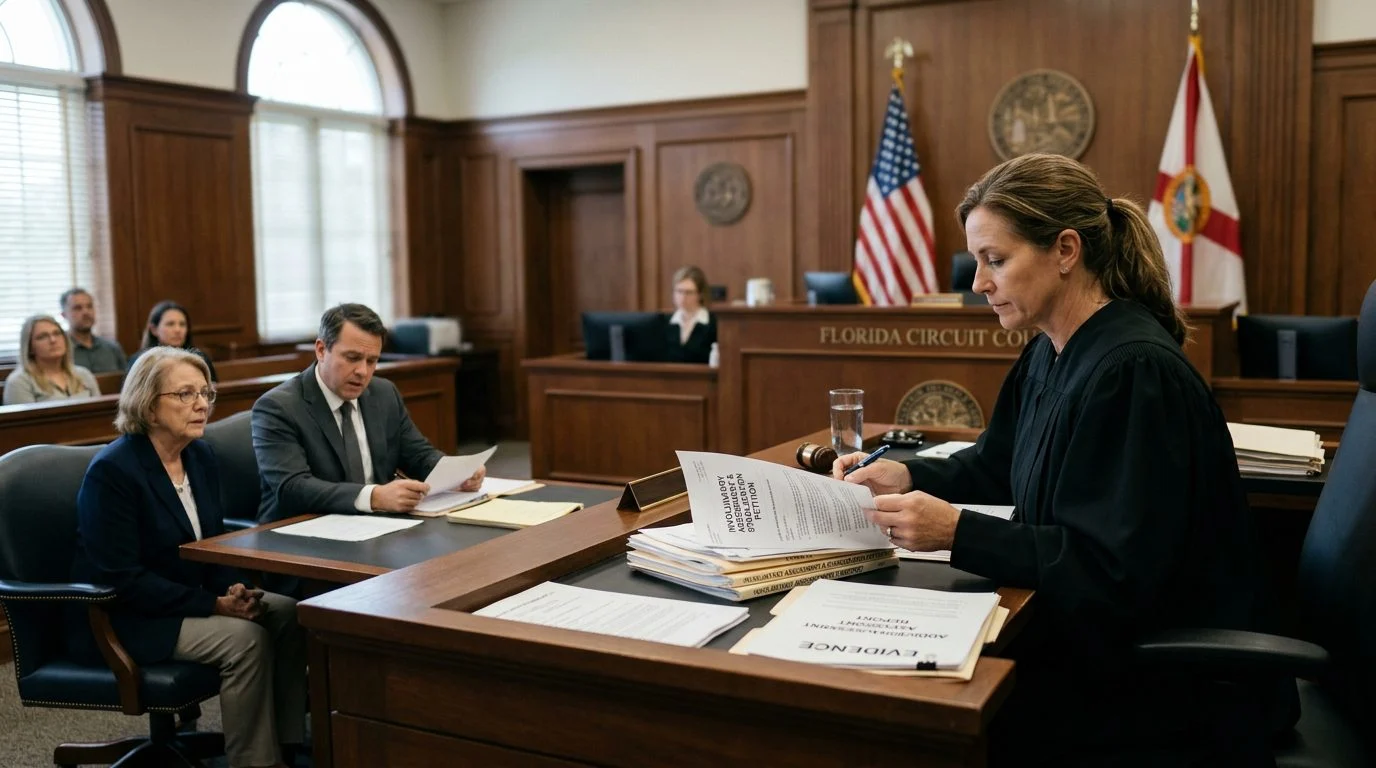
Marchman Act Petitions | Miami-Dade & South Florida
Marchman Act Petition Review: What to Check First
Robinson Casey focuses on Marchman Act petitions and guardianship matters for families in Miami-Dade, across South Florida, and statewide. Richard J. Casey III, Esq. and our team can review your papers with you.
Your First Step With Robinson Casey
Free
First consultation
Confidential
Every conversation
No obligation
To continue after the consultation
South Florida
And statewide
Casey III, Esq. · Published November 4, 2026
A Florida Marchman Act petition review is a careful check of your facts and paperwork before anything goes to court. The Marchman Act, found in Chapter 397 of the Florida Statutes, lets a family member ask a judge to order a loved one into involuntary assessment and treatment for substance use. This page explains what a reviewer checks, how the process runs, and what families ask before they decide.
Robinson & Casey focuses on Marchman Act petitions and guardianship matters. The firm serves families across South Florida and statewide. Richard J. Casey III, Esq. is the responsible lawyer for this page.
What a Marchman Act Petition Review Is and Who It Is For
A petition review is a lawyer’s look at your facts, your draft petition, and your supporting papers. It happens before anything is filed. It helps you judge whether the court process fits your situation.
This page is written for family members, not for the person with the problem. That includes parents, adult children, spouses, siblings, and other relatives. Many families come here while they are still deciding. Some aren’t sure their facts support a petition. Others want the paperwork checked before it reaches the clerk.
A person may be the subject of a petition if they reasonably appear to meet the involuntary admission criteria. Under Fla. Stat. § 397.68111, a person may also be the subject of a petition if they were placed under protective custody or had an emergency admission within the previous 10 days, or were assessed by a qualified professional within 30 days. If you’re still weighing a court petition against an addiction intervention, read our guide on intervention or court petition.
If you're weighing a Marchman Act petition for someone you love, you don't have to work through it alone. Our team can talk through the facts you have. Talk it through with our team — the first consultation is free, confidential, and carries no obligation.

What the Review Covers
A review checks who may file, where the petition goes, what it says, and whether the sworn statements hold up.
- Who may file. For an adult, a petition can come from a spouse or legal guardian, any relative, a service provider, or an adult with direct personal knowledge of the impairment and prior treatment (Fla. Stat. § 397.68112).
- Where it goes. The petition is filed with the clerk in the county where the person is located. The clerk may not charge a filing fee (Fla. Stat. § 397.681). In Miami-Dade, the Clerk routes adult cases to Probate Court and minors’ cases to Juvenile Court (Miami-Dade Clerk). In J.P. v. J.N., the Fifth District held that a wrong-county filing did not divest the circuit court of jurisdiction.
- Required contents. The petition must name the respondent and the petitioner. It must state their relationship, the respondent’s attorney if known, and the facts (Fla. Stat. § 397.68141).
- The facts. The reviewer looks for specific reasons. Why do you believe the person is impaired? Why do you believe they have lost self-control? The petition must state the reason the petitioner believes that your loved one has inflicted or is likely to inflict physical harm on themselves or others unless the court orders involuntary services, or the reason the petitioner believes that your loved one’s refusal to voluntarily receive care is based on judgment so impaired by substance abuse that they cannot appreciate their need for care or make a rational decision about it (Fla. Stat. § 397.68141).
- Anyone who knowingly makes a false declaration in that form commits the crime of perjury by false written declaration, a felony of the third degree (Fla. Stat. § 92.525).
- See J.C. v. State, 293 So. 3d 627 (Fla. 5th DCA 2020), No. 5D19-739. A judge who questions the only witness while the petitioner is absent has acted as the absent petitioner (J.C. v. State).
How the Review Works, Step by Step
The review runs in five steps, from your first call to a decision about filing.
- Free first consultation. The first consultation is free, confidential, and carries no obligation to continue. You describe the situation, and the lawyer identifies the key facts.
- Document intake. You share your timeline, messages, notes, incident reports, and any court papers you hold.
- Draft review. The petition and affidavit are checked against the requirements above. You receive written notes on gaps, unclear statements, and facts that need support.
- Options conversation. You talk through the paths that fit your facts. That may mean filing, gathering more information first, or using a different process.
- Filing preparation. If you decide to proceed, the papers are prepared for the proper county court.
Timing matters once a petition is filed. The court must schedule a hearing within 10 court working days unless a continuance is granted (Fla. Stat. § 397.68151). How long the review takes depends on how much material you can provide.
Documents and Information to Gather Before You File
Gather a dated timeline, the records that show the behavior, and a list of people who saw it firsthand.
- A dated timeline of the most serious recent incidents, written as what you saw or heard.
- Texts, voicemails, emails, photos, and notes that show the behavior or its effects.
- Police, emergency room, or other agency records, if any exist.
- Names and contact details for people with firsthand knowledge.
- Prior court papers, protective orders, or treatment records, with their dates.
- Your loved one’s full legal name, date of birth, and last known address.
- Notes on what your family has already tried, including voluntary treatment offers.
Label each item as firsthand or secondhand. If you’re filing because you have direct personal knowledge, the petition should show that. Dates matter too. The statute lets a petition be accompanied by a qualified professional’s certificate or report of an exam within 30 days before filing (Fla. Stat. § 397.68141).
Common Questions Before You File
Does filing a petition mean my loved one will be committed?
A petition asks the court to act under Chapter 397. The judge decides based on the evidence at each stage, and no result can be promised.
Does my loved one get a lawyer?
Yes. As the respondent, your loved one has the right to counsel at every stage of a judicial proceeding on a petition for involuntary treatment for substance abuse impairment, unless they waive that right while present and the court finds the waiver made knowingly, intelligently, and voluntarily. If the court believes the respondent needs or desires the assistance of counsel, the court must appoint counsel without regard to the respondent’s wishes (Fla. Stat. § 397.681). The Second District has also held that due process gives a respondent a constitutional right to counsel (Hillsborough County v. Albrechta).
Is the petition public?
Petitions, court orders, and related records are confidential under Florida law (Fla. Stat. § 397.6760).
Do I need an assessment before filing?
Not always. A petition may be filed if the person reasonably appears to meet the criteria, or after the recent custody, admission, or assessment described above.
Is this the same as guardianship?
No. A Marchman Act petition addresses substance use under Chapter 397. Guardianship is a separate area the firm handles. The review identifies which path fits your facts.

Why Families Work With Robinson Casey on Marchman Act Petitions
Robinson & Casey limits its practice to Marchman Act petitions and guardianship matters. The firm serves families across South Florida and statewide.
- Practice focus. Marchman Act petitions, involuntary commitment for addiction, and guardianship. Guardianship includes emergency temporary, plenary, limited, and mental health guardianship.
- Responsible lawyer. Richard J. Casey III, Esq. is responsible for this page. Our team, including support staff, helps with scheduling and document intake.
- Referrals. If your matter may need to be referred to another lawyer or firm, we’ll tell you during the consultation.
If you’re gathering facts for a loved one who is struggling, you’re carrying a heavy load. You don’t have to sort through the paperwork alone. Our team can talk through what you have. Call (561) 849-4700 or request a consultation.
What to Check First in a Marchman Act Petition
Read the petition itself
Look at who filed it, which court received it, and the case number. Note each statement about your loved one's behavior, and the dates and places given.
Gather every court paper
Keep notices, summonses, hearing dates, and any letters from the court or a facility. Missing papers can hide important details.
Write down what you know
Record recent events, treatment history, and who has been involved. Clear notes make it easier to review the petition with an attorney.
Prepare your questions
Ask what the petition asks the court to do, what hearings may follow, and what your role will be. Bring these questions to your consultation.
Why Families Start With Robinson Casey
A focused practice
Robinson Casey focuses on Marchman Act petitions and guardianship matters, including emergency temporary, plenary, limited, and mental health guardianship.
Confidential conversations
Your questions and family details are kept confidential from the start of your first call.
Direct contact
Call (561) 849-4700 to speak with our team about the papers you have received.
Guidance for the whole family
We explain the process in plain terms so every family member understands what is being asked of them.
Keep Every Paper
Do not discard any court notice, petition copy, or letter about your loved one. Bring all of them to your consultation so the details can be reviewed together.
Review Your Marchman Act Petition With Robinson Casey
Related practice areas
- Involuntary Commitment for Addiction in Florida
- Florida Marchman Act Attorney: Husband Drinks at Home