
Marchman Act & Guardianship | Miami-Dade and South Florida
Emergency Petition for Drug Treatment in Florida: Guidance for Families in Crisis
Robinson Casey focuses on Marchman Act petitions and guardianship matters for families in Miami-Dade, South Florida and across Florida. Start with a free, confidential first consultation with no obligation to continue.
By Richard J. Casey III, Esq. · Published November 1, 2026
When Your Child’s Addiction Has Reached an Emergency
Florida’s Marchman Act lets a family ask a court to order assessment and treatment for an adult who is severely impaired by substance use. This page explains the same-day emergency petition: what it is, what the court needs, and where the timing gets tight.
Maybe your son or daughter overdosed last week. Maybe they were taken to the hospital, arrested, or have been gone for days with no word. You have paid for treatment, tried interventions, and held firm boundaries. The crisis keeps coming back.
Robinson Casey limits its practice to Marchman Act petitions and guardianship matters. We serve families in Miami-Dade, South Florida, and statewide.
If your adult child is in danger and you feel out of options, our team can talk through whether a Marchman Act petition fits your family's situation. Talk it through with our team — the first consultation is free, confidential, and carries no obligation.

What an Emergency Marchman Act Petition Is and Who Can File One
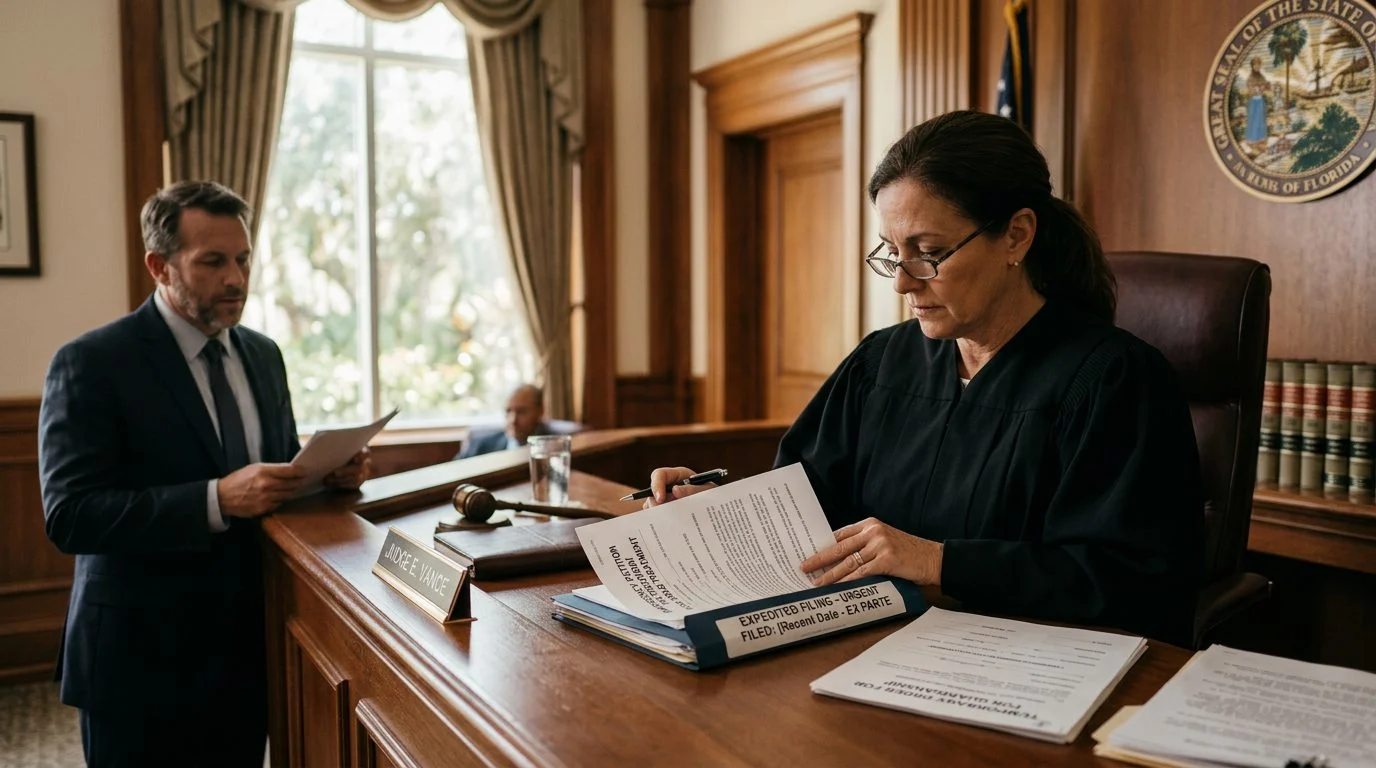
An emergency petition asks the court to act now, instead of waiting for a regular hearing. If there is an emergency, the petition must also describe the exigent circumstances and include a request for an ex parte assessment and stabilization order.
As a parent, you are a relative, so you can file for an adult child. The law also allows a spouse, a legal guardian, a service provider, or another adult who has direct personal knowledge of the impairment and of the person’s prior course of assessment and treatment (Fla. Stat. § 397.68112).
“Same-day” describes urgency, not a set result. Courts control their own calendars, and no same-day outcome is promised. A voluntary admission needs your child’s agreement. An involuntary petition is for cases where your child is substance abuse impaired, has a history of not complying with treatment, and, because of that impairment, is unlikely to voluntarily accept recommended services or cannot judge whether services are needed, and either (1) without services, is likely to neglect self-care or refuse care, posing a real and present threat of substantial harm to his or her well-being, with a substantial likelihood of serious bodily harm to self or others in the near future, as evidenced by recent behavior, or (2) your child’s refusal of care is based on judgment so impaired by substance abuse that he or she cannot appreciate the need for care and cannot make a rational decision about it.
Warning Signs That Make Time Feel Short
Emergency filings usually follow a recent, dangerous event, not just a hard year.
Families often bring these situations to a lawyer:
- A recent overdose or near-overdose
- Repeated emergency room or hospital visits tied to drug or alcohol use
- Relapse after treatment, with your child leaving or refusing programs
- Arrests connected to drug use, or a mental health crisis alongside substance use
- Disappearance, homelessness, or a child you cannot reach
Each case turns on its own facts, so dates matter as much as the event. Your timeline needs to show more than a “no.”
What the Court Needs to See
A petition is a written request filed with the court, and clear details about your adult child’s recent situation help explain why help is needed. The petition must state why you believe your child is impaired, has lost self-control, and has harmed or is likely to harm themselves or others. It can also rest on impaired judgment that blocks care (Fla. Stat. § 397.68141).
Useful support includes:
- Dated examples of overdoses, threats, dangerous driving, or self-harm
- Hospital, police, or jail records
- Treatment history, including past programs and how they ended
- Statements from people who saw the behavior
At the hearing, the court reviews relevant evidence, including testimony from family members who know your child’s history (Fla. Stat. § 397.6957). The petitioner has the burden of proving by clear and convincing evidence that the respondent is substance abuse impaired, has a history of lack of compliance with treatment, and, because of such impairment, is unlikely to voluntarily participate in the recommended services or is unable to determine whether services are necessary, with the additional harm showing the statute requires; so a petition must meet those statutory criteria (D.H. v. K.J.R.).
How the Emergency Process Works, Step by Step
The process runs in order, from preparation to a treatment order. The court sets the pace, and timing varies by county, court, and facts. No timeline is promised.
- Consultation. Review the timeline, the records, and whether the Marchman Act fits.
- Preparation. Gather dates and records, and put the facts in order.
- Filing. File with the clerk in the county where your child is physically located. A wrong-county filing is a venue problem, not a loss of the court’s power (J.P. v. J.N.).
- Emergency order. If an emergency exists, the court may rely on the petition alone and enter an ex parte assessment order (Fla. Stat. § 397.6818). A provider may not hold your child for more than 72 hours of observation unless a listed exception applies.
- Notice and hearing. The court schedules a hearing within 10 court working days unless a continuance is granted (Fla. Stat. § 397.68151). Your child has a right to counsel (Fla. Stat. § 397.681).
- If the court finds the conditions proved by clear and convincing evidence, it may order treatment for up to 90 days (Fla. Stat. § 397.697).
What a Marchman Act Petition Cannot Do
A petition can ask a court to order assessment and treatment. It cannot promise recovery, and it cannot control what your child does after an order ends.
The court keeps jurisdiction after an order to monitor compliance and change treatment if needed (Fla. Stat. § 397.697). That is a court tool, not a result.
A Fifth District court reversed an order where the judge questioned the only witness while the petitioner was absent (J.C. v. State). Florida appellate courts have not all taken the same view, so the rule is not uniform statewide (J.J.J. v. D.G.).
Families with different needs may need a different legal tool, such as guardianship. A careful lawyer will tell you when the Marchman Act is the wrong route.
Not sure what your next step is?
Talk it through with our team — the first consultation is free, confidential, and carries no obligation.
Why Families Work With Robinson Casey
Robinson Casey limits its practice to Marchman Act petitions and guardianship matters, serving families across South Florida and statewide. Richard J. Casey III, Esq. is the responsible lawyer for this page.
Our team works with families on the paperwork an urgent matter requires. Support staff help organize records, dates, and deadlines while the case moves. The petition is built around what the statute asks the court to decide, in the order the court will read it.
Questions Parents Ask Before Filing
Most parents ask about filing rights, cost, and timing first. Here are short answers.
Can I file if my child is an adult?
Yes. A relative, including a parent, may file for an adult respondent (Fla. Stat. § 397.68112).
Do I need a lawyer to file?
Legal guidance can help with the petition’s required content and the steps that follow.
What does it cost?
The clerk may not charge a filing fee for a Marchman petition (Fla. Stat. § 397.681). The first consultation is free, confidential, and has no obligation to continue (consulta inicial gratuita, confidencial y sin compromiso).
Will the court send my child to treatment right away?
The answer depends on the facts and the court’s findings. No outcome is promised.

Talk With Robinson Casey Today
If your child is in danger right now, you should not have to carry this decision alone. You have been holding things together for a long time, and the next step can be a conversation. Call (561) 849-4149 or request a consultation to talk through whether a Marchman Act petition fits your family.
How Robinson Casey Supports Your Family
Petition Preparation
We help you understand the required content of a Marchman Act petition and the steps that follow filing.
Protective Guardianship Options
Our practice covers emergency temporary, plenary, limited and mental health guardianship matters.
Compassionate, Clear Guidance
Families facing addiction or mental health crises need straightforward answers. We explain each option in plain language.
Confidential First Consultation
Your free first consultation is confidential and comes with no obligation to continue.
Do Not Wait Alone
A loved one's addiction or mental health crisis can change quickly. Speaking with a lawyer early can help you understand your options and prepare the information a petition requires.
Matters We Handle
Marchman Act Attorney
Petitions for court-ordered assessment and treatment of a family member struggling with substance use.
Plenary and Limited Guardianship
Guardianship structures tailored to the needs of the person and the scope of support required.
Mental Health Guardianship
Guidance on guardianship petitions for adults whose mental health affects their ability to make decisions.