
Marchman Act Evidence · Miami-Dade & South Florida
Marchman Act Evidence in Florida: What the Court Needs
Robinson Casey focuses on Marchman Act petitions and guardianship matters for families across South Florida and statewide. Here is what a judge looks for and how to prepare.
By Richard J. Casey III, Esq. · Published November 2, 2026
A Marchman Act petition in Florida needs evidence that your adult child is impaired by substance use and that the impairment puts them, or others, at risk. That evidence is made of dated facts you can point to, not general worry. This guide explains the proof that matters and how to organize it.
Where You Are Right Now: A Recent Crisis and a Question You Cannot Put Down
You are looking at this page because something recent pushed you to look for another way.
Maybe it was a call from a hospital. Maybe your child overdosed again, walked out of treatment, or did not come home for days. You may have spent years paying for programs, setting limits, and watching each plan fall apart.
You want a legal path that gets your child into proper treatment, with people who understand addiction. You want to stop managing every crisis alone. That goal is reasonable, and Florida law gives families a court route for it.
Florida’s Marchman Act is a court process for ordering assessment and treatment of a person impaired by substance use. You do not have to settle every detail today. You do need to know what a judge will look for. The Marchman Act process guide covers the full timeline.
If your child's crisis has left you gathering dates, records, and messages, you don't have to sort through them alone, and our team can talk them through with you. Talk it through with our team — the first consultation is free, confidential, and carries no obligation.

What the Court Must Be Shown: The Statute’s Core Tests
The criteria require a good faith reason to believe your child is substance abuse impaired, and that because of it your child has lost the power of self-control and either cannot appreciate the need for services or is at risk of harm.
Under the current text of Fla. Stat. § 397.675, the court needs a good faith reason to believe the person is substance abuse impaired. That impairment must have caused the person to lose the power of self-control with respect to substance abuse.
The statute then gives two paths. The first is that your child needs services and, because of impairment, cannot appreciate that need or make a rational decision about it. The second is that without care, your child is likely to neglect themselves in a way that poses a real and present threat of substantial harm, and that it is not apparent that such harm may be avoided through the help of willing, able, and responsible family members or friends or the provision of other services. Fla. Stat. § 397.675 reads: “(b) Without care or treatment, is likely to suffer from neglect or refuse to care for himself or herself; that such neglect or refusal poses a real and present threat of substantial harm to his or her well-being; and that it is not apparent that such harm may be avoided through the help of willing, able, and responsible family members or friends or the provision of other services, or there is substantial likelihood that the person has inflicted, or threatened to or attempted to inflict, or, unless admitted, is likely to inflict, physical harm on himself, herself, or another.” A substantial likelihood of physical harm to self or another can also meet this second path. Fla. Stat. § 397.675 reads: “(b) Without care or treatment, is likely to suffer from neglect or refuse to care for himself or herself; that such neglect or refusal poses a real and present threat of substantial harm to his or her well-being; and that it is not apparent that such harm may be avoided through the help of willing, able, and responsible family members or friends or the provision of other services, or there is substantial likelihood that the person has inflicted, or threatened to or attempted to inflict, or, unless admitted, is likely to inflict, physical harm on himself, herself, or another.”
Refusing services alone does not prove a lack of judgment. The statute says so directly. You need facts beyond “she said no.”
Your petition has to spell out the reasons. Under Fla. Stat. § 397.68141, it names both of you, your relationship, and the facts behind each belief. It may include a report from a qualified professional who examined your child within 30 days before filing. If your child was never assessed, or refused, the petition must say that.
Facts matter at the start, too. In D.H. v. K.J.R., the Second District held that the trial court erred in entering an ex parte order where the petition did not establish a good faith reason to believe the statutory criteria were met.
Recent Conduct With Dates: Specific Incidents Carry the Petition
Dated incidents from the recent past usually carry more weight than a general description of how your child has been.
Useful events include an overdose, an emergency room visit, a threat, violence, driving while impaired, an arrest, or leaving treatment early. Each one can show impairment or danger.
Recency matters. The statute describes possible harm “as evidenced by recent behavior” in Fla. Stat. § 397.6957. A recent protective custody or emergency admission within the previous 10 days can also make a person the subject of a petition, under Fla. Stat. § 397.68111.
For each event, write the date, the time, the place, what was said or done, and who else saw it. Start with the most recent crisis, then work backward.
Tie patterns to specific days. “He always relapses” is weak. “On March 3 he did not come home, and I found him at a friend’s apartment the next morning” gives a judge something concrete to weigh.
Records From Hospitals, Police, and Prior Treatment
Hospital, police, and treatment records can back up your account, but some are protected by federal privacy law.
Look for emergency department and hospital discharge papers, police or incident reports, and discharge papers from earlier treatment stays. These show what happened and when, in someone else’s written words.
You may already hold some proof. That can include discharge papers you were given, your own call logs, and bills. A lawyer can advise which records can be requested, and how to ask.
Federal law limits how treatment records are used. Under 42 U.S.C. § 290dd-2, records that identify a patient’s diagnosis or treatment at a federally assisted substance use program generally cannot be used against the patient in a civil case without a court order or the patient’s consent. Court filings have their own protection. Under Fla. Stat. § 397.6760, Marchman Act petitions and related court records are confidential.
Keep copies of what you legitimately hold. Do not assume you can get everything. For how a history of leaving care early is documented, read adult child leaves treatment early.
First-Hand Knowledge: What You Saw, Heard, and Can Describe
Your own observations count as evidence, and as a parent you are one of the people the statute lets file.
Under Fla. Stat. § 397.68112, a petition about an adult may be filed by a spouse or legal guardian, any relative, a service provider, or an adult with direct personal knowledge of the impairment and prior treatment. That includes you.
Think about what you have seen and heard at home. Missing money, changes in sleep, late-night calls, and shifts in behavior all matter if you can say when they happened.
Keep texts, voicemails, photos, and messages in their original form. Do not edit, crop, or delete them. Note which parts you saw yourself and which you heard from someone else, and name that person.
Be careful with exaggeration. When you sign a petition by written declaration, Florida law defines that declaration as the statement “Under penalties of perjury, I declare that I have read the foregoing [document] and that the facts stated in it are true,” followed by your signature, except when a verification on information or belief is permitted by law, in which case the words “to the best of my knowledge and belief” may be added (Fla. Stat. § 92.525(2)). Fla. Stat. § 92.525 provides that a person who knowingly makes a false declaration in a written declaration signed “under penalties of perjury” is guilty of the crime of perjury by false written declaration, a felony of the third degree. Write only what you directly observed and can support.
What the Court Weighs at the Hearing
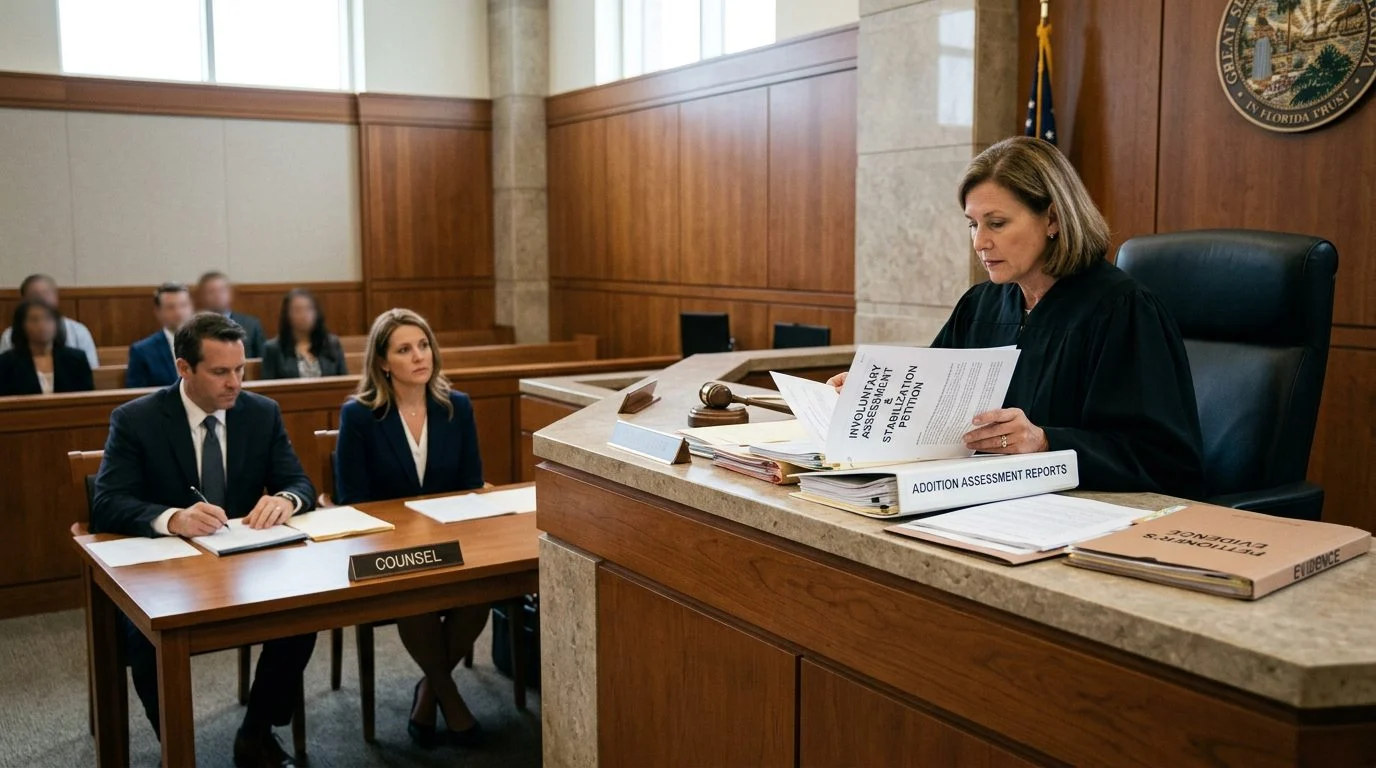
The judge may order involuntary treatment only if the conditions are proved by clear and convincing evidence.
This is a higher bar than many everyday civil disputes, so the proof has to be clear and specific.
At the hearing, testimony is taken under oath and recorded. The court may hear family members who know your child’s history, along with the assessment results. The court may also order drug tests, and your child may refuse to testify. Under Fla. Stat. § 397.6957, a witness may testify remotely if they give the parties their documents by the close of business the day before.
Who presents the case matters. In J.C. v. State, the Fifth District found that the court failed to follow the applicable statute by essentially functioning as the absent petitioner. A judge who questioned the only witness after the petitioner was absent had functioned as the absent petitioner, and the order was reversed. The Fourth District reached a different result in J.J.J. v. D.G. and certified conflict, and the 2024 amendments may affect that dispute.
The result depends on the facts and the judge. Your child also has the right to counsel at every stage, under Fla. Stat. § 397.681, though your child may waive that right if present and the court finds the waiver is made knowingly, intelligently, and voluntarily. For what an order can mean for work and licenses, see job and license consequences.
Not sure what your next step is?
Talk it through with our team — the first consultation is free, confidential, and carries no obligation.
Organizing What You Have Before You Make the Call
A dated timeline, with a source for each entry, is the most useful thing you can bring to a first conversation.
Use a simple table with five columns: date, event, who saw it, where the information came from, and which document shows it. Put one line per event.
Keep three folders: records, witnesses, and a one-page summary of the latest crisis. For each witness, write the name, the phone number, and what that person saw or heard.
Note where your child is right now. Under Fla. Stat. § 397.681, a petition is filed with the clerk in the county where the person is located, and the clerk may not charge a fee to file it. In J.P. v. J.N., the Fifth District held that filing in the wrong county was a venue defect, not a loss of jurisdiction.
Protect your own safety while you prepare. Do not confront your child with the petition plan or the documents you have gathered. A lawyer can help decide which evidence fits your situation and point out what is missing.

Talk Through Your Family’s Situation With Robinson Casey
If your child is in crisis now and you have a timeline and some records, the next useful step is a conversation about whether those facts fit a petition.
Common Questions
What evidence does a judge need for a Marchman Act petition in Florida?
The judge needs facts showing lost self-control, impaired judgment, or a risk of harm, proved by clear and convincing evidence.
Do I need a doctor’s evaluation first?
A petition may include a qualified professional’s report from an exam within 30 days before filing. If there was no assessment, the petition must say so.
Is there a filing fee?
The clerk may not charge a fee for filing the petition.
Which county do I file in?
You file with the clerk in the county where your child is located.
Can my child refuse to testify?
Yes. The respondent may refuse to testify at the hearing.
Does my child get a lawyer?
Yes. A respondent has the right to counsel at every stage of the proceeding, though the respondent may waive that right if present and the court finds the waiver is made knowingly, intelligently, and voluntarily.
Richard J. Casey III, Esq. is the responsible lawyer for this page at Robinson Casey, which focuses on Marchman Act petitions and guardianship matters for families across South Florida and statewide. Your first consultation is free, confidential, and without obligation to continue. To talk through your timeline against these requirements, call (561) 849-4700 or schedule a consultation with our team.
Why families bring their petition to Robinson Casey
Focused practice
Robinson Casey limits practice to Marchman Act and guardianship matters, so the firm's work is concentrated in the same areas the court reviews.
Confidential first consultation
The first consultation is free, confidential, and carries no obligation to continue.
South Florida and statewide
The firm serves families in Miami-Dade and across South Florida, and assists clients elsewhere in Florida.
Support staff who keep you informed
Our team helps you organize records, track deadlines set by the court, and know what to expect at each step.
Start gathering information now
Write down specific recent events, dates, and the names of anyone who witnessed them. Keep copies of any medical, treatment, or police records you already have. Clear notes make it easier for the attorney to review your situation.
Common types of evidence in a Marchman Act case
Professional evaluation
A report from a qualified professional who examined the person. Petitions may include an evaluation completed within 30 days before filing.
Treatment and records history
Prior treatment attempts, hospital or detox admissions, and records of how the person responded to care.
Witness accounts
Statements from family members, employers, or others who saw the behavior firsthand and can describe it clearly.