
Guardianship | Florida
Limited Guardianship of a Minor in Florida
When a parent needs court authority over specific decisions—education, medical care, finances—without full guardianship. Robinson & Casey guides families through the petition and court process.
By Richard J. Casey III, Esq. · Published September 19, 2026
Limited Guardianship of a Minor in Florida
Limited guardianship is a court-ordered arrangement that grants a guardian specific, defined powers over a minor rather than full parental authority. It’s the right tool when a minor has a living parent but needs a guardian to make particular decisions—medical, educational, or financial—that the parent cannot make due to incarceration, hospitalization, substance use disorder, mental health crisis, or other circumstances.
Robinson & Casey guides families through the entire limited guardianship process in Florida, from petition preparation through court approval and ongoing compliance.
Not sure what your next step is?
Talk it through with our team — the first consultation is free, confidential, and carries no obligation.

What Is Limited Guardianship of a Minor in Florida?
Limited guardianship is a legal arrangement in which a court grants a guardian specific powers to make decisions for a minor, while the parent retains other parental rights and responsibilities.
Unlike plenary (full) guardianship, which transfers comprehensive authority to a guardian, limited guardianship is narrowly tailored. The court order specifies exactly which powers the guardian receives. Powers not granted remain with the parent or revert to the court.
Limited guardianship is governed by Florida Statutes Chapter 744. It applies when:
- A minor has one or both parents living but unable to make specific decisions
- Full guardianship would be unnecessary or inappropriate
- A relative, caregiver, or other adult can make particular decisions in the minor’s best interest
- The family wants to preserve parental involvement while addressing a specific gap
Common scenarios include a parent who is incarcerated, hospitalized for an extended period, experiencing substance use disorder, or facing a mental health crisis that temporarily or permanently limits their ability to make medical, educational, or financial decisions for their child.
Who Needs Limited Guardianship of a Minor?
Limited guardianship serves families in specific, defined circumstances where partial legal authority is necessary.
You may need limited guardianship if:
- A parent cannot make medical decisions but is capable of other parental roles. For example, a parent hospitalized for mental health treatment may need a guardian to authorize the minor’s dental work or school-based mental health services.
- A relative or caregiver is stepping in for specific areas while the parent retains other authority. A grandparent might have guardianship over educational enrollment but not financial decisions.
- A minor has special needs requiring a designated decision-maker for education, healthcare, or mental health treatment, while the parent handles other matters.
- The parent is incarcerated and unable to make timely decisions for the minor’s medical or educational needs during their sentence.
- Substance use disorder or mental health crisis temporarily or long-term prevents a parent from making sound decisions in one or more areas, but the parent remains involved in other aspects of the child’s life.
- A temporary or long-term arrangement is needed depending on how family circumstances evolve.
Limited guardianship is flexible. The court defines the scope based on your family’s actual needs, not a one-size-fits-all model.
What Powers and Responsibilities Does Limited Guardianship Include?
The guardianship order specifies exactly which powers are granted; powers not listed remain with the parent or require court approval.
Common limited powers include:
- Medical decision-making: authorizing medical treatment, surgery, hospital admission, or ongoing medical care
- Mental health treatment authorization: consenting to therapy, psychiatric evaluation, medication, or inpatient mental health services
- Educational enrollment and decisions: enrolling the minor in school, making educational placement decisions, attending IEP (Individualized Education Program) meetings, and authorizing special education services
- Dental care: authorizing routine dental treatment and orthodontics
- Financial powers (if included): managing the minor’s funds, paying living expenses, handling inheritance or settlement proceeds, and managing accounts on the minor’s behalf
Guardian duties under Florida law include:
- Acting in the minor’s best interest at all times
- Maintaining accurate records of decisions and expenditures
- Reporting to the court as required
- Avoiding conflicts of interest
- Communicating with the parent(s) and, when appropriate, the minor
- Seeking court approval for certain major decisions, depending on the order’s language
Ongoing obligations:
- If financial powers are included, filing annual accountings with the court
- Filing annual guardianship reports with the court
- Maintaining documentation of medical, educational, and financial decisions
- Responding to court inquiries or modification requests
How the Limited Guardianship Process Works in Florida
The Florida limited guardianship process moves through six key steps, typically taking 4–8 weeks from petition filing to order entry.
Step 1: Petition Filing
Your attorney prepares a guardianship petition naming the minor, the proposed guardian, and the specific powers being requested. The petition must include factual detail about why limited guardianship is necessary and in the minor’s best interest. The petition is filed in the circuit court in the county where the minor resides.
Step 2: Notice and Service
The parent(s), the minor (if age-appropriate), and other interested parties receive formal notice of the petition. Florida law requires notice be served at least 5–10 business days before the hearing, giving parties time to respond or object.
Step 3: Hearing Preparation
Depending on the circumstances, the court may require:
- A medical evaluation or report supporting the need for guardianship
- A home study or background check on the proposed guardian
- Documentation (school records, medical records, evidence of the parent’s incapacity)
- Statements from interested parties
Step 4: Court Hearing
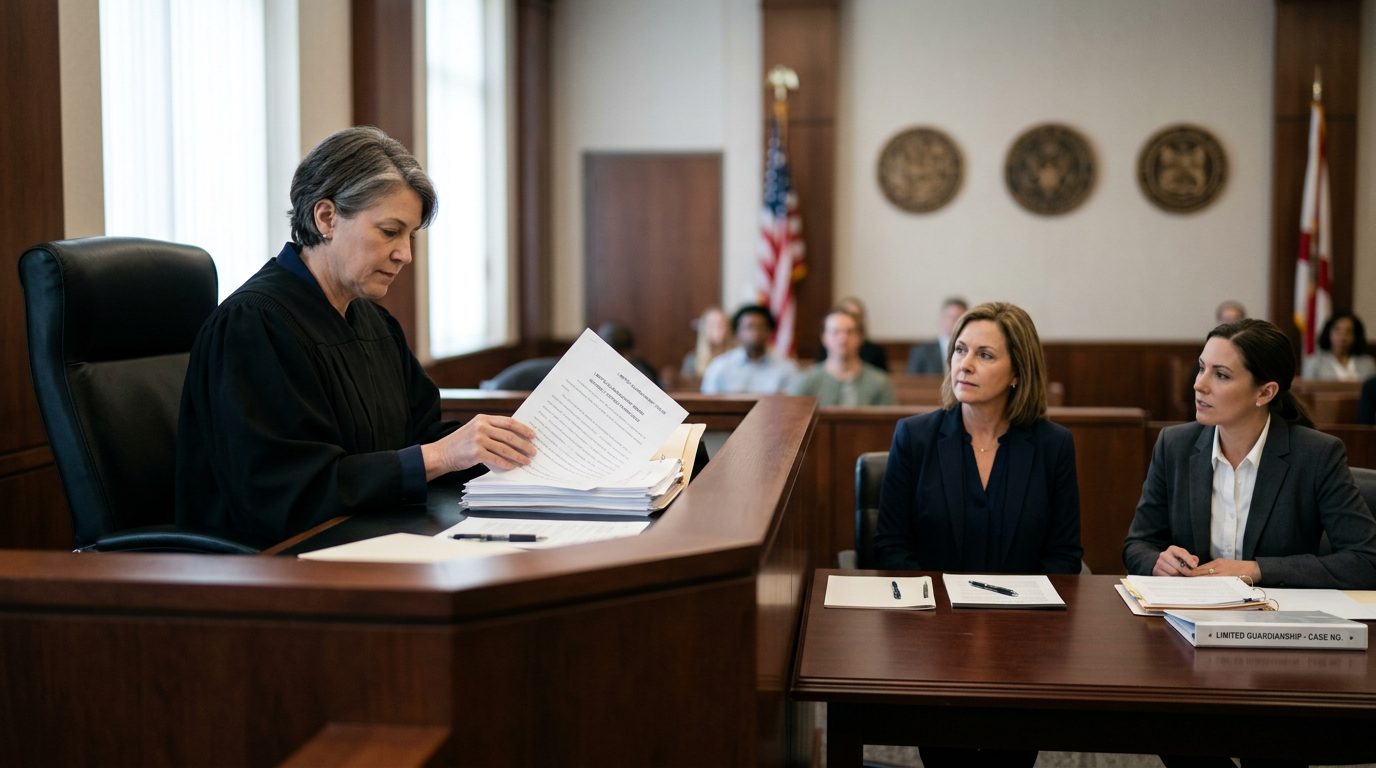
The judge reviews the petition, hears testimony from you and any other witnesses, examines whether limited guardianship is in the minor’s best interest, and addresses any objections from the parent or other parties. If the parent objects, the court decides based on evidence and the minor’s best interest.
Step 5: Order Entry
If the court approves, the judge issues a guardianship order detailing the exact powers granted, the duration of the guardianship, and any conditions or restrictions. You receive certified copies of the order for use with schools, medical providers, and financial institutions.
Step 6: Ongoing Compliance
After appointment, you file annual reports with the court, maintain records of decisions and expenditures, and comply with any court directives. If circumstances change and powers need adjustment, either party can petition the court for modification or termination.
What Robinson & Casey Handles in Limited Guardianship Cases
Robinson & Casey manages every phase of the limited guardianship process, from initial strategy through post-appointment compliance.
Our services include:
- Petition drafting: We use precise legal language to define the specific powers your family needs, tailored to your circumstances rather than a generic template.
- Court filing and procedural compliance: We ensure all documents meet Florida court requirements, are filed timely, and include all necessary supporting evidence.
- Representation at hearing: We present your case to the judge, answer questions, address objections, and advocate for your family’s needs.
- Coordination with parents: We communicate with the custodial parent(s) to clarify roles, reduce conflict where possible, and ensure all parties understand the limited nature of the guardianship.
- Documentation and evidence gathering: We collect medical records, school records, evaluations, and other proof supporting the need for limited guardianship.
- Post-appointment guidance: We explain ongoing reporting, record-keeping, and compliance obligations so you understand your duties as guardian.
- Modification or termination: If circumstances change and powers need adjustment or guardianship should end, we assist with court filings and hearings.
Not sure what your next step is?
Talk it through with our team — the first consultation is free, confidential, and carries no obligation.
Why Families Choose Robinson & Casey for Limited Guardianship
Robinson & Casey’s practice is focused exclusively on guardianship matters and related petitions. Limited guardianship isn’t a sideline service—it’s our core work.
What sets us apart:
- Narrow, focused practice: We handle guardianship petitions, Marchman Act petitions, and related matters. This focus means deep familiarity with Florida guardianship law and local court procedures.
- Florida-based: We’re licensed to practice throughout Florida and know the procedures, judges, and filing requirements in circuit courts statewide.
- Years of experience: We guide families through guardianship petitions, hearings, and ongoing compliance. We understand the emotional and practical challenges families face.
- Clarity on scope: Before you proceed, we explain exactly what limited guardianship will and won’t do for your situation, so you make an informed decision.
- Personalized approach: Each family’s circumstances differ. We tailor the petition and strategy to your specific needs rather than applying a one-size-fits-all template.
- Accessible: You can reach us directly at (561) 849-4149 with questions. Consultations are available to discuss your case in detail.
Common Questions About Limited Guardianship of a Minor
Can a parent object to limited guardianship?
Yes. If the parent objects, the court holds a hearing and decides based on the minor’s best interest. Our role is to present evidence supporting the need for limited guardianship and to answer the judge’s questions.
What if the parent’s situation improves?
Limited guardianship can be modified or terminated by court order if circumstances change and the powers are no longer necessary. Either the guardian or the parent can petition the court for modification or termination.
Do I need a lawyer to file for limited guardianship?
While not legally required, an attorney ensures the petition is properly drafted, filed, and presented—reducing delays and the risk of denial or objection.
How much does limited guardianship cost?
Court filing fees apply (typically a few hundred dollars). Attorney fees vary by case complexity. We discuss costs during your consultation.
Will the minor know about the guardianship?
The court process is public record. Depending on the minor’s age and the court’s discretion, the minor may be notified or present at the hearing.
Can limited guardianship be temporary?
Yes. The court order specifies duration. Some limited guardianships are indefinite; others end when the minor reaches age 18, when the parent’s circumstances improve, or when a specific condition is met.

Next Steps: Schedule Your Consultation
If you’re facing a situation where a minor needs a guardian for specific decisions—medical care, educational enrollment, mental health treatment authorization, or financial management—while a parent remains involved, Robinson & Casey can help you understand whether limited guardianship is the right path and what to expect.
Contact us today to discuss your family’s circumstances:
- Call: (561) 849-4149
- Schedule a consultation: https://robinsoncasey.com/contact/
Families navigating limited guardianship reach out regularly. We’re here to guide you through the process with clarity and care.
Why Robinson & Casey for Limited Guardianship
Petition Preparation
We prepare and file the limited guardianship petition, ensuring all required documentation is complete and submitted to the court.
Court Representation
We represent you at hearings, present evidence of the minor's best interests, and respond to objections or judicial questions.
Focused Authority
We help define the specific powers you need—medical decisions, educational choices, financial management—tailored to your situation.
Clear Guidance
We explain the difference between limited and plenary guardianship, what the court will consider, and what to expect at each step.
Limited Guardianship: Key Points
What Is Limited Guardianship?
Limited guardianship grants you court-authorized authority over specific decisions for a minor—such as medical treatment, school enrollment, or financial matters—while the minor retains other rights and the parent may retain some decision-making power.
When Is It Appropriate?
Limited guardianship may be sought when a parent is unable to make certain decisions due to illness, incapacity, or absence, or when the minor's circumstances require protective court oversight in particular areas.
The Court Process
You petition the court, provide evidence of the minor's best interests, and attend a hearing. The judge decides whether limited guardianship is necessary and defines the powers granted.
Parental Objection
If a parent objects, the court holds a hearing. We present evidence supporting the need for limited guardianship and answer the judge's questions about why it serves the minor's best interests.
Important: Limited Guardianship Can Change
Limited guardianship is not permanent. If circumstances improve, the court can modify or terminate it. We can help you petition for changes when the minor's situation or your capacity shifts.