
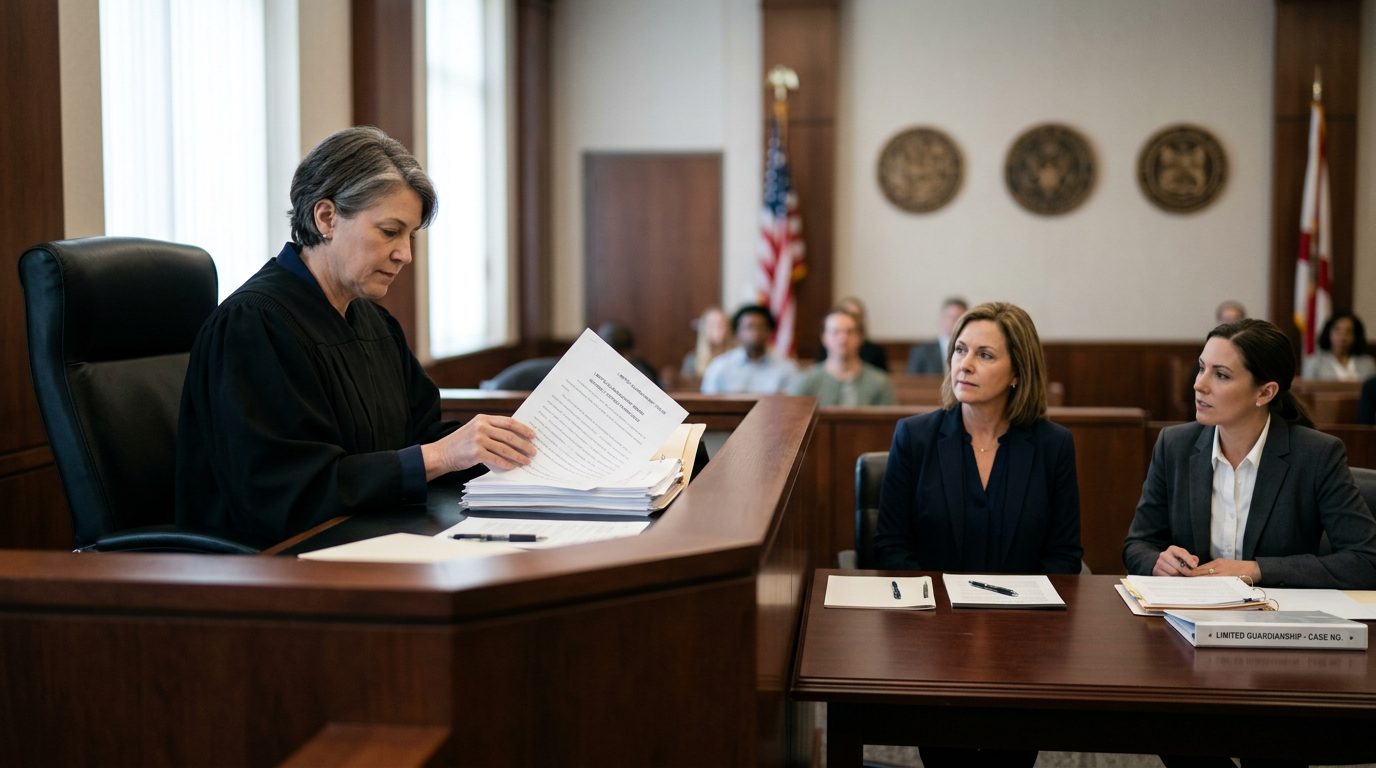
Florida Guardianship
Limited Guardianship of a Minor in Florida
When a parent needs court authority over specific decisions—without terminating parental rights. Robinson & Casey handles contested and uncontested limited guardianship petitions across Florida.
By Richard J. Casey III, Esq. · Published September 20, 2026
Limited Guardianship of a Minor in Florida: What It Is, How It Works, and When You Need It
A limited guardianship of a minor is a court order that grants you specific parental powers—such as medical decision-making or school enrollment—while the parent keeps other rights and responsibilities. It’s a practical tool when a parent is temporarily unable or unwilling to exercise certain duties due to addiction treatment, incarceration, mental or physical illness, or absence, but the parent-child relationship should continue and parental rights don’t need to be fully terminated.
This guide walks you through what limited guardianship covers, who needs it, how the process works, realistic timelines and costs, and how it differs from full guardianship. If you’re already caring for a minor and need legal authority to make decisions on their behalf, this is the right starting point.
Not sure what your next step is?
Talk it through with our team — the first consultation is free, confidential, and carries no obligation.

What Is Limited Guardianship of a Minor in Florida?
Limited guardianship is a court-ordered arrangement that grants you specific parental powers while the parent retains other rights and responsibilities.
Under Florida Statutes Chapter 744, limited guardianship is distinct from plenary (full) guardianship. The key difference is scope: you receive only the powers the court grants in the order. All other parental authority stays with the parent unless the court explicitly removes it.
Limited guardianship is used when:
- A parent is in active addiction treatment and temporarily unable to provide care or make decisions
- A parent is incarcerated or facing criminal proceedings
- A parent has a serious mental or physical health condition requiring temporary care delegation
- A parent is absent or unreachable for an extended period
- A relative or caregiver is already caring for the minor but lacks legal authority to make medical, educational, or financial decisions
- Full guardianship (which terminates parental rights) is unnecessary or inappropriate
The arrangement is often temporary or conditional. If the parent’s situation improves, the guardianship can be modified or ended. This flexibility makes limited guardianship different from plenary guardianship, which typically transfers all parental rights to the guardian.
Who Needs Limited Guardianship of a Minor?
You may need limited guardianship if you’re a relative, family friend, or current caregiver in one of these situations:
Parent in addiction treatment. If a parent enters a rehabilitation or recovery program and cannot safely care for the minor during treatment, limited guardianship gives you authority to make day-to-day decisions, enroll the child in school, and consent to medical care without waiting for the parent’s involvement.
Parent incarcerated or facing criminal charges. When a parent is unavailable due to incarceration or pending trial, limited guardianship lets you maintain the minor’s stability and make necessary decisions without the parent present.
Parent with serious mental or physical illness. A parent hospitalized, undergoing intensive mental health treatment, or dealing with a condition that temporarily impairs their ability to parent can consent to limited guardianship while retaining contact and eventual restoration of full parental rights.
Parent absent or unreachable. If a parent has abandoned the minor or is unreachable for months, limited guardianship provides legal standing to care for the child and make decisions on their behalf.
You’re already the de facto caregiver. Many families care for a minor informally—a grandparent, aunt, uncle, or family friend—but lack the legal authority to enroll the child in school, authorize medical treatment, or manage the child’s finances. Limited guardianship formalizes your role.
Full guardianship isn’t appropriate. If the parent’s incapacity is temporary, or if maintaining the parent-child relationship is important, limited guardianship is a better fit than plenary guardianship, which suspends most parental rights.
What Powers and Responsibilities Does Limited Guardianship Grant?
The court order specifies exactly which powers transfer to you. Common powers include:
Medical decision-making: You can consent to routine medical care, emergency treatment, mental health services, and therapy. This is critical if the minor needs ongoing care and the parent is unavailable.
Educational authority: You can enroll the minor in school, make academic decisions, participate in special education proceedings, and sign school forms on behalf of the parent.
Financial management: You can control and spend the minor’s assets, including inheritance, Social Security benefits, or other funds—within limits set by the court and subject to accounting requirements.
Day-to-day care: You can make decisions about housing, nutrition, supervision, discipline, and daily living arrangements.
What the parent retains: Unless the court removes them, the parent typically keeps:
- Visitation rights (unless the court restricts them due to safety concerns)
- Inheritance rights
- The ability to consent to adoption in most cases
- The right to petition the court to modify or restore parental rights if circumstances change
The court order is specific. If you need medical authority but not financial control, the order will say so. You don’t receive powers not listed in the order. This precision protects both you and the parent.
Limited Guardianship vs. Plenary Guardianship: Key Differences
Understanding the difference helps you choose the right tool for your family.
| Aspect | Limited Guardianship | Plenary Guardianship |
|---|---|---|
| Parental Rights | Parent retains some rights and responsibilities | Guardian assumes nearly all parental rights; parent’s authority is largely suspended |
| Scope | Guardian has only the powers the court grants | Guardian has broad authority over the minor’s person and estate |
| Duration | Often temporary or conditional | Typically longer-term or indefinite |
| Modification | Can be modified or terminated more readily if circumstances change | Requires a formal petition to modify or terminate |
| When to use | Parent’s incapacity is temporary, partial, or situational; relationship and contact should continue | Parent’s rights must be fully suspended; parent poses a risk to the minor; complete authority transfer is required |
Choose limited guardianship if the parent’s situation is temporary (treatment, incarceration with a known release date, recovery from illness) or if you want to preserve the parent-child relationship while you handle specific decisions.
Choose plenary guardianship if the parent’s incapacity is permanent, if the parent poses a safety risk to the minor, or if the parent has abandoned the child and you need full legal authority.
In many cases, limited guardianship is the right fit because it balances the minor’s need for stability with the parent’s retained rights and the possibility of restoration if circumstances improve.
The Limited Guardianship Process: Step-by-Step
Here’s what to expect from start to finish.
Step 1: Consultation and case assessment. You’ll discuss your situation, the minor’s needs, and whether limited guardianship is the right tool. We’ll review alternatives and explain the process, timeline, and costs.
Step 2: Petition preparation. We draft a formal petition naming the minor, the proposed guardian (you), the parent(s), and the specific powers you’re requesting. We gather supporting documents—birth certificate, proof of residence, medical records if relevant, school records, and evidence of why the parent cannot exercise those duties.
Step 3: File with the court. The petition is filed with the circuit court in the county where the minor resides. A filing fee (typically $300–$500, depending on the county) is due at filing.
Step 4: Serve notice. The parent(s) and other interested parties must be notified of the petition. Service requirements vary depending on whether the parent consents or opposes the guardianship.
Step 5: Parent response. The parent may consent, object, or request modifications. If the parent consents, the process moves faster. If the parent objects, the case becomes contested and a hearing will be scheduled.
Step 6: Court hearing (if contested). The judge reviews evidence, hears testimony from you and the parent, and evaluates what’s in the minor’s best interest. The parent can present their own evidence and arguments.
Step 7: Order entry. If the court approves, it enters an order granting limited guardianship. The order lists the specific powers granted to you and any powers retained by the parent.
Step 8: Letters of guardianship. You obtain certified copies of the order to present to schools, medical providers, banks, and other institutions. These letters prove your authority.
Not sure what your next step is?
Talk it through with our team — the first consultation is free, confidential, and carries no obligation.
Timeline and What to Expect
Uncontested cases (parent consents): 4–8 weeks from filing to order. This is the fastest path because there’s no dispute.
Contested cases (parent objects or hearing required): 2–4 months or longer, depending on the court’s schedule and case complexity. The judge may order evaluations or request additional evidence.
Expedited temporary limited guardianship: Available in urgent situations. The court can grant temporary guardianship within days pending a full hearing if the minor’s welfare is at immediate risk.
Costs:
- Filing fee: $300–$500 (varies by county)
- Service of process: $50–$150
- Court-ordered evaluations (if required): $200–$500
- Attorney fees (if contested): varies; discuss with us upfront
Documentation you’ll need:
- Minor’s birth certificate
- Proof of residence (yours and the minor’s)
- School records
- Medical records (if relevant)
- Evidence of the parent’s current situation (treatment admission letter, incarceration records, medical diagnosis, etc.)
- Any existing custody orders or family court documents
Why Robinson & Casey for Limited Guardianship of a Minor
Robinson & Casey focuses exclusively on guardianship matters and Marchman Act (involuntary commitment for addiction) cases. We handle limited guardianship across South Florida and statewide.
Focused practice. Guardianship is our core work. We’re not a general practice firm juggling dozens of practice areas. We know Florida Statutes Chapter 744 inside and out.
Local court knowledge. We understand the procedures, judges, and timelines in each Florida county. We file correctly the first time, avoiding delays and mistakes.
Personalized approach. We listen to your family’s specific situation. We don’t use templates. We tailor the petition to what your family actually needs, not what’s easiest for us to file.
Experience with complexity. We handle straightforward cases and those involving parental objection, substance abuse history, prior court involvement, or multiple counties.
Clear communication. We explain each step, timeline, and cost upfront. No surprises. You’ll know what to expect and why.
Accessibility. We serve families across Florida. We offer flexible scheduling for consultations, including evening and weekend availability.
Common Questions About Limited Guardianship of a Minor
Can I get limited guardianship without the parent’s consent?
Yes. If the court finds that limited guardianship is in the minor’s best interest, it can grant it even if the parent objects. Contested cases take longer and may require a hearing, but consent is not required.
Will the parent lose all rights?
No. Limited guardianship preserves parental rights not specifically transferred to the guardian. The court order lists which powers you receive; all others stay with the parent.
Can limited guardianship be temporary?
Yes. You can request it for a defined period (such as while the parent completes treatment) or until a specific condition changes. The court can modify or terminate it.
What if the parent’s situation improves?
Either you or the parent can petition the court to modify or end the guardianship. If circumstances change significantly, the court will reconsider the arrangement.
Do I need a lawyer?
Not required, but strongly recommended. An attorney ensures the petition is filed correctly, protects your interests, and speeds the process. Mistakes can delay approval or create legal gaps.
What happens if I don’t follow the court order?
Violating the order can result in contempt charges, loss of guardianship, or other court sanctions. The order is legally binding.
Can a limited guardian make medical decisions for the minor?
Only if the court grants you that power in the order. Medical authority is not automatic; it must be specifically requested and approved.

Next Steps: Get Started Today
If you’re caring for a minor whose parent is in treatment, incarcerated, or unable to make decisions, limited guardianship can give you the legal authority you need—without terminating parental rights. Families in this situation can reach out to us, and we’re ready to help.
Schedule a consultation to discuss your family’s specific situation and explore whether limited guardianship is the right path. Bring relevant documents: the minor’s birth certificate, any existing custody orders, school records, medical records, and evidence of the parent’s current situation.
We’ll explain your options, realistic timeline, costs, and next steps in plain language. There’s no obligation—just honest guidance to help you make the right decision for your family.
Call us at (561) 849-4149 or contact us online to get started.
Why Robinson & Casey for Limited Guardianship
Focused Practice
We focus exclusively on Marchman Act petitions and guardianship matters. Limited guardianship is core to what we do.
Petition & Court Work
We prepare and file your limited guardianship petition, handle service, and represent you at hearings—whether the case is contested or unopposed.
Statewide Service
We serve families across South Florida and statewide, handling limited guardianship matters in courts throughout Florida.
Direct Access
Call us directly at (561) 849-4149 to discuss your situation and get answers about the limited guardianship process.
Key Point: Limited Guardianship Preserves Parental Rights
Unlike plenary guardianship, limited guardianship lets you obtain court authority over specific decisions while the parent retains other rights. The court defines which decisions you control based on the minor's best interest.
Common Limited Guardianship Scenarios
Medical & Mental Health Decisions
Guardianship limited to consent for medical treatment, therapy, psychiatric care, or medication—when a parent is unable or unwilling to make sound decisions.
Educational & Special Needs
Authority over school enrollment, special education planning, IEP decisions, and related services when parental involvement is absent or harmful.
Financial & Property Matters
Limited guardianship over the minor's funds, inheritance, or property management without controlling custody or other parental rights.
Contested Guardianship
When a parent objects to limited guardianship, we prepare your case for hearing and advocate for the court to find it in the minor's best interest.
Frequently Asked Questions
Can I get limited guardianship without the parent's consent?
Yes. If the court finds that limited guardianship is in the minor's best interest, it can grant it even if the parent objects. Contested cases take longer and may require a hearing, but consent is not required.
Will the parent lose all rights?
No. Limited guardianship preserves parental rights not specifically granted to you by the court. The judge defines the scope of your authority based on the minor's needs.
How long does limited guardianship take?
Uncontested cases typically move faster than contested ones. The timeline depends on court scheduling, service of the petition, and whether the parent or other interested parties file objections.
What happens after the court grants limited guardianship?
You receive a court order defining your authority. You can then make the specified decisions on behalf of the minor. The guardianship continues until the minor reaches age 18 or the court modifies or terminates it.