
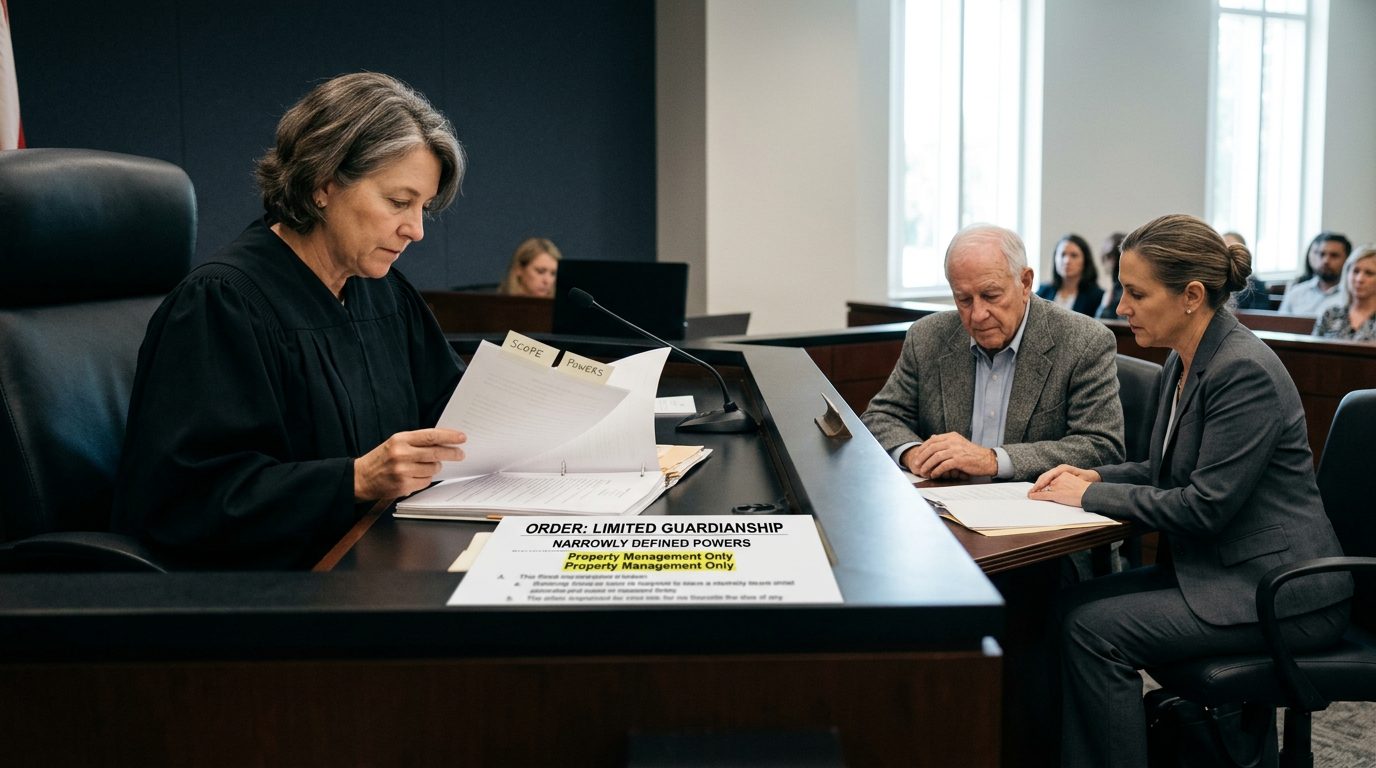
Limited Guardianship
Limited Guardianship in Florida: Protect Without Full Control
When a loved one needs support but can retain independence, limited guardianship grants you specific powers tailored to their situation. Robinson & Casey guides families through the petition process.
By Richard J. Casey III, Esq. · Published September 19, 2026
Limited Guardianship Petition in Florida: Process, Powers & Timeline
A limited guardianship petition asks a Florida court to grant a guardian authority over only specific decisions—not all personal and financial matters—allowing the ward to retain autonomy and decision-making power in areas where they have capacity. This approach is less restrictive than plenary guardianship and is appropriate when someone has capacity in some domains but not others.
If you're managing care for a family member with capacity in some areas but not others, a limited guardianship petition may preserve their autonomy while protecting their interests—families in your situation can reach out to us. Talk it through with our team — the first consultation is free, confidential, and carries no obligation.

What Is a Limited Guardianship Petition in Florida?
A limited guardianship petition is a court filing that seeks to appoint a guardian with authority over only the specific decisions you identify, preserving the ward’s independence in all other areas. Unlike plenary guardianship (which grants full authority over personal and financial matters) or conservatorship (which covers finances only), limited guardianship tailors the guardian’s powers to the ward’s actual needs.
Limited guardianship is appropriate for adults and minors who retain capacity in some areas but lack it in others. Common scenarios include:
- Cognitive decline from aging or illness, where judgment about medical care is impaired but financial independence remains
- Mental illness affecting specific decision-making (e.g., treatment compliance) but not all functioning
- Developmental disability limiting capacity in certain domains while preserving other skills
- Substance use disorder affecting judgment in specific areas, such as financial management or healthcare decisions
The key principle: a limited guardianship preserves dignity and autonomy by granting only the powers truly needed.
Who Can File a Limited Guardianship Petition?
Florida law allows several categories of people to file a limited guardianship petition:
- Family members: spouse, adult children, parents, siblings
- Close relatives or friends with knowledge of the alleged incapacity and genuine concern for the person’s welfare
- Healthcare providers or social workers in some circumstances, particularly when the person is at risk
- The individual themselves, through a self-petition for limited guardianship
- Anyone with legal standing to act in the person’s best interest
The petitioner must have personal knowledge of the alleged incapacity and demonstrate a genuine concern for the ward’s welfare. The court will evaluate whether the petitioner’s motives align with the ward’s best interests.
What Powers Does a Limited Guardianship Cover?
The petitioner specifies which decisions the guardian will make, and the court approves only those powers listed in the final order. This is the core strength of limited guardianship: any power not explicitly granted remains with the ward.
Common Limited Powers
- Healthcare decisions: medical treatment, surgery, medication management, psychiatric care
- Living arrangements: where the ward resides, facility placement, housing decisions
- Education: school enrollment, educational planning (for minors)
- Specific financial matters: bill payment, benefit management, but not asset sale or major financial decisions
- Personal care: grooming, nutrition, daily living support
Powers Retained by the Ward
If the court order does not grant a power to the guardian, the ward retains it. For example:
- Guardian controls medical care → Ward retains right to manage personal relationships and social decisions
- Guardian controls housing → Ward retains financial independence and right to work
- Guardian manages bill payment → Ward retains right to make charitable donations or personal purchases within their means
The court order lists powers explicitly. This clarity protects both the guardian (who knows their authority) and the ward (who retains control where possible).
Limited Guardianship Petition Requirements in Florida
Florida law specifies what must be included in a limited guardianship petition filing:
- Court petition form (Florida Supreme Court approved): filed with the circuit court in the county where the alleged incapacitated person resides
- Physician’s affidavit or medical evidence: a sworn statement from a licensed physician describing the incapacity, its nature, and the specific areas affected
- Proof of service: notice to the alleged incapacitated person, their spouse, parents, adult children, and other statutory parties (typically 10–14 days before hearing)
- Capacity evaluation: the court may order an independent medical examination to verify incapacity
- Attorney ad litem or guardian ad litem: the court appoints an independent advocate to represent the alleged incapacitated person’s interests and investigate the petition
- Hearing: the petitioner and respondent (the alleged incapacitated person) have the right to be heard; evidence is presented to a judge
Medical evidence is critical. The physician’s affidavit must address the specific areas of incapacity relevant to the powers you’re requesting.
How to File a Limited Guardianship Petition: Step-by-Step Process
Step 1: Initial Consultation
Discuss your situation, determine whether limited guardianship is appropriate, and identify which specific powers are needed. This consultation clarifies your goals and ensures limited guardianship is the right tool.
Step 2: Gather Medical Evidence
Obtain a physician’s affidavit or relevant medical records from a licensed physician documenting incapacity in the specific areas where guardianship powers are needed. The physician must address the nature and extent of the incapacity.
Step 3: Prepare Petition and Supporting Documents
Complete Florida court forms, draft the petition statement, and prepare the notice of hearing. All documents must comply with Florida court rules and local requirements.
Step 4: File with the Circuit Court
Submit the petition, physician’s affidavit, and filing fee to the circuit court in the county where the alleged incapacitated person resides. Filing fees vary by county but typically range from $200 to $500.
Step 5: Serve Notice
Ensure all required parties receive notice of the petition and the hearing date. Service must occur at least 10–14 days before the hearing. Proper service is mandatory; failure to serve can delay or invalidate the petition.
Step 6: Court Appoints Attorney Ad Litem or Guardian Ad Litem
The court appoints an independent advocate to investigate the petition, interview the respondent, and report findings to the judge. This protects the respondent’s interests and ensures the court has complete information.
Step 7: Attend Hearing
Present evidence, testify about the need for limited guardianship and the specific powers requested. The respondent may testify, present evidence, and contest the petition. The judge hears both sides.
Step 8: Court Issues Order
If the petition is granted, the judge signs an order specifying which powers are granted to the guardian. The order is the legal document defining the guardian’s authority.
Step 9: Guardian Takes Oath and Receives Letters of Guardianship
The guardian takes an oath, and the court issues letters of guardianship—the official document authorizing the guardian to act on behalf of the ward.
Not sure what your next step is?
Talk it through with our team — the first consultation is free, confidential, and carries no obligation.
Timeline: How Long Does a Limited Guardianship Petition Take?
The typical timeline from filing to court order is 6–12 weeks in most cases, though this varies:
- Initial preparation and filing: 2–4 weeks (depending on availability of medical evidence and attorney availability)
- Notice and service period: 10–14 days minimum before hearing
- Court hearing: typically scheduled 4–8 weeks after filing (depends on court calendar)
- Total: 6–12 weeks in routine cases
Expedited Process
If imminent danger exists, you may petition for emergency temporary guardianship, which can be granted within days. This temporary order protects the person while a full limited guardianship hearing is scheduled. Emergency temporary guardianship can later be converted to limited guardianship after the full hearing.
Factors That Delay the Process
- Incomplete or outdated medical evidence requiring updated physician affidavits
- Respondent contests the petition, requiring additional evidence and hearing time
- Court calendar congestion in busy counties
- Service delays if required parties are difficult to locate
What Robinson & Casey Handles in Your Limited Guardianship Petition
Our firm manages every stage of your limited guardianship petition:
- Consultation and case assessment: determine whether limited guardianship is appropriate and which specific powers to request
- Document preparation: complete all court forms, draft the petition, prepare supporting statements and affidavits
- Medical evidence coordination: work with physicians to obtain required affidavits and ensure medical documentation meets statutory standards
- Filing and service: file the petition with the correct court and ensure proper notice to all required parties
- Court representation: appear at the hearing, present evidence, respond to objections, and advocate for the powers you need
- Post-order guidance: explain your duties as guardian, clarify the court order, and advise on ongoing compliance and reporting
Why Choose Robinson & Casey for Your Limited Guardianship Petition
Focused practice: Limited guardianship and related guardianship matters are our core work—not a side service. We handle these petitions and understand the nuances of Florida law.
Statewide experience: We file limited guardianship petitions across Florida, including Miami-Dade, Broward, Palm Beach, and beyond. We know local court procedures and judges.
Hands-on representation: Your attorney handles your case personally. You’re not passed to a paralegal or junior associate.
Realistic guidance: We explain what to expect, including potential objections and how courts evaluate evidence. We don’t promise outcomes; we prepare you for the process.
Efficiency: We manage the process to minimize delays and keep costs reasonable without compromising quality.
Frequently Asked Questions About Limited Guardianship Petitions
Q: What’s the difference between limited and plenary guardianship?
Limited guardianship grants only specific powers you request; plenary grants authority over all personal and financial decisions. Limited guardianship is less restrictive and preserves the ward’s autonomy where possible.
Q: Can the ward object to a limited guardianship petition?
Yes. The respondent has the right to contest the petition, present evidence, and have an attorney ad litem represent their interests. The judge will hear both sides before deciding.
Q: What if the ward refuses to cooperate or denies incapacity?
The court will still hold a hearing. Medical evidence, testimony from the petitioner, and the attorney ad litem’s report will be presented. The judge decides based on the evidence, not the respondent’s agreement.
Q: Can a limited guardianship be modified later?
Yes. If circumstances change, either the guardian or the ward can petition the court to modify, expand, or terminate the powers granted.
Q: What are the ongoing duties of a limited guardian?
You must act in the ward’s best interest, keep detailed records, file annual accountings with the court (if financial powers are granted), and respect the ward’s rights in areas outside your authority.
Q: How much does a limited guardianship petition cost?
Costs include court filing fees ($200–$500, depending on county), physician affidavit fees ($200–$500), and attorney fees. We discuss costs upfront during your consultation.
Q: Can I file a limited guardianship petition without an attorney?
You can file pro se (without an attorney), but the process is complex. Court forms must be completed correctly, medical evidence must meet statutory requirements, and you must present your case effectively at hearing. An attorney significantly increases the likelihood of success.

Next Steps: Schedule Your Limited Guardianship Consultation
If you’re managing care for a family member with capacity in some areas but not others, a limited guardianship petition may preserve their autonomy while protecting their interests. Robinson & Casey handles these petitions for families across South Florida and statewide.
Call us at (561) 849-4149 or contact us online to schedule your consultation. We’ll explain whether limited guardianship is appropriate for your circumstances, outline the process and timeline, discuss costs, and answer your questions. If you decide to proceed, we’ll guide you through every step—from gathering medical evidence through the court hearing and beyond.
People in your situation can reach out to us. Let us help you protect your family member while preserving their dignity and independence.
The Limited Guardianship Process
File the Petition
Submit a petition to the court naming the proposed ward and specifying which powers you seek—medical decisions, financial management, living arrangements, or others. The petition must include medical or professional evidence of incapacity in those specific areas.
Notice & Hearing
The proposed ward receives notice and has the right to attend the hearing and be represented by counsel. The court examines whether limited guardianship is appropriate and whether the powers you request are necessary.
Court Order
If the court finds clear and convincing evidence that limited guardianship serves the ward's best interests, it issues an order defining your powers. The ward retains all rights not explicitly granted to you.
Ongoing Duties
As guardian, you must act in the ward's best interest, file annual accountings and reports, and respect the ward's remaining autonomy. The court retains jurisdiction to modify or terminate the guardianship.
Why Limited Guardianship May Fit Your Situation
Preserves Ward Autonomy
Unlike plenary guardianship, limited guardianship restricts your authority to only the areas where the ward needs help. The ward keeps decision-making power in other matters.
Tailored to Specific Needs
You petition for the exact powers required—perhaps medical decisions and healthcare, but not financial control, or vice versa. The court order reflects what the ward actually needs.
Clear Legal Authority
A court order gives you documented authority to act on the ward's behalf in the designated areas, protecting both you and the ward from disputes or third-party challenges.
Flexible & Reviewable
The court can modify the guardianship as circumstances change, expanding or limiting your powers, or terminating the arrangement if the ward's condition improves.
Key Difference: Limited vs. Plenary
Limited guardianship grants only the specific powers you request and the court approves. Plenary guardianship gives you authority over all personal and financial decisions. Limited guardianship is less restrictive and keeps the ward's independence where possible—but it requires the court to find that limited powers are sufficient to meet the ward's needs.
Common Questions About Limited Guardianship
Can the ward object to a limited guardianship petition?
Yes. The ward has the right to notice, to attend the hearing, and to be represented by an attorney. The court will hear any objections and must find clear and convincing evidence that limited guardianship is necessary before granting it.
What powers can I request?
You can petition for authority over medical decisions, healthcare, living arrangements, financial matters, education, or any other specific area where the ward lacks capacity. The court will evaluate whether each requested power is necessary.
How long does limited guardianship last?
Limited guardianship continues until the court modifies or terminates it. You must file annual reports, and either party can petition the court to change the arrangement if circumstances change.
What if the ward's condition changes?
Either you or the ward can petition the court to modify the guardianship—expanding your powers if the ward's incapacity worsens, or reducing them if the ward improves. The court will hold a new hearing to decide.