
Marchman Act Attorney | Miami-Dade and South Florida
Your Adult Son Promised Rehab. Now What?
Robinson Casey focuses on Marchman Act petitions and guardianship matters for families in Miami-Dade, South Florida and across Florida. Talk with us about the options available when a promise to get help is not followed through.
Casey III, Esq. · Published November 6, 2026
A promise from an adult son to enter rehab is not a court order. Florida’s Marchman Act gives a family member a way to ask a court for assessment and treatment when substance use has cut into an adult’s ability to make safe choices. This page explains what that process asks for, what the court looks at, and where its limits are.
You Have Heard the Promise Before
Most parents in your position have heard the same promise many times. “I’ll go Monday.” “I already made the call.” The bag packed by the door that never leaves the closet. Then comes the call from the emergency room, or the news that he hasn’t come home.
Each promise may be sincere when he makes it. Still, the pattern keeps ending the same way: relapse, a hospital stay, or an admission that never happens. You have paid for treatment. You have tried interventions and set firm boundaries. You have watched him keep getting worse.
That exhaustion is real, and it doesn’t mean you failed him. Asking what the law allows is a reasonable step when voluntary options have run out. Many parents also hold back because they fear that pushing harder will drive their child away. After years of broken promises from an adult son or daughter, it is natural for a parent to want to understand what options may exist.
When your adult son keeps promising treatment and then not showing up, you don't have to work out the legal options by yourself. Talk it through with our team — the first consultation is free, confidential, and carries no obligation.

Why a Promise Is Not a Legal Commitment
It is a choice he has to keep making, day after day.
Florida’s voluntary admission statute says a person who wants treatment may apply to a provider. Within the provider’s financial and space capabilities, the provider must admit him when there is sufficient evidence of impairment and it can safely manage his medical and behavioral needs. That route depends on him walking in and agreeing to stay. A parent can’t supply that agreement at the front door.
The Marchman Act also sets a higher bar than a broken promise. Under Fla. Stat. § 397.675, mere refusal to receive services does not constitute evidence of lack of judgment with respect to his or her need for such services. Fla. Stat. § 397.675 requires good faith reason to believe the person is substance abuse impaired (or has a substance use disorder and a co-occurring mental health disorder) and, because of that, has lost the power of self-control with respect to substance abuse, and either needs substance abuse services but has judgment so impaired that he cannot appreciate that need or make a rational decision about it, or, without care or treatment, is likely to suffer from neglect or refuse to care for himself in a way that poses a real and present threat of substantial harm (and it is not apparent that family, friends or other services can avoid that harm), or there is a substantial likelihood that he has inflicted, or threatened or attempted to inflict, or, unless admitted, is likely to inflict physical harm on himself or another. A missed admission is painful. It is not, on its own, the whole legal case.
So the real question is whether Florida offers a court process when substance use keeps an adult from making safe decisions. For an overview, read our Marchman Act guide.
What the Marchman Act Allows a Family Member to Request
Under Florida’s Marchman Act, a parent can ask a court to order involuntary assessment and treatment for an adult with a substance abuse impairment. The parent files as the petitioner. Your son is named as the respondent.
The Florida Department of Children and Families explains who may start the process. Under Fla. Stat. § 397.68112, for an adult respondent, a petition may be filed by any relative, a spouse or legal guardian, a service provider, or an adult with direct personal knowledge of the impairment and his or her prior course of assessment and treatment.
The petition must name both of you and state your relationship. It must also give the facts. Under Fla. Stat. § 397.68141, those facts must explain why you believe he is impaired and has lost power of self-control over substance use. They must also explain the physical harm he has inflicted or is likely to inflict on himself or others unless the court orders involuntary services, or why his refusal to get care rests on impaired judgment.
Where you file matters too. However, as J.P. v. J.N. states, the filing of the petition in the wrong county did not divest the circuit court in Putnam County of jurisdiction.
What Happens After a Court Takes the Petition
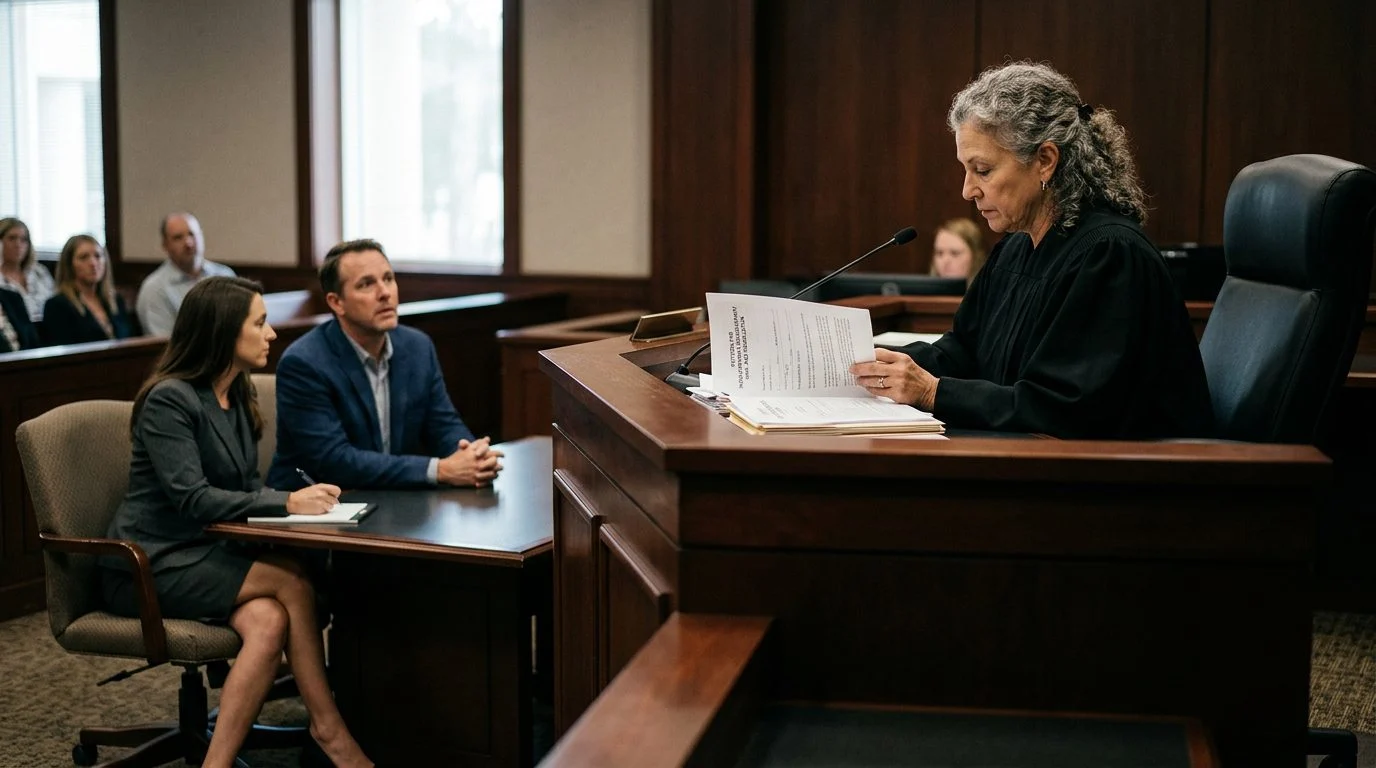
The court must schedule a hearing within 10 court working days unless a continuance is granted. Under Fla. Stat. § 397.68151, the court must also decide right away whether your son has a lawyer or should have one appointed.
At the hearing, the court hears all relevant evidence. Under Fla. Stat. § 397.6957, that includes testimony from family members about his history and the assessment results. The court may also order drug tests. Testimony is taken under oath, and your son may refuse to testify.
In J.C. v. State, the Fifth District reversed an order where the trial judge questioned the only witness while the petitioner was absent. In J.J.J. v. D.G., the court wrote: “we certify conflict with R.S., J.W., and C.W.R.K., for the reasons stated above. Affirmed; conflict certified.” Florida courts have not spoken with one voice on this point, so the district matters.
At the end of the hearing, the court must either dismiss the petition or order involuntary treatment services from the respondent’s chosen licensed service provider if possible and appropriate. Any treatment order must include findings on his need for treatment and on whether less restrictive alternatives are appropriate. The court keeps jurisdiction to monitor compliance under Fla. Stat. § 397.697.
A provider may not hold a person for more than 72 hours of observation unless a listed exception applies, under Fla. Stat. § 397.6818. Timing depends on the court and the case, and no outcome is promised. For more on helping a struggling adult son, see this guide.
The Fears Behind the Question: Overdose, Jail, Homelessness
If your son’s life is in immediate danger, call 911 or take him to the nearest emergency room now. A court petition is not emergency medical care, and it does not replace it.
The fear of losing him to an overdose is one of the hardest parts. The court process runs on court dates, not on crisis timing. That is why the emergency steps above come first.
The fear of jail is also real. The statute lets the court order a law enforcement officer or another designated agent of the court to take the respondent into custody and deliver him or her for evaluation at the nearest appropriate licensed service provider or a licensed service provider designated by the court.
Homelessness and losing hope are heavy too. You do not have to carry this alone.
Talk Through Your Son’s Situation Before You Decide Anything
Deciding whether to file a petition is hard to reverse, and your son’s safety is at stake. A free first talk can help you sort out the facts before you choose a next step.
Robinson Casey is a Florida law firm that limits its practice to Marchman Act petitions and guardianship matters, serving families across South Florida and statewide. Richard J. Casey III, Esq. is the responsible attorney for this page. The first consultation is free, confidential, and carries no obligation to continue.
Not sure what your next step is?
Talk it through with our team — the first consultation is free, confidential, and carries no obligation.

Frequently Asked Questions
What if my adult son promises rehab but never goes in Florida?
Florida law does let a family member ask a court to order assessment and treatment.
Are Marchman Act court records public?
How Robinson Casey Can Help Your Family
Marchman Act Petitions
We prepare and file petitions under Florida's Marchman Act, which allows a family member to ask a court to order assessment and treatment for an adult struggling with substance use.
Involuntary Commitment for Addiction
We guide families through the court process for involuntary commitment when substance use puts an adult and those around them at risk.
Guardianship Matters
Our practice covers emergency temporary, plenary, limited and mental health guardianship, so each family receives help matched to its situation.
Clear, Confidential Communication
Our team keeps you informed at every step and treats your family's information with discretion.
A Promise Is Not a Court Order
A verbal promise to enter rehab can change quickly. Waiting for good intentions to turn into action can leave the person, and the family, in a dangerous situation. Speaking with an attorney early helps you understand your options.
Matters We Handle
Marchman Act Attorney Services
Petitions for assessment, stabilization and treatment for adults whose substance use is affecting their safety and well-being.
Emergency and Temporary Guardianship
Urgent court filings for families who need prompt protection while a longer-term guardianship matter moves forward.
Plenary and Limited Guardianship
Guardianship petitions tailored to the level of decision-making support a loved one needs.
Mental Health Guardianship
Guardianship matters involving mental health needs, handled with careful attention to the person at the center of the case.