
Marchman Act Attorney | South Florida and Statewide
Marchman Act Help for Families Facing Repeat Relapse
Robinson Casey focuses on Marchman Act petitions and guardianship matters for families across South Florida and statewide. Call (561) 849-4149 or schedule a free, confidential first consultation with no obligation to continue.
By Richard J. Casey III, Esq. · Published October 30, 2026
When Relapse Keeps Coming Back: Is a Marchman Act Petition the Right Step?
A Marchman Act petition can be the right step when your adult child’s substance use puts them in serious danger and they can’t accept help on their own. A Marchman Act attorney can tell you whether your facts fit the law.
Maybe it’s the third overdose this year. Or it’s the late-night call from a hospital, the detox that sent your child home after a few days, or the weeks when you didn’t know where they were sleeping. You’ve paid for treatment and set boundaries, and the crisis still comes back.
The Marchman Act is Florida’s civil process for court-ordered assessment and, when the legal criteria are met, treatment for a person with a substance use impairment. Every family’s situation is different. The statute asks whether there’s a good faith reason to believe your child is substance abuse impaired (or has a substance use disorder and a co-occurring mental health disorder), has lost the power of self-control, and either needs substance abuse services and cannot appreciate that need, or is likely to neglect themselves or refuse care in a way that poses a real and present threat of substantial harm that cannot be avoided through willing family or friends or other services, or there is substantial likelihood they have inflicted, threatened, or attempted physical harm on themselves or another, or, unless admitted, are likely to inflict it (Fla. Stat. § 397.675). See Fla. Stat. § 397.675.
Parents usually reach this point after a pattern: repeated overdoses, cycles of detox and discharge, refusal of voluntary care, or a child who can’t make safe choices. Those facts matter when they fit the statutory criteria.
If your adult child keeps relapsing and you feel you're managing every crisis alone, we can talk through your options in a free, confidential first consultation. Talk it through with our team — the first consultation is free, confidential, and carries no obligation.

What the Marchman Act Covers After Repeated Relapses
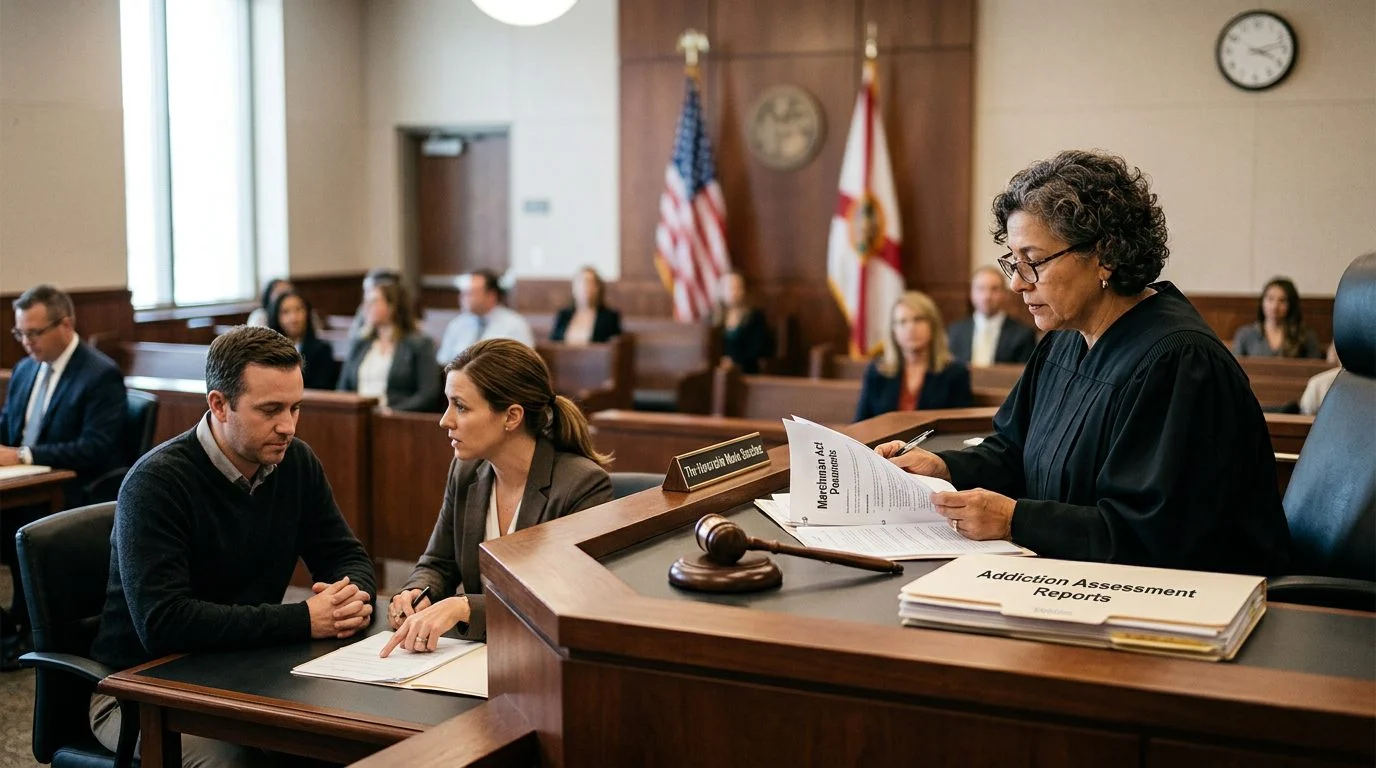
The Marchman Act covers two court stages: a short assessment and, if the criteria are proved, court-ordered treatment.
Assessment. In an emergency, a judge can rely on the petition alone and enter an ex parte order for assessment and stabilization. A provider may not hold your child longer than 72 hours of observation, except in situations the statute lists (Fla. Stat. § 397.6818).
Treatment. If the conditions are proved by clear and convincing evidence, the court may order treatment for no more than 90 days (Fla. Stat. § 397.697).
It must also give the facts behind your belief that your child is impaired, has lost self-control, and either has inflicted or is likely to inflict physical harm on himself, herself, or others, or has refused care because judgment is impaired (Fla. Stat. § 397.68141).
Who may file. For an adult, the respondent’s spouse or legal guardian, any relative, a service provider, or an adult who has direct personal knowledge of the respondent’s substance abuse impairment and his or her prior course of assessment and treatment may file (Fla. Stat. § 397.68112). That includes a parent.
How the Process Works, Step by Step
A Marchman Act case usually moves through five steps, from your first call to the period after the court rules.
- First consultation. You describe your child’s history, and the firm reviews whether a petition fits the facts.
- Records. Gather discharge summaries, hospital and EMS reports, and a dated list of incidents. A qualified professional’s exam from the 30 days before filing can be attached. If your child was never assessed or refused, the petition must say so.
- Filing. File with the clerk in the county where your child is physically located at filing. The clerk may not charge a filing fee (Fla. Stat. § 397.681).
- Hearing. The court must set a hearing within 10 court working days, unless a continuance is granted (Fla. Stat. § 397.68151).
- After the order. A treatment order lasts up to 90 days. The person is discharged at the end unless a renewal motion is filed (Fla. Stat. § 397.6977). Florida’s aftercare framework covers continuing recovery after treatment.
Building the Evidence Record Your Petition Needs
A petition works best when it lists dated, specific facts that show impairment and harm. General worry, however sincere, is not enough on its own.
- Medical and crisis records. Include discharge summaries from detox or rehab, emergency department and hospital records, and overdose reversal or EMS reports.
- Arrest records. If your child was booked or arrested, include those records.
- A dated incident log. Write down what happened, when, who saw it, and what help was tried.
- Witnesses. Treatment providers, physicians, and family members who saw the impairment firsthand can testify.
A refusal of services alone is not enough. The statute says mere refusal is not evidence of lack of judgment about the need for care (Fla. Stat. § 397.675). So your log should show more than “they said no.” Record the overdoses, the unsafe choices, and the harm that followed.
Keep originals. Don’t edit or delete texts, emails, or voicemails. Save copies in a dated folder, and write what you saw, not what you feared.
Guardianship and Related Options When a Marchman Act Petition Is Not Enough
Guardianship is a separate court track under Chapter 744 for adults a court finds incapacitated. The firm handles emergency temporary, plenary, limited, and mental health guardianship, along with involuntary commitment for addiction.
Emergency temporary guardianship. A court may appoint this before a guardian is named, but only after an incapacity petition is filed. The judge must find imminent danger that the person’s health or safety will be seriously impaired, or that property is in danger, unless immediate action is taken (Fla. Stat. § 744.3031).
Notice and counsel. The court must appoint counsel for the alleged incapacitated person. Notice must be served at least 24 hours before the hearing, unless the petitioner shows substantial harm would result.
Time limits. Emergency temporary authority ends 90 days after appointment or when a guardian is appointed, whichever comes first. It can be extended for another 90 days if emergency conditions still exist.
Other tracks. Limited, plenary, and mental health guardianships give the guardian different amounts of authority. The court sets the powers in each case.
Overlap. Involuntary treatment for addiction and guardianship can both come up in the same family crisis. Which tool fits depends on the facts.
Why Families Work With Robinson Casey
Robinson Casey is a Florida law firm that limits its practice to Marchman Act petitions and guardianship matters. It serves families across South Florida, including Miami-Dade County, and statewide.
- Responsible lawyer. Richard J. Casey III, Esq. is the responsible lawyer for this page.
- Focus. Every matter the firm takes falls within these two areas, so this guide reflects the work the firm does.
- Support staff. Our team’s assistants and office staff help families organize records, track court dates, and keep communication clear during a fast-moving case.
- Fee. The first consultation is free, confidential, and carries no obligation to continue.
- Limits. Every case turns on its own facts, and no lawyer can promise how a court will rule.
Not sure what your next step is?
Talk it through with our team — the first consultation is free, confidential, and carries no obligation.

Frequently Asked Questions About Marchman Act Petitions for Repeat Relapse
Parents often ask the same few questions before they decide what to do next.
Can a parent file without a lawyer?
A parent can file as a relative of an adult child. The respondent has the right to counsel at every stage of the case, but may waive it if present and the court finds the waiver is knowing, intelligent, and voluntary (Fla. Stat. § 397.681).
Will my child go to jail?
The court’s orders focus on assessment and treatment, but under Fla. Stat. § 397.6818, law enforcement may take a person into custody for assessment.
Will my child be locked up indefinitely?
At the conclusion of the 90-day period of court-ordered involuntary services, the respondent is automatically discharged unless a motion for renewal of the involuntary services order has been filed with the court (Fla. Stat. § 397.6977).
Can I get in trouble for filing?
A petition needs facts that give a good faith reason to believe the criteria are met.
What if my child refuses or leaves before the hearing?
Unless a circuit’s chief judge authorizes disinterested private process servers, the clerk must electronically submit the summons to law enforcement within 6 hours after it is issued (Fla. Stat. § 397.68151). The court can also order an officer to take the person into custody for evaluation (Fla. Stat. § 397.6818).
You’re looking into this in the middle of a crisis you didn’t choose, and you want to protect someone you love. If you’d like to talk through your situation, call (561) 849-4149 or schedule a consultation.
How Robinson Casey Supports Families
A Focused Practice
Our practice focuses on Marchman Act petitions and guardianship matters, so the questions you bring are handled by a team that works in these areas every day.
Confidential Conversations
Your first consultation is free and confidential. We listen to your family's situation and explain the options before you decide on any next step.
Clear Guidance on the Process
We explain the petition process, the court's role, and what to expect at each stage so you understand what is happening with your loved one's case.
Responsive Support
Our staff and attorneys are available to answer your calls and help you plan, especially when a family is facing a crisis.
Don't Wait Until the Next Crisis
Repeated relapses can put your loved one and your family at serious risk. Speaking with a Marchman Act attorney early gives you time to understand your options before another emergency arises.
Matters Robinson Casey Handles
Marchman Act Petitions
Guidance on filing a petition for involuntary assessment, stabilization, and treatment for substance use.
Involuntary Commitment for Addiction
Representation for families seeking court-ordered treatment for a loved one who repeatedly relapses.
Guardianship Matters
Guardianship attorney services, including emergency temporary, plenary, limited, and mental health guardianship.
Emergency Temporary Guardianship
Help with urgent guardianship requests when a person needs immediate court protection.