
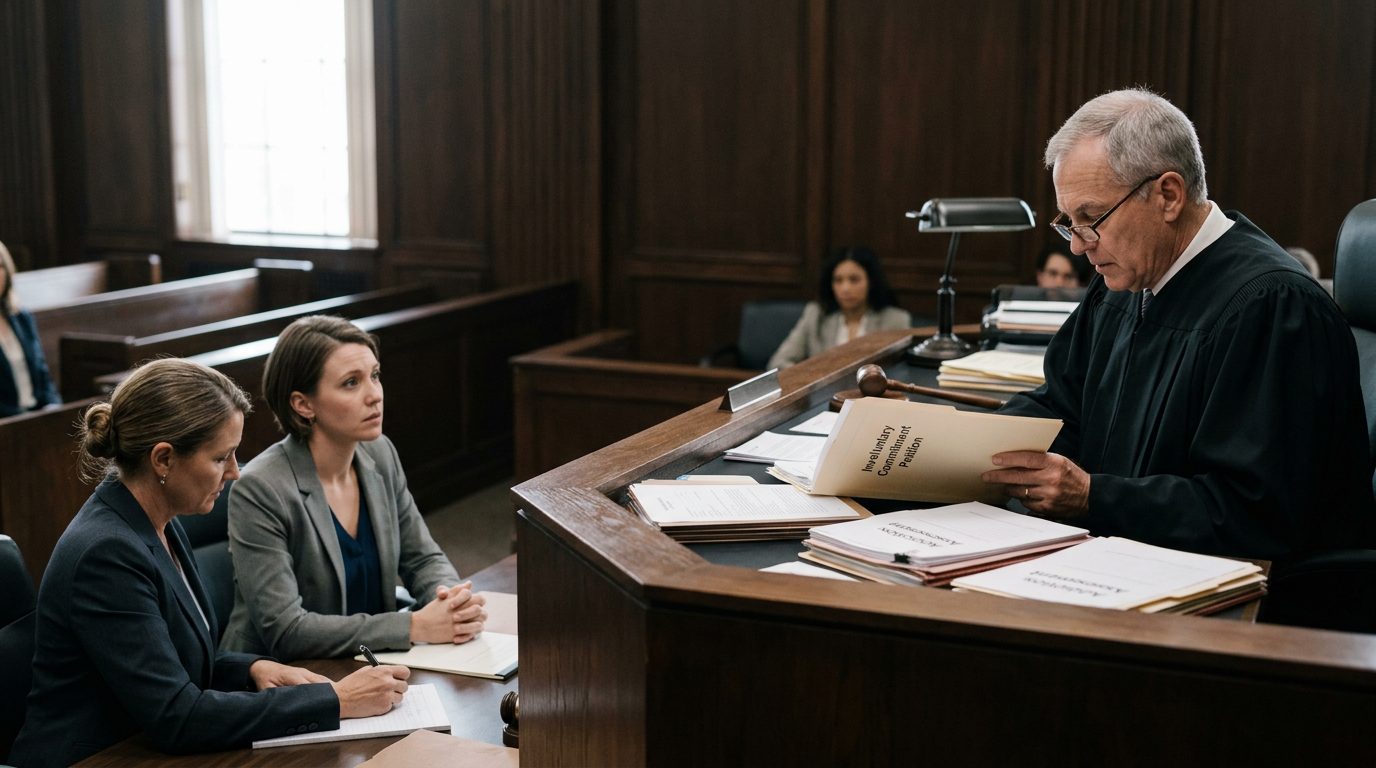
Involuntary Commitment for Addiction
Legal Help When Addiction Requires Court-Ordered Treatment
Robinson & Casey guides families through involuntary commitment proceedings in Florida. When voluntary treatment is refused and addiction poses imminent danger, we handle the petition process and court representation.
By Richard J. Casey III, Esq. · Published October 03, 2026
Involuntary Commitment for Addiction in Florida: Legal Guidance & Court Representation
Involuntary commitment for addiction is a legal process that allows family members, healthcare providers, or law enforcement to petition a Florida court to require someone struggling with substance use disorder to enter treatment—even when the person does not consent.
Not sure what your next step is?
Talk it through with our team — the first consultation is free, confidential, and carries no obligation.

What Is Involuntary Commitment for Addiction in Florida?
Involuntary commitment is a court-ordered intervention that removes the decision to seek treatment from the individual and places it in the hands of the judiciary. Unlike voluntary admission to a treatment facility, involuntary commitment requires a legal petition, a hearing before a judge, and proof that specific grounds exist.
In Florida, involuntary commitment for addiction is governed by the Marchman Act. The statute allows petitioners to ask a court to order someone into treatment when:
- The person poses imminent danger to themselves or others due to substance use
- The person cannot meet basic needs (food, shelter, hygiene) because of active addiction
- The person has refused voluntary treatment after being informed of the option
Who can file: Immediate family members, healthcare providers, law enforcement, the Department of Children and Family Services, or other authorized parties may petition the court.
Connection to guardianship: Involuntary commitment is distinct from guardianship, though families sometimes pursue both. The court sets the length of a commitment order, and the order is generally aimed at immediate treatment access. Guardianship (if needed) addresses broader decision-making authority and may be pursued separately.
Who Is Involuntary Commitment For?
Involuntary commitment is appropriate when voluntary treatment has failed, been refused, or is unsafe. Common situations include:
- Active crisis: The person is engaging in dangerous behavior—driving under the influence, violence, self-harm—or is in immediate medical danger due to overdose risk or severe withdrawal.
- Repeated treatment refusal: The person has been offered treatment multiple times and refuses, and their condition is worsening.
- Homelessness or inability to self-care: Active addiction has left the person unable to secure food, shelter, or medical care, and they lack insight into their condition.
- Family intervention exhausted: Loved ones have tried conversations, interventions, treatment offers, and other approaches without success.
- Danger to others: The person’s addiction is affecting their judgment in ways that endanger family members, coworkers, or the public.
Involuntary commitment is not a punishment. It is a legal tool designed to interrupt active addiction and connect the person to evidence-based treatment when they are unwilling or unable to seek help themselves.
What Does the Involuntary Commitment Process Cover?
When you work with Robinson & Casey on an involuntary commitment case, the firm handles:
- Petition preparation: Drafting the formal legal document that outlines the grounds for commitment, the person’s addiction history, and evidence of danger or inability to self-care.
- Emergency ex parte relief: If immediate danger exists, the petitioner may ask the court for a temporary hold, which the court may issue without the respondent present, allowing intervention before a full hearing.
- Evidence gathering: Collecting medical records, prior treatment attempts, documentation of dangerous behavior, witness statements, and other materials to present to the judge.
- Court representation: Advocating for the petition at the hearing, examining witnesses, and presenting evidence to establish grounds for commitment.
- Respondent’s rights protection: Ensuring the person has notice of the hearing and the opportunity to be represented by counsel and contest the petition (a core requirement of due process).
- Treatment facility coordination: Assisting in identifying appropriate licensed treatment facilities and coordinating admission once the court issues an order.
- Post-commitment modifications: Handling any requests to extend, modify, or terminate the commitment order based on changed circumstances.
How the Involuntary Commitment Process Works: Step-by-Step
Step 1: Initial Consultation
You meet with an attorney to describe the situation. Share the person’s addiction history, any dangerous incidents, prior treatment attempts, and why you believe involuntary commitment is necessary. The attorney explains whether involuntary commitment is appropriate, what legal grounds exist, and what evidence will be needed. This conversation is confidential and helps the attorney assess your case.
Step 2: Petition Preparation
The attorney drafts the formal petition to the circuit court. The petition details the grounds for commitment—imminent danger to self or others, inability to care for oneself, or refusal of voluntary treatment—and provides factual support for each claim. The petition must be precise and persuasive; vague or unsupported allegations will not satisfy the court.
Step 3: Emergency Filing (If Applicable)
If immediate danger exists—active overdose risk, violent behavior, or medical crisis—the attorney may file for emergency ex parte relief. This allows the court, at its discretion, to consider a temporary hold without the respondent’s presence at an initial hearing. The court sets the length of a temporary order and may schedule a full hearing at a later date.
Step 4: Service of Process
The respondent is formally notified of the petition and hearing date. Notice must be given before the hearing, and the timing depends on the court’s discretion and the circumstances of the case. The respondent has the right to know what is being alleged and when the hearing will occur.
Step 5: Evidence Gathering
The attorney collects supporting documentation: medical records, prior treatment attempts, police reports, witness statements, documentation of dangerous behavior, and any other evidence showing grounds for commitment. This evidence is critical. A judge will not order involuntary commitment without clear proof.
Step 6: Court Hearing
You and the attorney appear before a circuit court judge. The attorney presents evidence and may call witnesses (family members, healthcare providers, or others with direct knowledge). The respondent has the right to be present, to have an attorney, and to contest the petition. The judge hears both sides and decides whether grounds for commitment exist under the Marchman Act.
Step 7: Court Order
If the judge finds grounds, an involuntary commitment order is issued. The court may direct the person to be admitted to a licensed treatment facility, with the length of the commitment set by the court within the governing statute. An order of this kind is enforceable, and failure to comply may lead to enforcement steps, which can include law enforcement involvement, as the court directs.
Step 8: Treatment Placement
The attorney assists in identifying and coordinating admission to an appropriate treatment facility. The facility provides assessment, detoxification if needed, and evidence-based addiction treatment.
Step 9: Ongoing Legal Support
The attorney monitors the commitment. If the treatment facility believes additional time is needed, the attorney can assist with extension proceedings. If circumstances change or the person’s condition improves, modifications to the order can be requested.
What You Need to Know About Florida’s Involuntary Commitment Law
Statutory basis: Florida Statute § 397.675 (the Marchman Act) governs involuntary commitment for substance use disorder. The statute sets out who can petition, what grounds must be proven, and what procedural protections apply.
Grounds for commitment: A court may order involuntary commitment if the person:
- Poses imminent danger to themselves or others due to substance use
- Is unable to meet basic needs due to active addiction
- Has refused voluntary treatment after being advised of the option
Who can petition: Immediate family members, healthcare providers, law enforcement, the Department of Children and Family Services, and other authorized parties may file. Immediate family members often have standing and may find the process more straightforward.
Court jurisdiction: The petition is filed in the circuit court of the county where the person resides or is found. If the person is in another state, Florida courts may have limited jurisdiction; an attorney can advise on options.
Respondent’s rights: The person has the right to legal representation, to be notified of the petition and hearing, to be present at the hearing, and to contest the petition. The court cannot order commitment without a hearing and proof of grounds.
Timeline: Emergency ex parte orders may be issued by the court at its discretion if immediate danger exists. Emergency ex parte orders may be issued by the court at its discretion, and the timing of a full hearing depends on the court’s schedule and the circumstances of the case. The timing of a full hearing and of the overall process depends on the court’s schedule and discretion and on the circumstances of each case. The time from petition to court order depends on the court’s schedule and discretion and on the circumstances of the case.
Treatment requirement: If the court orders commitment, the person must be admitted to a licensed treatment facility within a specified timeframe. The facility provides medical detoxification, assessment, and evidence-based addiction treatment.
Not sure what your next step is?
Talk it through with our team — the first consultation is free, confidential, and carries no obligation.
Why Families Choose Robinson & Casey for Involuntary Commitment Cases
Practice focus: Robinson & Casey handles involuntary commitment for addiction and related guardianship matters.
Step-by-step guidance: The firm explains the entire process—from initial consultation through court hearing to treatment placement—so you understand what to expect and why each step matters.
Family-centered approach: The firm recognizes that involuntary commitment is often a last resort, made after years of worry and failed interventions. The attorneys work to guide families through a difficult decision with clarity and compassion.
Treatment coordination: Beyond the legal petition, the firm assists in identifying appropriate treatment facilities and coordinating admission. This removes an additional burden from families during a stressful time.
Clear communication: The firm provides clear explanations of next steps.
Common Questions About Involuntary Commitment for Addiction
Q: Can I force someone into rehab without their consent?
Involuntary commitment through the court process may be possible, but whether an order is issued is up to the court. Voluntary admission is always preferable if the person is willing, but involuntary commitment is available when voluntary treatment is refused or unsafe.
Q: What happens after the 60-day commitment order expires?
The treatment facility evaluates the person’s progress. If they are responding to treatment and no longer meet commitment criteria, they may be discharged or transitioned to outpatient care. If additional treatment is needed and grounds for commitment still exist, the commitment can be extended by court order.
Q: Does the person have the right to refuse treatment once committed?
Once committed by court order, the person is legally required to participate in treatment. However, they retain certain rights, including the right to legal representation and the right to petition the court for modification or termination of the order.
Q: How long does the involuntary commitment process take?
Emergency ex parte orders may be issued by the court at its discretion, and the timing of a full hearing depends on the court’s schedule and the circumstances of the case. The timing of a full hearing and of the overall process depends on the court’s schedule and discretion and on the circumstances of each case. The time from petition to court order depends on the court’s schedule and discretion and on the circumstances of the case.
Q: What evidence do I need to file for involuntary commitment?
Medical records, prior treatment attempts, documentation of dangerous behavior, witness statements, and a clear description of how the addiction is affecting the person’s ability to care for themselves or poses a danger. The more specific and detailed the evidence, the stronger your case.
Q: Can I file for involuntary commitment if I’m not a family member?
Yes. Healthcare providers, law enforcement, and other authorized parties can petition. However, immediate family members often have standing and may find the process more straightforward with legal guidance.
Q: What if the person is homeless or in another state?
The petition is filed in the county where the person is found or resides. If the person is in another state, Florida courts may have limited jurisdiction; an attorney can advise on alternatives and options.
Q: Does involuntary commitment for addiction actually work?
According to NIDA research, addiction is a chronic brain disorder, and involuntary commitment can remove individuals from active addiction environments and provide access to evidence-based treatment. Success depends on the individual’s willingness to engage in treatment, the quality of the facility, and ongoing support after discharge. The court’s role is to order treatment; recovery outcomes depend on many factors including the person’s motivation, family support, and post-discharge planning.

What to Expect When You Call Robinson & Casey
Initial conversation: Describe your situation, the person’s addiction history, any immediate safety concerns, and what has already been tried.
Legal assessment: The attorney explains whether involuntary commitment is appropriate, what grounds exist under the Marchman Act, and what the process will involve.
Timeline and costs: You receive a clear explanation of the expected timeline (typically 1–2 weeks from petition to court order) and fee structure.
Next steps: If you decide to proceed, the attorney begins gathering information, preparing the petition, and coordinating with the court.
Ongoing support: The firm keeps you informed throughout the process and represents you at the court hearing.
If a loved one’s addiction has progressed beyond voluntary treatment and you’re considering involuntary commitment, families in your situation reach out to Robinson & Casey regularly. Call (561) 849-4149 to speak with an attorney about your options and take the next step toward getting your loved one the help they need.
Involuntary Commitment Is a Legal Process
A court must find legal grounds—imminent danger to self or others, inability to care for oneself, or refusal of voluntary treatment—before ordering involuntary commitment. Voluntary admission is always preferable when the person is willing. Our role is to present the facts and legal basis to the court.
The Involuntary Commitment Process
Petition & Filing
We prepare and file the involuntary commitment petition with the court, documenting the grounds and circumstances that support the need for court-ordered treatment.
Court Representation
Robinson & Casey represents you at hearings, presenting evidence and legal arguments to the judge regarding the necessity and basis for involuntary commitment.
Coordination with Treatment
Once a court order is issued, we help coordinate with treatment facilities and ensure compliance with the court's directive and the individual's rights.
Family Guidance
We explain each step of the process, answer your questions, and help your family understand what to expect throughout the involuntary commitment proceedings.
Why Choose Robinson & Casey
Focus on Addiction & Mental Health Law
We focus exclusively on Marchman Act petitions, guardianship matters, and involuntary commitment for addiction. This narrow focus means we know Florida's laws and court procedures inside out.
Serving South Florida & Statewide
Based in South Florida, we serve families across Miami-Dade, Broward, Palm Beach, and throughout Florida in involuntary commitment cases.
Clear Communication with Families
We explain the legal process in plain language, answer your questions, and keep you informed every step of the way.
Experienced in Court Filings & Hearings
Our familiarity with Florida courts and involuntary commitment statutes means your petition is prepared correctly and presented effectively.