
Marchman Act & Guardianship | Miami-Dade and South Florida
Marchman Act Help When Your Family Needs It Most
Robinson Casey focuses on Marchman Act petitions and guardianship matters for families across South Florida and statewide. Start with a free, confidential first consultation with Richard J. Casey III, Esq.
By Richard J. Casey III, Esq. · Published October 28, 2026
If a loved one’s drinking or drug use has become dangerous, Florida’s Marchman Act may let a court order assessment and treatment. This guide starts with the first safety steps, then explains the process in plain terms. It is general information, not legal advice for your situation.
When a Marchman Act Situation Hits After Hours
A Marchman Act situation usually starts when a family member can’t keep a loved one safe at night or on a weekend. Substance use may be causing harm to the person or threats to someone else. The offices that normally help may be closed, and the next step may not be clear.
The Marchman Act is a Florida law in Chapter 397 of the Florida Statutes. The Florida Department of Children and Families says it allows voluntary admission and involuntary assessment, stabilization, and treatment for adults and youth severely impaired by substance abuse.
This page is for spouses, adult children, relatives, and guardians who are weighing whether a petition is the right step. Robinson Casey focuses exclusively on Marchman Act petitions and guardianship matters for families across South Florida, including Miami-Dade County, and statewide.
If your family is deciding tonight whether a Marchman Act petition is the next step, you don't have to work through it alone. Call (561) 849-4149 or request a free first consultation. Talk it through with our team — the first consultation is free, confidential, and carries no obligation.

Immediate Safety Steps for the First Hours
Safety comes before paperwork. Call 911 right away if there is an immediate threat of harm, overdose, or violence.
- Keep your loved one from driving. Secure car keys, firearms, and medications where it’s safe to do so.
- Write a timeline. Note dates, times, what was said or done, substances involved if known, and who saw it.
- Gather basics: full legal name, date of birth, address, known doctors or prescriptions, and any past treatment or court history.
- Save texts, voicemails, and photos that show the pattern.
- Avoid promises you can’t keep, and don’t confront your loved one physically.
Your timeline matters later. Clear notes make those facts easier to share.
What the Marchman Act Covers
The Marchman Act is a court process for adults whose substance use has impaired their judgment or safety. That impairment must have caused them to lose the power of self-control with respect to substance abuse.
The statute also requires a second showing. The person must need services but be unable to see that need. Or, without care or treatment, they are likely to suffer from neglect or refuse to care for themselves, a real and present threat of substantial harm to their well-being, and it must not be apparent that such harm may be avoided through the help of willing, able, and responsible family members or friends or the provision of other services. Or there must be a substantial likelihood that they have inflicted, threatened, or attempted to inflict, or, unless admitted, are likely to inflict, physical harm on themselves or another.
Refusing services alone is not evidence of lack of judgment. A petition needs more than a refusal to show the criteria are met.
Florida law also allows voluntary admission. Involuntary commitment for addiction is the court route. It applies when the person does not agree to treatment.
Who Can File a Marchman Act Petition in Florida
For an adult, a petition may be filed by a spouse or legal guardian, any relative, a service provider, or an adult with direct personal knowledge of the impairment and prior treatment.
Location matters. Under Fla. Stat. § 397.681, the petition goes to the clerk of the court in the county where the person is located. The clerk may not charge a filing fee for it.
In J.P. v. J.N., a petition filed in the wrong county was treated as a venue problem.
A petition may include a report from a qualified professional who examined the person within 30 days before filing. Such petitions must be filed with the clerk of the court in the county where the person is located; Fla. Stat. § 397.681 contains no requirement that the petition state whether an assessment occurred.
How the Marchman Act Process Typically Moves
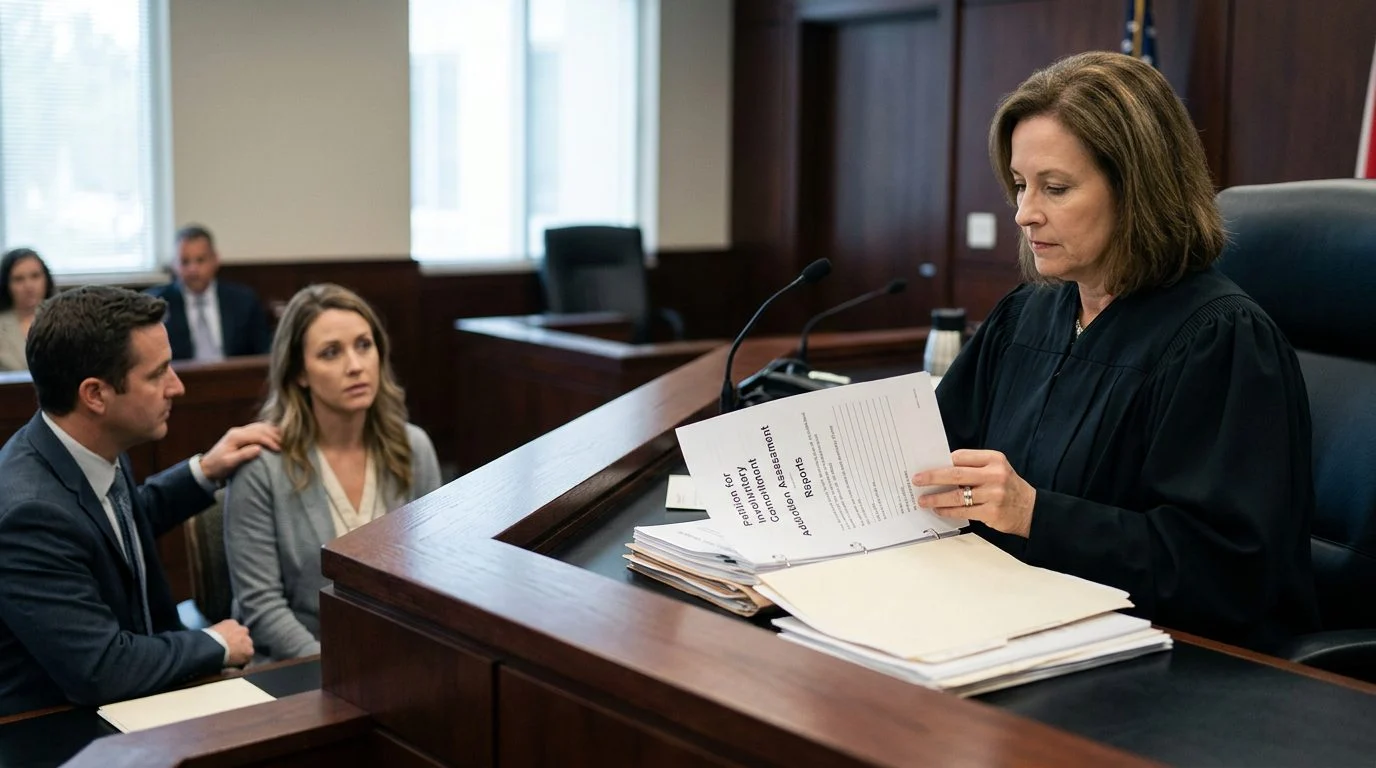
The process moves in stages: filing, possible emergency orders, assessment, a hearing, and then treatment with set time limits. Some stages have statutory deadlines. Court calendars set the rest.
- Filing. The court decides whether the person has a lawyer or should get one. Under Fla. Stat. § 397.68151, the hearing is set within 10 court working days unless it is continued. Under Fla. Stat. § 397.68151(2), the court shall schedule a hearing to be held on the petition within 10 court working days unless a continuance is granted.
- Under Fla. Stat. § 397.6818, a provider generally may not hold the person for more than 72 hours of observation, subject to listed exceptions.
- Assessment and hearing. Section 397.6818 does not address sworn testimony or a respondent’s right to refuse to testify; for an emergency ex parte order, the court may rely solely on the contents of the petition.
- Treatment order. If the conditions are proved by clear and convincing evidence, the court may order up to 90 days of treatment, under Fla. Stat. § 397.697.
- Renewal or early release. When a service provider believes the person still meets the criteria as the release date nears, a petition for renewal must be filed with the court before the expiration of the court-ordered services period, by the service provider or by the person who filed the initial petition with supporting documentation from the service provider, under Fla. Stat. § 397.6975. It can add up to 90 more days, under Fla. Stat. § 397.6975. Early discharge is possible under Fla. Stat. § 397.6971. For more, read what happens when a court order ends.
A person who can’t afford a lawyer may get court-appointed counsel, under Fla. Stat. § 397.681. Florida law gives a respondent the right to counsel at every stage of a judicial proceeding on a petition for involuntary treatment for substance abuse impairment (Fla. Stat. § 397.681(2)).
In J.C. v. State, the Fifth District reversed where the trial court questioned the only witness after the petitioner was absent.
Why Robinson Casey Focuses on This Work
Robinson Casey focuses exclusively on Marchman Act petitions and guardianship matters. That narrow focus is the firm’s core practice.
- Richard J. Casey III, Esq. is the responsible lawyer for this page. Our lawyers and staff can answer questions about these matters.
- Related guardianship matters include emergency temporary guardianship, plenary guardianship, limited guardianship, and mental health guardianship.
- This guide uses the current statute text, including the 2024 and 2025 amendments.
- Some matters call for another lawyer or firm. If that applies to your case, the firm will tell you.
- The first consultation is free, confidential, and carries no obligation to continue.
Not sure what your next step is?
Talk it through with our team — the first consultation is free, confidential, and carries no obligation.

Common Questions About After-Hours Marchman Act Help
What should I do tonight if my loved one is in danger?
Call 911 first. Then focus on safety before any paperwork.
Can I file a petition myself?
Florida law lists who may file, including relatives and adults with direct knowledge of the impairment. A consultation can show whether you qualify and what the petition must include.
How long can court-ordered treatment last?
An order can last up to 90 days. A renewal can add up to another 90 days.
If you’re deciding right now whether a petition makes sense for your family, reach out. Call (561) 849-4149 or use our contact page to set up a time to talk.
Why Families Contact Robinson Casey
A Focused Practice
Our practice focuses on Marchman Act petitions, guardianship, and involuntary commitment for addiction, so we concentrate on the matters that families bring to us.
Confidential First Consultation
Your free first consultation is confidential and carries no obligation to continue.
Speak With Our Office
Call (561) 849-4149 to talk with our team about your family's situation.
Clear Guidance on the Process
We explain what a petition involves and how the Florida court process works, step by step.
Compassionate Counsel
We understand that a Marchman Act or guardianship matter is stressful for the whole family, and we treat it that way.
If Someone Is in Immediate Danger, Call 911
Ensure everyone's safety first. Once the situation is safe, contact our office to learn about the legal options available to your family.
Matters We Handle
Marchman Act Petitions
Guidance and representation for families seeking help for a loved one struggling with substance use under the Florida Marchman Act.
Guardianship
Support for plenary and limited guardianship petitions, so families can plan for a loved one who needs help making decisions.
Emergency Temporary Guardianship
Assistance with urgent petitions when a loved one needs protection and decisions cannot wait.
Mental Health Guardianship & Involuntary Commitment for Addiction
Representation in mental health guardianship and involuntary commitment matters for addiction, from first call through the court process.