
Marchman Act Petitions | Miami-Dade and South Florida
Helping Parents Take the Next Step for an Adult Child
Robinson Casey focuses on Marchman Act petitions and guardianship matters for families across South Florida and statewide. Your free first consultation is confidential and carries no obligation to continue.
By Richard J. Casey III, Esq. · Published October 27, 2026
Watching an adult child struggle with drugs or alcohol while they refuse help is hard. You may be asking whether a parent can file a Marchman Act for an adult child in Florida. Here is a plain-language guide to the answer and the steps that follow.
Short Answer: Can a Parent File a Marchman Act Petition for an Adult Child in Florida?
Yes. A parent can file a Marchman Act petition for an adult child when substance use impairment is the problem, even if the child refuses voluntary treatment. Florida law lets any relative file for an adult, and a parent is a relative. § 397.68112
A petition asks a court to order an assessment and, if the legal criteria are met, treatment. Filing starts a court process. It does not decide the outcome.
Not sure what your next step is?
Talk it through with our team — the first consultation is free, confidential, and carries no obligation.

What the Marchman Act Covers and Who It Is Designed For
Families usually reach this law after a pattern. Common examples include use that keeps getting worse, a firm refusal of care, and harm or risk of harm that the family watches build. The law addresses these situations, but each case turns on its own facts.
The adult does not have to ask for help before a petition is filed. That is why many families look at this law. This page covers an adult child only, because the law has separate rules for minors.
Robinson Casey focuses on Marchman Act petitions and guardianship matters. The firm serves families across South Florida and statewide, including Miami-Dade County.
Who Can Initiate a Marchman Act Petition for an Adult?
Under Florida law, a parent can petition for an adult child because a parent is a relative. For an adult, the statute names these possible petitioners: the adult’s spouse or legal guardian, any relative, a service provider, or an adult with direct personal knowledge of the substance abuse impairment and the adult’s prior assessment and treatment. § 397.68112
Siblings, aunts, uncles, and cousins fit in the “any relative” group too. For a closer look at siblings, read can a sibling file a Marchman Act.
Under § 397.68112, if the adult is the respondent, a petition may be filed by the adult’s spouse or legal guardian, any relative, a service provider, or an adult with direct personal knowledge of the impairment. § 397.68141 State your relationship plainly. Explain how you know each fact you report.
The Criteria the Court Must Find Before It Orders Treatment
The court needs a good faith reason to believe the adult meets the criteria. The adult must be substance abuse impaired, or have a substance use disorder with a co-occurring mental health disorder. Because of that, the adult must have lost the power of self-control about substance use. § 397.675
The factual allegations must demonstrate the reason for the petitioner’s belief that the respondent is substance abuse impaired, under Fla. Stat. § 397.68141. Second, the petition must give the reason the petitioner believes the adult has inflicted or is likely to inflict physical harm on themselves or others unless the court orders the involuntary services, or the reason the petitioner believes the adult’s refusal to voluntarily receive care is based on judgment so impaired by reason of substance abuse that the adult is incapable of appreciating the need for care and of making a rational decision regarding that need. [Fla. Stat. § 397.68141] Or the adult has harmed, threatened, or is likely to harm themselves or someone else. § 397.675
Here is the point many parents miss. The statute says a mere refusal to receive services is not, by itself, evidence of lack of judgment. Fla. Stat. § 397.675 reads: “(b) Without care or treatment, is likely to suffer from neglect or refuse to care for himself or herself; that such neglect or refusal poses a real and present threat of substantial harm to his or her well-being; and that it is not apparent that such harm may be avoided through the help of willing, able, and responsible family members or friends or the provision of other services, or there is substantial likelihood that the person has inflicted, or threatened to or attempted to inflict, or, unless admitted, is likely to inflict, physical harm on himself, herself, or another.” So the petition needs facts about what the adult did and what harm has happened or is likely. If the claim is neglect, the petition also needs facts showing that it is not apparent the harm may be avoided through the help of willing, able, and responsible family members or friends or other services.
Gathering Evidence of Drug Use Before Filing
Write down what you saw, with dates, to build the facts a petition needs. Record what happened, what was said, who was present, and what came next.
Useful records include incidents where the adult was hurt or put others at risk. Police or emergency room contacts belong on the list, along with job or housing losses tied to use. Note any treatment the adult accepted or refused. Keep copies of messages that show the adult’s words and condition.
A common mistake is describing character instead of behavior. “He’s selfish” tells the court very little. “He missed three shifts and drove after drinking” gives the court specific facts to weigh.
The petition may include a report from a qualified professional who examined the adult within 30 days before filing. § 397.68141
For what a relative’s lawyer usually reviews before filing, see Marchman Act attorney for relatives in Florida.
Filing the Petition and the Initial Court Review
File the petition with the clerk of the court in the county where the adult is located. The clerk may not charge a fee for filing. § 397.681
Location matters. The county where a petition is filed matters. Section 397.681(1), Florida Statutes, requires that petitions be “filed with the clerk of the court in the county where the person is located.” See J.P. v. J.N. for the Putnam County venue discussion. J.P. v. J.N.
After filing, the court must decide whether the adult has a lawyer or should get one appointed. § 397.68151
Court forms and local steps can differ by county. Ask the clerk’s office in the county where your child is located about current procedure.
Not sure what your next step is?
Talk it through with our team — the first consultation is free, confidential, and carries no obligation.
Protective Custody, Assessment, and the Court Hearing
After a petition is filed, the court can order an emergency assessment, and a hearing follows. Law enforcement may also get involved first. An officer may take an adult into protective custody when the adult appears to meet the involuntary admission criteria. That applies when the adult is brought to the officer’s attention or is in a public place. § 397.677
§ 397.6818 A service provider generally may not hold the adult for more than 72 hours of observation, subject to listed exceptions.
§ 397.6957 The court hears relevant evidence, including family members who know the adult’s history.
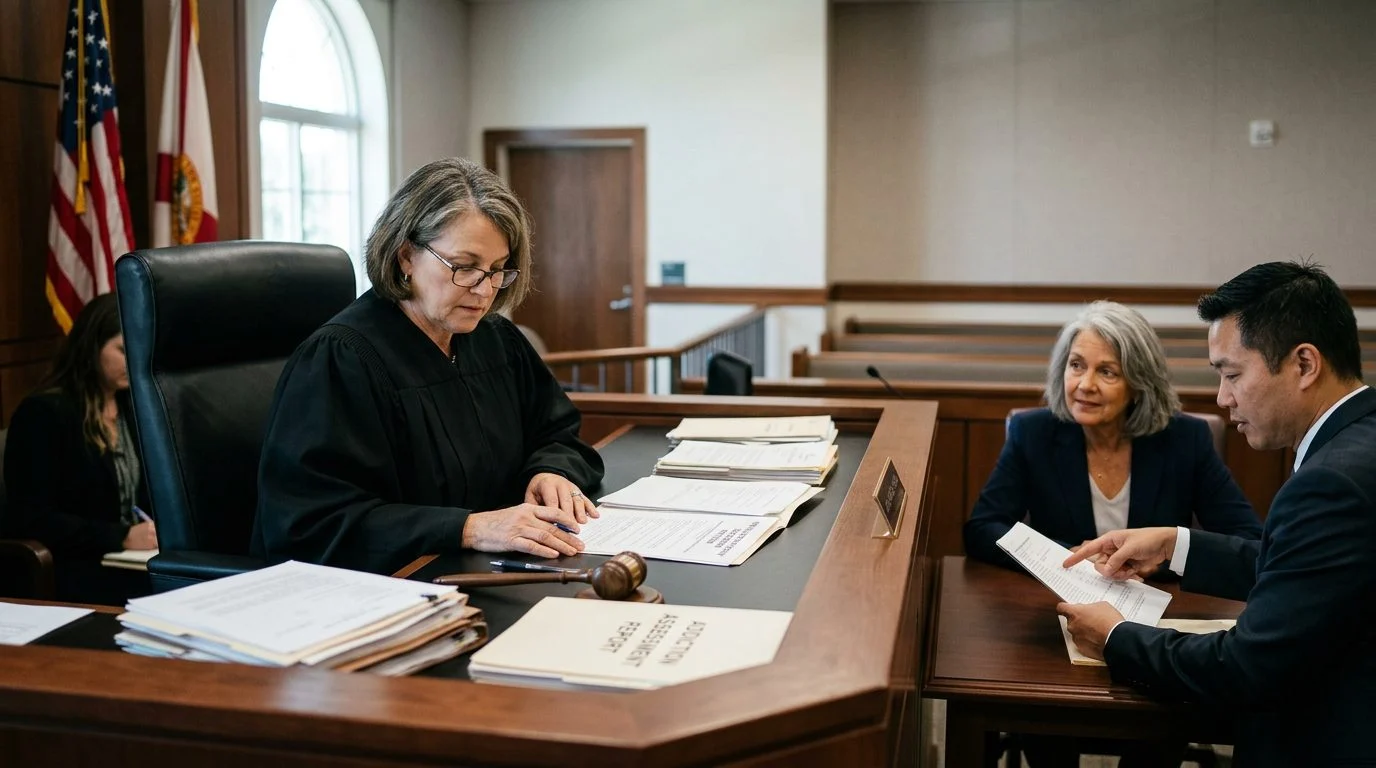
Under § 397.6957, the respondent must be present at a hearing on a petition for involuntary treatment services unless the court finds a knowing, intelligent, and voluntary waiver or that presence is inconsistent with the respondent’s best interests or likely to be injurious. The right to counsel at every stage is stated in § 397.681. Under Fla. Stat. § 397.681(2), a respondent has the right to counsel at every stage of a judicial proceeding relating to a petition for involuntary treatment for substance abuse impairment, and if the court believes the respondent needs or desires the assistance of counsel, the court shall appoint such counsel without regard to the respondent’s wishes. Hillsborough County v. Albrechta Expect a structured hearing that follows the court’s schedule, not a television courtroom scene.
Marchman Act vs. Baker Act: Understanding the Difference
The Marchman Act covers substance use impairment, while the Baker Act covers mental health conditions. Families often hear both names, and the difference matters when choosing a route.
Some adults have both problems. The Marchman Act criteria recognize a substance use disorder paired with a co-occurring mental health disorder. § 397.675 Describe both conditions accurately, with the dates and behaviors you saw.
Which law fits depends on the facts. The main condition, and what the adult has actually done, shape that choice.
Related Situations: Out-of-State Relatives and Next Questions
J.P. v. J.N. A parent living out of state can still be the petitioner for a Florida adult.
Plan for distance. § 397.6957
The Department of Children and Families also explains who may start an adult’s involuntary admission and how protective custody works in its respondent rights guide.

Talking Through Your Family’s Situation
You may be worried, tired, and unsure what comes next. You may also be gathering facts for a spouse, sibling, or other family member. That is a heavy job to carry alone.
Can a parent file a Marchman Act for an adult child in Florida?
Yes. A parent is a relative, and Florida law lets any relative file for an adult. § 397.68112
Does it cost money to file?
The clerk may not charge a fee for filing the petition. § 397.681
Does my child have to agree?
The petition does not need your child’s agreement. Refusing care alone is not enough, and the court looks at the full set of facts. § 397.675
Does my child get a lawyer?
Yes. The adult has the right to counsel at every stage, which the adult may waive only if present and the court finds the waiver is knowing, intelligent, and voluntary. If the court believes the adult needs or desires counsel, the court must appoint one, regardless of the adult’s wishes. § 397.681
Richard J. Casey III, Esq. is the responsible lawyer for this page. If your adult child keeps refusing help and substance use is putting them at risk, call Robinson Casey at (561) 849-4149 or request a consultation. The first consultation is free, confidential, and carries no obligation to continue.
How Robinson Casey Supports Families
Clear Answers to Hard Questions
We explain the Marchman Act process in plain language so you know what to expect before you decide on a next step.
Confidential Conversations
Your first consultation is private. Share what is happening with your family in a safe, judgment-free setting.
Focused Petition Support
Our practice concentrates on Marchman Act petitions and related guardianship matters, so your case is handled by a team that works in this area every day.
Support for the Whole Family
We understand that addiction and mental health crises affect every member of the household, and we keep the family's needs in view.
Do Not Wait Until a Crisis Escalates
Families often delay seeking legal guidance because they hope the situation will improve on its own. Speaking with an attorney early helps you understand your options before an emergency forces a fast decision.
Common Questions Families Bring to Us
Marchman Act Petitions
We help parents, relatives and other eligible family members understand how a petition for involuntary assessment or treatment may apply to an adult child.
Guardianship Matters
From emergency temporary guardianship to plenary and limited guardianship, we explain the differences and how each may fit your family's situation.
Mental Health Guardianship
We assist families seeking court oversight when an adult relative's mental health affects their ability to make safe decisions.
Involuntary Commitment for Addiction
We walk families through the court process for involuntary treatment when substance use puts a loved one or others at risk.