
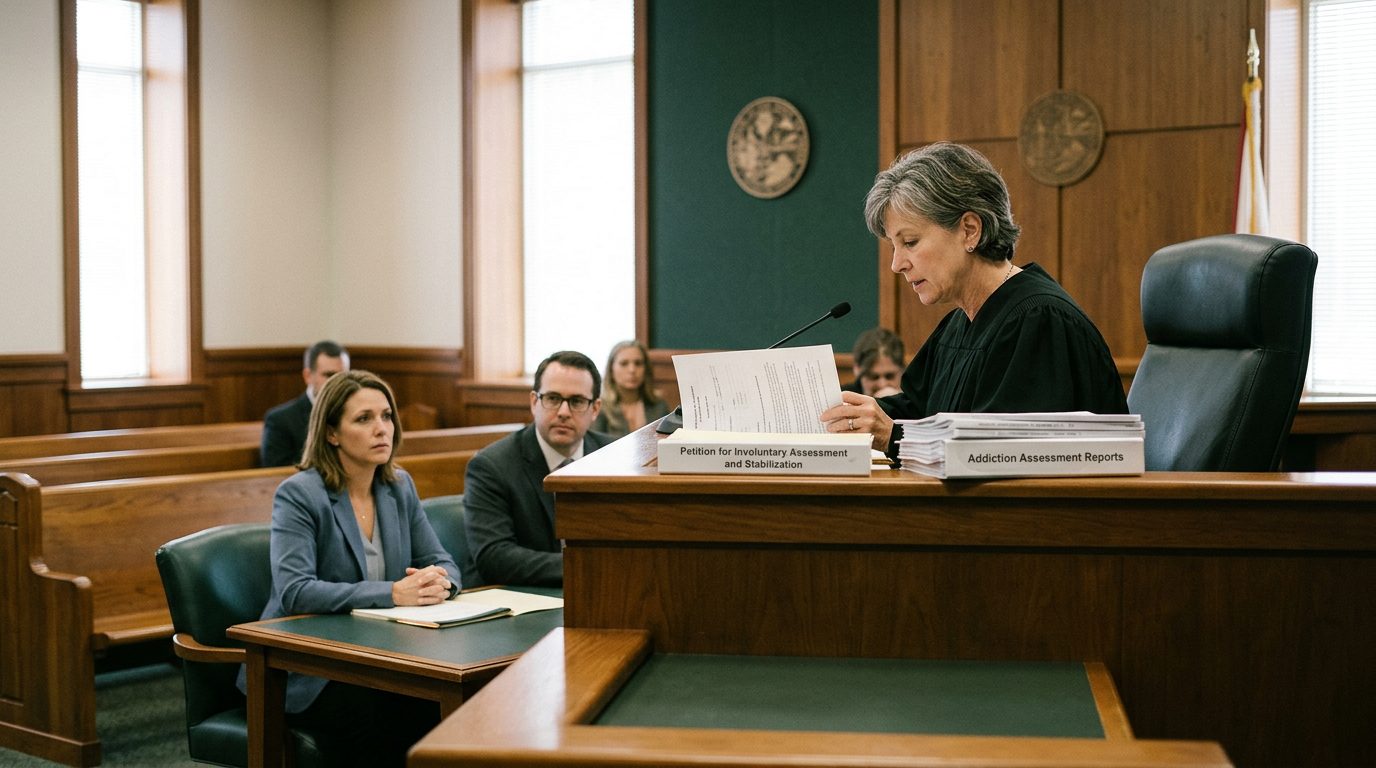
Marchman Act Guide
Can Family Force Detox in Florida? Understanding the Marchman Act
Robinson Casey focuses exclusively on Marchman Act petitions and guardianship matters. Learn how Florida's law works and what a court may decide.
By Richard J. Casey III, Esq. · Published October 16, 2026
Can a family force detox in Florida? In some cases, a court can order it. But a family cannot make that decision alone. A relative can file a petition under Florida’s Marchman Act, and the judge decides what happens next. It is general information, not advice about your situation.
The Short Answer: Can a Family Force Detox in Florida?
A family can start the process, but a judge makes the final call. Florida’s Marchman Act lets a court order involuntary assessment and, when the statute’s criteria are met, involuntary treatment for an adult with a substance use problem. The criteria appear in Fla. Stat. § 397.675.
The family’s job is to file the petition and present the facts. The court then reviews the petition and decides whether to enter an order. Think of the petition as a request. The court is the one that answers it. For the broader picture, read our involuntary commitment for addiction guide.
If you are worried about a loved one's drug or alcohol use, you do not have to work through the Marchman Act process alone. Our office can talk with you about your situation. Talk it through with our team — the first consultation is free, confidential, and carries no obligation.

About the Florida Marchman Act
The Marchman Act is a Florida law that addresses involuntary assessment and treatment for substance use. The Legislature describes substance abuse impairment as “a disease which affects the whole family and the whole society.” Fla. Stat. § 397.305 That finding helps explain why the statute gives families a role.
The same section says services should be delivered “in the most appropriate and least restrictive environment.” It also says the chapter protects “the rights of individuals.” That balance runs through the rest of the process.
Involuntary treatment is different from a voluntary admission. The involuntary track runs through a court. The person named in the petition receives a copy of the petition and a notice of the hearing.
For Spanish-language information on this topic, read our guide on forcing an adult into treatment in Florida.
Who Can File a Petition and What the Court Considers
For an adult, the statute names who may file. A petition may come from the respondent’s spouse or legal guardian, any relative, a service provider, or an adult with direct personal knowledge of the impairment and prior treatment. Other requirements may apply.
The petition must include facts. Fla. Stat. § 397.68141 lists the names of the respondent and petitioner, their relationship, and the reasons the petitioner believes the person needs services. Those reasons include a belief that the person has lost power of self-control with respect to substance abuse.
The statute also says that “mere refusal to receive such services does not constitute evidence of lack of judgment.” A refusal alone does not settle the question. The court decides whether the evidence meets the criteria. Under Fla. Stat. § 397.681, the petition is filed with the clerk in the county where the person is located.
Emergency Admission and the Role of Law Enforcement
Under Florida’s emergency provision for involuntary assessment, when the petitioner asserts that emergency circumstances exist, or when upon review of the petition the court determines that an emergency exists, the court may rely solely on the contents of the petition. When emergency circumstances are asserted, the court “may rely solely on the contents of the petition.” It may then enter an ex parte order for assessment and stabilization without appointing an attorney.
The same section lets the court order a law enforcement officer or designated agent to take the person into custody for evaluation. It also says a service provider may not hold the person for more than 72 hours of observation, unless a listed exception applies. One exception is a court-granted extension after a hearing.
A separate provision covers emergency admission to a facility. A person who meets the criteria may be admitted for emergency assessment upon a qualifying professional’s certificate and an application for emergency admission. Timing in any case depends on the court’s schedule and discretion.
What Happens After a Petition Is Filed
After filing, the court schedules a hearing and decides whether to order treatment. The statute says the court “shall schedule a hearing” within 10 court working days, unless a continuance is granted. Scheduling still depends on the court’s calendar and discretion.
The respondent must be present at the hearing unless the court makes the findings the statute lists. The court hears relevant evidence, including testimony from family members familiar with the person’s history. Testimony is under oath, and the respondent may refuse to testify.
If the court finds the conditions proved by clear and convincing evidence, it “may order” treatment for a period “not to exceed 90 days.” The court keeps jurisdiction for later orders. The Florida Department of Children and Families describes state-regulated substance-use services, including detoxification.
Common Questions and Objections Families Raise
Can the person push back? Yes, in several ways. The respondent has a right to counsel at every stage. The respondent may waive that right only if the court finds the waiver knowing, intelligent, and voluntary. Fla. Stat. § 397.6957 In cases where an assessment was attached to the petition, the respondent may request, or the court on its own motion may order, an independent assessment by a court-appointed or otherwise agreed-upon qualified professional. The respondent shall be informed by the court of the right to an independent assessment.
The petitioner bears the burden of proof.
Not sure what your next step is?
Talk it through with our team — the first consultation is free, confidential, and carries no obligation.
Treatment Records and Privacy During the Process
Petitions, court orders, and related records are confidential under Florida law. Fla. Stat. § 397.6760 makes them confidential and exempt from public records disclosure. The clerk may release them on request to listed people, such as the petitioner, the respondent, and the respondent’s attorney. A court may also order disclosure for good cause.
Treatment records from federally assisted programs follow a separate federal rule. Federal law on substance use disorder records provides that records of the identity, diagnosis, prognosis, or treatment of any patient, maintained in connection with a substance use disorder program that is conducted, regulated, or directly or indirectly assisted by a federal department or agency, are confidential. Except as the statute otherwise provides, they may be disclosed only for the purposes and under the circumstances it expressly authorizes, such as with the patient’s prior written consent. The exceptions are a qualifying court order or the patient’s consent. The court decides how these rules apply to a given case.

Talk With Robinson Casey About Your Family’s Situation
If you are reading this for a family member, you may be carrying a heavy load right now. A loved one’s substance use can put them and others at risk, and the next step is hard to choose. You do not have to make that choice without information.
Richard J. Casey III, Esq. is the lawyer responsible for this page. Robinson Casey is a Florida law firm that limits its practice to Marchman Act petitions and guardianship matters. Call (561) 849-4149 or use our contact page to ask about your situation. The first consultation is free, confidential, and carries no obligation to continue (Spanish: “consulta inicial gratuita, confidencial y sin compromiso”).
How Robinson Casey Can Help
Focused Practice
Robinson Casey focuses exclusively on Marchman Act petitions and guardianship matters, and has done so as its core practice.
The Court Decides
Under Florida's Marchman Act, a judge reviews the evidence and the statute's criteria. Outcomes depend on the court's discretion and the facts of each case.
Free First Consultation
Your first consultation is free, confidential, and carries no obligation to continue.
Guardianship Matters Too
The practice also handles guardianship matters, including emergency temporary, plenary, limited, and mental health guardianship.
Important: General Information Only
This guide is general information, not legal advice about your situation. A Marchman Act petition is a court filing, and the judge decides what happens next. Other requirements may also apply.
Matters We Handle
Marchman Act Petitions
Assistance with petitions for involuntary assessment and treatment for substance use under Florida's Marchman Act.
Guardianship Matters
Guidance on plenary and limited guardianship, and on the court process for each.
Emergency Temporary Guardianship
Help understanding emergency temporary guardianship, where the court may consider urgent protection on a temporary basis.
Mental Health and Addiction Cases
Representation in mental health guardianship and involuntary commitment for addiction matters, with the court deciding based on the statute and the evidence.