
Florida Law Guide | Miami-Dade & South Florida
Helping Families Navigate the Marchman Act and Florida Guardianship
Robinson Casey focuses on Marchman Act petitions and guardianship matters for families across South Florida and statewide. Start with a free, confidential first consultation with no obligation to continue.
By Richard J. Casey III, Esq. · Published October 31, 2026
When Your Adult Child’s Addiction Has Reached a Crisis Point
“We’ve paid for treatment. We’ve tried interventions. We’ve held the boundaries, and still our child keeps getting worse.” Many parents reach that point after an overdose, a hospital stay, an arrest, or a disappearance. Florida law can let a court order an adult into assessment and treatment for substance abuse when specific legal criteria are met.
This page answers that question. The current involuntary admission rules appear in Fla. Stat. § 397.675 and the sections around it, so this page works from that text.
This page explains those criteria, the court steps, and the limits of the process in plain English. No lawyer or page can promise how a case will end. Use this information to understand your options and decide your next step.
Not sure what your next step is?
Talk it through with our team — the first consultation is free, confidential, and carries no obligation.

What Florida’s Involuntary Admission Law Covers
Florida’s Marchman Act is the state framework for substance abuse impairment.
Voluntary and involuntary admission work differently. A person who wants help can apply to a provider. Under Fla. Stat. § 397.601, a provider must admit a person, within its financial and space capabilities, when there is sufficient evidence of substance abuse impairment and the provider can safely manage that person’s conditions.
Involuntary admission is different. A judge decides, based on evidence, whether the legal criteria are met. The person’s own request is not what triggers the court’s power.
The Criteria a Florida Court Looks At
Involuntary admission for substance abuse requires that the person meet the criteria set out in Florida law. First, there must be a good-faith reason to believe the person is substance abuse impaired, or has a substance use disorder with a co-occurring mental health disorder. Second, because of that condition, the person has lost the power of self-control about substance use, and either is in need of substance abuse services and, because of impaired judgment, cannot appreciate that need or make a rational decision about it, or, without care or treatment, is likely to neglect themselves or refuse care, which poses a real and present threat of substantial harm that cannot apparently be avoided through willing, able, and responsible family members or friends or other services; or there is substantial likelihood the person has inflicted, threatened or attempted to inflict, or, unless admitted, is likely to inflict, physical harm on themselves or another.
The statute then requires one of two further findings. Under the first, the person needs substance abuse services and impaired judgment keeps them from seeing that need or making a rational decision about it. Under the second, the person is likely to neglect their own care, and that neglect poses a real and present threat of substantial harm. Family, friends, or other services cannot avoid that harm. Or there is a substantial likelihood the person has inflicted, threatened, or attempted physical harm on themselves or someone else.
The statute also says that mere refusal to accept services does not, by itself, show lack of judgment. Refusal alone does not prove the test is met.
Facts decide this. A recent overdose, a hospital visit, or a disappearance matters when it links to loss of self-control, impaired judgment, or a real risk of harm. Each case turns on its own facts.
How the Petition and Court Process Works
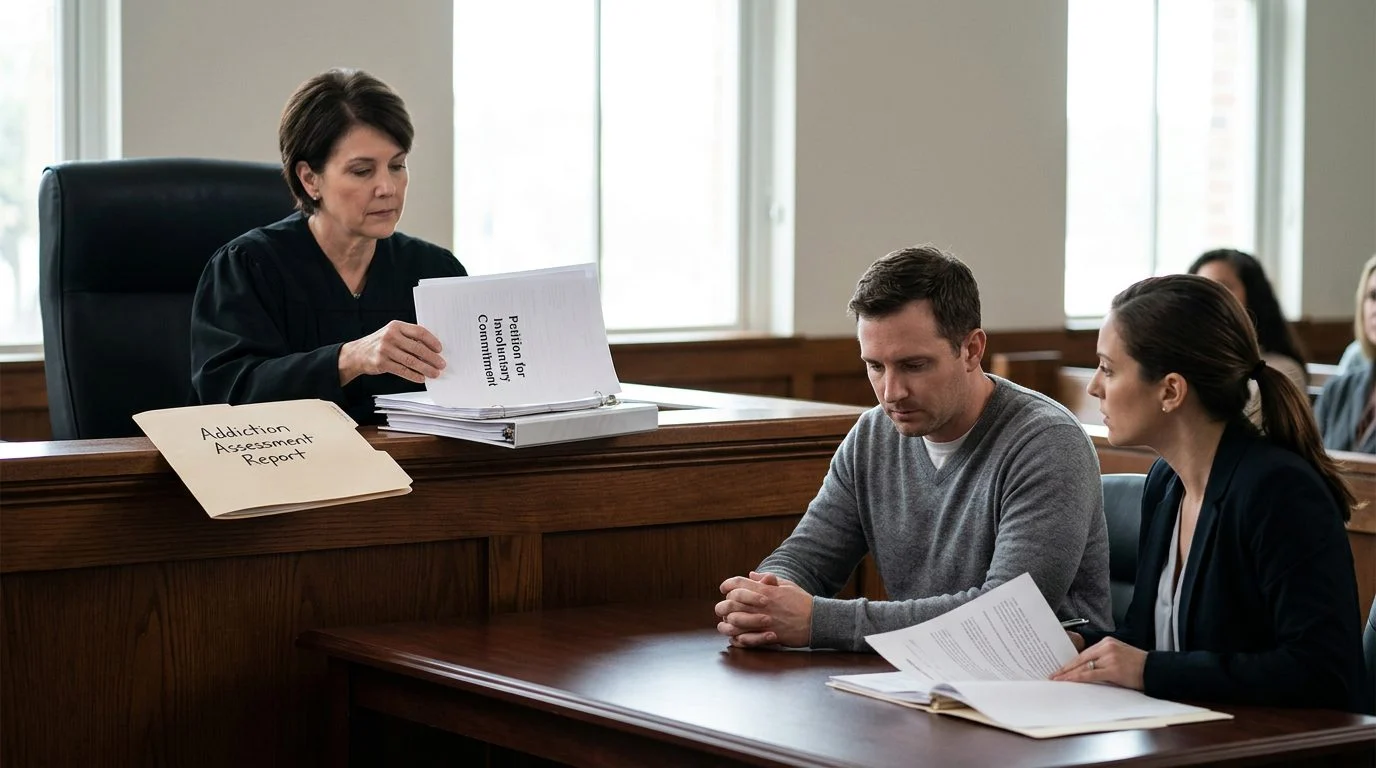
For an adult, a petition can be filed by a spouse or legal guardian, any relative, a service provider, or an adult with direct personal knowledge of the person’s impairment and prior treatment. A parent is a relative, so a parent may file.
The petition must name the person and the petitioner, and state their relationship. It must also state the facts that show why the petitioner believes the person is impaired and has lost self-control. A report from a qualified professional who examined the person within 30 days before filing may be attached. If the person was never assessed or refused an evaluation, the petition must say so. See Fla. Stat. § 397.68141.
The petition is filed with the clerk in the county where the person is located. The clerk may not charge a filing fee. The respondent has the right to counsel at every stage of a judicial proceeding on a petition for involuntary treatment for substance abuse impairment, however, the respondent may waive that right if the respondent is present and the court finds that such waiver is made knowingly, intelligently, and voluntarily, and a respondent who wants counsel and cannot afford private counsel has the right to court-appointed counsel. A Florida appeals court has held that this right to counsel in Marchman Act proceedings rests on due process (Hillsborough County v. Albrechta).
Venue matters. In J.P. v. J.N., a Florida appeals court held that filing in the wrong county is a venue defect, not a loss of the court’s power to hear the case.
The person and other listed people must receive a copy of the petition and notice (Fla. Stat. § 397.68151).
Involuntary Assessment and Stabilization Before Treatment
In an emergency, the court can act before the full hearing. The petition must describe the emergency and request an ex parte assessment and stabilization order (Fla. Stat. § 397.68141). Ex parte means the court acts on the petition alone, without a full hearing first. The court may rely on the petition’s contents and enter that order without appointing an attorney (Fla. Stat. § 397.6818).
In D.H. v. K.J.R., a Florida appeals court found the trial court erred in entering an ex parte order because the petition did not show a good-faith reason to believe the statutory criteria were met.
A provider may not hold a person for more than 72 hours of observation. There are exceptions, including an extension granted after a hearing and withdrawal or medical needs (Fla. Stat. § 397.6818).
Emergency admission to a hospital, detox facility, or addictions receiving facility requires a certificate from a listed professional that is specific to substance abuse impairment, plus a completed application (Fla. Stat. § 397.679).
Before any involuntary treatment order, the person generally must receive a clinical assessment. The respondent must be present at the hearing on the treatment petition unless the court finds that he or she knowingly, intelligently, and voluntarily waives the right to be present or, after receiving proof of service and evaluating the circumstances, that presence is inconsistent with his or her best interests or likely to be injurious to self or others (Fla. Stat. § 397.6957).
What Involuntary Treatment Involves and Its Limits
If the court finds the conditions proved by clear and convincing evidence, it can order involuntary treatment for up to 90 days (Fla. Stat. § 397.697). The treatment comes from a licensed provider. A privately funded provider can be used if the person can pay, or if someone acting for the person shows a willingness and ability to pay.
A renewal of the involuntary services order may be requested before the 90-day period ends (Fla. Stat. § 397.697). If the conditions still exist, the court may order up to an additional 90 days (Fla. Stat. § 397.6975).
The hearing is conducted pursuant to ss. 397.6957 and 397.697, under which testimony must be taken under oath and the proceedings must be recorded (Fla. Stat. § 397.6975). The hearing is conducted pursuant to ss. 397.6957 and 397.697, and the court shall hear and review all relevant evidence, including testimony from family members familiar with the respondent’s prior history (Fla. Stat. § 397.6975).
In J.C. v. State, a Fifth District appeals court reversed an order where the trial court questioned the only witness after the petitioner was absent. The Fourth District has reached a different result on a related question.
After an order, the court keeps jurisdiction to monitor compliance with treatment (Fla. Stat. § 397.697). Results after treatment starts depend on many factors, including the person’s own participation.
Not sure what your next step is?
Talk it through with our team — the first consultation is free, confidential, and carries no obligation.
Answering the Fears Parents Raise Most
Overdose or death. The emergency paths are built for immediate danger. Florida law limits how long a service provider may hold a respondent for observation: it may not hold the respondent for longer than 72 hours of observation, unless a statutory exception applies (Fla. Stat. § 397.6818).
The process runs through a court petition about treatment.
Losing hope. You do not have to keep managing this crisis alone.
Talk With Robinson Casey About Your Child’s Situation
If your child’s recent overdose, hospital discharge, or disappearance fits these criteria, a Marchman Act petition may be your next legal step. Call Robinson Casey at (561) 849-4700 or request a consultation to talk through your child’s facts.
Your first consultation is free, confidential, and carries no obligation to continue (consulta inicial gratuita, confidencial y sin compromiso).
Richard J. Casey III, Esq. is the responsible lawyer for this page. Robinson & Casey focuses on Marchman Act and guardianship matters for families in Miami-Dade, South Florida, and across Florida.

Related Guides on Involuntary Commitment for Addiction
For a broader overview, read the involuntary commitment for addiction guide.
Frequently Asked Questions
Can a parent file a petition for an adult child in Florida?
Yes. A relative may file for an adult under Fla. Stat. § 397.68112.
How long can a provider hold a person for observation?
A provider may not hold a person for more than 72 hours of observation, unless an exception applies under Fla. Stat. § 397.6818.
How long does an involuntary treatment order last?
An initial involuntary treatment services order may not exceed 90 days (§ 397.697(1)(a)). A renewal may run for no more than an additional 90 days, but only after a new petition is filed and the court makes a new finding (§ 397.6975).
Does the respondent have a right to a lawyer?
Yes. The respondent has the right to counsel at every stage under Fla. Stat. § 397.681, but the respondent may waive that right if the respondent is present and the court finds that such waiver is made knowingly, intelligently, and voluntarily.
How We Work With Families
Plain-Language Guidance
We explain each step of the process in clear terms so you know what to expect before you decide on a course of action.
Support for Families in Crisis
Our team understands how stressful these matters are and works to keep families informed through every stage.
Focused Practice Areas
Our attorneys focus on Marchman Act petitions and guardianship matters, so your case is handled within the areas we concentrate on every day.
Confidential Consultations
Your first consultation is free, confidential, and carries no obligation to continue with our firm.
Do Not Wait Until the Situation Becomes an Emergency
Questions about involuntary admission, guardianship, or a loved one's safety are easier to address early. Speaking with an attorney before a crisis escalates gives your family more time to understand the options.
Matters We Handle
Marchman Act Petitions
Guidance on filing and responding to petitions for involuntary assessment, stabilization, or treatment for substance use disorders.
Emergency Temporary Guardianship
Help with urgent requests for a court-appointed guardian when a person needs immediate protection.
Plenary and Limited Guardianship
Representation in guardianship proceedings, including comparisons of broad and narrowly tailored guardianship arrangements.
Mental Health and Involuntary Commitment
Support for families dealing with mental health guardianship and involuntary commitment for addiction.