
How Do I Help My Son Get Off Drugs? A Florida Guide
By Richard J. Casey III, Esq. · Published October 10, 2026
How do I help my son get off drugs? Start with calm, specific conversations at home, learn which treatment options exist, and know that Florida has a court process for people who refuse help. This guide explains each step in plain language. It is general information, not legal advice, and every family’s situation is different.
Start With Where You Are Right Now
Finding out your son is using drugs is frightening. Many parents feel shocked, guilty, angry, and alone, sometimes all in the same day.
You may be reading this late at night, after a call from a school, a bank, or the police. You may still wonder whether you are reading the situation right. That is a reasonable place to be.
This page covers three things. First, what you can do at home now. Second, how treatment is usually approached. Third, what Florida law provides when a loved one will not accept help.
Nothing here promises how your son will respond or how a court will rule. Outcomes depend on the person, the facts, and the court’s discretion.
Recognizing the Signs Your Son May Be Using Drugs
The most common signs are changes in daily habits, money, and friendships. No single sign proves drug use, but several together deserve attention.
Watch for:
- Big changes in sleep, appetite, or weight
- Missing money, valuables, or prescription medicine
- Secrecy about where he goes, who he sees, or his phone
- Dropping out of work, school, or family routines
- New friends, frequent requests for cash, or lies that don’t add up
- Mood swings, irritability, or long stretches of withdrawal
Some of these signs overlap with mental health conditions such as depression or anxiety. That overlap is one reason to ask for a medical evaluation. A doctor or licensed clinician can look at the whole picture.
Keep simple notes with dates, what you saw, and what was said. Notes help you think clearly when emotions run high. They also help any doctor, program, or lawyer understand what is happening.
Why Addiction Is Hard to Stop by Willpower Alone
Addiction is hard to stop by willpower alone because it is more than a bad habit. Many health professionals treat it as a medical condition, and quitting usually takes more than a promise.
Parents often ask whether addiction is a family disease. In a practical sense, families absorb the stress, the lies, the money problems, and the fear. Still, your son is the one using. Being affected does not mean you caused the problem, and it does not mean you can fix it alone.
Many parents try arguments, ultimatums, or rescuing their son from every bill and crisis. These efforts come from love. They often leave the family exhausted without ending the drug use. When that happens, many parents feel they have failed. Often they have simply tried tools that were never designed to work alone.
Setting limits and getting professional help is different from giving up. You can stay connected to your son and still stop covering for the consequences of his use.
How to Talk With Your Son Without Making Things Worse
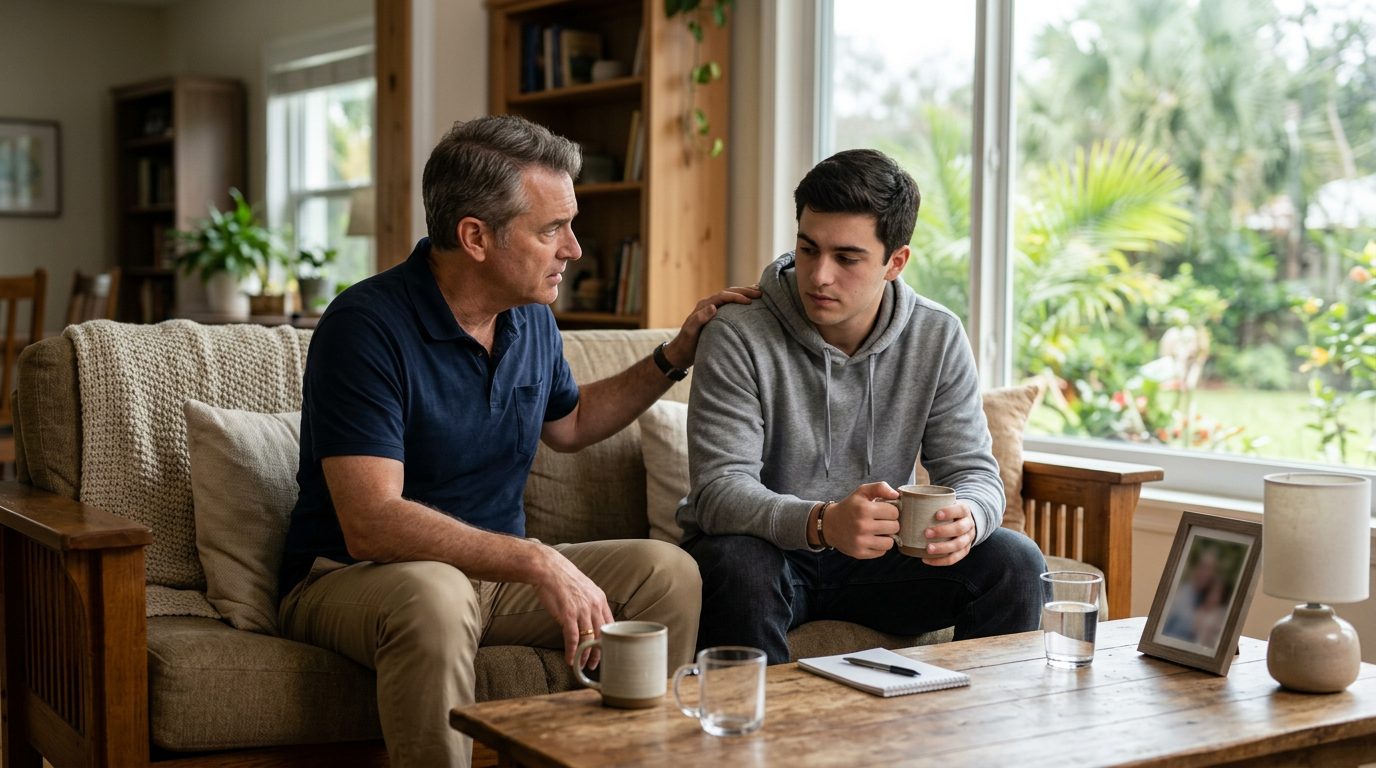
Talk with your son when he is sober and calm, not in the middle of a fight. Short, specific, and kind works better than long lectures.
Try these steps:
- Pick a private, quiet time with no audience.
- Describe what you have seen, such as “I noticed money missing from my purse twice this month.”
- Avoid labels like “addict” or “liar,” which tend to shut the conversation down.
- Say you love him and want help, then offer one specific next step, such as an assessment.
- Set one or two clear boundaries about money, housing, or access to the home.
Decide ahead of time what you will do if a boundary is crossed. Then follow through. A threat you never enforce teaches him the boundary is optional.
Avoid bargaining, covering for missed work, or lending money you suspect will go to drugs. A short first conversation is often enough. Write a few sentences beforehand so you stay on track if emotions rise.
Treatment Options and How Families Usually Begin
Treatment comes in several levels, and an assessment helps decide which level fits. Common options include medical detoxification, outpatient treatment, intensive outpatient programs, and residential treatment. Some substances also have medication-based treatment.
Many adults begin treatment voluntarily, meaning they agree to the program. Their willingness affects how any program works. No program can promise a particular result, and relapse can happen during or after treatment.
When you talk with a provider, ask:
- Is the program licensed, and what level of care does it offer?
- How will the family be involved, and with his written permission?
- What happens after discharge, including follow-up appointments and medication access?
- Does the program treat co-occurring mental health conditions?
Florida’s discharge rules for court-ordered services list follow-up appointments, medication access, living arrangements, and recovery supports. Fla. Stat. § 397.6977 sets out that planning. Ask any provider what its discharge plan looks like.
For minors only, Florida requires a parent who seeks involuntary admission to take part in treatment. That rule does not apply to an adult son.
When Your Son Refuses Help: What Florida Law Provides
Under Fla. Stat. § 397.68112, if the respondent is an adult, a petition for involuntary treatment services may be filed by the respondent’s spouse or legal guardian, any relative, a service provider, or an adult who has direct personal knowledge of the respondent’s substance abuse impairment and his or her prior course of assessment and treatment. For an adult, a petition may be filed by a spouse or legal guardian, any relative, a service provider, or an adult with direct knowledge of the impairment. A parent is a relative, so a parent may be among those who can file.
The court decides whether the criteria are met. Under Fla. Stat. § 397.675, there must be good faith reason to believe the person is impaired and has lost the power of self-control. The statute also says mere refusal of services is not, by itself, evidence of lack of judgment.
Petitions are filed with the clerk in the county where the person is located, and the clerk may not charge a filing fee. Fla. Stat. § 397.681 also gives the respondent a right to counsel. A respondent who cannot afford a private lawyer may have one appointed. The Second District held that Hillsborough County v. Albrechta rests this right on due process.
If the court finds the conditions proved by clear and convincing evidence, Fla. Stat. § 397.697 allows an order for up to 90 days. That is a maximum, not an automatic result. Hearings and orders depend on the court’s schedule and discretion.
Florida’s appellate courts have not agreed on every procedural question. In J.J.J. v. D.G., the Fourth District certified conflict with other decisions on how much a judge may question witnesses when the petitioner does not present the case. Readers should not treat any one rule as settled statewide.
Caring for Yourself and Other Family Members at Home
Caring for yourself and your household is part of helping your son. Parents, siblings, and younger children all feel the strain. Caregiver burnout is common in families dealing with addiction.
Start with routine. Regular meals, bedtimes, and a predictable schedule give everyone some stability, even when the house feels chaotic. Keep adult problems away from younger children, but do not pretend nothing is happening. Offer simple, age-appropriate explanations, such as “Your brother is sick, and grown-ups are getting him help.”
Siblings often feel ignored or blamed. Check in with them on their own. Ask how they are doing at school, with friends, and at home. Their needs deserve attention alongside your son’s.
Identify one person you can talk with honestly. That might be a friend, a relative, or a counselor. Taking care of yourself does not mean you care less about your son. It helps you keep going.

Talking With Robinson Casey About Your Options
If your son refuses help, a conversation with Robinson Casey can help you understand what options may apply. Robinson & Casey is a Florida law firm that limits its practice to Marchman Act petitions and guardianship matters. It serves families in South Florida, including Miami-Dade, and across the state. Any matter may be referred to another lawyer or firm.
Frequently Asked Questions
Can a parent file a Marchman Act petition for an adult son? Under Florida law, a relative of an adult may file a petition, so a parent may be able to. Whether a petition is filed and granted is up to the family and the court.
Do I need a lawyer for a Marchman Act case? The respondent has a right to counsel. A lawyer can explain how the process works for your facts.
How long can a court order last? Under Fla. Stat. § 397.697, an order for services may last up to 90 days. Any renewal depends on a new court finding.
Asking how do I help my son get off drugs is hard, and you don’t have to answer it alone. If you are still deciding, call (561) 849-4149 or request a consultation.