
Marchman Act Attorney | South Florida and Statewide
Marchman Act Help for Families Filing From Out of State
Robinson Casey focuses on Marchman Act petitions and guardianship matters, helping families who live outside Florida take the first steps in the state. Schedule a free, confidential first consultation.
By Richard J. Casey III, Esq. · Published October 27, 2026
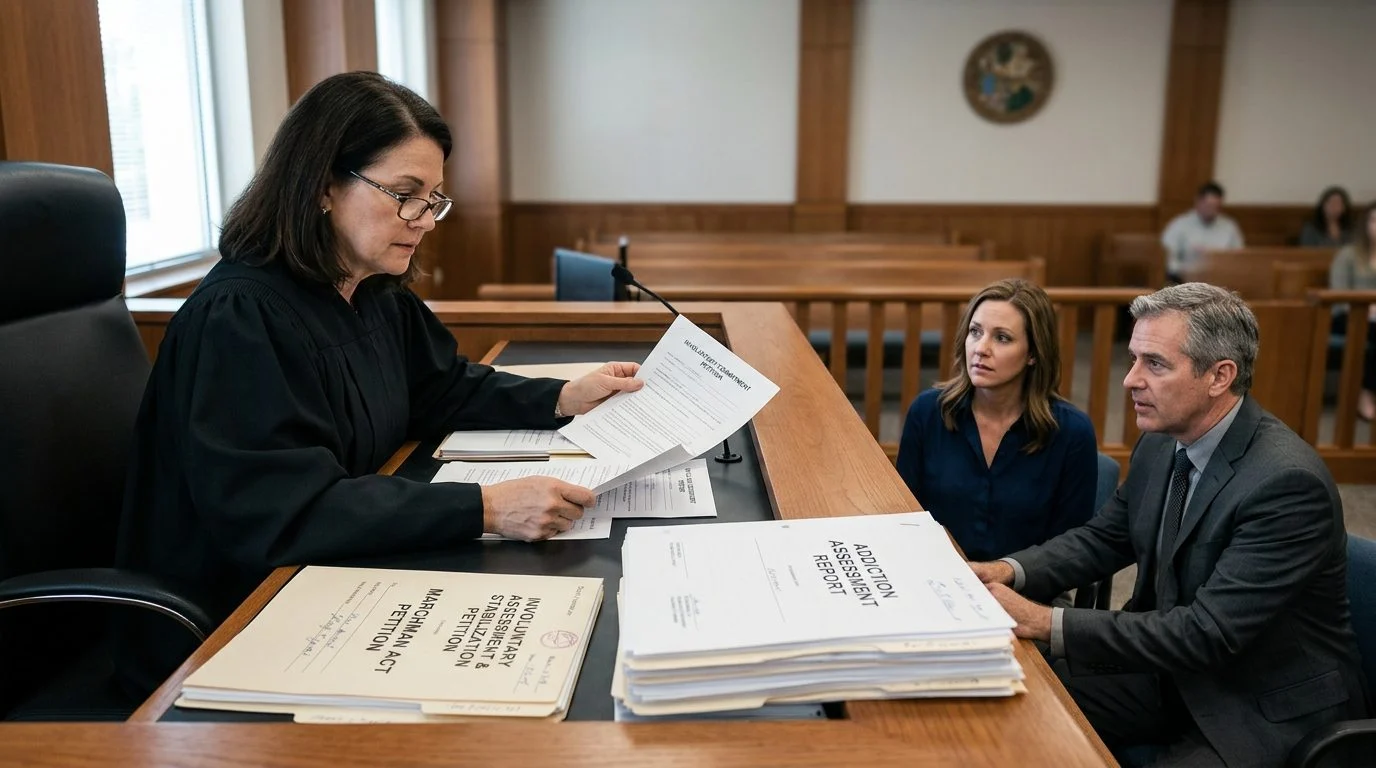
If your loved one is in Florida and you live somewhere else, you may still be able to start a case. To file Marchman Act from out of state Florida, the petition goes to the clerk of the court in the county where your loved one is located. This page explains who can file, where the case goes, the steps and deadlines, and what happens after a court order.
What Is Florida’s Marchman Act and Who Can Use It?
The Marchman Act is a Florida court process for getting an adult with a substance use problem assessed and, when the law allows, treated. It can apply even when that person refuses help.
For an adult, the law lets a spouse or legal guardian, any relative, a service provider, or an adult who has direct personal knowledge of the respondent’s substance abuse impairment and his or her prior course of assessment and treatment file a petition. § 397.68112
A court can order involuntary treatment only if the criteria are met.
Families usually reach this point when a loved one refuses care while substance use puts them or others at risk.
If your loved one is in Florida and you are working from another state, you do not have to sort out the court steps alone. Our team can talk with you about your situation. Talk it through with our team — the first consultation is free, confidential, and carries no obligation.

Can You File a Marchman Act Petition From Out of State?
Yes. Your own address does not decide where the petition goes. The county where your loved one is physically located does.
§ 397.681 says the petition must be filed with the clerk of the court in the county where the person is located. The clerk may not charge a fee to file it. The impaired person is named as the respondent.
Location errors matter. In J.P. v. J.N., a petition was filed in the wrong county. The court held that the filing did not take away the circuit court’s jurisdiction. However, the filing of the petition in the wrong county did not divest the circuit court in Putnam County of jurisdiction. (J.P. v. J.N.)
The respondent has a right to counsel at every stage of a judicial proceeding on the petition, but the respondent may waive that right if the respondent is present and the court finds that such waiver is made knowingly, intelligently, and voluntarily. § 397.681 If the respondent wants a lawyer and cannot afford one, the court appoints counsel. The clerk then notifies the office of criminal conflict and civil regional counsel. § 397.68151
You do not have to sit in the courtroom. Witnesses may attend remotely and testify under oath by audio-video technology. They must give the parties their documents by the close of business the day before the hearing. § 397.6957
Out-of-state filers usually take these steps:
- Confirm the Florida county where your loved one is physically located.
- Write down recent behavior, any harm or threats, prior treatment, and any refusal to be assessed.
- Prepare the petition for that county’s clerk of the court.
- Keep your records and contact details ready for the hearing notice.
Step-by-Step: Filing, Assessment, and Timeline
A Marchman case moves through a petition, a hearing date, an assessment, and a final hearing. Florida law sets limits at several of these steps.
- The petition. It must name the respondent and the petitioner, state their relationship, and give the facts showing a need for services. § 397.68141 It may include a professional’s report from within 30 days. If there was no assessment, the petition must say so.
- The hearing date. The court schedules a hearing within 10 court working days unless a continuance is granted. § 397.68151
- The emergency path. If an emergency exists, the court may enter an ex parte order for assessment and stabilization. It can do so based on the petition alone. § 397.6818 A provider generally may hold the respondent no longer than 72 hours of observation, with listed exceptions.
- If the respondent does not appear at the hearing and the court reasonably believes the respondent meets the commitment criteria and that a substance abuse emergency exists, the court may issue or reissue an ex parte assessment and stabilization order. That order is valid for 90 days. § 397.6957
- The respondent must be present unless the court finds that he or she knowingly, intelligently, and voluntarily waives the right to be present or, upon receiving proof of service and evaluating the circumstances of the case, that presence is inconsistent with his or her best interests or is likely to be injurious to self or others. The court hears all relevant evidence, including testimony from family members familiar with the respondent’s history. Witnesses may attend remotely and, as appropriate, testify under oath by audio-video technology, but a witness who plans to do so must give the parties all relevant documents by the close of business on the day before the hearing. Treatment can be ordered only if the conditions are proved by clear and convincing evidence. § 397.697
The petitioner carries the burden of proof. In J.C. v. State, the Fifth District reversed a case where the trial court questioned the only witness while the petitioner was absent. A Fourth District court disagreed in J.J.J. v. D.G., and the 2024 amendments may affect that dispute.
Relocating a Loved One for Treatment After an Order
A treatment order can require your loved one to receive treatment from a publicly funded licensed provider, from a privately funded licensed provider if he or she can pay, or from the provider the court specifies or the nearest appropriate one. The court controls how that placement happens.
It may order private treatment if the respondent can pay, or if someone acting for the respondent shows a willingness and ability to pay. If needed, the court may direct the sheriff to take the respondent to the provider named in the order, or to the nearest appropriate provider.
The order can be renewed. § 397.6975
Release is also set by law. § 397.6971
Court records in these cases are confidential. The clerk may release them to the petitioner, the respondent, and the respondent’s attorney, among others. § 397.6760
Bring these questions to your consultation: which provider the order names, who will pay for treatment, and how the court will be kept informed.
Can a Marchman Act Be Dropped Once It Is Filed?
The court controls how a Marchman case ends. The law sets specific outcomes that can end it.
- Dismissal for no assessment. If an ex parte order is issued and the respondent is not assessed within 90 days, the court must dismiss the case. § 397.6818
- Dismissal for a missing recommendation. If the qualified professional’s report does not include a treatment recommendation, the petition is dismissed. § 397.6957
- Early release. A person may be discharged before the period ends if the criteria no longer apply or treatment is no longer needed. § 397.6971
Many families talk with their loved one first. When that conversation fails and the risk is real, a petition may be the next step.
Why Families Work With Robinson Casey
Robinson Casey focuses on Marchman Act petitions and guardianship matters.
The practice covers Marchman Act petitions, involuntary commitment for addiction, and guardianship matters. Those include emergency temporary guardianship, plenary guardianship, limited guardianship, and mental health guardianship.
Richard J. Casey III, Esq. is the responsible lawyer for this page. Our support staff handles calls and document intake. Our team can take information from family members who are working outside Florida.
A matter may be referred to another lawyer or firm. If that happens, we will tell you.
Not sure what your next step is?
Talk it through with our team — the first consultation is free, confidential, and carries no obligation.

Frequently Asked Questions
How do you Marchman Act someone in Florida if you live out of state?
File the petition with the clerk of the court in the Florida county where your loved one is located. If your loved one is an adult, eligible filers include his or her spouse or legal guardian, any relative, a service provider, or an adult with direct personal knowledge of the impairment and prior course of assessment and treatment. If your loved one is a minor, the filer must be a parent, legal guardian, or service provider. § 397.681
Does the filer need to live in Florida?
The statute names who may file by relationship, and it requires the petition to be filed with the clerk of the court in the county where the person is located. § 397.68112
How long does it take to get a Marchman Act in Florida?
The law sets firm limits, such as a hearing within 10 court working days and a 72-hour observation limit in emergencies. The overall timing depends on the facts of each case.
Can a Marchman Act be dropped after it is filed?
The court decides how the case ends. The law requires dismissal if the respondent is not assessed within 90 days after an ex parte order.
Can a family member testify from out of state?
Yes. Witnesses may attend the hearing remotely and testify under oath by audio-video technology. The qualified professional must send the clinical assessment to the clerk no later than the ordinary close of business on the day before the hearing.
Who pays for the first consultation, and what does it cover?
The first consultation is free, confidential, and carries no obligation to continue. It is a time to explain your loved one’s situation and ask your questions.
If your loved one is in Florida and you are working from another state, you do not have to sort out the court steps alone. Contact our office or call (561) 849-4149.
How We Help Out-of-State Families
Talk With Us Directly
Call (561) 849-4149 to describe your loved one's situation and ask how the process works in Florida.
Petition Preparation
We help organize the information and paperwork needed for a Marchman Act petition filed with the clerk in the Florida county where your loved one is located.
Plain-Language Guidance
Our team explains each step in clear terms, so you know what to expect while you are far from home.
Confidential Consultations
Your free first consultation is confidential and comes with no obligation to continue.
Across South Florida and Statewide
We represent families in Miami-Dade, throughout South Florida and across Florida, wherever your loved one is located.
Time Matters in a Crisis
If a family member is in immediate danger or unable to care for themselves, do not wait. Contact our office as soon as possible so we can discuss your situation and the options available to you.
Matters We Handle
Marchman Act Petitions
Petitions for involuntary assessment and treatment of an adult with a substance use disorder, filed in Florida from anywhere.
Emergency Temporary Guardianship
Urgent guardianship requests when a person needs immediate protection and decisions cannot wait.
Plenary and Limited Guardianship
Full and partial guardianship petitions tailored to the level of support a person needs.
Mental Health Guardianship
Guardianship matters involving a loved one's mental health needs and the decisions that follow.