
Marchman Act & Guardianship | Florida
Involuntary Commitment for Addiction: A Florida Spouse's Guide to the Marchman Act
Robinson & Casey focuses exclusively on Marchman Act petitions and guardianship matters. Learn how the process works, then schedule a free, confidential first consultation with no obligation to continue.
By Richard J. Casey III, Esq. · Published October 16, 2026
A spouse can ask a Florida court for help under the Marchman Act, the state law on involuntary assessment and treatment for substance use. For an adult, the statute lets a spouse file a petition, but the court decides whether that petition qualifies and what, if anything, to order. This page offers general information about the Marchman Act and the petition process. It is general information, not legal advice for your situation.
Why a Spouse Is Asking This Question
If you are reading this, you may be watching a partner’s drinking or drug use hurt your home, your health, or your money. You may feel stuck. You may not know whether the law lets you ask a court for help, or what that request involves.
This page is general information about Florida’s Marchman Act. It does not give legal advice for any particular case, and it does not predict how a court will rule. Instead, it offers general information about these topics. Each point links to the official statute text, so you can read the wording yourself.
Think of this page as a map of the process. It shows the steps and the decision points. It does not promise where your situation will end up.
If your partner's drinking or drug use has put your family at risk, you don't have to work out the law alone; our team offers a free, confidential first consultation with no obligation to continue. Talk it through with our team — the first consultation is free, confidential, and carries no obligation.

What the Marchman Act Is (Chapter 397, Florida Statutes)
The Marchman Act is Florida’s law on involuntary assessment, stabilization, and treatment for substance use. Under this law, a person may be asked to receive services even when they do not want them.
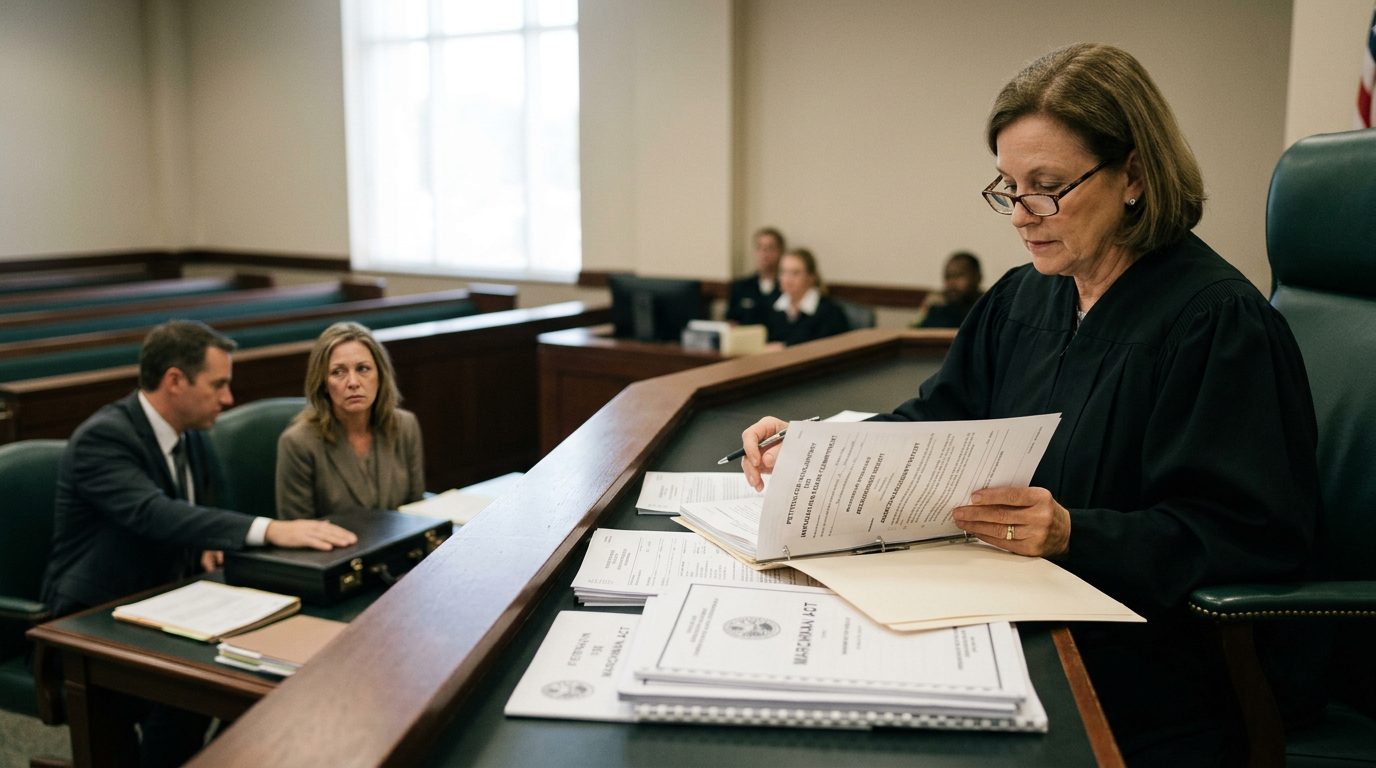
Involuntary commitment for addiction is a court process. The court is at the center of it. Under the statute, a judge decides whether to order an assessment or treatment after reviewing a petition and the evidence.
The statute also sets out who may start the process and where. Petitions go to the court. For more on how the process works, read our involuntary commitment for addiction guide.
Can a Spouse File a Petition in Florida?
Yes, the statute names a spouse as one of the people who may file. For an adult respondent, a petition may be filed by the respondent’s spouse or legal guardian, any relative, a service provider, or an adult with direct personal knowledge of the respondent’s substance abuse impairment and prior course of assessment and treatment (Fla. Stat. § 397.68112). Other requirements may apply.
So, can a wife have her husband committed to rehab? Under that section, a wife who is the respondent’s spouse may file a petition for an adult husband. Whether the petition moves forward depends on the statute’s requirements, the facts, and the court’s decision. Filing does not decide the case.
The statute also says a petition must be filed with the clerk of the court in the county where the person is located. The clerk may not charge a fee for filing it (Fla. Stat. § 397.681).
What a Spouse Can Ask the Court to Do
A petition asks the court to order involuntary services for substance abuse impairment. The statute says the petition must include the respondent’s name, the petitioner’s name, and the relationship between them. It must also list the respondent’s attorney’s name if known, and the facts that show the need for services (Fla. Stat. § 397.68141).
The petitioner must explain why they believe the respondent is impaired. They must also explain why they believe the respondent has lost the power of self-control with respect to substance abuse. The petition may include a report from a qualified professional who examined the respondent within 30 days before filing. If the respondent was not assessed, or refused, the petition must say so.
In an emergency, the petition must also describe the emergency facts. The court may rely on the petition alone and enter that order without appointing an attorney (Fla. Stat. § 397.6818).
If the court finds the conditions proved by clear and convincing evidence, it may order involuntary treatment services for a period not to exceed 90 days (Fla. Stat. § 397.697). Each of these steps is a request. The court decides whether to grant it.
The Criteria the Court Must Find
The criteria have several parts, so they are not a short checklist.
First, the court looks for a good faith reason to believe the person is substance abuse impaired, or has a substance use disorder and a co-occurring mental health disorder. Because of that impairment or disorder, the person must have lost the power of self-control with respect to substance abuse.
The statute then lists alternative grounds. One ground looks at whether the person needs services and cannot appreciate that need. Another looks at whether the person is likely to neglect their own care in a way that poses a real and present threat of substantial harm. A third looks at whether the person has inflicted, threatened, or attempted physical harm, or, unless admitted, is likely to inflict it.
The statute also says that mere refusal to receive services is not, by itself, evidence of lack of judgment about the need for services. Other requirements may apply. The court decides, based on the evidence, whether each part is met.
What Evidence a Spouse Might Bring to the Court
The court hears and reviews all relevant evidence. The statute names testimony from family members familiar with the respondent’s prior history. The court may also order drug tests.
The statute says the qualified professional’s clinical assessment must reach the clerk by the close of business on the day before the hearing. Testimony is taken under oath, and the proceedings are recorded. The respondent may refuse to testify.
Practical steps help. Write down dates, specific incidents, and what you saw or heard. Note the names of people who witnessed events. Keep facts separate from your conclusions about what they mean. Specific facts give the court more to weigh than general worries.
What evidence is needed, and how it is weighed, is for the court to decide under the statute and the circumstances of each case.
Not sure what your next step is?
Talk it through with our team — the first consultation is free, confidential, and carries no obligation.
What Happens After a Petition Is Filed
The statute says a respondent has the right to counsel at every stage of a judicial proceeding on an involuntary treatment petition. The respondent may waive that right only if present and the court finds the waiver knowing, intelligent, and voluntary (Fla. Stat. § 397.681).
On filing, the court must determine whether the respondent has an attorney, or whether appointing one is appropriate (Fla. Stat. § 397.68151). The statute says the court shall schedule a hearing within 10 court working days unless a continuance is granted. Actual timing depends on the court’s schedule and discretion.
Possible outcomes include an order for treatment for a period not to exceed 90 days. The court may also decline to order treatment, or may order another step the statute allows. The court decides based on its findings.
Questions a Spouse May Have About Their Own Position
How a petition may relate to a divorce, a separation, or shared money is a legal question. It depends on the facts and on other laws. This page does not answer it.
A spouse’s own legal interests may need a separate review with a lawyer. Those interests can differ from the respondent’s interests, and a review of your specific facts helps you see them clearly.
Safety comes first. If someone is in immediate danger, contact emergency services right away. A petition is not a substitute for emergency help.
Depending on the facts, a matter may be referred to another lawyer or firm.
Key Takeaways
- A spouse may file a petition for an adult under Fla. Stat. § 397.68112. Other requirements may apply.
- The petition must include the items listed in § 397.68141.
- The criteria in § 397.675 have several parts, and the court applies them to the evidence.
- The court reviews all relevant evidence under § 397.6957.
- Under § 397.697, an initial treatment order may be entered for a period not to exceed 90 days. The statute also provides for extensions of the services period (see Fla. Stat. § 397.6975), and the court decides whether to enter any order and for what duration, based on its discretion and the circumstances of the case.
This page is general information. The court decides each petition based on the evidence and its discretion. Richard J. Casey III, Esq., is the responsible lawyer for this page. You can read more on his Marchman Act practice page.

Talk With Robinson Casey About Your Situation
If you are trying to make sense of a partner’s addiction while also working out what the law allows, you may feel pressure without a clear plan. Robinson Casey limits its practice to Marchman Act petitions and guardianship matters. Our team offers a free, confidential first consultation with Richard J. Casey III, Esq., with no obligation to continue. Call (561) 849-4149 or schedule a consultation.
How Robinson Casey Can Help
Marchman Act Petitions
We focus on helping spouses understand and prepare petitions under Florida's Marchman Act for involuntary assessment and treatment for substance use.
Guardianship Matters
Our practice covers guardianship petitions, including emergency temporary, plenary, limited, and mental health guardianship.
Confidential First Consultation
Your first consultation is free, confidential, and carries no obligation to continue.
Supported by Our Team
Our team of assistants and office staff supports every matter, and Richard J. Casey III, Esq. is the responsible lawyer.
Important: General Information Only
This page does not provide legal advice for your situation. Under the Marchman Act, the court decides whether a petition qualifies and what, if anything, to order. Other requirements may also apply, and outcomes depend on the evidence and the court's discretion.
Common Questions Spouses Ask
What does the Marchman Act cover?
Its requirements are set out in the statute.
Who can file a petition?
The statute addresses who may file. Other requirements may apply, and the court decides whether a petition meets them.
Can I get help before deciding?
Our free, confidential first consultation gives you a chance to discuss your situation, with no obligation to continue.