
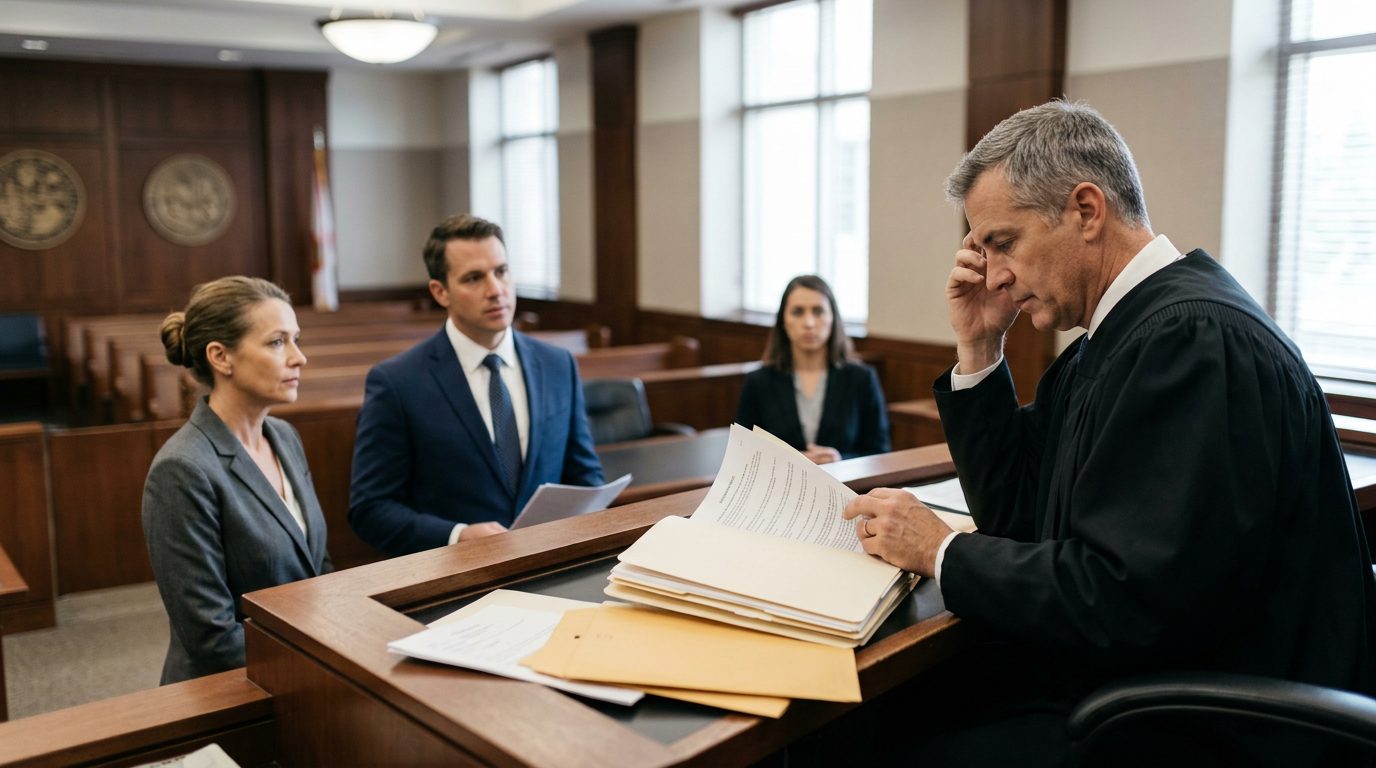
Involuntary Commitment Hearings
Legal Representation at Your Involuntary Commitment Hearing
Robinson & Casey represents individuals and families facing involuntary commitment proceedings in Florida. We protect your rights and help you navigate the hearing process.
By Richard J. Casey III, Esq. · Published September 22, 2026
Involuntary Commitment Hearing Representation for Addiction in Florida
An involuntary commitment hearing is a court proceeding. A judge decides whether someone meets legal grounds for involuntary commitment due to substance use disorder. If you or a family member faces this hearing, an attorney who understands Florida’s commitment laws is essential. Your rights and voice must be protected in court.
If you're facing an involuntary commitment hearing for addiction and want to understand your rights and options before the judge, reach out—families and individuals in your situation can contact us. Talk it through with our team — the first consultation is free, confidential, and carries no obligation.

What Is an Involuntary Commitment Hearing for Addiction?
An involuntary commitment hearing is a formal judicial review. It determines whether legal grounds for commitment exist under Florida law. The respondent, petitioner, judge, and witnesses gather in court. They present evidence and arguments.
Your attorney represents your interests. They cross-examine the petitioner’s witnesses. They present your defense or position to the judge.
This hearing differs from an emergency temporary commitment. An emergency temporary commitment is an immediate hold. It can be issued without a full hearing. The involuntary commitment hearing is the formal adjudication. It is your opportunity to be heard. The court makes a final decision about commitment.
Who Needs Involuntary Commitment Hearing Representation?
Legal representation in an involuntary commitment hearing is critical for:
- The respondent facing commitment who wants to contest the petition or protect their legal rights
- Family members or guardians who want to understand their role and support the respondent
- Individuals who need clarity on the hearing process and commitment outcomes
- Anyone facing commitment under Florida’s involuntary commitment statutes for substance use disorder
What Legal Representation Covers
When you retain Robinson & Casey for an involuntary commitment hearing, your attorney provides comprehensive support:
Case Review and Strategy
Your attorney examines the petition and medical records. They identify weaknesses in the petitioner’s case and legal defenses available to you.
Rights Explanation
You’ll receive clear guidance on your rights. You can remain silent. You can present evidence. You can cross-examine witnesses.
Evidence Evaluation
Your attorney assesses the strength of the petitioner’s evidence. They determine what facts support your position.
Witness Preparation
If you present witnesses—family, treatment providers, or employers—your attorney coaches them on testimony.
Direct Advocacy Before the Judge
Your attorney represents you in court. They cross-examine the petitioner’s witnesses. They present your evidence and witnesses. They make closing arguments.
Negotiation
Your attorney may discuss the case with opposing counsel. They explore stipulations or alternative outcomes that serve your interests.
Post-Hearing Guidance
After the judge issues an order, your attorney explains what it means. They discuss your appeal rights and next steps.
The Involuntary Commitment Hearing Process: Step by Step
Understanding each stage helps you prepare and know what to expect.
Step 1: Initial Consultation
You meet with Robinson & Casey. You review the petition and explain your circumstances. Your attorney outlines the strategy.
Step 2: Case Preparation
Your attorney reviews all documents. They identify the legal grounds alleged. They develop a defense strategy tailored to your situation.
Step 3: Pre-Hearing Communication
Your attorney may contact opposing counsel. They discuss the case and explore settlement or clarify procedural matters.
Step 4: Hearing Day
You appear before the judge. The petitioner presents evidence and witnesses. Your attorney cross-examines those witnesses and argues your position.
Step 5: Judge’s Ruling
The judge issues an order—dismissal, commitment, or conditional commitment.
Step 6: Post-Hearing Guidance
Your attorney explains the order. They discuss appeal or modification options if applicable.
Timeline and What to Expect
Florida law requires an involuntary commitment hearing within 5 business days of petition filing. This tight timeline means preparation is critical.
- Petition filed: The involuntary commitment process begins. You may be placed on an emergency temporary hold.
- Hearing scheduled: Typically within 5 business days.
- Preparation window: You’ll have 3–5 days to meet with your attorney and prepare.
- Hearing duration: Usually 30 minutes to 2 hours, depending on complexity.
- Judge’s decision: Issued the same day or within a few days.
- Appeal or modification: Must be filed within specific timeframes set by Florida law.
Not sure what your next step is?
Talk it through with our team — the first consultation is free, confidential, and carries no obligation.
Why Robinson & Casey for Your Involuntary Commitment Hearing
Robinson & Casey’s practice focuses exclusively on involuntary commitment and guardianship matters. This is our core work.
Focused Practice
We handle involuntary commitment cases across South Florida and statewide. This focus means deep knowledge of the statutes and court rules.
Procedural Mastery
We understand Florida’s involuntary commitment statutes. We know the specific procedural requirements courts enforce. Procedural defects can be grounds for dismissal.
Responsive Communication
You have direct access to your attorney. There are no delays in answering your questions.
Client-Centered Approach
Your goals and rights drive our strategy. Whether you’re contesting commitment or negotiating terms, we focus on your interests.
Established Relationships
We work regularly with judges and court staff throughout Florida. This familiarity helps us navigate the system effectively.
Common Questions About Involuntary Commitment Hearings
Can I contest the involuntary commitment in the hearing?
Yes. You have the right to present evidence, cross-examine witnesses, and argue why commitment is not appropriate.
What if I agree with the commitment?
Your attorney can help you negotiate the terms—such as facility or conditions—or facilitate a stipulation that protects your interests.
Do I have to testify?
No. You have the right to remain silent. Your attorney will advise whether testifying helps your case.
What happens if the judge orders commitment?
You are admitted to a treatment facility. Your attorney will explain the duration and any appeal options.
Can the hearing be postponed?
In some circumstances, yes. Your attorney can request a continuance if there is good cause.
What if I cannot afford an attorney?
Contact Robinson & Casey to discuss your situation and fee options.
Key Legal Grounds Your Attorney Will Address
Florida law requires proof of specific grounds for involuntary commitment. Your attorney will examine each one:
- Substance use disorder diagnosis: Is the diagnosis accurate and properly documented?
- Danger to self or others: Does the evidence prove this?
- Likelihood of serious harm without commitment: Are there alternative supports or treatment options?
- Inability to consent to treatment: Can you make informed decisions about your care?
- Procedural compliance: Was the petition filed correctly?
What to Bring and Prepare Before Your Hearing
Come prepared with:
- Medical records, treatment history, and diagnoses
- Documentation of support from family, employers, or treatment providers
- Names and contact information for any witnesses
- A list of questions or concerns for your attorney
- Identification and proof of residence
- A current medication list, if applicable
After the Hearing: Your Rights and Options
The hearing is not necessarily the end. Your attorney will guide you through what comes next.
Understanding the Order
Your attorney will explain what the judge ordered and what it means for you.
Appeal Rights
If the outcome was unfavorable, your attorney will advise whether an appeal is viable.
Modification or Early Release
In some cases, you can petition the court to modify or terminate the commitment. Your attorney can pursue this if appropriate.
Compliance
If committed, your attorney can advise on your rights during treatment.
Future Proceedings
If a renewal hearing is scheduled, your attorney can represent you again.
If you're facing an involuntary commitment hearing for addiction and want to understand your rights and options before the judge, reach out—families and individuals in your situation can contact us. Talk it through with our team — the first consultation is free, confidential, and carries no obligation.

How to Get Started
If you’re facing an involuntary commitment hearing for addiction, reach out to Robinson & Casey. Families and individuals in your situation can contact us.
Call Robinson & Casey at (561) 849-4149 to schedule a consultation. Bring or be ready to discuss the involuntary commitment petition and any court documents you have received.
Your attorney will explain the hearing process, your options, and the representation we provide. Once retained, we begin case preparation immediately to meet the hearing deadline.
For more information, see our FAQs on involuntary commitment or learn about emergency temporary guardianship and other guardianship services. You can also contact us or learn more about Robinson & Casey.
How We Help
Protect Your Rights
You have the right to contest the commitment, present evidence, cross-examine witnesses, and argue against the petition. We ensure those rights are exercised.
Review the Petition
We examine the grounds for commitment, challenge factual claims, and identify weaknesses in the case against you or your family member.
Represent You at Hearing
We appear on your behalf, present your defense, and advocate for your interests before the court.
Explore All Options
Whether contesting the commitment or negotiating terms—such as facility choice or conditions—we work toward the outcome that protects you.
Common Questions About Involuntary Commitment Hearings
Can I contest the commitment in the hearing?
Yes. You have the right to present evidence, cross-examine witnesses, and argue why commitment is not appropriate. Your attorney will present your defense.
What if I agree with the commitment?
Your attorney can help you negotiate the terms—such as facility or conditions—or facilitate a stipulation that protects your interests.
What happens if I don't have representation?
Without an attorney, you may not fully understand the hearing process, the evidence against you, or your options. Legal representation ensures your voice is heard.
How quickly can you help?
Involuntary commitment hearings move fast. Contact us immediately if you or a family member faces a hearing. We handle urgent matters and can often move quickly.
Act Now
Involuntary commitment hearings are time-sensitive. The sooner you have legal representation, the better prepared you'll be to protect your rights and present your case.