
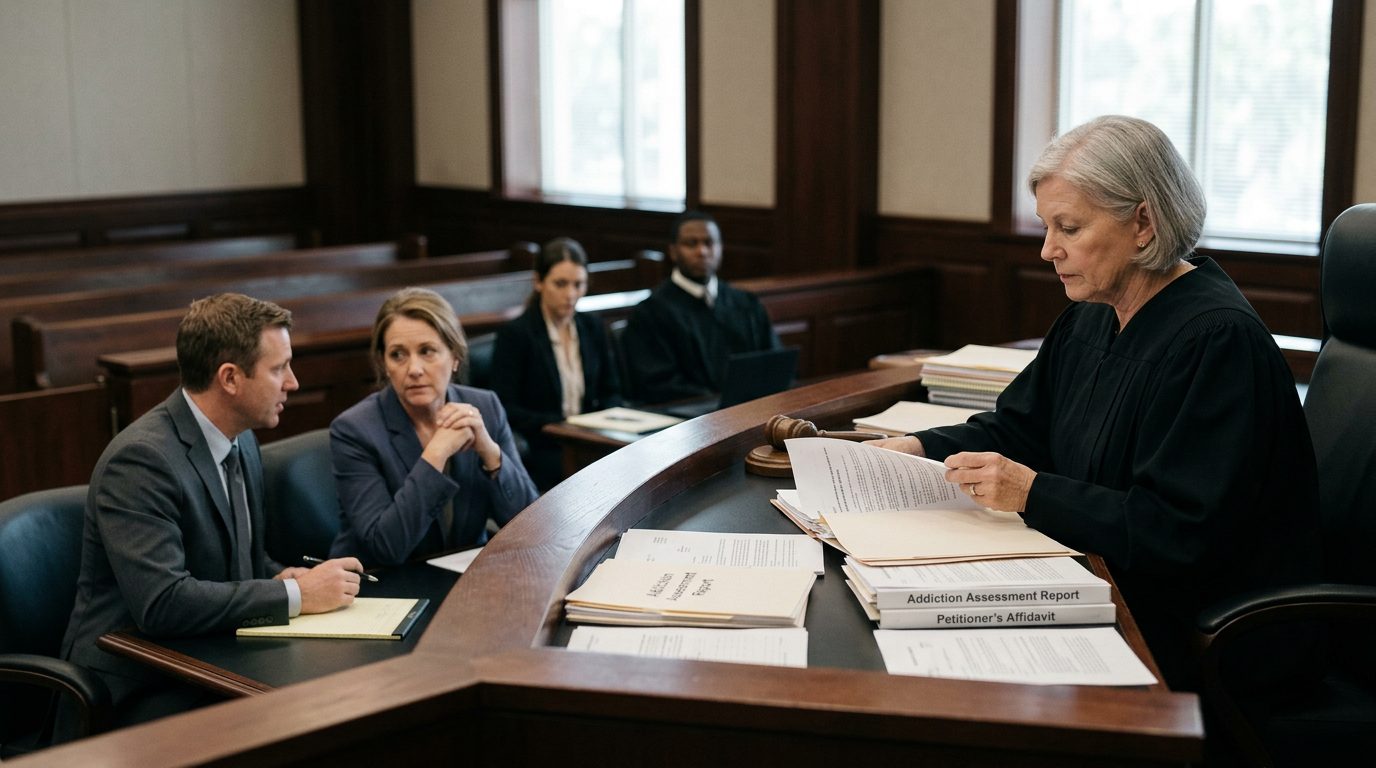
Marchman Act & Involuntary Commitment
Legal Grounds for Involuntary Commitment for Addiction
Understanding when Florida law permits intervention for substance abuse disorder—and how Robinson & Casey can guide your family through the process.
By Richard J. Casey III, Esq. · Published September 22, 2026
Legal Grounds for Involuntary Commitment for Addiction in Florida
Florida’s Marchman Act establishes specific legal grounds that must exist before a court can order involuntary commitment for addiction. Understanding these grounds helps families and caregivers determine whether their situation may warrant legal action and what evidence courts will evaluate.
If you’re facing this decision and need clarity on whether the legal grounds apply to your situation, reach out to discuss your options. Talk it through with the firm to see how these grounds may relate to your circumstances.

Overview: The Marchman Act and Legal Grounds for Involuntary Commitment
Florida Statute § 397.675 is the primary statute governing involuntary commitment for addiction in Florida. Legal grounds are the specific conditions that must exist before a court can order involuntary commitment. Understanding these grounds helps families and caregivers determine whether their situation may warrant legal action.
The grounds focus on the individual’s substance use, behavior, and risk to self or others—not on moral judgment or family preference alone. Courts apply a careful legal standard before removing someone’s liberty through involuntary commitment.
The Core Legal Grounds Under Florida Statute 397.675
Fla. Stat. § 397.675 sets out the findings a court must consider before ordering involuntary commitment, and other requirements may also apply.
Other requirements also apply, and the court decides based on the evidence in each case.
What Constitutes ‘Substance Abuse Disorder’ Under Florida Law
Whether a person has a substance abuse disorder is a question the court decides based on the evidence in each case. Evidence of the disorder may include documentation or the individual’s behavior, statements, or medical history.
For example, a person whose daily alcohol use interferes with work, family relationships, or health may present facts that a court considers, though other requirements also apply and the court decides.
The ‘Unwilling or Unable’ Standard
Alternatively, they may be unable to seek treatment due to the nature of their addiction or mental state.
Prior refusal of treatment, broken promises to stop, or repeated failed attempts at voluntary recovery can demonstrate unwillingness to seek treatment. For instance, if someone has entered a rehabilitation program multiple times, left early, and returned to active use, that pattern can support a finding of unwillingness.
The ‘Substantial Threat of Serious Harm’ Standard
This is one legal ground a court may consider for involuntary commitment under the Marchman Act.
The threat must be substantial—not speculative or remote, but reasonably likely given the person’s current substance use and behavior. Examples include active overdose risk, driving under the influence, violent behavior while intoxicated, neglect of medical conditions, or suicidal ideation linked to substance use. The court considers the individual’s history, current substance use patterns, and any recent incidents or escalation. For example, if someone has experienced multiple overdoses, is using increasingly potent substances, or has become violent when intoxicated, courts typically find a substantial threat of serious harm.
Not sure what your next step is?
Talk it through with our team — the first consultation is free, confidential, and carries no obligation.
Evidence Used to Establish Legal Grounds
Petitions typically include statements from family members, friends, or healthcare providers describing the person’s substance use and behavior. Medical records, emergency room visits, arrests, or prior treatment attempts provide objective documentation.
Specific incidents—overdoses, accidents, threats, or deterioration in functioning—demonstrate the threat of serious harm. The person’s own statements about their use, or their inability to stop despite consequences, can support the grounds. Florida courts do not require proof beyond a reasonable doubt; the standard is “clear and convincing evidence” that the grounds exist. This is a lower threshold than criminal proof but higher than a simple preponderance (more likely than not).
What Does NOT Constitute Legal Grounds
Mere disagreement about substance use or lifestyle choices, without evidence of disorder or harm, is not sufficient to support involuntary commitment. The person’s refusal to stop using substances alone, without evidence of serious harm or inability to seek treatment, does not meet the legal standard.
Family frustration or desire for the person to change is not a legal ground; the statute requires objective evidence of disorder and risk. Past substance use that has been resolved does not support current involuntary commitment. Courts are careful to distinguish between legitimate legal grounds and family conflict or moral disapproval.
How Courts Evaluate Legal Grounds at Hearing
At an involuntary commitment hearing, the petitioner (usually a family member or healthcare provider) must present evidence of the grounds. The person subject to the petition has the right to be present, to present evidence, and to cross-examine witnesses.
The judge weighs the evidence and determines whether the legal grounds have been proven by clear and convincing evidence. If grounds are established, the court may order involuntary commitment for evaluation, treatment, or both. The judge also considers whether less restrictive alternatives (such as voluntary outpatient treatment) might be appropriate before ordering involuntary commitment.
Temporary vs. Long-Term Commitment Grounds
Emergency temporary commitment (up to 5 days) may be ordered based on immediate risk of serious harm, with a lower threshold of evidence. Extended involuntary commitment requires the same statutory grounds but with a more thorough hearing and stronger evidence.
The legal grounds do not change between temporary and extended commitment; the difference is in the duration and the level of proof required. An emergency temporary commitment might be ordered on the same day a petition is filed if the court finds immediate danger. Extended commitment requires a full hearing and clearer proof of the ongoing grounds.
Frequently Asked Questions
Can involuntary commitment be ordered if the person refuses treatment but hasn’t caused harm yet?
Yes. The statute permits commitment based on a substantial threat of serious harm, not only on harm that has already occurred. Refusal of treatment combined with evidence of substance abuse disorder and risk can meet the legal grounds.
What is ‘clear and convincing evidence’ in a Marchman Act case?
It is a legal standard requiring more proof than “more likely than not” but less than “beyond a reasonable doubt.” The evidence must be substantial, precise, and leave no reasonable doubt about the existence of the legal grounds.
Who can file a petition for involuntary commitment under the Marchman Act?
Typically, a family member, healthcare provider, law enforcement officer, or other person with knowledge of the situation can file. An attorney can advise on who is best positioned to petition in your specific circumstances.
If you're facing this decision and need clarity on whether the legal grounds apply to your situation, reach out to discuss your options. Talk it through with our team — the first consultation is free, confidential, and carries no obligation.

Next Steps
If you believe a family member or loved one meets the legal grounds for involuntary commitment for addiction, consulting with an attorney familiar with the Marchman Act is the appropriate next step. An attorney can review the specific facts of your situation, explain whether the legal grounds are likely to be met, and guide you through the petition process.
Robinson & Casey handles Marchman Act petitions throughout South Florida and statewide. We help families understand the legal grounds, gather evidence, and navigate the involuntary commitment process. If you’re facing this decision and need clarity on whether the legal grounds apply to your situation, reach out to discuss your options.
If you’re watching someone struggle with addiction and wondering whether involuntary commitment might be necessary, families in your situation often find it helpful to discuss the legal grounds and options with an attorney who handles these cases. Contact Robinson & Casey today to schedule a consultation and learn how we can help.
Time Matters in Addiction Cases
Involuntary commitment proceedings move quickly. If you believe a family member meets the legal grounds for commitment, contacting an attorney promptly protects your rights and ensures proper procedures are followed from the start.
Key Legal Standards for Involuntary Commitment
Substantial Threat of Serious Harm
Florida law permits commitment when evidence shows the person poses a substantial threat of serious bodily harm to themselves or others due to substance abuse—even without prior incidents. Refusal of treatment combined with active substance use disorder can meet this standard.
Clear and Convincing Evidence
The court requires clear and convincing evidence—a high standard of proof—that the legal grounds for commitment are met. This means the evidence must be substantially more persuasive than a preponderance, establishing grounds with reasonable certainty.
Inability to Consent to Treatment
If the person cannot consent to voluntary treatment due to their condition, and meets other grounds, involuntary commitment may be appropriate. The statute recognizes that active addiction can impair judgment about seeking help.
Likelihood of Serious Harm Without Intervention
Courts examine whether the person's substance abuse disorder creates a likelihood of serious harm if intervention does not occur. Medical and behavioral evidence, substance use history, and current circumstances all inform this determination.
How Robinson & Casey Helps Your Family
Petition Preparation & Filing
We prepare and file Marchman Act petitions with precision, ensuring all legal grounds are properly documented and presented to the court.
Legal Representation at Hearings
Our attorneys represent families at commitment hearings, present evidence, and advocate for the intervention your loved one needs.
Clear Explanation of Your Options
We explain the differences between emergency temporary commitment, plenary guardianship, and limited guardianship—and which approach fits your situation.
Responsive & Available
Addiction crises don't follow business hours. We respond promptly to urgent situations and guide families through time-sensitive proceedings.
Direct Attorney Access
You work with an attorney who focuses on Marchman Act and guardianship matters—not a general practice firm juggling unrelated cases.
Support for Difficult Decisions
We understand that pursuing involuntary commitment is emotionally complex. We listen, answer your questions, and help you navigate the legal and personal dimensions.
Ready to Discuss Your Family's Situation?
Related practice areas
- Involuntary Commitment for Addiction in Florida
- How Long Does Involuntary Commitment for Addiction Last in Florida?