
Marchman Act & Guardianship | South Florida and Statewide
Help for a Homeless Family Member Who Refuses Help
Robinson Casey focuses exclusively on Marchman Act petitions and guardianship matters for families across South Florida and statewide. Start with a free first consultation that is confidential and carries no obligation to continue.
By Richard J. Casey III, Esq. · Published October 18, 2026
If a homeless loved one refuses help in Florida, your family can start now with calm talks, a written record, and clear limits. Florida law also lets certain adult relatives ask a court to order an assessment and, if the legal standard is met, involuntary treatment.
You may be reading this for someone you love, while the situation is still unfolding. That is a hard place to be. This guide covers each step in order.
Why a Homeless Loved One Refuses Help
Refusal is common because addiction can damage judgment and the ability to see a need for change.
Addiction changes how a person weighs choices. Florida’s statute describes this directly. It asks whether a person has lost self-control over substance use and whether impaired judgment keeps them from seeing their need for services.
Homelessness makes things harder. Sleeping outside, going without food, and losing contact with family can push a person further from help. Untreated mental health symptoms often add to the pull toward using. Each problem can feed the others.
Florida law also says a simple refusal of services is not, by itself, evidence of impaired judgment. Your loved one’s “no” is real, but it is only one piece of the picture.
Help does exist. The Florida Department of Health describes treatment options for drug use, including detoxification, treatment, and recovery support.
If your loved one is sleeping outside, using, and turning down help, you don't have to sort out the court options alone. Talk with our team about your family's facts. Talk it through with our team — the first consultation is free, confidential, and carries no obligation.

What Can a Family Do Now When a Loved One Refuses Help?
Start with private, calm talks, keep a dated record, stop paying for substances, and learn the signs of overdose.
- Talk privately and calmly. Describe one specific behavior and your worry, such as “You haven’t eaten in three days.” Skip labels and lectures.
- Keep a dated log. Write down dates, places, incidents, injuries, and any contact with police, hospitals, or shelters. A court can hear testimony from family members familiar with the person’s history (Fla. Stat. § 397.6957), so specific examples matter.
- Stop giving direct cash. Money that goes to substances can deepen the crisis. Keep showing care through meals, a phone, or a ride to a clinic.
- Learn overdose warning signs. Keep naloxone, also called Narcan, in the home if you can get it. Our overdose next steps guide covers emergency steps.
Do Ultimatums Work With Addicts?
An ultimatum works only when the family follows through, and no approach promises a particular response.
A threat is a warning you may not enforce. A boundary is a rule you will keep. For example: “I won’t let you sleep in my home while you’re using. You’re welcome to come in if you’re sober.”
Consistency gives a boundary its weight. Families often set a rule, then bend it after one hard night. The person learns the rule can bend. Choose a limit you can keep, and hold it the same way each time.
Think about safety before you set a consequence. Ending housing support is the family’s decision. Ask what your loved one will face outside, and plan for that risk.
A boundary alone does not compel treatment. Under Fla. Stat. § 397.697, a court may order involuntary treatment only after the conditions are proved by clear and convincing evidence.
How to Hold an Intervention With a Family Member
A family intervention is a planned talk where relatives share concern and state the limits they will keep.
Plan it before anyone sits down. Choose a small group of calm people the person respects. Each person writes a short statement about specific events and how they felt. Agree on one clear ask, such as a visit for an assessment. Pick a sober time and a private place.
Decide ahead what happens if the person leaves or says no. Without a plan, the meeting can turn into a fight.
Do not confront someone who is intoxicated or may become violent. Step back, and get emergency help if anyone is in danger.
An intervention may or may not change the person’s decision. It is one option among several, and it does not replace legal steps when they are needed.
Florida’s Marchman Act: How a Petition Works
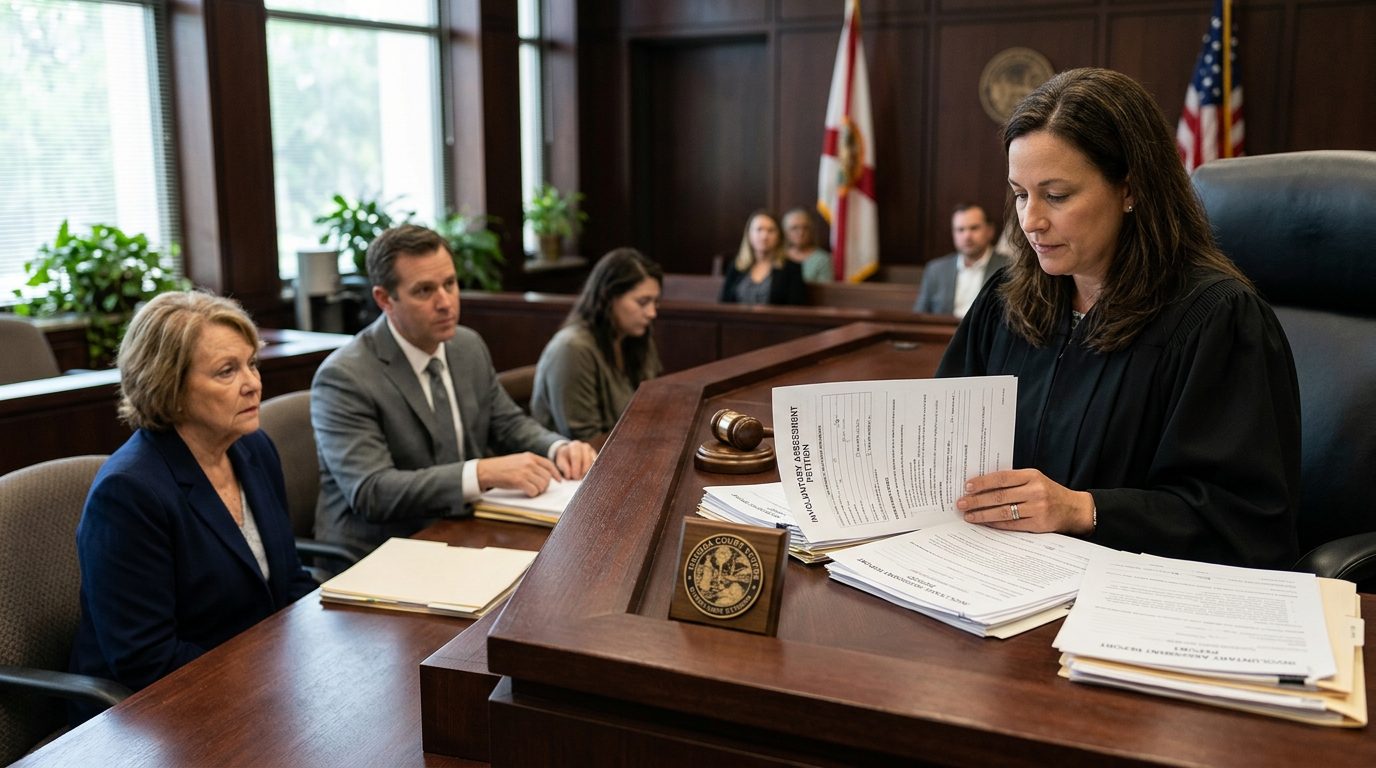
A Marchman Act petition asks a court to order assessment and, if the criteria are met, involuntary treatment for an adult with a substance problem.
Certain people may file. A spouse or legal guardian, any relative, a service provider, or an adult with direct personal knowledge of the person’s impairment may file (Fla. Stat. § 397.68112).
The petition goes to the clerk of court in the county where the person is located. The clerk may not charge a fee to file it (Fla. Stat. § 397.681). A homeless person may move between counties, so location on the filing day matters. In J.P. v. J.N., a Florida appeals court held that a wrong-county filing did not take away the circuit court’s jurisdiction.
A petition should name both parties, state their relationship, and give facts showing why you believe the person is impaired and has lost self-control.
In an emergency, the court may act on the petition alone and enter an ex parte order for assessment and stabilization. A provider generally may not hold the person for more than 72 hours of observation, unless a statutory exception applies (Fla. Stat. § 397.6818).
The respondent has a right to counsel at every stage (Fla. Stat. § 397.681). The court must schedule a hearing within 10 court working days unless it grants a continuance (Fla. Stat. § 397.68151). The petitioner must prove impairment and a history of non-compliance with treatment by clear and convincing evidence (Fla. Stat. § 397.6957). The outcome depends on the facts and the evidence.
When Guardianship Applies Instead
When a petition to determine incapacity is filed, the alleged incapacitated person must be served with notice and copies of the petitions, and the notice must state that an attorney has been appointed to represent that person.
A court must find incapacity by clear and convincing evidence. It may remove only the rights the person cannot exercise. Because the court can limit specific rights, a limited guardianship fits when a person can handle some decisions but not others.
An emergency temporary guardian may be appointed only after an incapacity petition is filed. The court must find imminent danger to the person’s health or safety unless immediate action is taken (Fla. Stat. § 744.3031). That authority expires after 90 days and may be extended for another 90 days if the emergency continues.
A person who has been determined to be incapacitated retains the right to be treated humanely, with dignity and respect, and to be protected against abuse, neglect, and exploitation. A guardian may not commit the ward to a facility without a formal placement proceeding (Fla. Stat. § 744.3215).
If mental illness is part of the picture, other involuntary examination proceedings may be relevant.
Guardianship is not a quick fix for homelessness. It and the Marchman Act are different tools, and the right fit depends on the facts.
Not sure what your next step is?
Talk it through with our team — the first consultation is free, confidential, and carries no obligation.
Protecting Yourself and Coping as a Family Member
Watching someone you love live outside takes a heavy toll, and looking after yourself is part of the plan.
Guilt, anger, sleeplessness, and a sense of responsibility for every choice are common reactions. Notice them without letting them run your day.
Set limits on your time, money, and safety. A crisis should not control every hour. Decide what you can give, and say it kindly.
Lean on people you trust. A close friend, a faith community, or a counselor can help you carry this.
You cannot control another adult’s choices. Your well-being still counts in the decisions ahead.

Next Steps for Miami-Dade and South Florida Families
Robinson Casey limits its practice to Marchman Act petitions, guardianship, and involuntary commitment for addiction. The firm serves families in Miami-Dade, across South Florida, and statewide.
Richard J. Casey III, Esq. is the responsible lawyer for this page. Our team can help you sort out whether a court petition fits your family’s facts. Depending on the facts, a matter may be referred to another lawyer or firm.
The first consultation is free, confidential, and without obligation to continue. For the broader process, see our involuntary commitment for addiction guide.
If your loved one is sleeping outside, using, and turning down help, you may be weighing whether a court petition is worth exploring. Reach out through the contact page or call (561) 849-4149 to talk through your facts.
What can a family do when a homeless loved one refuses help in Florida?
Start with calm, specific talks, a dated record, and clear limits on your own support. Florida law also lets certain relatives ask a court for an assessment.
Who can file a Marchman Act petition in Florida?
A spouse or legal guardian, any relative, a service provider, or an adult with direct personal knowledge may file. The petition goes to the clerk of court in the county where the person is located.
Does a Marchman Act petition cost anything to file?
The clerk may not charge a fee for filing a Marchman Act petition. Respondents also have a right to counsel at every stage of the case.
Why Families Contact Robinson Casey
Focused Practice
Our practice is limited to Marchman Act petitions and guardianship matters, so every case we take falls within the same area of law.
Clear Next Steps
We explain the process in plain language, outline the options available to your family, and help you decide what to do next.
Confidential Conversations
Your first consultation is free, confidential, and carries no obligation to continue. Share what you are facing and get straight answers.
Support for Families
Our team works with you to organize documents, timelines, and information so that your family can move forward with confidence.
If Someone Is in Immediate Danger
If your loved one is in immediate danger or a medical emergency, call 911 right away. Then contact our office to talk through the legal options available to your family.
Legal Help We Provide
Marchman Act Attorney
Guidance on filing a Marchman Act petition for a family member who needs assessment and possible treatment for substance use.
Guardianship Attorney
Support for families who need a court-supervised guardian to help a loved one who cannot manage personal or financial affairs.
Emergency Temporary Guardianship
Help with urgent petitions when a vulnerable adult faces immediate risk and needs prompt court intervention.
Plenary and Limited Guardianship
Guidance on full and limited guardianship options, so the arrangement matches the needs of your loved one.
Mental Health Guardianship
Legal assistance for families navigating guardianship when a loved one's mental health affects their ability to make decisions.