
Marchman Act & Guardianship | South Florida
Preparing a Marchman Act Petition for Your Spouse? Start With This Checklist
Robinson Casey focuses on Marchman Act petitions and guardianship matters for families in Miami-Dade and across South Florida. Use this checklist to organize what you need before you call.
Casey III, Esq. · Published November 8, 2026
Your home is unstable, and the children are seeing it
Yes, Florida law lets a spouse ask a court to order an assessment and possible treatment for a partner whose substance use is harming the household. That request is called a Marchman Act petition.
You may be listening for the car in the driveway. The drinking may happen after the kids are in bed, or in front of them. Money keeps going missing, and you don’t know what tomorrow will bring.
A spouse is on the list of people who may file for an adult, under § 397.68112. A petition asks a court to act. Those are separate questions.
If your spouse's drinking has made home feel unsafe for your children, you don't have to work out the next step alone. Call Robinson Casey at (561) 849-4700 to talk through your checklist results. Talk it through with our team — the first consultation is free, confidential, and carries no obligation.

Petitioner checklist: is this the right step for your family?
Work through these five tests in order. Each result tells you what to do next.
Test 1: Is your spouse’s drinking or drug use hurting the home or the children? Yes means missed work, unsafe driving, lapses in supervision, or intoxication around the kids. If yes, keep going. If no, keep notes and return to this list later.
Test 2: Can you describe specific recent incidents with dates? If yes, keep going. If no, start a dated log before you do anything else.
Test 3: Has your spouse refused help or played down the problem when you raised it? If yes, a petition may be the next option to discuss. If no, have one planned conversation first and write down what was said.
Test 4: Is there an immediate risk, such as threats, violence, a child left alone while impaired, or a medical emergency? If yes, call 911 or emergency services first, then contact Robinson Casey the same day. If no, move on to Test 5.
Are you willing to sign a sworn statement and testify about what you have seen? Where a law or court rule requires a document to be verified, the verification may be made under penalties of perjury, and a person who knowingly makes a false declaration is guilty of perjury by false written declaration, a felony of the third degree, under § 92.525. If yes, keep going. If unsure, talk it through with Robinson Casey before filing.
Documenting what you have seen before you file
Write down what you observed, when it happened, and who else was there. Keep the record factual and calm.
- Dates and times for each incident, such as a night you could not wake your spouse for the school run.
- What you saw yourself versus what you were told. Mark which is which.
- Who else was present, such as a babysitter, a teacher, or a neighbor.
- Effects on the children, such as missed school, fear, sleep trouble, or sudden changes in behavior. Describe what you saw without exaggerating.
- Messages or photos you have a lawful right to keep.
Why it matters: the court hears all relevant evidence, including testimony from family members who know the person’s history and how it connects to the current problem (§ 397.6957). A dated record gives the court something concrete. A list of general complaints does not.
When your spouse denies drinking or says there is no problem
The court looks at the facts in the petition and the evidence presented at the hearing.
Being told you are overreacting while the household pays the price is exhausting. You may start doubting your own memory. Trust the notes you wrote on the day things happened.
Refusing help alone is not enough. The statute says mere refusal to receive services does not, by itself, show lack of judgment about the need for them (§ 397.675). Under § 397.675, there must be good faith reason to believe the person is substance abuse impaired, or has a substance use disorder and a co-occurring mental health disorder, and, because of it, has lost the power of self-control with respect to substance abuse. The person must also meet one of these. First, they are in need of substance abuse services and their judgment is so impaired that they cannot appreciate that need or make a rational decision about it. Second, without care, they are likely to suffer neglect posing a real and present threat of substantial harm, and it is not apparent that the harm can be avoided through the help of willing, able, and responsible family members or friends or other services. Third, there is a substantial likelihood that they have inflicted, threatened or attempted to inflict, or, unless admitted, are likely to inflict physical harm on themselves or another. A pattern written down over time can say more than one bad night.
Avoid confrontations or threats that could raise the danger to your children. Bring that concern to your lawyer before any tense conversation.
What happens after you file: the process step by step
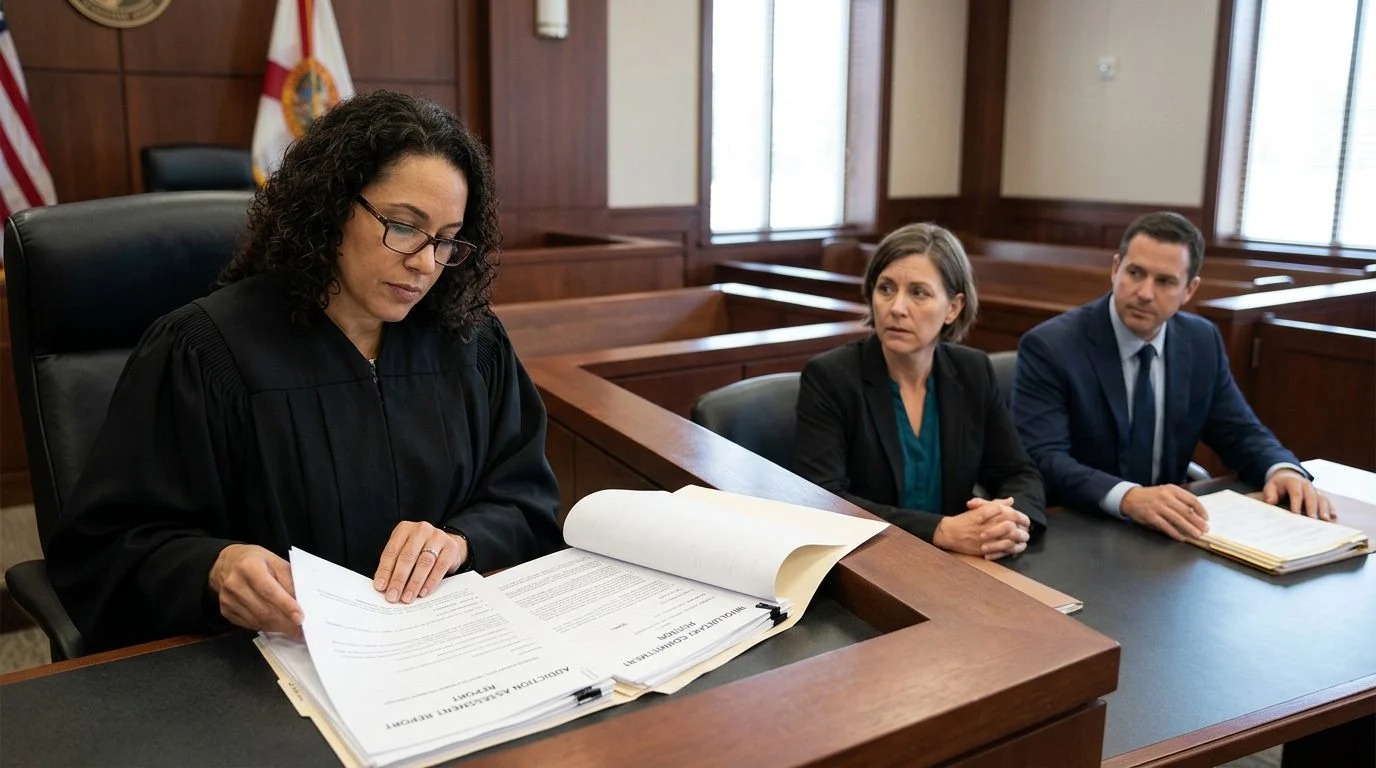
The court must schedule a hearing within 10 court working days, unless it grants a continuance (§ 397.68151). Here is the general path.
- It is filed with the clerk in the county where the person is located (§ 397.681).
- Assessment. The petition may include a report from a qualified professional who examined the person within 30 days before filing. If there was no assessment, the petition must say so (§ 397.68141).
- Notice. The person named gets a copy of the petition and the hearing notice. So does their attorney, if known (§ 397.68151).
- Any treatment order is limited to 90 days at a time (§ 397.697).
Timelines vary by county and by case. You will be told what to expect at each stage.
Why work with Robinson Casey on a Marchman Act petition
Robinson Casey limits its practice to Marchman Act petitions and guardianship matters, serving families across South Florida and statewide.
- Richard J. Casey III, Esq. is the responsible lawyer for this page.
- Our team, including support staff, helps families organize records and schedule consultations.
- The firm also handles guardianship, mental health guardianship, and involuntary commitment for addiction, for homes where drinking is not the only problem.
- The first consultation is free, confidential, and without obligation to continue.
Not sure what your next step is?
Talk it through with our team — the first consultation is free, confidential, and carries no obligation.
Frequently asked questions
Can a spouse file a Marchman Act petition in Florida?
Yes. Florida law lets a spouse, a legal guardian, any relative, a service provider, or an adult who has direct personal knowledge of the person’s substance abuse impairment and prior course of assessment and treatment file a petition for an adult (§ 397.68112).
Is there a filing fee?
No. The clerk may not charge a fee for filing the petition (§ 397.681).
Do I need a doctor’s report before I file?
Not always. Not always. The qualified professional’s clinical assessment must be filed with the clerk no later than the close of business the day before the hearing, and a report without a treatment recommendation, like a recommendation of no treatment, results in dismissal of the petition.
Will my spouse know I filed?
Yes. The person named receives a copy of the petition and the hearing notice.
Does a petition mean we are getting divorced?
No. A petition is a court matter about assessment and treatment.
Do I have to pay for treatment?
Under Fla. Stat. § 397.697(1)(a), a court may order treatment through a privately funded licensed service provider if the respondent has the ability to pay for the treatment, or if any person on the respondent’s behalf voluntarily demonstrates a willingness and an ability to pay for the treatment.

Talk through your situation with the firm
You did not choose this, and you are trying to protect your children and keep the household steady. If your spouse’s drinking has made home feel unsafe, call Robinson Casey at (561) 849-4700 or use the contact page to review your checklist results.
Your Petitioner Checklist
Gather Identification and Contact Details
Collect your spouse's full legal name, date of birth, address, and the contact information for any treating providers you know of. Having these details ready makes the process smoother.
Write Down Specific, Dated Observations
Record recent incidents, changes in behavior, and the substances involved, with dates and facts. Stick to what you directly observed rather than assumptions.
Summarize Prior Assessments and Treatment
List any past evaluations, detox stays, or treatment programs your spouse has attended, including the facility names and approximate dates, so your attorney can review the history.
Note Who Else Is Involved
Make a short list of family members, service providers, or others who have direct knowledge of the situation, along with how each one is connected to your spouse.
Keep Your Notes Factual
Courts rely on clear, specific information. Bring your records as they are, keep copies of anything you share, and avoid exaggeration or guesswork. Do not wait to get legal guidance because you are still gathering details.
How Robinson Casey Can Help
Marchman Act Petitions
We help petitioners prepare and file Marchman Act petitions for adults who need court-ordered assessment and treatment for substance use impairment.
Guardianship Matters
Our practice covers emergency temporary, plenary, limited, and mental health guardianship matters for families in South Florida and statewide.
Clear Explanations
We explain each step of the process in plain language so you know what to expect and what information the court will need.
Support for Families
We understand how difficult it is to seek help for someone you love, and we approach every matter with care and discretion.