
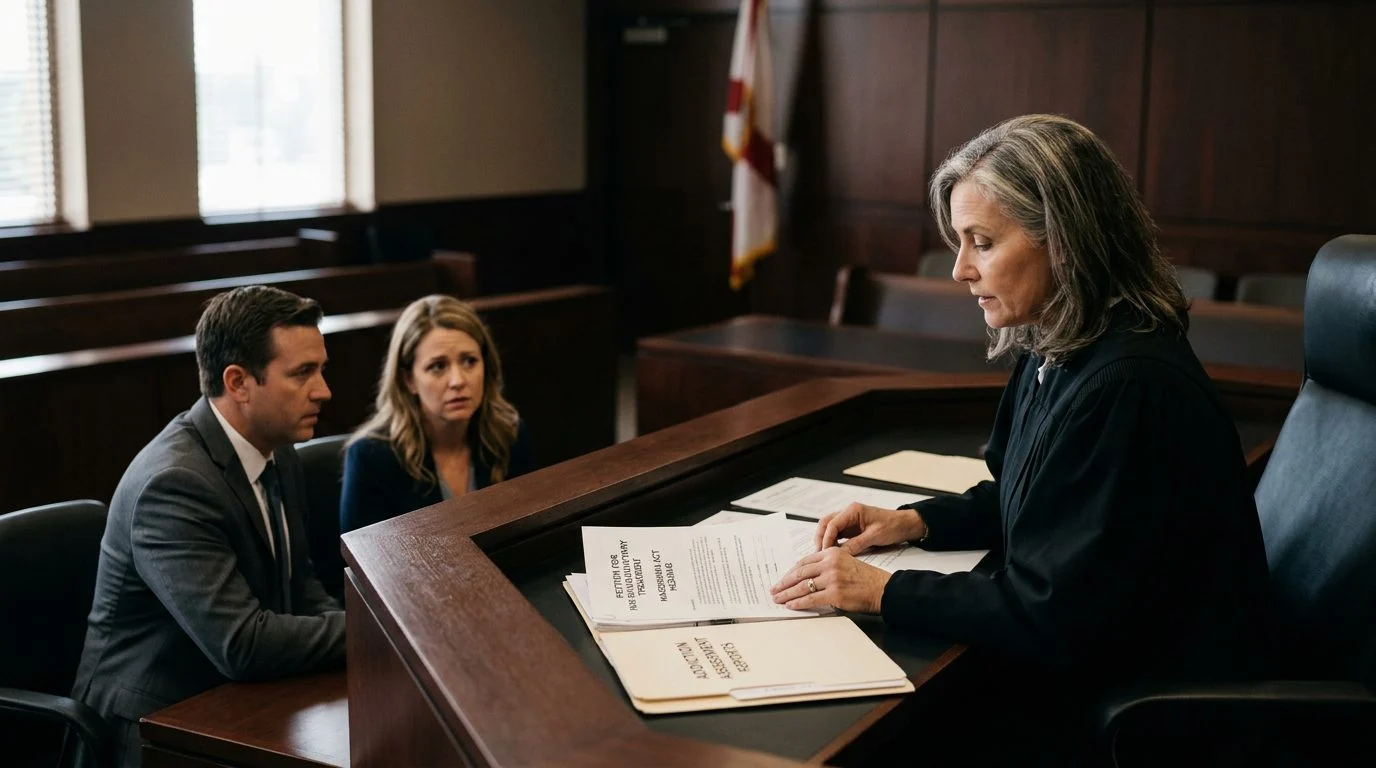
Marchman Act & Guardianship | Miami-Dade and South Florida
When Addiction and Mental Health Challenges Overlap, Your Family Needs a Clear Path Forward
Robinson Casey focuses on Marchman Act petitions, involuntary commitment for addiction, and guardianship matters for families across Miami-Dade, South Florida and statewide.
Casey III, Esq. · Published November 7, 2026
When addiction and mental illness occur together, Florida law may allow a court to order involuntary treatment. Two state laws can apply. The Marchman Act (Chapter 397) covers substance use impairment, and the Baker Act (Chapter 394) covers mental illness. This page explains how those laws meet for co-occurring conditions, how the court process moves, and what to gather before you talk with a lawyer. Robinson Casey focuses on Marchman Act petitions and guardianship matters for families across South Florida and statewide.
What Dual Diagnosis Means for Families
Dual diagnosis means a person has a substance use disorder and a mental health disorder at the same time. MedlinePlus notes that these co-occurring disorders can happen together and are usually treated at the same time.
Families often describe a similar pattern. Your loved one may relapse soon after leaving treatment, refuse care, act unpredictably, or lose a job or housing. Many families say the two problems seem to drive each other.
Florida law does not decide the case by a diagnosis name alone. Under Fla. Stat. § 397.675, the involuntary admission standard reaches a person with a substance use disorder and a co-occurring mental health disorder. That is why a family may not know which law fits.
If your loved one is facing addiction and mental illness at the same time, you don't have to sort out the court process alone. Call (561) 849-4700 to talk through your options. Talk it through with our team — the first consultation is free, confidential, and carries no obligation.

Chapter 397 and Chapter 394: How Florida Law Handles Each Condition
The Marchman Act (Chapter 397) is Florida’s process for substance use impairment. It lets an eligible person ask a court to order an assessment and, if the criteria are met, involuntary treatment.
The Baker Act (Chapter 394) addresses mental illness. Under Fla. Stat. § 394.463, a person may be taken to a receiving facility for involuntary examination. The person must have a mental illness and must have refused voluntary examination or be unable to decide whether an exam is needed. Under § 394.463(1), a person may be taken to a receiving facility for involuntary examination if there is reason to believe the person has a mental illness and, because of that illness, is likely to suffer neglect or refuse to care for himself or herself. That neglect or refusal poses a real and present threat of substantial harm to his or her well-being, and it is not apparent that such harm may be avoided through the help of willing, able, and responsible family members or friends or the provision of other services. Alternatively, there is a substantial likelihood, without care or treatment, that the person will cause serious bodily harm to himself or herself or others in the near future, as evidenced by recent behavior.
The two laws address different conditions. One situation can still touch both. A person may need a substance use assessment and a mental health evaluation at the same time.
Robinson Casey focuses on Marchman Act petitions and guardianship matters. A matter that falls mainly under the Baker Act may be referred to another lawyer or firm.
Overlap: When Addiction and Mental Illness Are Both Present
A case can involve both laws when substance use and mental illness both affect the person’s behavior. The Marchman Act addresses involuntary treatment petitions for substance abuse impaired persons. Both parts must be shown.
First, has the person lost the power of self-control with respect to substance use? Second, does the person either need services and lack the judgment to see that need, or, without care, face a real and present threat of substantial harm to his or her well-being, where that harm cannot be avoided through the help of willing, able, and responsible family members or friends or other services? The person may also be likely to harm self or others.
A refusal alone is not enough.
Documentation matters. A qualified professional’s report must note whether the person has any co-occurring mental health or other treatment needs, under Fla. Stat. § 397.6957.
A diagnosis alone does not decide the case. The court must hear and review all relevant evidence, including testimony from family members who know the person’s history. Florida’s publicly funded behavioral-health system supports assessment for co-occurring mental illness and substance use.
How the Court Process Typically Moves
A Marchman Act case starts when a petition is filed with the clerk in the county where the person is located. Under Fla. Stat. § 397.681, the clerk may not charge a fee for filing. Under Fla. Stat. § 397.681(1), such petitions must be filed with the clerk of the court in the county where the person is located.
Here is the typical sequence:
- Emergency order. When emergency circumstances exist, the court may rely on the petition alone. Under Fla. Stat. § 397.6818, a provider may hold the person for no more than 72 hours of observation, unless an exception applies. An order not executed by the initial hearing date is void.
- Hearing. The court sets a hearing within 10 court working days, unless a continuance is granted, under Fla. Stat. § 397.68151.
- Treatment order. The court may order treatment for up to 90 days if the conditions are proved by clear and convincing evidence, under Fla. Stat. § 397.697.
Courts have also held that the petition itself matters. In D.H. v. K.J.R., the Second District held the trial court erred in entering an ex parte order where the petition did not give a good-faith reason to believe the criteria were met.
In the Fifth District, the petitioner carries the burden of proof. In J.C. v. State, the court reversed an order where the trial court questioned the only witness after the petitioner was absent. The Fourth District has certified conflict with that line of cases, so this rule is Fifth District law.
Guardianship Questions That Can Arise Alongside Treatment
Guardianship is a separate court proceeding from a treatment petition, with its own standards. It asks the court to decide whether a person needs a guardian for personal or financial decisions.
An emergency temporary guardian can be appointed only after a petition for determination of incapacity is filed. The court must find imminent danger to the person’s physical or mental health or safety, or danger to property. Under Fla. Stat. § 744.3031, notice must be served on the alleged incapacitated person and their attorney at least 24 hours before the hearing, unless the petitioner demonstrates that substantial harm would occur if the 24-hour notice is given. The court must appoint counsel for the alleged incapacitated person. The emergency authority lasts 90 days after the date of appointment or until a guardian is appointed, whichever comes first, and may be extended for an additional 90 days upon a showing that the emergency conditions still exist. Under Fla. Stat. § 744.3031, the court must find the conditions still exist to extend it.
Robinson Casey also handles plenary guardianship, limited guardianship, and mental health guardianship matters. Each type sets a different scope of authority, and the court decides the powers a guardian receives.
What to Gather Before Speaking With an Attorney
Before the first call, gather a timeline, treatment and hospital dates, current medications, and any court history. These facts help show what a petition needs to say.
A petition must name the respondent and the petitioner, state their relationship, and list the factual reasons for needed services. Under Fla. Stat. § 397.68141, it may attach a professional’s report from an exam within 30 days before filing. If the person was never assessed or refused, the petition must say so.
Keep these documents:
- Discharge summaries from treatment or hospital stays
- Police or emergency reports
- Texts or messages that show your loved one’s condition
- Proof of your family relationship
Write observations in date order. Use facts, such as “slept in the car for two nights,” not conclusions like “out of control.” Note where your loved one is now. The county matters, because a petition belongs where the person is physically located when it is filed.
Not sure what your next step is?
Talk it through with our team — the first consultation is free, confidential, and carries no obligation.
Why Robinson Casey and What a Consultation Covers
Robinson Casey is a Florida law firm that focuses on Marchman Act petitions and guardianship matters for families across South Florida and statewide. Richard J. Casey III, Esq. is the responsible lawyer for this page. Our team supports families through each step of the process.
A consultation covers your loved one’s situation and your family’s goals. It also covers which statutes may apply, the likely process and timing, and the questions you should ask. Bring your timeline and records if you have them.
The first consultation is free, confidential, and comes with no obligation to continue.
If your loved one is in crisis, relapsing, or refusing care, you don’t have to face the court process alone. Call (561) 849-4700 or request a consultation today.

Frequently Asked Questions
Can a family member start a Marchman Act petition?
Yes, for an adult, a spouse or legal guardian, any relative, a service provider, or an adult with direct personal knowledge may file.
Does a dual diagnosis mean the case must go under the Baker Act?
No. A dual diagnosis can touch both laws, and the facts of each case shape the path.
What is the difference between an ex parte order and a full hearing?
An ex parte order can rest on the petition alone when emergency circumstances exist. A full hearing takes evidence and testimony before the court decides.
Does involuntary treatment mean jail or criminal charges?
Florida’s Marchman Act process is aimed at treatment. The court may direct a sheriff to take a person to a treatment provider, under Fla. Stat. § 397.697.
What does a guardianship petition add that a treatment petition does not?
A guardianship case asks whether a person needs a guardian for decisions. A treatment petition asks for assessment and treatment.
What should a family have ready for a first call?
Have a timeline, treatment and hospital dates, current medications, court history, and any recent professional evaluation ready.
How We Approach Co-Occurring Cases
Clear Review of the Facts
Substance use and mental health often affect each other. We look closely at the facts of your family's situation to identify which legal process fits.
Family-Centered Guidance
We explain each step in plain language so you know what to expect as your family works through a difficult period.
Confidential Representation
Your conversations with our office are handled with care and discretion from the first call onward.
Responsive Communication
Our team keeps you informed and is available to answer questions as your matter moves forward.
If Someone Is in Immediate Danger
A legal process is not a substitute for emergency care. If a person is in immediate danger, call 911 right away. For questions about Marchman Act or involuntary treatment matters, call Robinson Casey at (561) 849-4700.
Matters We Handle
Marchman Act Petitions
Guidance on filing and handling petitions for involuntary assessment and treatment when substance use is at the center of the concern.
Involuntary Commitment for Addiction
Representation for families seeking court-ordered treatment for a loved one whose addiction puts their health and safety at risk.
Guardianship Matters
Help with emergency temporary, plenary and limited guardianship, tailored to each person's needs and the court's requirements.
Mental Health Guardianship
Support for families navigating guardianship when a mental health condition affects a loved one's ability to make decisions.
Start With a Free, Confidential First Consultation. There Is No Obligation to Continue.
Related practice areas
- Involuntary Commitment for Addiction in Florida
- Involuntary Treatment for Young Adult Addiction Florida