
Marchman Act Attorney | Miami-Dade and South Florida
Your Son Refuses Help? Understand Your Options Under the Marchman Act
Robinson Casey focuses on Marchman Act petitions and guardianship matters for families across South Florida and statewide. Talk with our team about where your family stands.
By Richard J. Casey III, Esq. · Published October 31, 2026
If your son overdosed and refuses treatment in Florida, first get him medical care. Then ask whether a court can order assessment and treatment. Florida’s Marchman Act, found in Chapter 397 of the Florida Statutes, lets certain family members file a petition for that purpose. Whether it fits your family depends on the facts.
Many parents type the same question: my son overdosed and refuses treatment Florida what can I do? You are not alone in asking it, and the options are clearer than they feel tonight.
Your Son Overdosed and Refuses Treatment: What to Do Right Now
Safety comes first. Get emergency help before you take any legal step.
- If he is not breathing, is hard to wake, or you suspect an overdose, call 911 right away.
- Stay with him until help arrives.
- Ask the hospital for discharge instructions and write them down.
Hospital discharge is often when families ask what comes next. A court petition is a separate civil process. It can be considered apart from emergency medical care.
Start a written log today. Record dates of overdoses, ER visits, threats, missing days, and each time he refused treatment. Write what happened, not your guesses. Clear records make the facts easier to present later.
If he is in crisis, Florida’s 988 Florida Lifeline offers free, 24/7 help. Counselors can connect callers with a crisis counselor and may refer them to mobile or short-term crisis care.
If he keeps refusing care, the next question is whether Florida law gives you a court route. The sections below explain that.
If your son has overdosed and still refuses help, you don't have to work out the court options alone; ask us about a free, confidential first consultation. Talk it through with our team — the first consultation is free, confidential, and carries no obligation.

What the Marchman Act Is and Who Can File
The Marchman Act lets a court order assessment and treatment for an adult with a substance use problem, if the legal criteria are met. Section 397.681 of the Florida Statutes, Fla. Stat. § 397.681, addresses jurisdiction over involuntary treatment petitions for substance abuse impaired persons.
Your adult child named in the petition is called the “respondent.”
A Marchman petition is a civil filing. It is not a criminal charge against your son.
Voluntary treatment depends on his agreement. Guardianship is a different legal tool with different rules. Robinson Casey limits its practice to Marchman Act petitions and guardianship matters, serving families across South Florida and statewide.
Can a Marchman Act Petition Work When Your Adult Child Refuses Treatment?
A refusal alone does not decide the case. Florida law says that mere refusal to receive services is not, by itself, evidence of lack of judgment about the need for care. Fla. Stat. § 397.675 reads: “(b) Without care or treatment, is likely to suffer from neglect or refuse to care for himself or herself; that such neglect or refusal poses a real and present threat of substantial harm to his or her well-being; and that it is not apparent that such harm may be avoided through the help of willing, able, and responsible family members or friends or the provision of other services, or there is substantial likelihood that the person has inflicted, or threatened to or attempted to inflict, or, unless admitted, is likely to inflict, physical harm on himself, herself, or another.”
The person must have lost self-control because of substance use. He must also be unable to understand his need for care, or, without care, be likely to neglect himself in a way that poses a real and present threat of substantial harm that cannot be avoided through willing family, friends, or other services, or be substantially likely to inflict physical harm on himself or others.
A Second District court held that a Marchman respondent has a due-process right to counsel.
That protection can feel frightening for a parent. It is part of the process. A court may also decline to order treatment. No one can promise a result, so hear that before you decide.
The Marchman Act Process and Timeline, Step by Step
The process moves from filing to a hearing, then to a court decision. Timing can vary by county and court calendar, so ask about your county at the consultation.
- Gather the facts. Collect records, incident reports, and a dated timeline of events.
- File with the clerk. The petition goes to the clerk of the court in the county where your son is located. The clerk may not charge a filing fee under Fla. Stat. § 397.681. Under § 397.681, such petitions must be filed with the clerk of the court in the county where the person is located; the statute does not address what happens when a petition is filed in the wrong county, but J.P. v. J.N. treats it as a venue issue, with transfer as the remedy.
- Set the hearing. The court schedules a hearing within 10 court working days unless a continuance is granted, under § 397.68151.
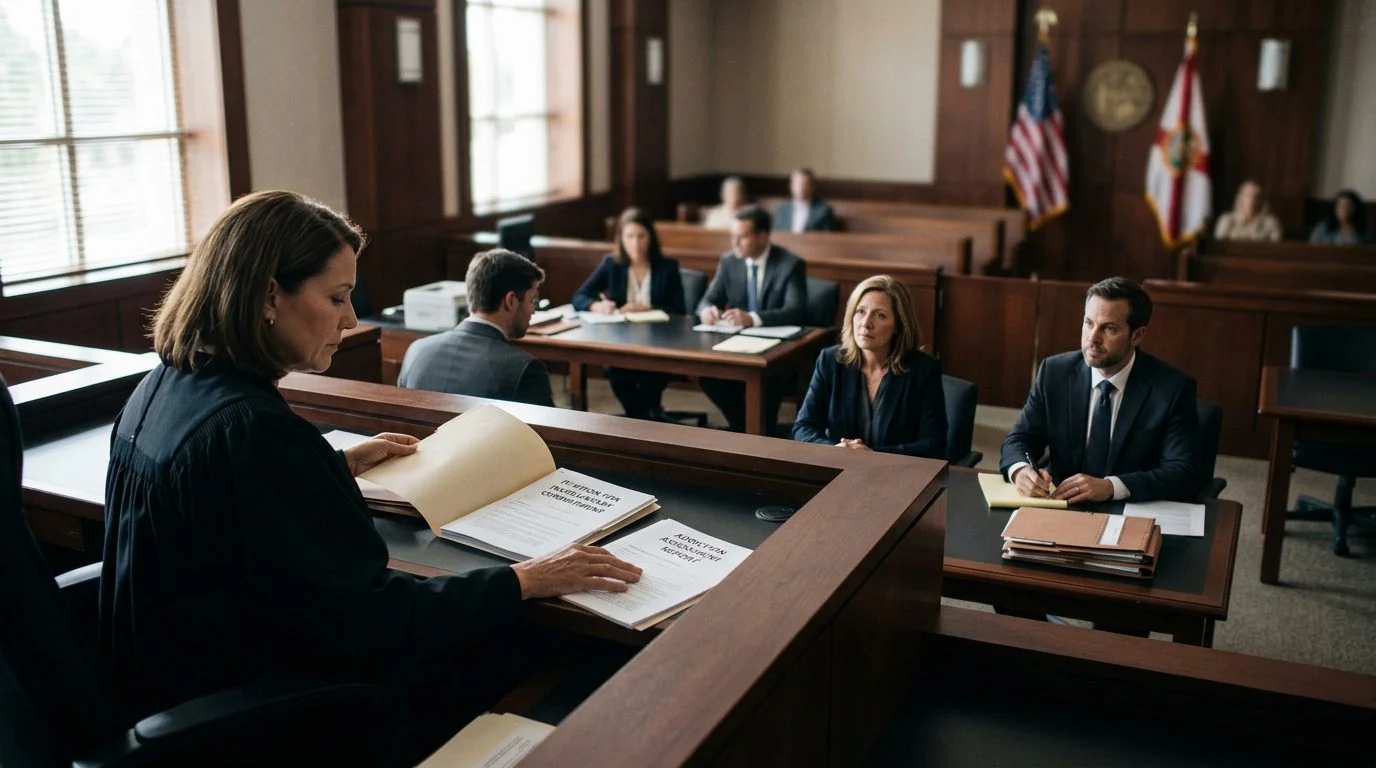
- Hold the hearing. Under § 397.68151, a copy of the petition and notice of the hearing must be provided to your son. Testimony is under oath, and family members who know his history may testify. The court may also order drug tests, under § 397.6957.
- Decide. If the court finds the conditions proved by clear and convincing evidence, it may order treatment for up to 90 days, under § 397.697.
In an emergency, a judge may enter an ex parte order for assessment and stabilization without appointing an attorney, under § 397.6818.
What Evidence the Court Needs From the Family
Specific, dated facts help the court most. Gather the following before you consult a lawyer.
- Medical records. Overdose, hospital, and ER records with dates and diagnoses.
- Incident reports. Any police or incident reports tied to substance use or dangerous behavior.
- Witnesses. Names of family members or others who saw the behavior, and what they saw.
- Treatment history. Each prior program, its dates, and why it ended.
- Assessments. A petition may include a report from a qualified professional who examined him within 30 days before filing. If he refused an assessment, the petition must say so, under § 397.68141.
Keep your log factual. Describe events, dates, and what you saw. Avoid general statements about worry.
Your Fears, Answered Plainly
A Marchman petition is a civil court process. It is not a criminal case against your son. Here is how the common fears line up with the process.
- Overdose death. A petition does not replace 911 or emergency care. Emergency orders exist, but emergency medical care always comes first.
- Incarceration. The Marchman process is civil. Other legal issues can arise separately and need their own review.
- Homelessness. The court order focuses on assessment and treatment. Housing and money questions are separate planning matters.
- Losing hope. Years of trying can wear a parent down. A court process is one option among several, not a sure fix.
- Honest limit. Results depend on the facts, the judge, and your son’s response. No one can promise a particular outcome.
Not sure what your next step is?
Talk it through with our team — the first consultation is free, confidential, and carries no obligation.
Why Families Work With Robinson Casey
Robinson Casey limits its practice to Marchman Act petitions and guardianship matters.
Richard J. Casey III, Esq. is the lawyer responsible for this page. Our team, including support staff, can walk you through the petition, the notice, and the hearing in plain language.
The first consultation is free, confidential, and carries no obligation to continue. If another lawyer or firm may be a better fit for your matter, we will say so during that consultation.
Frequently Asked Questions About Marchman Act Petitions After an Overdose
Can I force my adult son into rehab in Florida?
A parent who is a relative can file a Marchman Act petition for an adult. The court decides whether the legal criteria are met.
What if my child leaves treatment early?
Florida law requires that the person be released when the conditions justifying involuntary treatment no longer exist. Ask about this in your consultation so you understand your options.
Does the petition require my child to be arrested?
No. The grounds listed in Florida law for involuntary treatment do not require an arrest.
How long does the process take?
The hearing is set within 10 court working days unless a continuance is granted. Other timing depends on your county and the facts of the case.
Does my son get a lawyer?
Yes. He has the right to counsel at every stage, which he may waive if he is present and the court finds the waiver is knowing, intelligent, and voluntary; if he desires counsel and is unable to afford private counsel, he has the right to court-appointed counsel, under Fla. Stat. § 397.681.

Talk Through Your Son’s Situation Before You Decide Anything
You may be living through the hardest stretch of your life. Your son overdosed, may be back home, and still says he doesn’t want help. You are tired, scared, and unsure whether a court is the right step.
That is a serious decision. It deserves clear facts before you commit to anything. If you want to talk through your son’s situation, call (561) 849-4700 or request your consultation.
Why Families Contact Robinson Casey
Free First Consultation
Your first consultation is free, confidential, and carries no obligation to continue.
Focused Practice
Our practice focuses on Marchman Act petitions and guardianship matters, the areas we have concentrated on for our clients.
South Florida and Statewide
We represent families in Miami-Dade and across South Florida, and we handle matters statewide.
Support Staff Who Help You Through the Process
Our team of assistants and office staff helps keep your questions, documents, and deadlines organized.
Ask Before the Crisis Peaks
Questions about involuntary treatment, guardianship, and court procedure are easier to work through before an emergency forces quick decisions. A conversation now can help you understand the process.
Legal Options We Handle
Marchman Act Petitions
We help families file and prepare Marchman Act petitions when a loved one needs court-ordered substance use treatment.
Involuntary Commitment for Addiction
We explain how involuntary commitment for addiction proceedings work in Florida courts and what to expect at each stage.
Emergency Temporary Guardianship
When a situation calls for immediate court action, we discuss emergency temporary guardianship and how it differs from longer-term options.
Guardianship Matters
We assist with plenary, limited, and mental health guardianship, so families can compare the options that fit their circumstances.
Talk With Robinson Casey About Your Family's Situation
Related practice areas
- Involuntary Commitment for Addiction in Florida
- Florida Involuntary Admission Law: Marchman Act Guide