
Marchman Act Attorney · South Florida & Statewide
Helping Families Navigate Marchman Act Petitions for Homeless Adult Treatment
Robinson Casey focuses on Marchman Act petitions and guardianship matters for families across South Florida and throughout Florida. Your first consultation is free, confidential and comes with no obligation to continue.
By Richard J. Casey III, Esq. · Published October 19, 2026
Florida families can ask a court to order treatment for an adult who is using drugs or alcohol and refuses help. The main tool is the Marchman Act, the state process for involuntary assessment and treatment. A family member files a petition, and a judge decides after a hearing. If you are trying to learn how to get homeless adult into treatment Florida, this page walks through the process in plain steps.
Robinson Casey limits its practice to Marchman Act petitions and guardianship matters. The firm serves families across South Florida and statewide.
What the Marchman Act Is and Who It Fits
The Marchman Act lets a court order assessment and treatment for an adult who is substance abuse impaired; the petitioner has the burden of proving by clear and convincing evidence that the respondent meets the statutory conditions. The Florida Department of Children and Families says the law also allows voluntary admission.
Under § 397.68112, a petition for an adult may be filed by a spouse or legal guardian, any relative, a service provider, or an adult who has direct personal knowledge of the respondent’s substance abuse impairment and his or her prior course of assessment and treatment. The person who files is the petitioner. The person named in the case is the respondent.
The court needs more than a bad week. Under § 397.675, a person meets the criteria for involuntary admission if there is good faith reason to believe that the person is substance abuse impaired or has a substance use disorder and a co-occurring mental health disorder, and because of that impairment or disorder has lost the power of self-control with respect to substance abuse and either lacks the judgment to see the need for services, or, without care, is likely to neglect himself or herself in a way that poses a real and present threat of substantial harm and it is not apparent that such harm may be avoided through the help of willing, able, and responsible family members or friends or the provision of other services, or there is a substantial likelihood that the person has inflicted, threatened, or is likely to inflict physical harm on himself, herself, or another.
A common fit is a relative who is living on the street, using substances, and refusing help, when that use puts their health or safety at serious risk. Whether the law fits your family depends on the facts. This is a court case, not a police action. Under § 397.6818, after an ex parte order is issued, the court may further order a law enforcement officer or another designated agent of the court to take the respondent into custody and deliver him or her for evaluation.
If your relative is living outdoors and using drugs or alcohol, you don't have to work out the next step alone. Call Robinson Casey at (561) 849-4149 to talk through the facts. Talk it through with our team — the first consultation is free, confidential, and carries no obligation.

How to Get a Homeless Adult Into Treatment in Florida
Start by writing down what you have seen and what help has been offered. A petition needs facts, not general worry.
Under § 397.68141, a petition must include the name of the respondent, the name of the petitioner, the relationship between them, the name of the respondent’s attorney if known, and the factual allegations establishing the need for involuntary services for substance abuse impairment:
- The names of the respondent and the petitioner, and how they are related
- Facts showing why you believe the person is substance abuse impaired and has lost self-control
- Facts showing a real and present threat of substantial harm from the person’s neglect or refusal to care for himself or herself without services, or physical harm to self or others that the person has inflicted or is likely to inflict, or judgment so impaired the person is incapable of appreciating the need for care and of making a rational decision about it
A professional’s report helps. The petition may include a report from a qualified professional who examined the person within 30 days before filing. If the person was never assessed or refused an evaluation, the petition must say so.
Keep a log with dates, places, and what you saw. Note hospital or emergency visits, police contacts, nights without shelter, missed calls, and any offer of treatment that was refused or left early. Vague statements give a court little to work with. Specific dates and places do more.
Your living situation is one of the details an attorney can review with you during a consultation. Under § 397.681, the petition goes to the clerk in the county where the person is located. The statute ties filing to location, not to a home address. In J.P. v. J.N., the Fifth District treated a petition filed in the wrong county as a venue problem, not a loss of jurisdiction.
How a Marchman Act Case Moves Forward, Step by Step
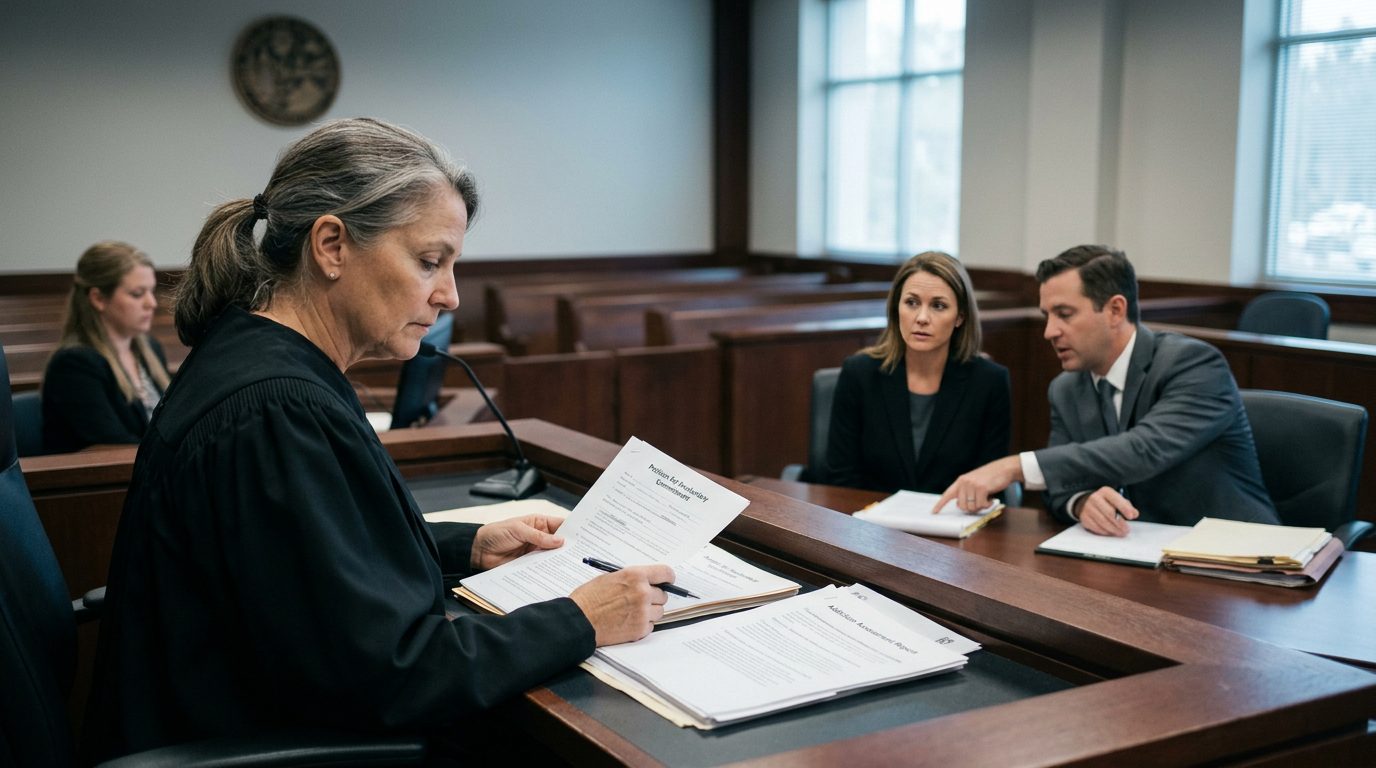
Under § 397.68151, the court must schedule a hearing within 10 court working days unless it grants a continuance. Here is the typical path:
- Consultation. You share the facts, dates, and documents with the firm.
- Counsel. The respondent has the right to counsel at every stage of the proceeding and may waive it only if present and the court finds the waiver knowing, intelligent, and voluntary. A respondent who cannot afford private counsel may get court-appointed counsel, and the court appoints counsel if it believes the respondent needs it, regardless of the respondent’s wishes.
- Notice. The respondent receives the petition and the hearing notice. Law enforcement usually serves the summons.
- Emergency orders. If emergency circumstances are asserted, the court may enter an ex parte assessment and stabilization order based on the petition. The person may be held no more than 72 hours for observation unless an exception applies, under § 397.6818.
- If the respondent does not appear at the hearing, the court, upon reviewing the petition, testimony, and evidence presented, may issue or reissue an ex parte assessment and stabilization order valid for 90 days if it reasonably believes the respondent meets the commitment criteria and that a substance abuse emergency exists. Testimony is taken under oath, under § 397.6957.
Your own evidence matters.
What a Court Order Can Cover and What Follows
A court may order involuntary treatment for up to 90 days when the conditions are proved by clear and convincing evidence, under § 397.697. A publicly funded provider can deliver the treatment. A private provider can be used if the person can pay or someone pays for them. The court keeps jurisdiction to monitor compliance and can act if an order is violated.
A renewal can add up to 90 more days, under § 397.6975.
Before the court-ordered services period expires, a renewal petition must be filed with the court, or the person is discharged automatically under § 397.6977. Discharge planning must address follow-up appointments, medications, living arrangements, transportation, and recovery support, as set out in § 397.6977.
Why Families Bring This Matter to Robinson Casey
Robinson Casey limits its practice to Marchman Act petitions and guardianship matters. That narrow focus keeps the firm’s work centered on these two areas.
Richard J. Casey III, Esq. is the lawyer responsible for this page. Our team includes support staff who help with scheduling and paperwork.
The firm serves families across South Florida and statewide, including Miami-Dade County. We explain each step in plain language, walk through the petition contents with you, and help you organize dates and witnesses. Some families also need a related guardianship matter reviewed, and the firm handles those too. No lawyer can promise how a court will rule in any case.
Questions Families Ask Before Filing
Can a relative file if the person has no home?
Yes.
Does the person have to agree?
No. Refusing help alone does not prove a lack of judgment, but the court looks at the full picture, as § 397.675 explains.
Do we need a lawyer?
The respondent has the right to counsel at every stage, and the court can appoint one. Robinson Casey can also help your family prepare the petition.
How long does the process take?
A hearing is set within 10 court working days unless it is continued.
What does the first consultation cost?
The first consultation is free, confidential, and comes with no obligation to continue. The clerk also may not charge a filing fee for the petition.
Not sure what your next step is?
Talk it through with our team — the first consultation is free, confidential, and carries no obligation.

Talk With Robinson Casey About Your Relative
Watching someone you love live on the street and use drugs wears you down. Deciding whether to go to court is a serious, personal choice. Before you decide, gather your notes, dates, and any records you have.
If your relative is living outdoors and using, call Robinson Casey at (561) 849-4149 or schedule a consultation and bring your notes.
Why Families Contact Robinson Casey
A Focused Practice
Robinson Casey focuses on Marchman Act petitions and guardianship matters, so the firm's work centers on these areas of Florida law.
Confidential First Consultation
Your first consultation is free, confidential and comes with no obligation to continue.
Support Staff Who Keep Things Moving
Our team of assistants and office staff helps keep your case organized and your paperwork on track.
South Florida and Statewide
We serve families in Miami-Dade and across South Florida, and we assist families throughout Florida.
Do Not Wait When Safety Is at Risk
If a loved one is in immediate danger, has no safe place to stay or refuses help while their health is declining, do not wait to get answers. Call the firm to talk through your family's situation.
Matters Robinson Casey Handles
Marchman Act Petitions
Petitions under the Florida Marchman Act for adults who need substance use assessment and treatment, handled with care for the person and the family.
Involuntary Commitment for Addiction
Guidance on the involuntary commitment process for substance use disorders and what families can expect along the way.
Emergency Temporary Guardianship
Help for families who need urgent court protection for an incapacitated adult while a longer-term plan is put in place.
Guardianship Matters
Plenary, limited and mental health guardianship petitions, with clear explanations of the options available for your loved one.