
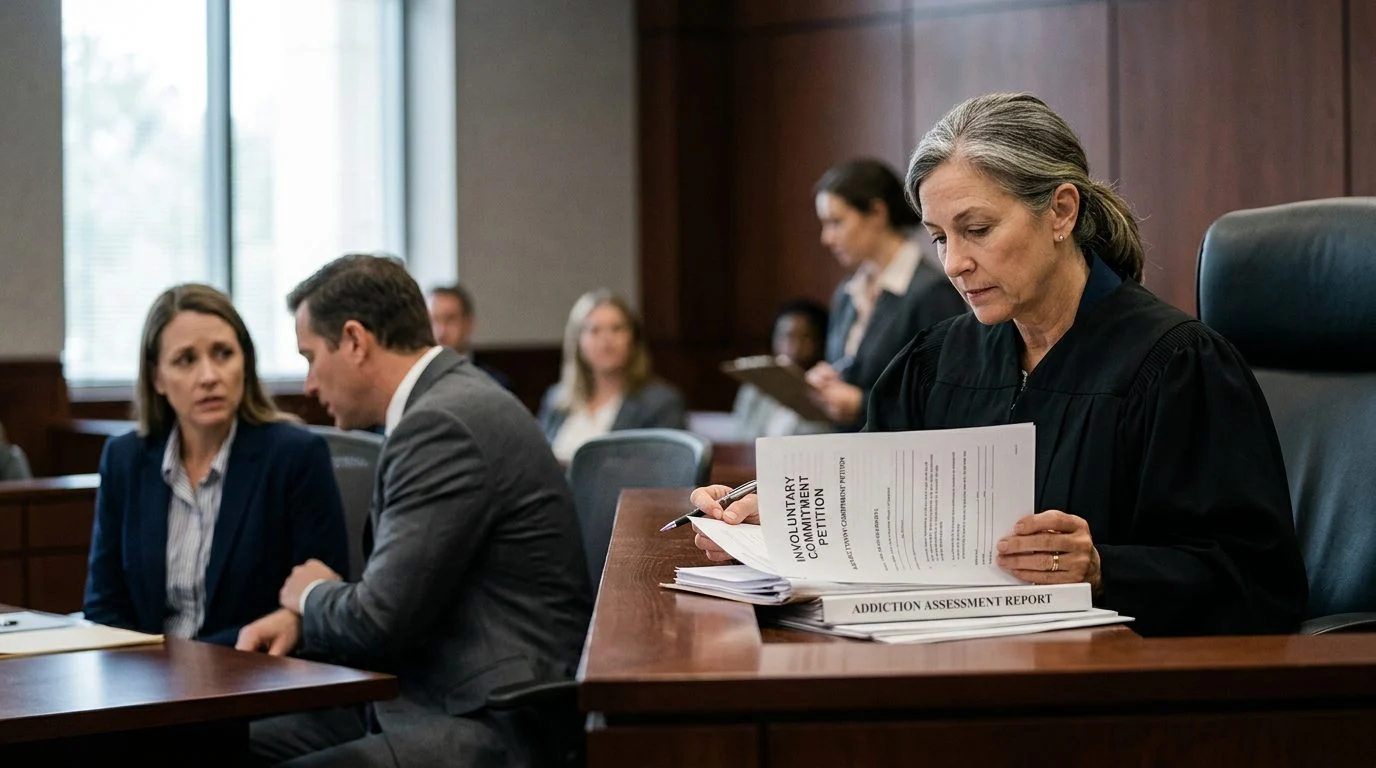
Marchman Act Attorney | Miami-Dade and South Florida
When someone you love is using drugs, you deserve a clear next step
Robinson Casey focuses on Marchman Act petitions and guardianship matters for families in Miami-Dade, South Florida and across Florida. Start with a free, confidential consultation.
Getting started with Robinson Casey
Free
First consultation, confidential and with no obligation to continue
Statewide
Serving families across South Florida and throughout Florida
(561) 849-4149
Call to speak with our team
By Richard J. Casey III, Esq. · Published October 25, 2026
If your loved one is using drugs right now, start with safety. Call 911 if the person is in immediate danger. After that, Florida’s Marchman Act may let a qualifying family member ask a court for an assessment and, if the law’s criteria are met, involuntary treatment. This page explains the first steps in plain language.
If Your Loved One Is in Danger Right Now
Call 911 first if the person is unresponsive, struggling to breathe, or in any immediate danger. Emergency medical care comes before any court process.
Stay with the person until help arrives. If they are unresponsive, keep them on their side so their airway stays clear. Don’t leave them alone to “sleep it off.” Tell the dispatcher what you know, including any drugs or medicines you think were taken.
If your loved one talks about hurting themselves or someone else, say so clearly to the 911 operator. Florida’s Marchman Act looks closely at whether there is substantial likelihood that a person has inflicted, or threatened to or attempted to inflict, or, unless admitted, is likely to inflict, physical harm on himself, herself, or another (Fla. Stat. § 397.675).
A court process takes time. A medical emergency cannot wait for it.
If your loved one's drug use has left you searching for safe options, Richard J. Casey III and our team can talk through what the Marchman Act may mean for your family. Talk it through with our team — the first consultation is free, confidential, and carries no obligation.

What the Marchman Act Is and Who It Covers
The Marchman Act is Florida’s law for court-ordered assessment and treatment of people whose substance use impairs them. It covers adults and minors.
For an adult, the law names who may file. A petition may be filed by the respondent’s spouse or legal guardian, any relative, a service provider, or an adult with direct personal knowledge of the impairment and the person’s prior assessment and treatment (Fla. Stat. § 397.68112). A parent, sibling, or adult child who is a relative can fall within “any relative.”
The court must have a good-faith reason to believe the person meets the criteria. Those criteria include substance abuse impairment and a loss of the power of self-control.
How to Marchman Act Someone in Florida: The Basic Steps
A petition for involuntary treatment of a substance-impaired person must be filed with the clerk of the court in the county where that person is located (Fla. Stat. § 397.681), and the impaired person is named as the respondent. The clerk may not charge a fee for filing it (Fla. Stat. § 397.681). In one Fifth District case, a wrong-county filing was treated as a venue problem, not a loss of jurisdiction (J.P. v. J.N.).
The petition must name the person as the respondent. It must also state the petitioner’s relationship to that person, the respondent’s lawyer if known, and the facts showing why services are needed (Fla. Stat. § 397.68141). A professional’s report from an exam within 30 days may be attached.
The court must schedule a hearing within 10 court working days unless it grants a continuance (Fla. Stat. § 397.68151). The court reviews the results of the qualified professional’s assessment at the hearing, and that clinical assessment must be filed with the clerk by the close of business on the day before the hearing (Fla. Stat. § 397.6957). At the hearing, the court may hear family members who know the person’s history.
If the conditions are proven by clear and convincing evidence, the court may order treatment for up to 90 days (Fla. Stat. § 397.697). Timelines and outcomes depend on the facts of each case.
Common Questions Families Ask in the First Days
When emergency circumstances exist, the petition must describe the exigent circumstances and include a request for an ex parte assessment and stabilization order (Fla. Stat. § 397.68141(3)). Where conditions are proved by clear and convincing evidence, the court may order the respondent to receive involuntary treatment services for a period not to exceed 90 days (Fla. Stat. § 397.697). A judge decides based on the evidence presented.
Can you force someone into rehab in Florida?
A court may order involuntary treatment for up to 90 days when the legal criteria are proven (Fla. Stat. § 397.697).
Can an adult child be Marchman Acted?
Yes. For an adult respondent, a petition for involuntary treatment services may be filed by the respondent’s spouse or legal guardian, any relative, a service provider, or an adult who has direct personal knowledge of the respondent’s substance abuse impairment and his or her prior course of assessment and treatment.
What if my loved one refuses help?
Mere refusal does not by itself show a lack of judgment (Fla. Stat. § 397.675).
Does my loved one get a lawyer?
Yes. A respondent has the right to counsel at every stage of a judicial proceeding on a petition for involuntary treatment, and a respondent who cannot afford private counsel has the right to court-appointed counsel. The Second District has held this right is constitutional (Hillsborough County v. Albrechta).
Can a judge act without a hearing?
In an emergency, the court may enter an assessment and stabilization order based on the petition alone (Fla. Stat. § 397.6818). The Second District found an order improper where it did not (D.H. v. K.J.R.).
How long can someone be held?
A service provider may hold a person for no more than 72 hours of observation, unless a listed exception applies (Fla. Stat. § 397.6818).
How to Support a Loved One Without Enabling Drug Use
Supporting someone without enabling means you stop covering for drug use. It also means you stop shielding them from the results. Enabling often looks like paying bills the person should pay, lying for them to employers, or cleaning up after crises with no plan to change.
Set boundaries you can keep. Say what you will and will not do, in simple words, before the next crisis. Then follow through. A limit you don’t enforce teaches nothing.
Pick calm moments to talk. Arguments while someone is intoxicated rarely go well. Keep your words short and direct.
Get support for yourself. Family members often carry heavy stress during an active crisis. Talk with someone you trust, and protect your own sleep and safety. You can set limits, but you cannot control another adult’s choices.
What to Gather and Write Down While You Prepare
Write down dated, factual details now. A petition must explain the facts behind your belief (Fla. Stat. § 397.68141). Note the date, time, and place of each overdose, unsafe incident, missed work or school day, or other concrete event.
Record which substances you believe are involved. Include prescription medicines and where they came from, if you know. Keep copies of messages, emergency room records, and police reports that describe the person’s condition.
Collect the basics: the person’s full legal name, date of birth, address, and the county where they are now located. The county matters because the petition goes where the person is located (J.P. v. J.N.).
Write down what the person has said about treatment and what happened when you tried to help. Stick to what you saw and heard, not your conclusions.
Know that the petitioner carries the burden of proof. In one case, the Fifth District reversed an order where the trial court questioned the only witness while the petitioner was absent (J.C. v. State). Florida appellate courts have split on related questions, so that rule is not settled statewide (J.J.J. v. D.G.).
Not sure what your next step is?
Talk it through with our team — the first consultation is free, confidential, and carries no obligation.

Talk With Robinson Casey About Your Loved One’s Situation
If you are watching someone you love use drugs and feel you have run out of safe options, a conversation can clarify what the Marchman Act may mean for your family. Robinson & Casey focuses exclusively on Marchman Act petitions and guardianship matters. Richard J. Casey III, Esq. is the responsible lawyer for this page.
Your first consultation is free, confidential, and carries no obligation to continue (consulta inicial gratuita, confidencial y sin compromiso).
Call (561) 849-4149 or request a consultation to talk through your loved one’s situation.
How we help families
Marchman Act Petitions
We guide families through the Florida Marchman Act process for a loved one who is struggling with substance use, from first questions through the court filing.
Involuntary Commitment for Addiction
When a loved one refuses treatment, we explain the court process for involuntary treatment and what your family may need to prepare.
Emergency Temporary Guardianship
For urgent situations, we help families understand emergency temporary guardianship and how the court may respond when immediate protection is needed.
Guardianship Matters
We assist with plenary, limited and mental health guardianship, helping families understand the options that fit their loved one's needs.
Why families call Robinson Casey
A focused practice
Robinson Casey focuses on Marchman Act petitions and guardianship matters, so our attention stays on the issues that bring families to us.
Compassionate, plain-language guidance
We understand how stressful it is to watch a loved one struggle. We explain each step in clear terms so you can make informed decisions.
Confidential conversations
Your first consultation is free, confidential and comes with no obligation to continue. You can share your concerns openly.
Support for your whole family
Our team, including our attorneys and support staff, works with families across South Florida and statewide.
Don't wait to ask questions
Court processes involving a loved one's substance use or safety can move quickly. Speaking with a lawyer early helps you understand your options before decisions are made. Your first consultation is free, confidential and without obligation.