
Marchman Act Guidance | Miami-Dade and South Florida
Marchman Act Medication for Opioid Use: Understanding Your Options in Florida
Robinson Casey focuses on Marchman Act petitions and guardianship matters for families across South Florida and statewide. Call (561) 849-4700 to discuss your family's situation.
Casey III, Esq. · Published November 7, 2026
Short Answer: What a Marchman Act Order Can Direct
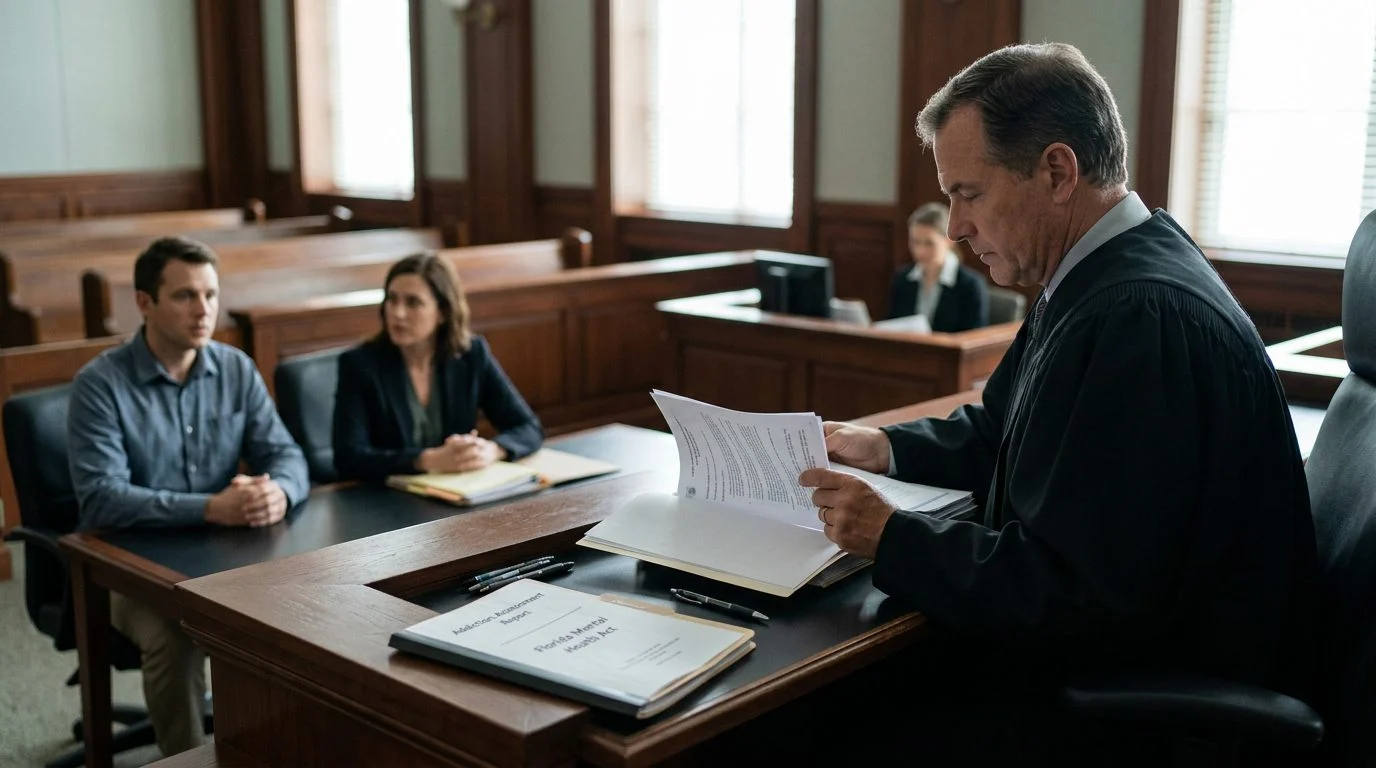
A Marchman Act order sends a person to assessment and services through a licensed provider. Medication for opioid use disorder can be part of a treatment plan, but whether a particular medication is included depends on the petition, the evidence, the provider’s clinical recommendation, and the court’s findings.
Many families ask this question after a loved one turns down help. This page explains how Florida law handles that situation. It covers the statute, how medication fits into treatment, what a judge reviews, and what a family can prepare. Robinson Casey focuses on Marchman Act petitions and guardianship matters for families in Miami-Dade, South Florida, and across Florida.
If you are worried about a loved one's opioid use and weighing a court petition, we can talk through your situation with you. Talk it through with our team — the first consultation is free, confidential, and carries no obligation.

What the Marchman Act Covers Under Florida Law
The Marchman Act lets a court order involuntary assessment and treatment for substance abuse impairment. The law requires a good faith reason to believe the person is impaired and has lost the power of self-control about substance use. The person must also need services and be unable to see that need, or, without care, be likely to neglect himself or herself in a way that poses a real and present threat of substantial harm that cannot be avoided through the help of willing, able, and responsible family members or friends or the provision of other services, or there must be a substantial likelihood the person will inflict physical harm on himself, herself, or another. Fla. Stat. § 397.675 sets out these criteria.
For an adult, a petition may be filed by a spouse or legal guardian, any relative, a service provider, or an adult with direct personal knowledge of the impairment and of the person’s prior course of assessment and treatment (Fla. Stat. § 397.68112). It goes to the clerk of the court in the county where the person is located, and the clerk may not charge a fee to file it (Fla. Stat. § 397.681).
In J.P. v. J.N., a Florida appeals court held that filing in the wrong county did not take away the circuit court’s jurisdiction. That makes the county requirement a venue question, not a jurisdiction question, but such petitions must still be filed with the clerk of the court in the county where the person is located.
How Medication Fits Into Treatment for Opioid Use Disorder
Medication for opioid use disorder is a clinical decision. Treating professionals make it after an assessment. Medications used in this area include buprenorphine, methadone, and naltrexone. The right choice depends on the person’s clinical picture, not on a family’s preference.
Florida law ties medication to counseling. Under Fla. Stat. § 397.427, a medication-assisted treatment protocol must specify how the medication is used with counseling or psychosocial treatment. The services must appear on the treatment plan. The same statute says providers of medication-assisted treatment for opiate addiction may not be licensed unless they also offer supportive rehabilitation, such as counseling, therapy, and vocational rehabilitation.
A Florida study of medication policies looked at drug and dependency courts in the state. It surveyed how these courts handle medication for opioid use disorder. That includes whether participants may start, continue, or complete programs while using medication.
What a Court Looks at When Deciding the Order
The court looks at the petition, the professional’s assessment, and testimony given under oath. The petitioner must prove by clear and convincing evidence that the respondent is substance abuse impaired and has a history of lack of compliance with treatment, and that because of such impairment the respondent is unlikely to voluntarily participate in the recommended services or is unable to determine whether services are necessary, and either that without services the respondent is likely to neglect himself or herself or refuse care in a way that poses a real and present threat of substantial harm and is substantially likely to cause serious bodily harm in the near future, as shown by recent behavior, or that the respondent’s refusal to receive care is based on judgment so impaired by substance abuse that the respondent cannot appreciate the need for care or make a rational decision about it (Fla. Stat. § 397.6957). Family members familiar with the person’s history may testify, and the court reviews the assessment results.
The qualified professional’s clinical report must reach the clerk by the close of business the day before the hearing. It must recommend a level of substance abuse treatment, if any, and note any co-occurring mental health needs. A report with no treatment recommendation leads to dismissal of the petition (same statute).
Florida’s Fifth District has also ruled on how a hearing runs. In C.W.R.K., the court held that a trial judge failed to follow the statute when, with the petitioner absent, it called and questioned the professional who signed the certificate.
If the court orders services, it orders the person to receive them from his or her chosen licensed service provider if possible and appropriate, and any treatment order must include findings on the need for treatment and on less restrictive alternatives. The court keeps authority to monitor compliance (Fla. Stat. § 397.697).
The hearing must be scheduled within 10 court working days unless a continuance is granted (Fla. Stat. § 397.68151). The respondent also has a constitutional right to counsel in these cases, as Hillsborough County v. Albrechta explains.
No result can be promised here. Each hearing turns on its own record.
Questions to Raise With the Treatment Provider
Ask the provider whether the proposed plan includes medication for opioid use disorder. If it does, ask which medication was recommended and why. Clear answers help you understand the plan, even though the clinical decision belongs to the treating team.
Share the loved one’s full medical history, known allergies, current medications, and any past response to opioid treatment. These details shape the clinical decision. Write them down before the assessment so nothing gets missed.
Ask how the plan pairs medication with counseling and what follow-up looks like. Under the statute, a medication protocol must spell out that pairing (Fla. Stat. § 397.427). Ask what the plan says if the loved one does not engage with services.
Preparing Information If You Are Considering a Petition
Start a written timeline of the loved one’s opioid use. Include dates of overdoses or near-overdoses, missed work or school, and safety incidents. Specific dates are easier to present clearly than general statements. Note even small changes, because a timeline shows a pattern more clearly than memory alone.
Gather records of prior treatment, detox stays, and hospital visits. Write down the names of every provider who has treated the loved one. A petition may come with a report from a qualified professional who examined the loved one within 30 days before filing. If the loved one was not assessed or refused, the petition must say so (Fla. Stat. § 397.68141).
Keep your own observations factual. Describe what you saw, when you saw it, and who else was there. The petition must also give the reason you believe the loved one has lost self-control. Facts tied to those points are easier for a court to follow.
Not sure what your next step is?
Talk it through with our team — the first consultation is free, confidential, and carries no obligation.
When a Family Situation Calls for Legal Guidance
Families often reach a point where court involvement is under consideration, especially when a loved one refuses help and the risk grows. In an emergency, Florida law allows faster action. Under Fla. Stat. § 397.6818, when the petitioner asserts that emergency circumstances exist, or the court determines that an emergency exists, the court may rely solely on the petition and, without appointing an attorney, enter an ex parte order for assessment and stabilization. That order must be carried out while the hearing is pending. In D.H. v. K.J.R., the Second District held that such an order must rest on petition facts giving a good faith reason to believe the statutory criteria are met.
Court records in these cases are confidential (Fla. Stat. § 397.6760). Robinson Casey focuses on Marchman Act petitions and guardianship matters. A Marchman Act attorney can explain how the statute applies to your situation.
Common Questions
The medication decision follows the clinical recommendation and the court’s findings.
Does the clerk charge a filing fee?
No. The clerk of the court may not charge a fee for filing the petition.

Talk With Robinson Casey About Your Situation
Robinson Casey offers a free, confidential first consultation, with no obligation to continue. You may be researching this on a loved one’s behalf, and you may not be ready to file anything yet. Richard J. Casey III, Esq. is the responsible lawyer for this page.
If you are worried about a loved one’s opioid use and weighing a court petition, we can talk through your situation with you. Call (561) 849-4700 or request a consultation.
How Robinson Casey Supports Families
Focused Practice
Our firm focuses on Marchman Act petitions, involuntary commitment for addiction, and guardianship matters.
Plain-Language Guidance
We explain court procedures, possible treatment pathways, and what to expect at each stage in clear terms.
Confidential Conversations
Your first consultation is confidential, so you can share the details of your family's situation openly.
Support for Families
Our team works with relatives and loved ones across Miami-Dade, South Florida, and throughout Florida.
Every Situation Is Different
Medication decisions within a Marchman Act case depend on the individual's assessment and treatment plan. Speak with our team about your loved one's circumstances before taking any step.
Matters We Handle
Marchman Act Petitions
Assistance with petitions for assessment, stabilization, and treatment for individuals with substance use disorders.
Involuntary Commitment for Addiction
Guidance on the court process for involuntary commitment when a loved one is unable to seek help voluntarily.
Emergency Temporary Guardianship
Help with urgent requests when a person needs immediate protection and decision-making support.
Guardianship Matters
Representation in plenary, limited, and mental health guardianship proceedings across Florida.