
Marchman Act & Guardianship | South Florida and Statewide
Helping Your Adult Child Get the Care They Need Under the Marchman Act
Robinson Casey focuses on Marchman Act petitions and guardianship matters for families across South Florida and statewide. Richard J. Casey III, Esq. is responsible for this page. Start with a free, confidential first consultation with no obligation to continue.
By Richard J. Casey III, Esq. · Published October 23, 2026
A Marchman Act petition is a court filing that asks a Florida judge to order assessment and, if the legal standards are met, treatment for an adult with a substance use problem who will not seek help on their own. A parent can file one. This page explains who may file, what the petition must say, how the process moves, and what happens at the hearing.
What a Marchman Act Petition Is and Who It Is For
A Marchman Act petition asks the court to address an adult’s substance abuse impairment when the adult refuses voluntary care. The law is part of Florida Statutes Chapter 397.
For an adult, Fla. Stat. § 397.68112 says who may file. The list includes the adult’s spouse or legal guardian, any relative, a service provider, and an adult with direct personal knowledge of the impairment and the adult’s prior assessment and treatment. A parent is a relative, so a parent may file.
The typical reader has already tried. You may have had hard talks, arranged treatment, or asked your child to get help, and heard a refusal each time. The petition is the next legal step when those efforts have not worked.
A Marchman Act petition is different from a guardianship case. Guardianship is a separate court process that the firm also handles. A Marchman Act petition focuses on substance use treatment.
Not sure what your next step is?
Talk it through with our team — the first consultation is free, confidential, and carries no obligation.

What the Court Looks For and What Your Petition Should Document
A petition must name the adult, name the petitioner, and explain how they are related. It must also name the adult’s attorney if known. Under Fla. Stat. § 397.68141, the factual allegations must give the reason you believe your child is impaired.
The admission criteria appear in § 397.675.
Good petitions are specific. Gather these items before your consultation:
- Dates and details of specific incidents
- Each treatment offer and how your child responded
- How substance use affected health, safety, work, or the home
- Texts, messages, and medical or treatment records you already have
A petition that lacks facts can fail. In D.H. v. K.J.R., the court found that the petition did not establish a good faith reason to believe D.H. met the statutory criteria for involuntary assessment and stabilization, and that the trial court erred in entering the ex parte order. An attorney reviews your facts to see whether they fit the law.
What a Marchman Act Petition Can and Cannot Do
A petition asks the court to order an assessment and, if the standards are met, court-ordered treatment. The judge decides the case. The court must find the conditions for involuntary treatment proved by clear and convincing evidence. Fla. Stat. § 397.697 allows an order for treatment for a period not to exceed 90 days.
In an emergency, the court may act faster. Under Fla. Stat. § 397.6818, the court may rely on the petition alone and, without appointing an attorney, enter an ex parte order for assessment and stabilization. A service provider may not hold the respondent for more than 72 hours of observation unless the statute’s listed conditions apply.
A petition is a court process about substance use treatment. It does not cover every problem your child may have. Treatment orders also have a time limit. At the end of the 90-day period, the respondent is automatically discharged unless a renewal motion was filed, under Fla. Stat. § 397.6977.
How the Process Works: Steps and Timeline
The process starts with a review of your facts and ends with a court decision. Each step builds on the one before.
- Consultation. You review the timeline and records with a lawyer. The lawyer helps you see whether a petition fits your facts.
- Filing. The petition goes to the clerk of the court in the county where your child is located. Florida law requires that such petitions be filed with the clerk of the court in the county where the person is located. In J.P. v. J.N., the court held that the filing of the petition in the wrong county did not divest the circuit court in Putnam County of jurisdiction. The location question is still important, so raise it early.
- Assessment. If your child was not assessed, the court may order an assessment and stabilization. Under § 397.6957, the court hears and reviews all relevant evidence, including the results of the assessment completed by the qualified professional in connection with this chapter.
- Notice. A copy of the petition and the notice of hearing go to your child, the petitioner, and the respondent’s attorney if known. The court sets the hearing within 10 court working days unless a continuance is granted, under § 397.68151.
- Hearing and order. The judge hears the evidence and decides whether the standards are met. If an order is entered, the law sets its time limit and discharge rules.
The Hearing, Costs, and Your First Consultation
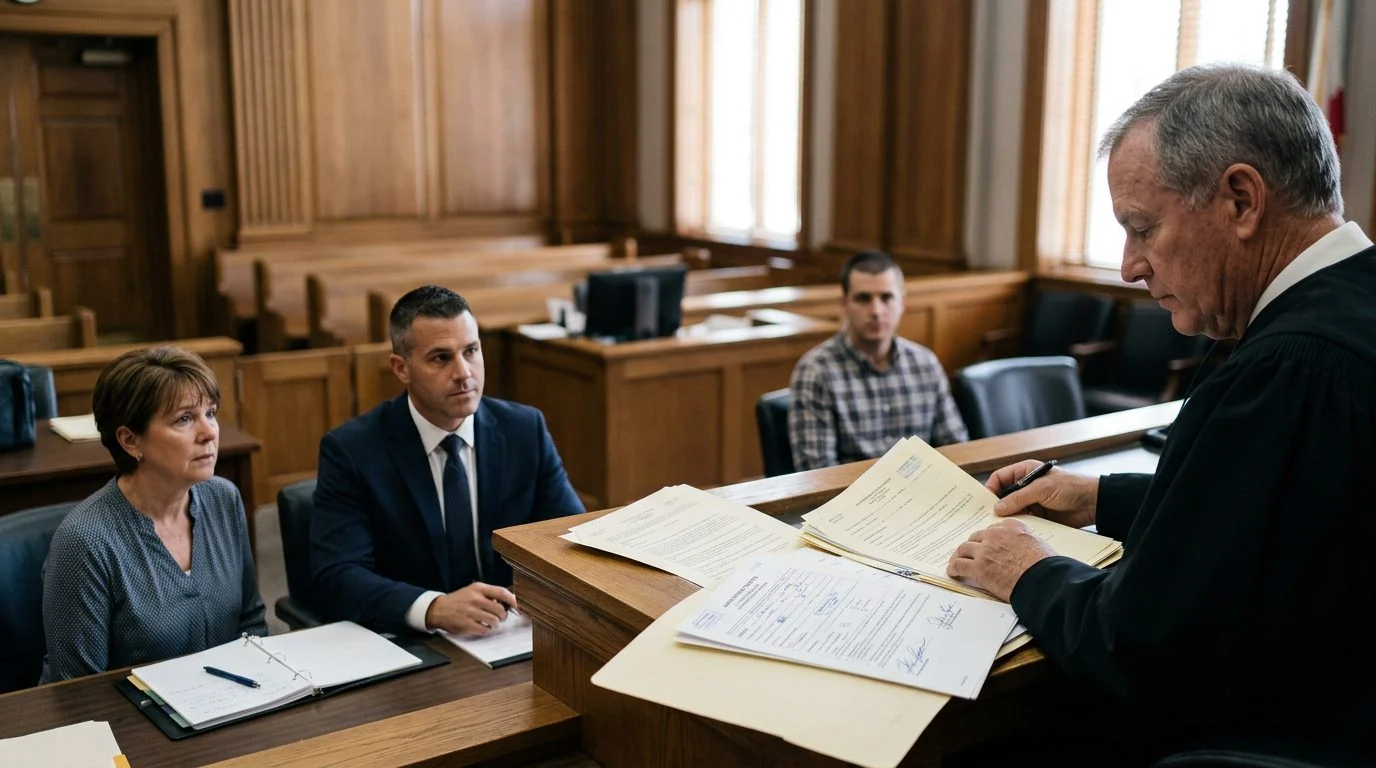
At the hearing, your child generally must be present unless the court accepts a valid waiver, or, after receiving proof of service and evaluating the circumstances, finds that your child’s presence is inconsistent with his or her best interests or is likely to be injurious to self or others. Testimony is taken under oath. Under § 397.6957, your child may refuse to testify.
Your child has the right to a lawyer at every stage. A respondent who desires counsel and cannot afford private counsel has the right to court-appointed counsel, under § 397.681. The Second District recognized that due process supports this right in Hillsborough County v. Albrechta.
Your role is to describe what you saw and heard, and to answer the judge’s questions. Witnesses may testify remotely by audio-video technology. Any witness doing so must send documents by the close of business the day before the hearing.
Florida courts also expect the petitioner to present the case. In C.W.R.K. v. Stewart Marchman Act Behavioral Healthcare, the court found that the trial court failed to follow the governing statute when, in the absence of the petitioner, it called and questioned the health care professional who executed the involuntary services certificate. The Fourth District reached a different result in J.J.J. v. D.G., and conflict was certified, so the rule varies by district.
The clerk may not charge a fee to file the petition, under § 397.681. Service of process fees may be waived if the petitioner is found indigent, under § 397.68112. The firm’s first consultation is free, confidential, and carries no obligation to continue. Bring your timeline and any treatment records. Bring your questions about costs too.
Why Robinson Casey for a Marchman Act Petition
Robinson Casey focuses exclusively on Marchman Act petitions and guardianship matters. The firm’s work is limited to these two areas, so each consultation centers on the facts that matter under this law.
Richard J. Casey III, Esq. is the responsible lawyer for this page. Our lawyers and our team serve families in Miami-Dade, South Florida, and across Florida. Our team can answer questions about filing, the hearing, and the steps that follow.
Our approach is practical. We review dates, records, and the petition’s required content with you. We explain what the court will ask and what your role will be. We also explain where the facts may not fit the statute, so you know that before you file.
Not sure what your next step is?
Talk it through with our team — the first consultation is free, confidential, and carries no obligation.

Frequently Asked Questions
Can I file a Marchman Act petition if my adult child lives outside my home?
Yes, if you are a relative or otherwise qualify under the statute.
Do I need proof my child is using right now?
The petition must give factual reasons for your belief about impairment and loss of self-control. It may include a professional assessment from the 30 days before filing.
What if my child agrees to treatment after I file?
The law sets out grounds for early release, including informed consent to voluntary treatment. Ask your lawyer how those rules apply to your facts.
Will I have to testify?
You may be asked to testify under oath about what you observed. Witnesses may also testify remotely.
Other costs depend on the facts of your case.
If your child keeps refusing help and you are weighing a petition, call Robinson Casey at (561) 849-4149 or request a consultation. We will review your facts with you.
How the Marchman Act Process Works
Understanding the Petition
A Marchman Act petition asks the court to review an adult's substance use and to consider whether treatment should be required. We explain what the petition must contain and what the court will look at.
Organizing Your Information
Petitions rely on specific facts about your loved one's behavior, impairment, and loss of self-control. We help you organize your observations, records, and any professional assessments in a clear, usable way.
Guardianship Options
We discuss emergency temporary, plenary, limited, and mental health guardianship so you can understand the differences.
Court Proceedings
Family members often have many questions about hearings, notices, and what to expect. We walk you through each step and keep you informed as your matter moves forward.
Why Families Bring Their Concerns to Robinson Casey
A Focused Practice
Robinson Casey focuses on Marchman Act petitions and guardianship matters, so our attention stays on the issues that matter most to families facing these situations.
Free, Confidential First Consultation
Your first consultation is free and confidential, with no obligation to continue. It is a chance to ask questions and understand your options.
Direct Access to Our Office
Call (561) 849-4149 to speak with our team about your family's situation and next steps.
Support for the Whole Family
Our team understands how stressful these matters can be. We communicate clearly and work to help your family feel informed at every stage.
Do Not Wait to Ask for Guidance
Concerns about an adult child's substance use often grow over time. Writing down specific, dated examples of what you have observed can help make your concerns clear, and speaking with an attorney early can help you understand your options.