
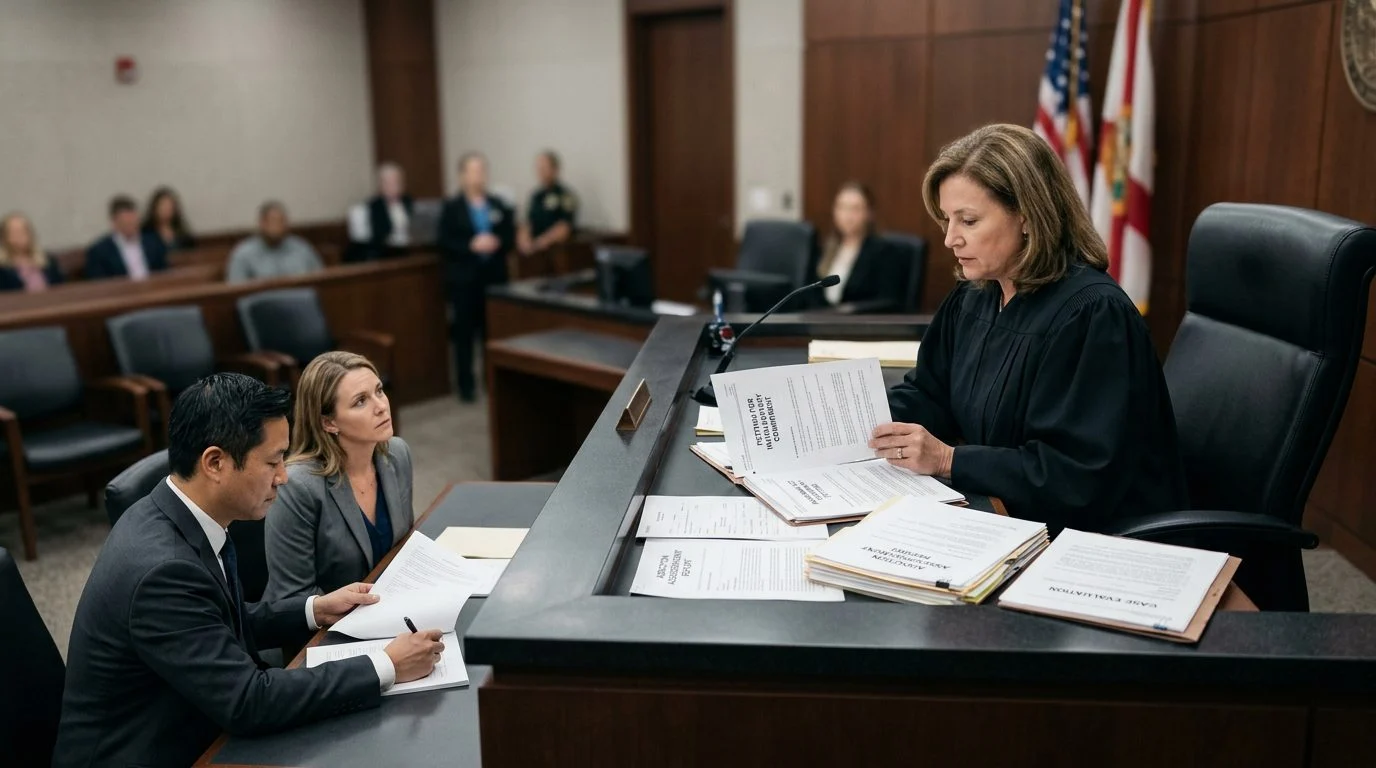
Marchman Act & Guardianship · South Florida
Marchman Act Hearings in Florida: Must the Respondent Attend?
Robinson Casey focuses on Marchman Act petitions and guardianship matters for families in Miami-Dade, across South Florida, and throughout Florida. Get clear answers about what the hearing involves.
Casey III, Esq. · Published November 7, 2026
Under Florida’s Marchman Act, the respondent must generally be present at the hearing. The court can excuse that presence only in limited situations that the statute describes. This page explains when a respondent must attend a Marchman Act hearing in Florida, and what a family member can do to prepare.
Why This Question Comes Up for Families
Most families first learn about a Marchman Act petition after someone has already filed it. That can feel sudden. You may be worried about your loved one, and now a court date is on the calendar.
The Marchman Act is Florida’s civil process for requesting a court-ordered treatment order when substance use puts a person or others at risk. Under Fla. Stat. § 397.6957, testimony in the hearing must be taken under oath, the proceedings must be recorded, and the respondent may refuse to testify at the hearing. The person the petition is about is called the respondent.
Florida law also says who may file. You can read the details in Florida’s rules on who may file.
Attendance is one of the first questions families ask. It matters because it decides whether your loved one must come to court, and what the court expects from the people involved.
If your loved one has been named in a petition and you're unsure what the hearing will require, our team is glad to talk it through with you. Talk it through with our team — the first consultation is free, confidential, and carries no obligation.

Short Answer: Does the Respondent Have to Attend?
Yes, the respondent generally must be present at the hearing. Under § 397.6957, the court may excuse the respondent’s presence at a hearing only if it finds that he or she knowingly, intelligently, and voluntarily waives the right to be present or, upon receiving proof of service and evaluating the circumstances of the case, that his or her presence is inconsistent with his or her best interests or is likely to be injurious to self or others. The first is when the respondent knowingly, intelligently, and voluntarily waives the right to be present. The second is when the court, after proof of service and a review of the circumstances, finds that presence is inconsistent with the respondent’s best interests or is likely to be injurious to self or others.
Whether either exception applies depends on the facts of the case, and the judge makes that decision. Do not assume an exception applies just because your loved one is struggling. The statute requires the court to make the finding.
The same statute lets witnesses attend remotely by audio-video technology and testify under oath, as appropriate, if they provide the parties with all relevant documents by the close of business on the day before the hearing. That rule covers witnesses, not the respondent. Keep the two ideas apart when you read court papers.
What the Marchman Act Hearing Is For
The hearing is where a judge decides whether to order involuntary treatment services. It is a court proceeding. It is not an intake appointment at a treatment provider, and it is not a family meeting.
Florida law sets the threshold. Under § 397.675, a person may meet the criteria for involuntary admission if there is good faith reason to believe the person is substance abuse impaired, or has a substance use disorder and a co-occurring mental health disorder, and, because of that impairment or disorder, meets the tests below. The person must also have lost the power of self-control with respect to substance use. The statute then adds a second test, such as being unable to appreciate the need for services, or facing a real and present threat of substantial harm.
The petitioner has the burden of proving by clear and convincing evidence both that the respondent is substance abuse impaired and has a history of lack of compliance with treatment for substance abuse, and that, because of that impairment, the respondent is unlikely to voluntarily participate in the recommended services or is unable to determine whether services are necessary; the petitioner must also prove one of two things: either that without services the respondent is likely to suffer from neglect or refuse to care for himself or herself, that this poses a real and present threat of substantial harm to his or her well-being, and that there is a substantial likelihood that without services the respondent will cause serious bodily harm to himself, herself, or another in the near future, as evidenced by recent behavior; or that the respondent’s refusal to voluntarily receive care is based on judgment so impaired by substance abuse that the respondent cannot appreciate the need for care or make a rational decision about it, as set out in § 397.6957.
A treatment order may last no more than 90 days, though a renewal may be requested before the 90 days end if the conditions are expected to continue, according to § 397.697.
Notice, Presence, and the Respondent’s Rights
The respondent must receive notice before the hearing. Under § 397.68151, the court must schedule the hearing within 10 court working days unless a continuance is granted. A copy of the petition and the notice of hearing goes to the respondent; for a minor, the parent, guardian, or legal custodian; the respondent’s attorney if known; the petitioner; the spouse or guardian if applicable; and anyone else the court directs.
The respondent also has the right to a lawyer. Under § 397.681, the respondent has the right to counsel at every stage of the proceeding. The respondent may waive that right only if present and the court finds the waiver knowing, intelligent, and voluntary. A respondent who cannot afford private counsel may receive a court-appointed lawyer.
Assessment is another protection. The exception is when the respondent is present in court and expressly waives the assessment. The respondent’s assessment by a qualified professional must occur within 72 hours after arrival at a licensed service provider (for a minor, it must begin within the first 12 hours of admission), unless the respondent shows signs of withdrawal or needs detoxification or medical treatment, which extends the observation period until that issue is resolved but no later than the scheduled hearing date, absent a court-approved extension, as § 397.6957 provides.
Voluntary Assessment Versus the Involuntary Petition Path
A voluntary assessment is a step a person agrees to on their own. An involuntary petition is different. It is a case filed with the court, and the court decides the outcome after a hearing.
The statute links involuntary treatment to a clinical assessment. Fla. Stat. § 397.6957 reads: “(b) A respondent may not be involuntarily ordered into treatment under this chapter without a clinical assessment being performed, unless he or she is present in court and expressly waives the assessment.” This order is part of the process, not a final decision on treatment.
Emergencies move faster. Under § 397.6818, when an emergency exists, the court may rely on the petition and enter an ex parte order, meaning one entered without the respondent present. The service provider may not hold the respondent for more than 72 hours of observation, unless a listed exception applies.
The same section explains what happens if the respondent does not appear at the hearing for any reason, including lack of service. The court may then issue or reissue an ex parte assessment and stabilization order valid for 90 days, if it reasonably believes the criteria and an emergency exist. If the respondent’s location is known, the court must continue the case for no more than 10 court working days.
Law enforcement can also be involved. The Florida Department of Children and Families explains that the court may order a law enforcement officer or another designated agent of the court to take the respondent into custody and deliver him or her for evaluation to either the nearest appropriate licensed service provider or a licensed service provider designated by the court.
What the Court Weighs at the Hearing
The court weighs all relevant evidence. The court may order drug tests.
Section 397.6818 does not address whether testimony is taken under oath or whether proceedings are recorded; it states that the court may issue or reissue an ex parte assessment and stabilization order valid for 90 days in certain cases. Under § 397.6818, if the respondent does not appear at the hearing for any reason, including lack of service, and the court reasonably believes after reviewing the petition, testimony, and evidence presented that the respondent meets the commitment criteria and that a substance abuse emergency exists, the court may issue or reissue an ex parte assessment and stabilization order valid for 90 days; this section does not address refusing to testify. Family members who testify should answer only what they saw, heard, or know first-hand.
Under § 397.68141, the petition must state why the petitioner believes the respondent is impaired, why the respondent has lost self-control, and either why the respondent has inflicted or is likely to inflict physical harm on himself or herself or others, or why the respondent’s refusal to voluntarily receive care is based on judgment so impaired by substance abuse that the respondent cannot appreciate the need for care. Dated, specific examples help show those reasons. Specific facts are what the court reviews, though no particular result can be promised.
Courts in Florida apply these rules differently in some situations. In J.C. v. State, the court failed to follow the applicable statute by essentially functioning as the absent petitioner. A trial court that calls and examines the only witness when the petitioner is absent functions as the absent petitioner and fails to follow the statute. The Fourth District reached a different view in J.J.J. v. D.G. and certified conflict. In J.J.J. v. D.G., the Fourth District affirmed and certified conflict with R.S., J.W., and C.W.R.K., for the reasons stated in the opinion.
Not sure what your next step is?
Talk it through with our team — the first consultation is free, confidential, and carries no obligation.
How a Family Member Can Prepare Before the Hearing
Start with a written timeline. List each dated event, what happened, where it happened, and who saw it. Specific dates and details are more useful to a court than general descriptions like “it’s been getting worse.”
Next, gather records you already have. These can include hospital or emergency room records, police reports, and records from earlier treatment. Write down the names and contact details of people who saw the events. Keep copies of any papers you received from the court.
If a witness will testify remotely, the witness must give the parties all relevant documents by the close of business on the day before the hearing. Plan that step early. Under § 397.6957, the rule applies to remote witnesses.
Know where the case is filed. Under § 397.681, a petition must be filed with the clerk of the court in the county where the person is located. The clerk may not charge a fee for filing the petition. For a loved one in Miami-Dade County, the petition goes to the clerk in that county.
Keep the file private. Under § 397.681, such petitions must be filed with the clerk of the court in the county where the person is located; this section does not address confidentiality, which is covered by § 397.6760. The clerk may release them on request to listed persons, including the petitioner and the respondent’s attorney, under § 397.6760.
Key Takeaways
- Organized dates, records, and witness details help the court review the facts.
- For the broader process, see our involuntary commitment for addiction information.
Can the respondent refuse to testify?
Yes, under Fla. Stat. § 397.6957(3), the respondent may refuse to testify at the hearing. Testimony is taken under oath, and the proceedings are recorded.
Does the respondent have a right to a lawyer?
Yes, the respondent has the right to counsel at every stage, though the respondent may waive that right if present and the court finds the waiver is knowing, intelligent, and voluntary. A respondent who wants counsel and cannot afford private counsel has the right to court-appointed counsel.
Can a family member testify?
Yes, the court must hear relevant evidence, including testimony from family members who know the respondent’s prior history.

Talking Through Your Loved One’s Hearing With Robinson Casey
If your loved one has been named in a petition, you may be trying to keep up with dates, papers, and what the judge will ask. You do not have to work through it alone.
Richard J. Casey III, Esq. is the responsible lawyer for this page. The first consultation is free, confidential, and carries no obligation to continue.
If you’d like to talk through your loved one’s hearing, call (561) 849-4700 or request a consultation.
Why Families Contact Robinson Casey
Focused Practice
Our practice focuses on Marchman Act petitions and guardianship matters, so your case is handled by a team concentrating on these proceedings.
Free First Consultation
Our free first consultation is confidential and carries no obligation to continue.
Confidential Discussions
Share your family's situation in a private setting, with a clear explanation of the next steps.
Direct Access
Call (561) 849-4700 to speak with our office about a Marchman Act hearing or guardianship question.
Don't Wait to Get Answers
Questions about a Marchman Act hearing are easier to address before the hearing date arrives. Contact our office early so we can review your situation and plan with you.
Matters We Handle
Marchman Act Petitions
Representation for families filing or responding to petitions for involuntary assessment and treatment of substance use disorders in Florida.
Involuntary Commitment for Addiction
Guidance on the court process for involuntary commitment when a loved one's substance use puts their safety at risk.
Guardianship Matters
Help with emergency temporary, plenary, and limited guardianship proceedings for adults who need court-supervised decision-making.
Mental Health Guardianship
Representation in guardianship cases where a family member's mental health condition affects their ability to make sound decisions.