
Marchman Act Help | Miami-Dade and South Florida
Wife Drinks Every Night? Get Clear Guidance on Your Marchman Act Options
Robinson Casey focuses on Marchman Act petitions and guardianship matters for families in Miami-Dade, across South Florida, and statewide. Your first consultation is free, confidential, and comes with no obligation to continue.
Casey III, Esq. · Published November 4, 2026
If your wife drinks every night and the kids are scared, start with three steps. Write down what happens, make a plan to keep the children safe, and learn how Florida’s Marchman Act works. This page walks through each one.
When Nightly Drinking Has Your Children Scared
Nightly drinking changes the whole house. Children learn to listen for the car in the driveway, watch their parent’s mood, and tiptoe past closed doors. You may be the one cleaning up after arguments, covering for missed work, and trying to keep everyone calm.
Your fears are real. You worry about harm to your children. You worry about money running out because bills go unpaid. You worry about what happens if nothing changes, and whether your marriage and family can survive it.
Waiting usually makes things harder. Florida gives a spouse real options, including asking a court for help when drinking puts the household at risk. You don’t have to fix this in one night. You can take concrete steps this week.
If your spouse's nightly drinking has your children frightened and the household on edge, you don't have to work out the next step alone; call Robinson & Casey to talk through your options. Talk it through with our team — the first consultation is free, confidential, and carries no obligation.

Signs the Drinking Has Become a Danger to the Household
Drinking becomes dangerous when it puts people at risk, even before anyone is badly hurt. Several patterns show the risk is growing.
Watch for drinking every night, sudden anger or mood swings, missed work, school, or bills, falls or injuries, and driving or caring for children after drinking. Each one shows the drinking is taking over daily life. A pattern that gets worse each month is a warning sign.
Florida’s involuntary admission criteria focus on whether a person has lost the power of self-control with respect to substance use. They also look at whether that loss creates a real threat of harm. Fla. Stat. § 397.675 sets out those criteria.
Separate two situations. An emergency means someone is in danger right now, such as a child left alone or a threat of violence. Call 911 in that moment. A pattern means the drinking keeps getting worse and the household is slipping. A pattern calls for a written plan and a clear record.
Start Documenting Incidents Now
Write down each incident on the day it happens, while the details are fresh. Clear, dated notes are often the most useful thing a worried spouse can keep.
For each entry, record the date, the time, what happened, who was there, and what the children saw or said. Write the children’s words as close to exact as you can. Describe facts instead of labels. “He slurred his words, knocked over a chair, and told our son to go to bed” is more useful than “he was drunk.”
Save what you already have. Keep text messages, voicemails, photos, school emails, and messages from family members. Keep copies of any police report, emergency room record, or detox admission. Store copies somewhere safe outside the house.
Avoid common mistakes. Don’t rely on memory alone, and don’t exaggerate or guess. Don’t delete messages to clean up the record. Don’t confront your spouse while he or she is drinking, because that often leads to a worse night. If anyone is in immediate danger, call 911 first, then write it down.
Protecting Your Children While the Situation Plays Out
A simple written safety plan protects children better than hoping the next night goes well. Keep it short enough that a child can remember it.
Decide where the children sleep on hard nights and which room they can lock from inside. Pick one trusted adult each child can call. Give them a code word that means “come get me,” and teach them to dial 911.
Tell the children’s school what is happening, at least as it affects pickup and emergency contacts. Ask who may collect each child. School staff can act quickly when they know the situation.
Keep car keys, medications, and alcohol out of easy reach where that’s practical. Tell the children they did nothing wrong and are not responsible for their parent’s drinking. Children often feel they must keep the peace. They need to hear that adults will handle the hard parts.
If you think a child may be harmed or neglected, report it. The Florida Department of Children and Families runs an abuse hotline. The Florida Department of Health says Child Protection Teams assess risk and investigate alleged neglect or abuse. Florida’s treatment-record confidentiality rules do not restrict reporting suspected child abuse or neglect to the appropriate state or local authorities as required by law, although those rules still apply to the provider’s original records.
What the Marchman Act Is and What It Can and Cannot Do
The Marchman Act is Florida’s law for court-ordered treatment of substance use. Florida Statutes § 397.675 sets out the criteria for involuntary admission based on substance abuse impairment or a substance use disorder with a co-occurring mental health disorder.
Here is what it can do. In an emergency, a judge can enter an order for assessment and stabilization based on the petition, without first appointing a lawyer, under Fla. Stat. § 397.6818. If the court finds the conditions proved by clear and convincing evidence, it may order treatment for up to 90 days, under Fla. Stat. § 397.697.
Here is what it cannot do. It is a treatment law, not a punishment. It does not repair a marriage, and it is not a divorce case.
Many families first ask whether a spouse will enter treatment on his or her own. A person who wants treatment may apply to a service provider for voluntary admission, as Chapter 397 allows. The court-ordered path applies only when the conditions for involuntary treatment have been proved by clear and convincing evidence.
How a Marchman Act Petition Works and What the Hearing Involves
A spouse may file a Marchman Act petition for an adult, under Fla. Stat. § 397.68112. The petition goes to the clerk of court in the county where the person is located. The clerk may not charge a filing fee for it, under Fla. Stat. § 397.681.
The petition must name both of you and state your relationship. It must lay out facts showing why you believe your spouse is impaired, has lost self-control, and either has inflicted or is likely to inflict physical harm on himself, herself, or others unless the court orders the involuntary services, or refuses care because impaired judgment prevents appreciating the need for it, as Fla. Stat. § 397.68141 requires. If a qualified professional examined your spouse within 30 days before filing, that report can go with the petition. If there was no assessment, the petition must say so.
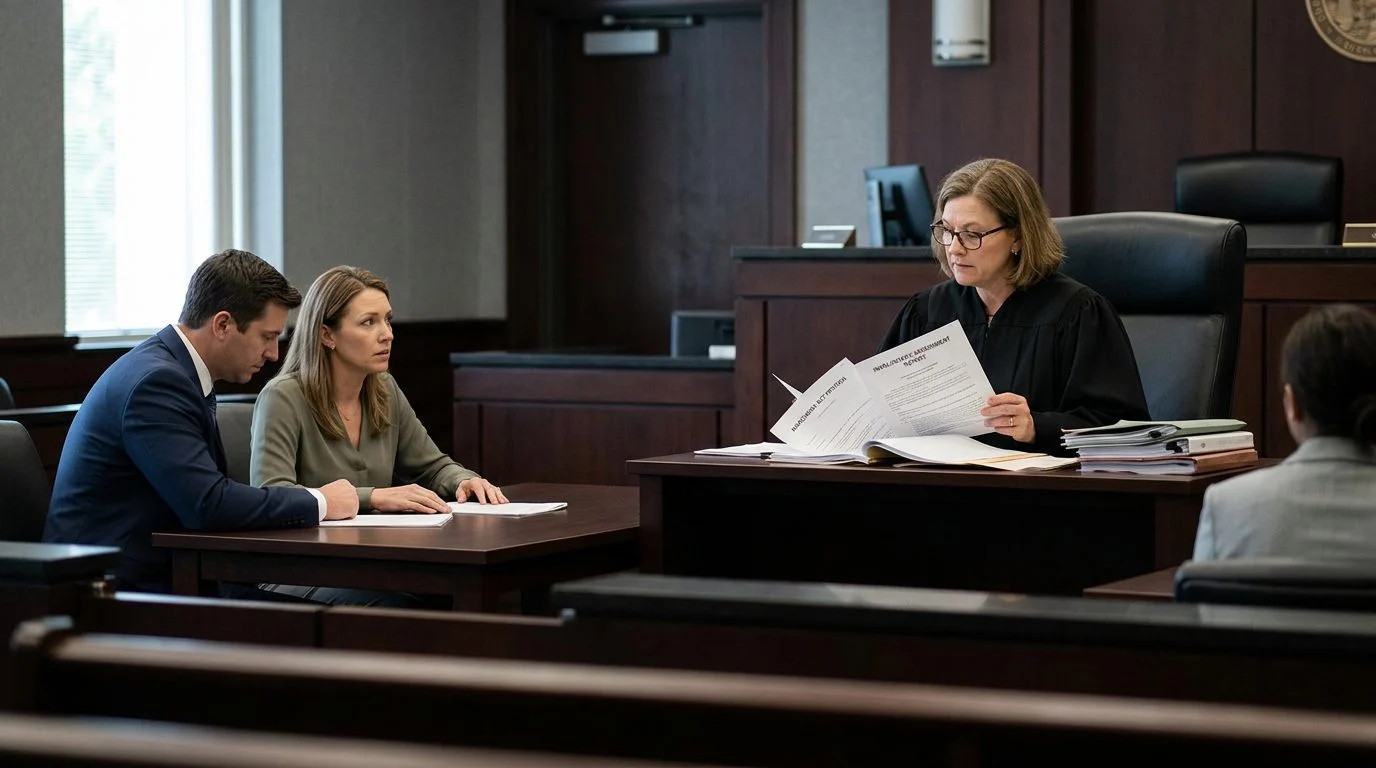
The court must schedule a hearing within 10 court working days unless a continuance is granted, under Fla. Stat. § 397.68151. A person who cannot afford one may receive a court-appointed lawyer. A Florida appeals court has also held that a Marchman respondent has a constitutional right to counsel, in Hillsborough County v. Albrechta.
At the hearing, the judge reviews all relevant evidence. That includes testimony from family members who know your spouse’s history, and the assessment results. The judge may order drug tests. Testimony at the hearing is taken under oath, and your spouse may refuse to testify.
The petitioner carries the burden of proof. In J.C. v. State, the Fifth District reversed when the trial court questioned the only witness after the petitioner was absent. That is Fifth District law, and Florida’s appeals courts have not all agreed on how the rule applies. A dated log gives a family witness specific facts to share with the judge.
Not sure what your next step is?
Talk it through with our team — the first consultation is free, confidential, and carries no obligation.
How Treatment Evidence Can Affect Custody, Time-Sharing, and Household Finances
Records of drinking, treatment, and household harm can become part of the picture a family court considers. That picture can include how children spend time with each parent. Your own documentation is part of that record.
Start with the facts you already have. Your incident log, school notes, police or emergency records, and treatment records can show patterns over time. Treatment records are confidential. They may not be disclosed without the written consent of the person they pertain to, except in the situations listed in the statute.
Money is often the next pressure point. Keep a simple record of household bills, missed payments, unexplained withdrawals, and money spent on alcohol. Save statements and receipts. Clear numbers help you tell the household’s story accurately.
No one can predict how a custody or money question will turn out. Each family’s facts are different, and judges weigh the evidence presented in each case. Focus on what you can control now: accurate records, a steady routine for the children, and a plan for hard nights.

Not Sure What Your Next Step Is?
The next step is to turn your notes and worries into a clear plan. Two quick answers may help you start.
Quick answers
Can a spouse file a Marchman Act petition in Florida?
Yes. Florida law lets a spouse file a petition for an adult respondent.
Where is the petition filed?
It goes to the clerk of court in the county where the person is located. The clerk may not charge a filing fee.
Does my spouse get a lawyer?
Yes. A respondent has the right to counsel at every stage of the case, and a respondent who wants a lawyer but cannot afford one has the right to court-appointed counsel. The respondent may waive the right to counsel only if present and the court finds the waiver is made knowingly, intelligently, and voluntarily.
A court may issue an emergency assessment and stabilization order. A 90-day ex parte order applies only when the respondent does not appear at the hearing and, after reviewing the petition, testimony, and evidence, the court reasonably believes the respondent meets the commitment criteria and that a substance abuse emergency exists, and then issues or reissues an order under Florida Statute § 397.6818. Otherwise, the order must be carried out while the hearing is pending, and it is void if it is not carried out by the initial hearing date.
It serves families across South Florida, including Miami-Dade, and statewide. Richard J. Casey III, Esq. is responsible for this page. For more background, read the Marchman Act attorney guide.
If your spouse’s nightly drinking has your children frightened and your household on edge, you don’t have to work out the next step alone. Call (561) 849-4700 or request a consultation. The first consultation is free, confidential, and comes with no obligation to continue.
What You Can Expect When You Reach Out
Confidential Conversation
Your first consultation is confidential, so you can describe what is happening at home openly and without pressure.
Plain-Language Answers
We explain the Marchman Act process, the roles involved, and the questions families most often ask, in terms you can use.
Review of Your Situation
We look at the facts of your family's situation and outline the paths that may be available, so you can decide what comes next.
Focus on Families
Our team understands how addiction affects spouses, children, and households, and we keep your family's safety at the center of the discussion.
Don't Wait for the Next Crisis
If drinking is putting your wife's health, your family's safety, or your household at risk, speak with an attorney now rather than after the next emergency. Your first consultation is free and confidential.
Matters Robinson Casey Handles
Marchman Act Attorney
Guidance on Marchman Act petitions for adults struggling with substance use, from the first questions through the steps that follow.
Involuntary Commitment for Addiction
Help understanding involuntary commitment for addiction and how it fits within the Marchman Act process in Florida.
Guardianship Attorney
Representation in guardianship matters for families in Miami-Dade, South Florida, and across the state.
Emergency Temporary Guardianship
Support for families who need emergency temporary guardianship when a loved one's safety or well-being is in immediate question.
Talk With Robinson Casey About Your Family's Situation. Call (561) 849-4700.
Related practice areas
- Involuntary Commitment for Addiction in Florida
- Involuntary Commitment For Addiction in Miami Dade
- Involuntary Commitment For Addiction in South Florida
- Marchman Act Attorney in South Florida: Adult Child Options