
Marchman Act Attorney · Miami-Dade & South Florida
Your Adult Child Refuses Detox. Here Is What You Can Do.
Robinson Casey focuses on Marchman Act petitions and guardianship matters for families in Miami-Dade and across South Florida. Richard J. Casey III, Esq. is responsible for this page. Your free first consultation is confidential and carries no obligation to continue.
Casey III, Esq. · Published November 8, 2026
When an Adult Child Refuses Detox in Florida
If an adult child refuses detox Florida families often turn to the courts. In most cases, that path is the Marchman Act, Florida’s civil process for people whose substance use leaves them impaired. A family member starts it by filing a petition with the court. A parent does not simply decide.
You have been here before. You have paid for treatment, tried interventions, and held the boundaries you were told to hold. Then came an overdose, a relapse, or a night in the emergency room. Now you are looking for another way.
Your fears are real. You may fear your child dying, going to jail, or ending up homeless. No lawyer can promise how a situation will turn out. What the law does provide is a way for a judge to review the facts and decide whether court-ordered care is needed.
If your adult child keeps refusing help after an overdose or relapse, you don't have to weigh the next legal step alone. Call Robinson Casey to talk through your options. Talk it through with our team — the first consultation is free, confidential, and carries no obligation.

How the Marchman Act Handles Detox Without Consent
The Marchman Act can lead to a court order for assessment, stabilization and treatment, even when the adult does not agree.
This is a court process, not a police or criminal case. The judge makes the findings. Under Fla. Stat. § 397.697, the court may order involuntary treatment only when the conditions are proved by clear and convincing evidence.
Your child keeps important rights. The respondent must be present at the hearing unless the court finds that he or she knowingly, intelligently, and voluntarily waives the right to be present, or that, after receiving proof of service and evaluating the circumstances, his or her presence is inconsistent with his or her best interests or is likely to be injurious to self or others.
Refusal alone is not enough, because mere refusal to receive services does not by itself prove lack of judgment about the need for services; the court may order involuntary treatment only when the conditions are proved by clear and convincing evidence. The criteria for involuntary admission say that mere refusal to receive services does not by itself prove lack of judgment. Fla. Stat. § 397.675 reads: “(b) Without care or treatment, is likely to suffer from neglect or refuse to care for himself or herself; that such neglect or refusal poses a real and present threat of substantial harm to his or her well-being; and that it is not apparent that such harm may be avoided through the help of willing, able, and responsible family members or friends or the provision of other services, or there is substantial likelihood that the person has inflicted, or threatened to or attempted to inflict, or, unless admitted, is likely to inflict, physical harm on himself, herself, or another.” The petition has to show more.
Who Can File a Petition and What It Must Describe
For an adult, a parent can file. Under Fla. Stat. § 397.68112, a petition may be filed by a spouse or legal guardian, any relative, a service provider, or an adult with direct personal knowledge of the impairment and prior treatment.
An appeals court held that a petition filed in the wrong county is a venue defect, not a lack of jurisdiction, in J.P. v. J.N..
Specific, dated facts carry the petition. Examples include overdoses, emergency visits, dangerous conduct, lost housing or work, and treatment refused before. A vague statement that your child is “using again” will not do the job.
What Happens After a Petition Is Filed
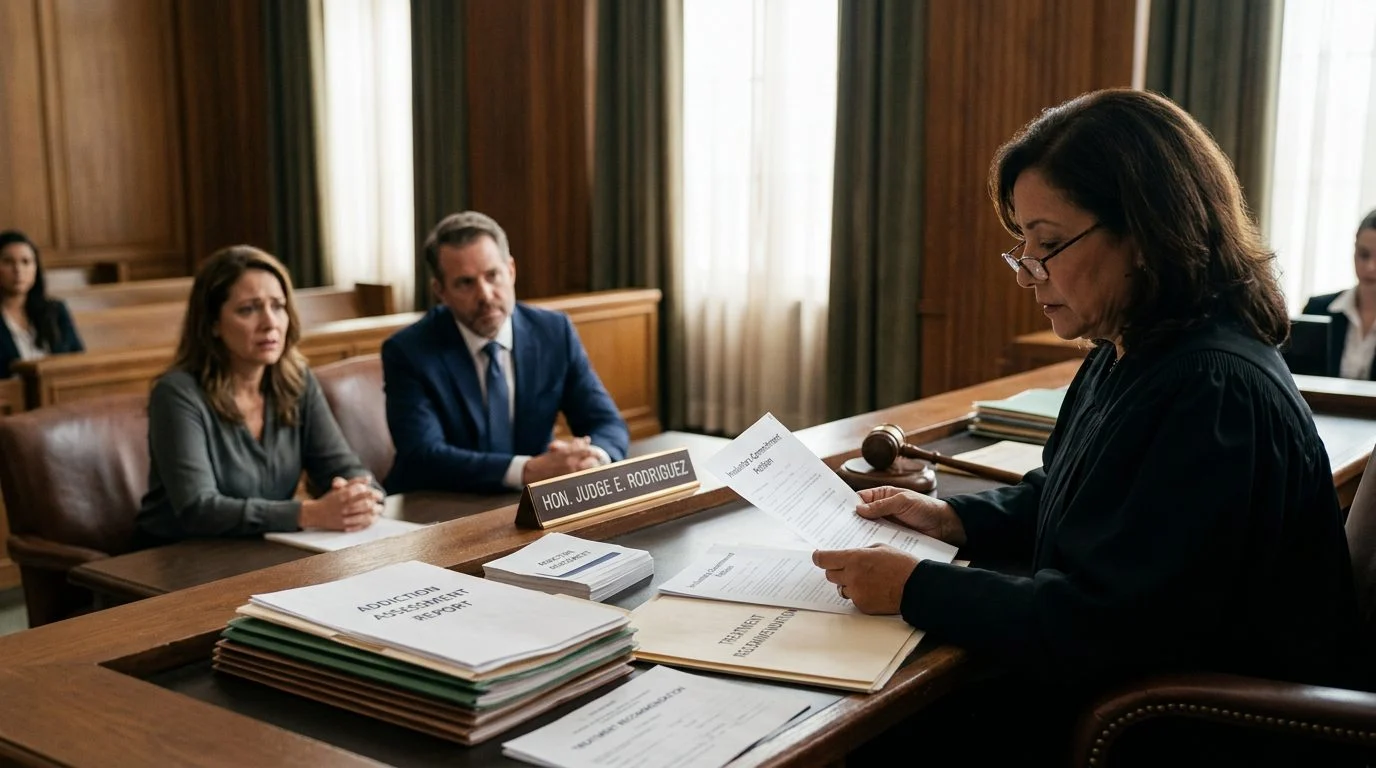
After filing, the court sets a hearing. In an emergency, the court may rely only on the petition and enter an ex parte order for assessment and stabilization, without first appointing a lawyer. Under Fla. Stat. § 397.6818, a provider generally may not hold the person for more than 72 hours of observation, unless a listed exception applies.
Your child must be present at the hearing unless the court accepts a valid waiver, or finds that presence is inconsistent with their best interests or likely to be injurious. Under Fla. Stat. § 397.6957, the court hears relevant evidence, including testimony from family members who know the history. Testimony is under oath, and the proceedings are recorded. Your child may refuse to testify.
If the court finds the conditions proved, it may order treatment for a period not to exceed 90 days.
What the Judge Looks At and What You Should Document
Under Fla. Stat. § 397.675, a person meets the criteria for involuntary admission if there is good faith reason to believe the person is substance abuse impaired, or has a substance use disorder and a co-occurring mental health disorder, and because of that impairment or disorder has lost the power of self-control with respect to substance abuse, and also either needs substance abuse services and is incapable of appreciating that need, or is likely to neglect or refuse care, that neglect or refusal poses a real and present threat of substantial harm, and it is not apparent that such harm may be avoided through the help of willing, able, and responsible family members or friends or the provision of other services, or there is substantial likelihood that the person has inflicted, or threatened or attempted to inflict, or is likely to inflict, physical harm on himself, herself, or another. The judge needs facts, not a general sense of worry.
Who must prove the case can be disputed. In J.C. v. State, the appeals court held that the trial court “failed to follow the applicable statute by essentially functioning as the absent petitioner.” A Fourth District court disagreed and certified a conflict with those Fifth District decisions, as explained in J.J.J. v. D.G.. Plan to present your own evidence and be ready to testify.
Start a dated record now. Write down each overdose, hospital or police contact, threat, missed commitment, and prior treatment attempt. Note the provider names and dates. This record supports your petition and your testimony.
Court records in these cases are confidential under Florida law. The clerk may not publish personal identifying information on a public docket.
Options for Families Who Cannot Wait for Another Relapse
A petition is one legal option. Many families use it alongside their own steps, such as family support and boundaries, not in place of them. A lawyer can help you weigh which path fits your facts.
Timing matters. The emergency path depends on a petition that shows real, specific facts. Under the Second District’s ruling in D.H. v. K.J.R., an ex parte order based on an insufficient petition was error. A complete petition protects the process for everyone involved.
Frequently Asked Questions
Can I force my adult child into detox in Florida if they refuse?
A parent cannot order it alone. A court can order involuntary treatment if the conditions for involuntary treatment services are proved by clear and convincing evidence.
Does my adult child have a right to a lawyer?
Under Fla. Stat. § 397.6818(1), when emergency circumstances exist, the court may rely solely on the contents of the petition and, without the appointment of an attorney, enter an ex parte order for your adult child’s involuntary assessment and stabilization, so ask early what representation your adult child will have.
Is refusing treatment enough to win a petition?
No. The statute says refusal alone does not show lack of judgment, so the petition needs more facts.
Not sure what your next step is?
Talk it through with our team — the first consultation is free, confidential, and carries no obligation.

Talk With a Marchman Act Attorney About Your Son or Daughter
If your adult child refused detox after an overdose, relapse, or hospital visit, you may be weighing a petition right now. Robinson & Casey limits practice to Marchman Act petitions and guardianship matters. The firm serves families in Miami-Dade, across South Florida, and statewide. Richard J. Casey III, Esq. is the responsible lawyer for this page.
The first consultation is free, confidential, and without obligation. Call (561) 849-4700 or use the contact page to talk about your child’s situation.
How Robinson Casey Can Help Your Family
Marchman Act Petitions
We prepare and file petitions under the Florida Marchman Act for families seeking court-ordered assessment and treatment for a loved one with substance use problems.
Involuntary Commitment for Addiction
We explain the court process for involuntary treatment and what evidence the court considers, so you understand each step before you decide how to proceed.
Guardianship Matters
We handle emergency temporary, plenary, limited, and mental health guardianship matters for families facing urgent decisions about a loved one's care.
Clear, Direct Communication
Our team keeps you informed and answers your questions in plain language, so you are never left guessing about what comes next.
Don't Wait Until the Situation Becomes a Crisis
Families often delay because they hope their adult child will agree to treatment on their own.
Common Questions Families Bring to Us
Can I force my adult child into detox?
A parent cannot order treatment alone. Florida courts decide whether involuntary treatment is appropriate after reviewing the evidence. We explain how that process works in your county.
What happens at the first hearing?
We walk you through what to expect, which documents may be needed, and how your role as the petitioner or family member fits into the process.
Is this a guardianship or a Marchman Act case?
The answer depends on your loved one's condition and circumstances. We review the facts with you and identify which legal path fits your family's situation.
What does the first consultation cost?
Your first consultation is free, confidential, and carries no obligation to continue. Call (561) 849-4700 or schedule online to begin.