
Marchman Act Petitions · South Florida
Your Adult Son Skipped His Marchman Act Hearing. What Happens Next?
Robinson Casey focuses on Marchman Act petitions and guardianship matters for families in Miami-Dade and across South Florida. Talk with us about where your family stands.
By Richard J. Casey III, Esq. · Published November 3, 2026
Your son keeps missing court, and you are running out of options
If your son keeps missing Marchman Act court dates, the case does not simply stop. Florida courts can still act, and if the court finds the conditions for treatment proved by clear and convincing evidence and finds it necessary, it may direct the sheriff to take him into custody and deliver him for involuntary treatment services.
You have probably tried treatment, interventions and firm boundaries already. You may be living with the fear that the next call will be about an overdose, a hospital stay or an arrest. This page explains the court process in plain terms, without blame.
This is general information about Florida’s Marchman Act. It is not advice about your own facts, so take it as a starting point for understanding the process.
If your son keeps missing court and you feel you are facing this alone, reach out to our team for a free, confidential first consultation. Talk it through with our team — the first consultation is free, confidential, and carries no obligation.

What is the Marchman Act, and why is a hearing scheduled?
The Marchman Act is Florida’s law for court-ordered assessment and treatment of a person whose substance use is harming them. The Florida Department of Children and Families describes it as allowing involuntary assessment, stabilization and treatment for adults and youth severely impaired by substance abuse.
Under § 397.675, a person may meet the criteria if there is a good faith reason to believe they are substance abuse impaired.
A petition asks a judge to decide whether those criteria are met. The judge decides at a hearing. The court must schedule that hearing within 10 court working days unless a continuance is granted, under § 397.68151.
For the full overview of the process, read our Marchman Act attorney guide.
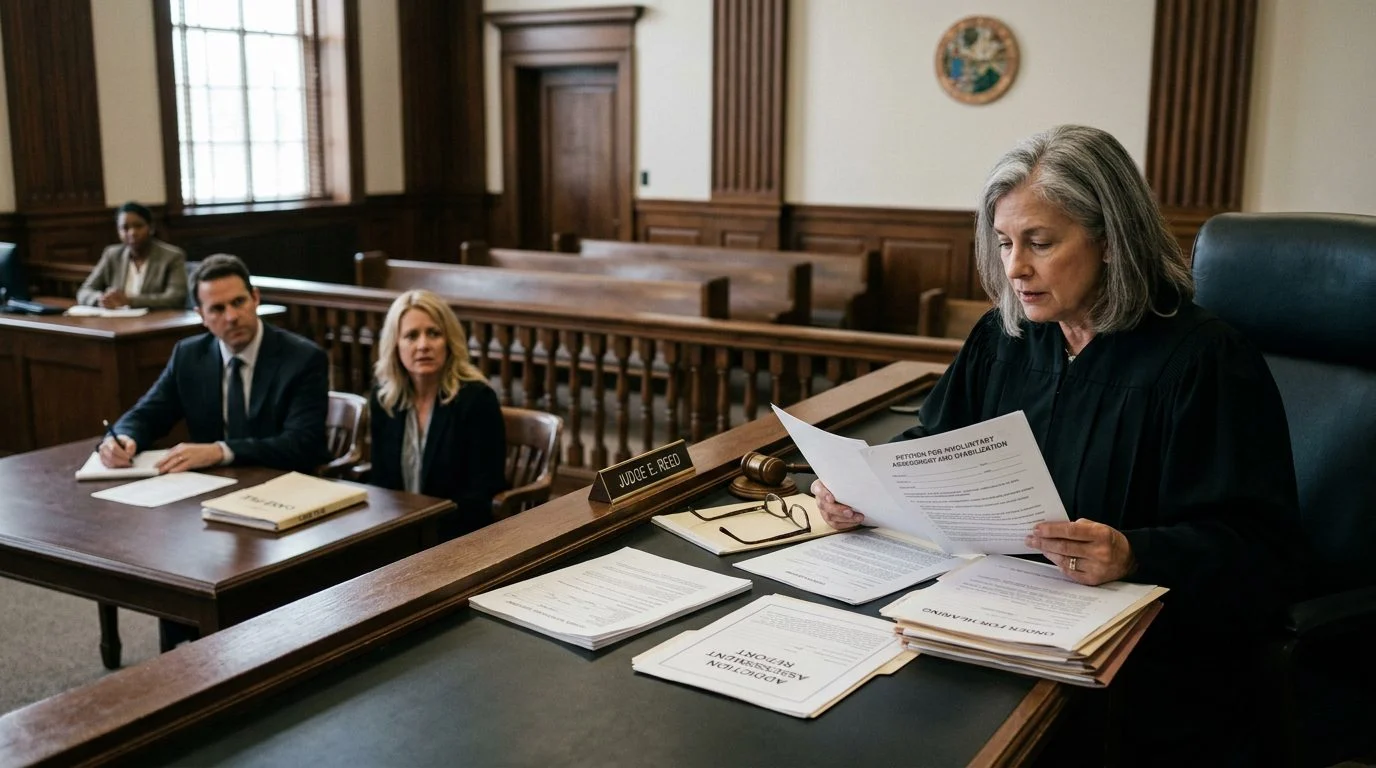
What happens if your adult son misses a Marchman Act hearing?
A missed hearing gives the judge more tools, not fewer. Your son must be present at the hearing unless the court finds he knowingly, intelligently, and voluntarily waives that right or, upon receiving proof of service, finds that his presence is inconsistent with his best interests or is likely to be injurious to himself or others, under § 397.6957.
If he does not appear and the court reasonably believes he meets the commitment criteria and that a substance abuse emergency exists, it may issue or reissue an ex parte assessment and stabilization order valid for 90 days, according to § 397.6818. If the court knows where he is, it must continue the case for no more than 10 court working days. It may also order law enforcement to take him into custody and deliver him for evaluation.
Before the hearing, the court may order a law enforcement officer or another designated agent to serve the respondent with the notice of hearing and a copy of the petition, under § 397.6818.
What happens next depends on the facts, the notices and the court’s schedule. Do not assume one outcome. A missed date does not end the petition. Keep copies of every notice, every call to the clerk and every date your son misses, all in one place.
Who can file a petition, and what must the court find?
A parent can file. For an adult, § 397.68112 allows a petition by a spouse or legal guardian, any relative, a service provider, or an adult with direct personal knowledge of the person’s substance use and treatment history.
The petition goes to the clerk in the county where your son is located when it is filed. The clerk may not charge a filing fee, under § 397.681. See J.P. v. J.N.
The petition must name your son and you, and state your relationship. It must give facts showing why you believe he is impaired and has lost self-control. It must also show either a risk of physical harm or a refusal based on impaired judgment, per § 397.68141.
In the Fifth District, the petitioner carries the burden of proof. A judge may not call and question witnesses to fill that gap, as shown in J.C. v. State. This is Fifth District law, and another district has certified a conflict on the point.
What do your fears mean for the next steps?
The steps in this process center on assessment, stabilization and treatment. Many parents fear overdose, jail, homelessness and losing hope. The law’s first steps focus on getting a person evaluated and stabilized.
The petition must include factual allegations establishing the need for involuntary services for substance abuse impairment (§ 397.68141). If the judge finds the conditions proved by clear and convincing evidence, the court may order involuntary treatment for up to 90 days under § 397.697. The court keeps jurisdiction to monitor compliance and can change the treatment plan, under § 397.697.
No one can predict how a judge will rule in your son’s case. Related topics, such as housing and firearm effects, are covered elsewhere on our site.
How do you check whether the Marchman Act fits your situation?
A short list of facts can show whether your son’s situation may fit. Under § 397.68111, a person may be the subject of a petition if he reasonably appears to meet the criteria for involuntary admission, was placed under protective custody or had an emergency admission within the previous 10 days, or was assessed by a qualified professional within 30 days. A person may also be the subject of a petition if he was assessed by a qualified professional within 30 days.
Write down the dates of missed hearings. Note any overdose, police or hospital contact, and each treatment attempt. Record whether he ever refused an assessment or care. A refusal can matter when it is based on judgment so impaired by substance abuse that he cannot appreciate his need for care or make a rational decision about it. Without services, he may also be likely to neglect himself in a way that poses a real and present threat of substantial harm, when it is not apparent that the harm can be avoided with help from willing, able and responsible family or friends or other services.
A petition needs specific facts, not only worry. A Second District court found the trial court erred in entering an ex parte order because the petition did not show a good faith reason to believe the criteria were met. See D.H. v. K.J.R.
Our Marchman Act checklist for parents walks through five yes-or-no checks.
Not sure what your next step is?
Talk it through with our team — the first consultation is free, confidential, and carries no obligation.
Your son’s court date is not the end of the road
A missed hearing is not the final step, and more court steps can follow.
Raise any questions about deadlines or notices with counsel promptly. Our firm focuses on Marchman Act petitions and guardianship matters for families in Miami-Dade, South Florida and statewide. Richard J. Casey III, Esq. is the responsible lawyer for this page.
You are trying to get your son into treatment while facing this court process largely on your own. Call (561) 849-4700 or use our contact page to request a free first consultation, which is confidential and carries no obligation to continue.

Common questions parents ask about a missed Marchman Act hearing
The questions below cover what parents usually ask after a missed court date.
Can my son be forced into treatment after he misses a hearing?
A judge may order law enforcement to take him into custody for evaluation. If the conditions are proved, the court may order involuntary treatment for up to 90 days, under § 397.697.
Who can file a Marchman Act petition for an adult son?
Any relative can file, along with a spouse, legal guardian, service provider or an adult with direct personal knowledge. The rule is set out in § 397.68112.
Does my son have a right to a lawyer?
Yes. He has the right to counsel at every stage, which he may waive only if he is present and the court finds the waiver knowing, intelligent and voluntary; if the court believes he needs or desires counsel, the court shall appoint one for him without regard to his wishes, per § 397.681.
What should I do next?
Keep every notice, missed date and incident record in one place. Raise deadline questions with counsel promptly.
Why Families Contact Robinson Casey
A Focused Practice
Robinson Casey limits practice to Marchman Act petitions and guardianship matters, so your family's situation is handled within that focus.
Ready When Time Matters
A missed hearing can leave families with urgent questions. Our team is ready to talk through the situation with you as soon as you call.
Confidential First Consultation
Your free first consultation is confidential and comes with no obligation to continue.
Clear, Compassionate Guidance
We explain the process in plain language so you know what to expect and can make informed decisions for your loved one.
Do Not Wait to Get Advice
A missed hearing can affect what the court does next. Contact us early so your situation can be reviewed with the facts in hand.
How Robinson Casey Can Help
Marchman Act Attorney
Guidance on Marchman Act petitions for adult family members who need help with substance use and related court proceedings.
Involuntary Commitment for Addiction
Representation in matters seeking court-ordered evaluation and treatment for an adult who is unable to make safe decisions about addiction.
Guardianship Attorney
Support with plenary, limited, and mental health guardianship matters, including the steps families take to protect a loved one's well-being.
Emergency Temporary Guardianship
Help with urgent guardianship requests when a loved one needs immediate protection while the court considers the case.