
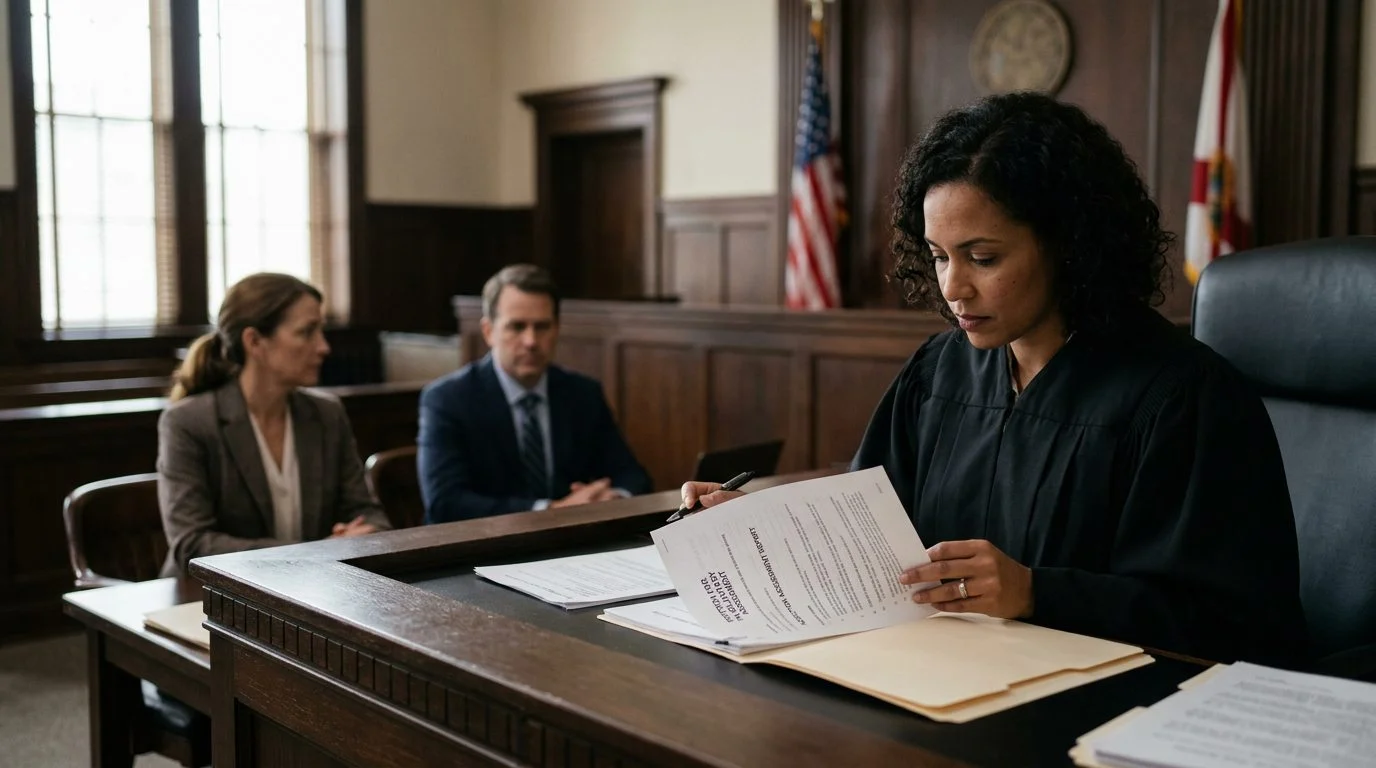
Marchman Act Petitions | Miami-Dade and South Florida
Is a Marchman Act Petition Right for Your Family? Start With This Checklist
Robinson Casey focuses on Marchman Act petitions and guardianship matters for families across South Florida and statewide. Work through the six questions, then talk with us about your situation.
By Richard J. Casey III, Esq. · Published November 3, 2026
This Marchman Act eligibility checklist for parents helps you see whether a petition may fit your adult child’s situation. It has six yes-or-no tests drawn from Florida law. Each test explains why it matters and what to do with the answer. Richard J. Casey III, Esq. is the lawyer responsible for this page.
Where You Are Right Now
You may be reading this after a hard phone call. Maybe the hospital called, or your child overdosed, relapsed, or disappeared again. You have already paid for treatment, tried interventions, and held firm on boundaries. The crisis keeps coming back.
You are still researching, and you have not chosen a legal step. That is a reasonable place to be. Your deepest fear is probably that your child will die before anything changes. You may also fear jail, or that your child will end up homeless. Those fears are real. A checklist can’t remove them, but it can help you separate what you know from what you dread.
If you're carrying this alone right now, you don't have to work out the next step by yourself, so talk with us about what you've recorded. Talk it through with our team — the first consultation is free, confidential, and carries no obligation.

What the Marchman Act Is and Is Not
The Marchman Act is a Florida court process for assessment and court-ordered treatment of a person with a substance use problem. It covers alcohol, illegal drugs, and prescription drugs, according to Flagler County clerk guidance.
The statute asks whether your child has lost the power of self-control with respect to substance use. Fla. Stat. § 397.675 sets out those criteria. The judge decides whether they are met, not you and not this checklist. This checklist cannot predict how a court will rule.
Treatment may be ordered only if the criteria for involuntary admission under § 397.675 are met. That means there is good faith reason to believe your child is substance abuse impaired, or has a substance use disorder and a co-occurring mental health disorder. That section does not itself address a sheriff taking your child into custody. Treatment is the goal of that delivery.
Petitions and related court records are confidential under Fla. Stat. § 397.6760. The clerk may not publish personal identifying information on a public docket.
How to Use This Checklist
Use this Marchman Act eligibility checklist for parents by answering each test with a plain yes or no. Answer from what you saw, heard, or recorded yourself. For every yes, write down the date, the place, who was there, and any paper that shows it. That could be a discharge summary, a police report, or a text message.
Your notes matter. Your notes become that factual base.
A single no does not close the question. Keep the full list. It will help in any conversation with a lawyer.
Checklist Part 1: Your Child and Substance Use
Part 1 asks two basic questions: Is your child an adult, and is substance use causing ongoing harm?
Who may file a petition when the respondent is an adult? If the respondent is an adult, a petition for involuntary treatment services may be filed by the respondent’s spouse or legal guardian, any relative, a service provider, or an adult who has direct personal knowledge of the respondent’s substance abuse impairment and his or her prior course of assessment and treatment (Fla. Stat. § 397.68112). Fla. Stat. § 397.68112 sets out who may petition. A parent is a relative.
- Yes: Keep going.
- No: Note it. If your child is a minor, the statute’s rules are different.
Test 2: Is alcohol or drug use causing ongoing problems at home, at work, at school, or with the law? Write specific examples: missed days, money that disappeared, incidents, or arrests.
- Yes: Move to Part 2.
- Unclear: Write the facts down and move on.
Checklist Part 2: Loss of Control and Refusal of Help
Part 2 asks whether your child has lost control over use and can’t make a clear choice about treatment.
Has your child lost the power of self-control with respect to substance abuse? The statute’s phrase is “lost the power of self-control with respect to substance abuse” (Fla. Stat. § 397.675). Record each attempt to stop or cut back, with dates and what happened.
- Yes: Continue.
- No: Keep your notes.
Test 4: Has your child refused treatment, or been unable to choose it clearly, after you or a clinician offered help? A refusal alone is not enough. The statute says mere refusal does not by itself show lack of judgment about the need for services. Fla. Stat. § 397.675 reads: “(b) Without care or treatment, is likely to suffer from neglect or refuse to care for himself or herself; that such neglect or refusal poses a real and present threat of substantial harm to his or her well-being; and that it is not apparent that such harm may be avoided through the help of willing, able, and responsible family members or friends or the provision of other services, or there is substantial likelihood that the person has inflicted, or threatened to or attempted to inflict, or, unless admitted, is likely to inflict, physical harm on himself, herself, or another.” Still, record each offer and each response.
- Yes to both Test 3 and Test 4: Move to Part 3.
- Otherwise: Keep notes and review them with a lawyer.
Checklist Part 3: Risk of Serious Harm
Part 3 asks whether your child faces serious harm without treatment, and whether you can prove the recent facts.
Test 5: Without treatment, is there a real risk of serious harm to your child or to others? Examples a parent would recognize include a recent overdose, a hospital visit, a threat, or a stretch of living on the street. The statute asks whether the harm could be avoided through willing, able, and responsible family members or friends. Fla. Stat. § 397.675 reads: “(b) Without care or treatment, is likely to suffer from neglect or refuse to care for himself or herself; that such neglect or refusal poses a real and present threat of substantial harm to his or her well-being; and that it is not apparent that such harm may be avoided through the help of willing, able, and responsible family members or friends or the provision of other services, or there is substantial likelihood that the person has inflicted, or threatened to or attempted to inflict, or, unless admitted, is likely to inflict, physical harm on himself, herself, or another.” Fla. Stat. § 397.675
- Yes: Continue.
- No or unsure: Keep records of what you observed.
If your child refused an evaluation, the statute says mere refusal does not by itself show lack of judgment (§ 397.675); the rule that a petition must note a refused evaluation is in § 397.68141.
- Yes: Continue.
- Not yet: Gather records first.
If you answered yes to all six, or nearly all, a petition may be worth discussing with a lawyer now. Gather your records before that conversation.
Not sure what your next step is?
Talk it through with our team — the first consultation is free, confidential, and carries no obligation.
If Your Answers Point Toward a Petition
If your answers point toward a petition, your child must be assessed by a qualified professional within 72 hours after arriving at a licensed service provider, unless your child shows signs of withdrawal or a need to be detoxified or treated for a medical condition, in which case observation continues until that issue is resolved but no later than the scheduled hearing date, absent a court-approved extension. A Marchman Act petition must be filed with the clerk of the court in the county where your adult child is located.
Does it cost money to file?
The clerk may not charge a fee to file the petition.
Does my adult child get a lawyer?
Yes, your child has the right to counsel at every stage, and may waive it only if present and the court finds the waiver is knowing, intelligent, and voluntary; the court shall appoint counsel if it believes your child needs or desires it. Fla. Stat. § 397.681
Must my adult child attend the hearing?
Generally, yes. The court may excuse presence only in limited situations, such as a knowing waiver.

Talk With Robinson Casey About Your Child’s Situation
The next step is a calm conversation about the facts you have written down. Robinson Casey concentrates its practice on Marchman Act petitions and guardianship matters, serving families across South Florida and statewide.
You may be reading this late at night, after another hard day. You don’t have to work out the legal path on your own. Call (561) 849-4700 or request a consultation. The first consultation is free, confidential, and comes with no obligation to continue.
Richard J. Casey III, Esq. is the responsible lawyer for this page. No one can tell you in advance how a court will rule, so bring your records and your questions.
How Robinson Casey Works With Families
Focused Practice
Our firm focuses on Marchman Act petitions and guardianship matters, so the questions you bring to us are handled within these areas.
Confidential Conversations
Your first consultation is free and confidential, with no obligation to continue.
Direct Phone Line
Call (561) 849-4700 to speak with our team about your family's situation.
Compassionate Guidance
We understand how urgent and painful these situations feel, and we take time to explain each option clearly.
Do Not Wait Until the Crisis Deepens
If your adult child is in immediate danger or a medical emergency, contact emergency services first. For a legal question about your family's options, reach out to our office as soon as you can to talk through the situation.
Matters Robinson Casey Handles
Marchman Act Petitions
Guidance for families seeking a petition for assessment, treatment, or involuntary commitment under Florida's Marchman Act.
Guardianship Matters
Help with plenary, limited, and mental health guardianships for adults who need a court-appointed decision-maker.
Emergency Temporary Guardianship
Support for families who need protective court action quickly when a loved one's safety or care is at immediate risk.
Involuntary Commitment for Addiction
Legal guidance for families considering court-ordered treatment for a loved one struggling with substance use.