
Marchman Act Attorney · Miami-Dade & South Florida
Worried About Jobs and Gun Rights During a Marchman Act Case?
Robinson Casey focuses on Marchman Act petitions and guardianship matters for families across South Florida and statewide. Get clear answers about your situation before you decide on a next step.
By Richard J. Casey III, Esq. · Published November 3, 2026
You Are Asking This Because Your Child Is in Danger Right Now
A Marchman Act case can affect an adult child’s job and gun rights, but these are two separate questions with separate rules. Neither one changes just because a petition was filed. The answer depends on the court’s findings and on the rules that apply to each question.
You have likely spent years on this. You paid for treatment, tried new programs, set limits, and watched your child slip again. Then came an overdose, a relapse, a hospital stay, or an arrest. Now you’re asking a harder question: what could this cost your child?
Those worries about work and guns sit on top of a deeper fear. You’re afraid your child will overdose, be locked up, lose a home, or die. That fear is real, and it’s why you’re reading this. This page covers only the job and firearm questions, with plain answers and no promises. For the bigger picture, read our Marchman Act attorney guide.
If your child's safety and future feel out of reach, you don't have to sort out the legal side alone. Talk it through with Robinson Casey. Talk it through with our team — the first consultation is free, confidential, and carries no obligation.

How a Marchman Act Case Works in Plain Terms
A Marchman Act case asks a Florida judge to order help for an adult with a substance use problem. The current text, amended in 2024, sets out the criteria. Under the criteria for involuntary admission, the court looks for a good faith reason to believe the person is substance abuse impaired and has lost the power of self-control.
A relative can start the process. Under Fla. Stat. § 397.68112, a parent who is a relative of an adult can file the petition.
Section 397.68112 says who may file a petition for involuntary treatment services; it does not say whether the person must attend the hearing. Testimony at the hearing must be taken under oath.
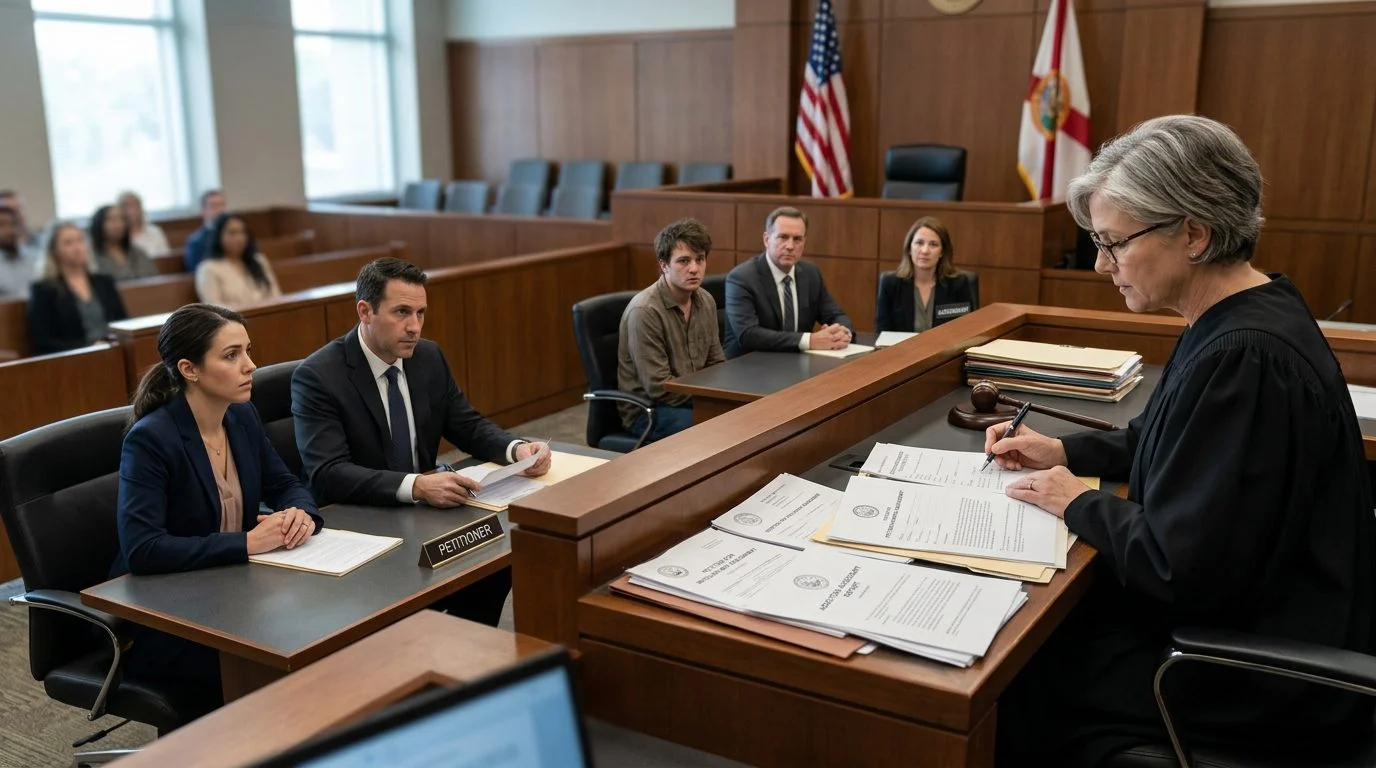
The person also has rights. The Second District has held that a Marchman respondent has a constitutional right to counsel in these proceedings. If the court finds the conditions proved by clear and convincing evidence, it may order treatment for up to 90 days. For who may file and what the petition involves, see our eligibility checklist for parents.
Can a Marchman Act Case Affect Your Child’s Job?
A court case does not set your child’s job rules by itself. The employer’s written policies, and any federal disability rules that apply, decide most job questions. Federal law draws a line around illegal drug use at work. Under 42 U.S.C. § 12114, an employee who is currently using illegal drugs is not protected when the employer acts on that use. An employer may also prohibit illegal drug use at work.
42 U.S.C. § 12114 does not address the confidentiality of court records; it sets out who is a qualified individual with a disability for purposes of the employment provisions. The court records in these cases are confidential, and the clerk may disclose them on request to listed people, such as the petitioner, the respondent, and the respondent’s attorney. An employer is not on that list.
Treatment records have their own protection. Under 42 U.S.C. § 290dd-2, records from a federally assisted substance use program generally cannot be used against the patient in civil proceedings. A court order of a court of competent jurisdiction, granted after application showing good cause therefor, or the patient’s prior written consent, can authorize that use. 42 U.S.C. § 290dd-2 reads: “If authorized by an appropriate order of a court of competent jurisdiction granted after application showing good cause therefor, including the need to avert a substantial risk of death or serious bodily harm. In assessing good cause the court shall weigh the public interest and the need for disclosure against the injury to the patient, to the physician-patient relationship, and to the treatment services.
Many families assume an employer will read the court file. Ask your child, if your child is willing, which written policies apply. Keep the court papers in one folder.
Drug Tests in Court and on the Job
Drug testing can come up in two places: the court hearing and the workplace. The court can order drug tests during a Marchman case. The court’s authority to order involuntary treatment services is set out in Florida law.
At work, federal law treats a drug test for illegal use as something other than a medical exam. Under 42 U.S.C. § 12114, an employer may still use reasonable testing to confirm that a person who finished a supervised rehab program has stopped using.
A common mistake is treating a positive test as a small issue. Under the same federal statute, an employer may hold an employee who engages in the illegal use of drugs or who is an alcoholic to the same job standards as everyone else, even if unsatisfactory performance or behavior is related to the drug use or alcoholism.
How Firearm Rights Can Be Affected After Drug Use or Commitment
Firearm rights turn on the exact finding in the order, not the case name alone. Florida law says a person who has been adjudicated mentally defective or committed to a mental institution may not own or possess a firearm until relief is obtained.
The same statute lets the person ask the court that made the adjudication or commitment for relief. Federal firearm law sets its own limits on who may possess a gun.
Whether a given Marchman order fits these rules turns on its exact wording and type. Keep every order, petition, and assessment report you have. The wording is the thing that matters most, so bring those papers to a consultation.
Where Work Rules and Gun Rules Meet
Your child’s job and gun questions often overlap, but they are separate questions. Employer policies answer the job question. Firearm limits answer the gun question. Clearing one does not clear the other.
If your child works around firearms, or keeps a gun in a vehicle at work, both sets of rules can apply. Review each one on its own. Don’t assume that a favorable step on one question settles the other.
If a firearm limit applies, the relief route runs through the court that made the order. That is why the order’s wording and the date it was entered belong in your file.
Not sure what your next step is?
Talk it through with our team — the first consultation is free, confidential, and carries no obligation.
Questions to Bring to a First Conversation
Bring your court papers, your own timeline, and any work or treatment records you have. A short list of dates helps more than memory does. Include hospital stays, treatment episodes, arrests, and any employer names.
Your child has rights in the case too. Your child generally must attend the hearing, unless a waiver is found or presence is inconsistent with best interests. Your adult child may refuse to testify at the hearing.
Where the petition is filed also matters. However, the filing of the petition in the wrong county did not divest the circuit court in Putnam County of jurisdiction, per J.P. v. J.N..
Can my adult child lose a job over a Marchman Act case?
Under 42 U.S.C. § 12114, nothing in this subchapter encourages, prohibits, or authorizes drug testing of job applicants or employees or employment decisions based on such test results, so the employer’s written policies and any drug testing rules matter. The court case name alone does not decide them. The court case name alone does not decide them.
Can a parent file a Marchman Act petition for an adult child?
Yes. Florida law lets, for an adult, an adult’s spouse or legal guardian, any relative, a service provider, or an adult who has direct personal knowledge of the person’s substance abuse impairment and prior course of assessment and treatment file a petition for involuntary treatment services, so a parent who is a relative can file.

Take the Next Step Toward Getting Your Child Help
A Marchman Act petition is one legal way to seek court-ordered treatment for an adult child who keeps getting worse. You have tried treatment, boundaries, and interventions. You want a legal path to proper treatment, so you don’t have to carry this crisis alone.
Responsible attorney: Richard J. Casey III, Esq. The first consultation is free, confidential, and without obligation.
Call (561) 849-4700 or request a consultation. Bring your papers and your timeline, and we’ll walk through your child’s next steps with you.
How Robinson Casey Supports Families
Plain-language guidance
We explain how a Marchman Act matter works, what questions to expect, and what information matters most to your case.
Organized case preparation
Our team helps you gather and organize the records, dates, and details that bear on your petition or response.
Focused on your family's concerns
We address work, firearm, and household questions alongside the court process so you are not left guessing.
Direct access to our office
Call (561) 849-4700 to reach our team and discuss your situation in a confidential setting.
Don't Wait to Ask Questions
A Marchman Act case can raise questions about employment, firearms, and family decisions. Speaking with a lawyer early helps you understand your options before the next hearing or deadline in your case.
Common Concerns Families Bring to Us
Employment questions
Parents, spouses, and adult children often ask whether a court case affects their job. Employer policies and drug testing rules can matter as much as the court record, and we can review them with you.
Firearm concerns
Questions about gun ownership or access frequently come up during a Marchman Act matter. We can discuss how these issues may apply to your situation and what steps to consider.
Marchman Act petitions
Robinson Casey assists families who are considering a petition for involuntary assessment or treatment for a loved one struggling with substance use.
Guardianship matters
We also handle guardianship matters, including emergency temporary, limited, plenary, and mental health guardianship, for families across South Florida and statewide.