
Marchman Act Attorney | Miami-Dade
When Your Adult Son Needs Help He Won't Accept, You Still Have Options
Robinson Casey limits its practice to Marchman Act petitions and guardianship matters for families in Miami-Dade and across South Florida. Your free first consultation is confidential and carries no obligation to continue.
By Richard J. Casey III, Esq. · Published October 30, 2026
My adult son disappeared, and I don’t know where he is or whether he’s safe. Yes, a parent can ask a Florida court for help under the Marchman Act. The Act lets a family member petition a judge for assessment and, when the legal conditions are met, involuntary treatment for an adult severely impaired by substance use. The Florida Department of Children and Families describes the Act the same way. This page explains what the petition says, where it’s filed, how notice works, and what happens at the hearing. Robinson Casey limits its practice to Marchman Act petitions and guardianship matters for families in Miami Dade, across South Florida and statewide.
What a Marchman Act Petition Is and Who It Is For
A Marchman Act petition is a court filing that asks a judge to order assessment and possible treatment for an adult with a substance use problem. Your son is the respondent. The family member who files is the petitioner.
For an adult, the law says who may file. Under Fla. Stat. § 397.68112, a spouse or legal guardian, any relative, a service provider, or an adult who has direct personal knowledge of the respondent’s substance abuse impairment and his or her prior course of assessment and treatment may file. As his parent, you are a relative, so you can file.
Many parents feel they lost every legal tool when their child turned 18. The Marchman Act is a civil process that starts with a petition, which may be filed by a spouse or legal guardian, any relative, a service provider, or an adult who has direct personal knowledge of the respondent’s substance abuse impairment and his or her prior course of assessment and treatment. It is one route open to families of adults facing a serious substance use problem, such as a recent overdose, relapse, hospital stay, or arrest.
When your adult son has disappeared and you feel out of options, you do not have to face the court process alone. Talk with our team about what you know. Talk it through with our team — the first consultation is free, confidential, and carries no obligation.

What the Sworn Petition Must Describe
The petition must name your son and you, state your relationship, and set out specific facts. Under Fla. Stat. § 397.68141, the petition must explain:
- Why you believe he is substance abuse impaired.
- Why you believe the impairment has taken away his power of self-control over substance use.
- Either that without services he is likely to neglect himself or refuse to care for himself, which poses a real and present threat of substantial harm to his well-being, and there is a substantial likelihood he will cause serious bodily harm to himself or another in the near future, as evidenced by recent behavior; or that his refusal of care is based on judgment so impaired by substance abuse that he is incapable of appreciating his need for care and of making a rational decision regarding that need for care.
The petition may include a report from a qualified professional who examined him within 30 days before filing. If he was never assessed or refused an assessment, the petition must say so.
Start a written timeline now. Write down dates, places, who was there, and what records exist, such as hospital, police, or treatment records. Stick to what you saw or learned, and leave out guesses. Many filings are verified by a written declaration under penalties of perjury. A knowingly false declaration is a third-degree felony under Fla. Stat. § 92.525.
For a checklist of what families file, see our guide on Marchman Act paperwork.
When Your Son Cannot Be Found: Filing and Service
The petition is filed with the clerk of the court in the county where your son is located, and the clerk cannot charge a filing fee for it. Under Fla. Stat. § 397.681, the county follows his physical location. So if you don’t know where he is, give your lawyer every known address, phone number, friend, employer, and recent message.
Filing in the wrong county is not a fatal mistake. However, the filing of the petition in the wrong county did not divest the circuit court in Putnam County of jurisdiction (J.P. v. J.N.). See J.P. v. J.N. (Fla. 5th DCA 2017).
After filing, the court must schedule a hearing within 10 court working days unless it grants a continuance. The clerk issues a summons. Within 6 hours, it goes to a law enforcement agency for service, unless a chief judge allows private process servers. See Fla. Stat. § 397.68151. Service runs through that court process, so you cannot control its timing.
How the Case Moves: Notice, Hearing, and What Follows
A case moves from filing to assessment, then to a hearing, then to a court order that can last up to 90 days.
- Counsel check. The court decides right away whether your son has a lawyer or whether one should be appointed.
- In an emergency, the court may rely on the petition alone and enter an ex parte order without appointing a lawyer. See Fla. Stat. § 397.6818. A provider may not hold him for more than 72 hours of observation, unless listed conditions apply.
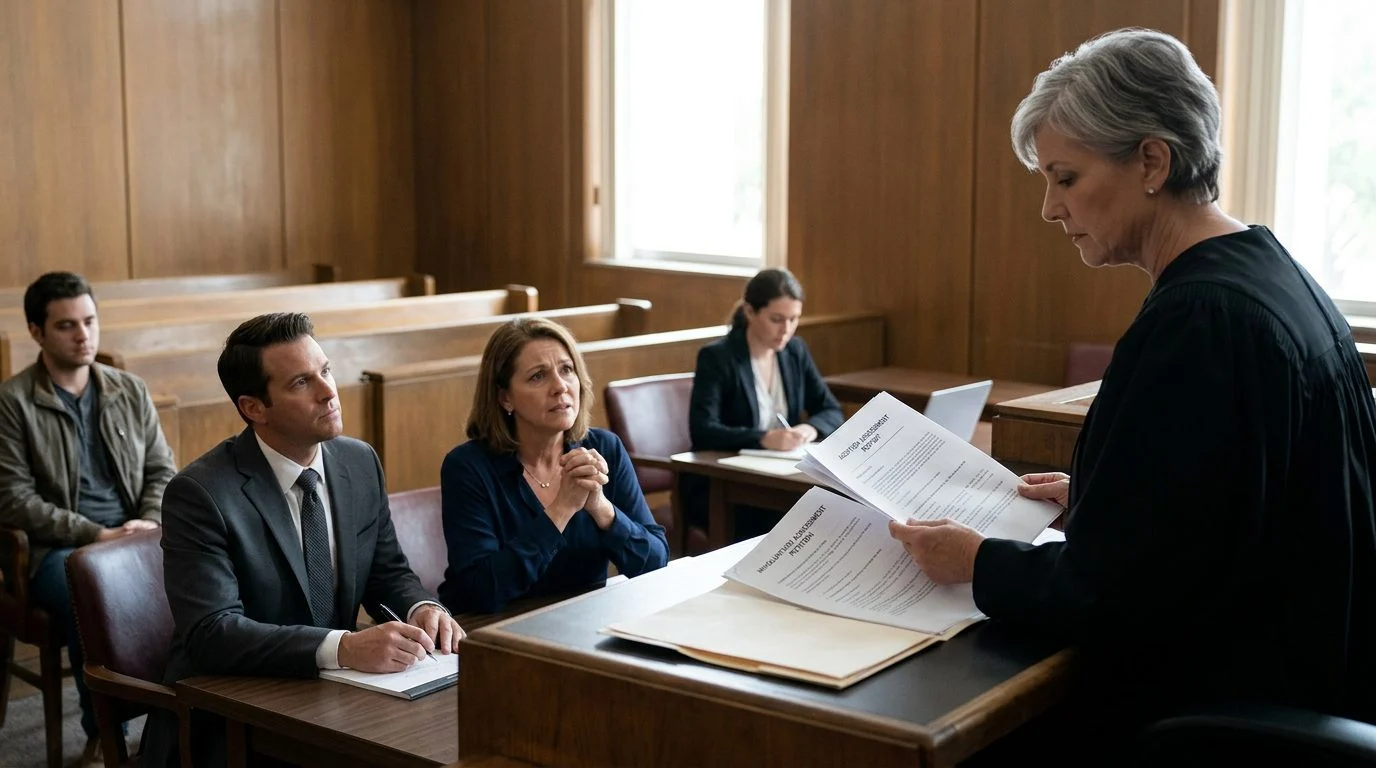
- Hearing. The ex parte order for his involuntary assessment and stabilization must be executed while the hearing on the petition is pending. Attendance at the hearing is governed by Fla. Stat. § 397.6957: he must attend unless he knowingly, intelligently, and voluntarily waives it, or the court finds that his presence is inconsistent with his best interests or likely to be injurious to self or others. The court hears family members who know his history. See Fla. Stat. § 397.6957.
- Under Fla. Stat. § 397.697, when the court finds that the conditions for involuntary treatment services have been proved by clear and convincing evidence, it may order the respondent to receive involuntary treatment services from a publicly funded licensed service provider for a period not to exceed 90 days.
A petition must give a good-faith reason to believe the legal criteria are met (D.H. v. K.J.R.), and under Fla. Stat. § 397.697 the court may order involuntary treatment only when it finds that the conditions for involuntary treatment services have been proved by clear and convincing evidence. The petition did not establish a good faith reason to believe D.H. met the statutory criteria for involuntary assessment and stabilization, and the trial court erred in entering the ex parte order (D.H. v. K.J.R.). If an order is renewed, the court may allow up to an additional 90 days under Fla. Stat. § 397.6975.
Your Son’s Rights, Respondent Counsel, and Other Paths
Your son has the right to a lawyer at every stage of the case. He also has the right to notice of the petition and the hearing. Because due process is implicated, we conclude that a defendant has a constitutional right to be represented by counsel in Marchman Act proceedings (Hillsborough County v. Albrechta).
Not appearing does not end the case. If he does not appear, the court may issue or reissue an order valid for 90 days when it reasonably believes the criteria and an emergency exist. If he is not assessed within 90 days, the court must dismiss.
Treatment-based drug court is a different path. See Fla. Stat. § 397.334. The Marchman Act is a civil petition a family member files. Whether it fits your family depends on the facts.
Why Families Work With Robinson Casey
Robinson Casey limits its practice to Marchman Act petitions and guardianship matters. The firm serves families in Miami Dade, across South Florida and statewide. Richard J. Casey III, Esq. is the responsible lawyer for this page.
Our team includes support staff who handle intake and scheduling. We work with families to:
- Review the facts and timeline you have gathered.
- Prepare the sworn petition and its required details.
- Coordinate records and the contacts that may help locate your son.
- Explain each step in plain language, from filing through the hearing.
The first consultation is free, confidential, and carries no obligation to continue. No lawyer can promise how a judge will rule, because each court decides on that family’s facts.
Not sure what your next step is?
Talk it through with our team — the first consultation is free, confidential, and carries no obligation.

Frequently Asked Questions
Can I file if I don’t know where my adult son is?
Location matters for filing because the petition goes to the county where he is located. The statute also covers a respondent who does not appear, including for lack of service.
Does my adult son have to agree to the petition?
What if my son refuses to go to the hearing?
The case does not simply stop. If he does not appear at the hearing, the court may issue an order valid for 90 days only if, upon reviewing the petition, testimony, and evidence, it reasonably believes he meets the commitment criteria and that a substance abuse emergency exists, and it must dismiss if he is not assessed within 90 days.
Is the Marchman Act the same as drug court?
No. Drug court is a county program for people in the justice system, while the Marchman Act is a civil petition a family member files.
How do I start?
Begin by writing a dated timeline and gathering records. Then talk with our team about your son’s situation.
If your son has disappeared and you feel out of options, you don’t have to work through this court process alone. Call Robinson Casey at (561) 849-4149, or contact our team to talk through what you know.
Matters We Handle
Marchman Act Petitions
We prepare and file petitions under the Florida Marchman Act for families seeking court-ordered assessment and treatment for a loved one struggling with substance use.
Involuntary Commitment for Addiction
We guide families through the court process for involuntary commitment when an adult's substance use puts his health or safety at risk.
Guardianship Matters
Our attorneys handle guardianship petitions for adults who cannot fully manage their personal or financial affairs, from the first filing through the hearing.
Emergency Temporary Guardianship
When an adult faces an immediate risk of harm, we help families request emergency temporary guardianship from the court.
Plenary and Limited Guardianship
We assist with both plenary and limited guardianship, helping families request the level of court authority that fits the adult's needs.
Mental Health Guardianship
We represent families in guardianship proceedings where a loved one's mental health condition affects his ability to make safe decisions.
How Our Firm Works With Families
Confidential First Consultation
Your free first consultation is confidential and carries no obligation to continue. Tell us what is happening and we will explain the options.
Careful Petition Preparation
We organize the facts, records and court forms needed to support your petition from the start.
Protecting Your Family's Interests
We focus on the safety of your loved one and your family while the case moves through the court.
Support Staff Who Keep You Informed
Our team keeps you updated on each step so you always know what comes next.
Prompt Attention to Urgent Situations
When a crisis is unfolding, we take the time-sensitive nature of your situation seriously and respond quickly.
Compassion for Hard Decisions
We understand that asking the court for help with a grown child is painful. We treat every family with dignity and respect.
Do Not Wait for a Crisis to Ask for Guidance
If your son's substance use is putting his health or safety at risk, speaking with an attorney early helps you understand the options available before a crisis forces a decision.