
Marchman Act Petitions | Florida
Understanding the Paperwork Behind a Marchman Act Petition
Robinson Casey focuses on Marchman Act petitions and guardianship matters for families across South Florida and statewide. Schedule a free first consultation: confidential, with no obligation to continue.
By Richard J. Casey III, Esq. · Published October 21, 2026
Why the Paperwork Matters Before a Marchman Act Case Starts
What paperwork is required for the Marchman Act in Florida?
That makes the documents the foundation for everything that follows.
If you’re reading this for someone you love, you may be worried about their drinking, drug use, or both. You may also not know what a judge will want to see. That’s a common place to start.
Paperwork can look like a formality. It isn’t. A petition that lacks specific reasons can be dismissed. In D.H. v. K.J.R., the Second District held that an ex parte order was entered in error because the petition did not give a good-faith reason to believe the statutory criteria were met.
This page walks through each document in order. For the bigger picture, read our involuntary commitment for addiction guide.
If your family member keeps refusing help after an overdose or repeated crises, our team can talk through your paperwork questions with you. Contact Robinson Casey to start that conversation. Talk it through with our team — the first consultation is free, confidential, and carries no obligation.

The Sworn Petition: What It Must Describe
A petition for involuntary services must contain the name of the respondent; the name of the petitioner; the relationship between the respondent and the petitioner; and the factual allegations establishing the need for involuntary services for substance abuse impairment (Fla. Stat. § 397.68141). It must also name the respondent’s attorney if known. § 397.68141 sets out these requirements.
The facts must explain why you believe the person is substance abuse impaired. They must also explain why you believe that impairment has taken away the person’s power of self-control over substance use.
The petition must then show one of two things.
That declaration says: “Under penalties of perjury, I declare that I have read the foregoing [document] and that the facts stated in it are true.” Knowingly signing a false declaration is a third-degree felony under § 92.525. Under Fla. Stat. § 92.525(2), a written declaration means the following statement: “Under penalties of perjury, I declare that I have read the foregoing [document] and that the facts stated in it are true,” followed by the signature of the person making the declaration, except when a verification on information or belief is permitted by law, in which case the words “to the best of my knowledge and belief” may be added.
A helpful step is to write a timeline first. Note dates of emergency visits, arrests, missed work, and statements about use. Then match each fact to the petition.
Supporting Statements, Assessments, and Records
A petition may come with a report from a qualified professional who examined the person within 30 days before filing. If the person was never assessed, or refused an evaluation, the petition must say so. See § 397.68141.
See § 397.6957.
The assessment must reach the clerk by the close of business the day before the hearing. It must include a treatment recommendation and note any co-occurring mental health needs. If the assessment has no treatment recommendation, the petition is dismissed.
The court hears relevant evidence, including testimony from family members who know the person’s history. The court may also order drug tests. Witnesses may testify remotely, but they must give the parties their documents by the close of business the day before.
The petitioner carries the burden of proving the statutory criteria by clear and convincing evidence. In J.C. v. State, a Fifth District case, the court stated: “In doing so, the court failed to follow the applicable statute by essentially functioning as the absent petitioner.”
Records you already have can support the facts. Hospital discharge papers and prior treatment admission records are good examples. Keep copies of everything.
Identification, Residence, and Contact Information
The petition must give the respondent’s name, the petitioner’s name, and their relationship. Those basics are required by statute. The petition should also include the person’s date of birth and last known address when you have them.
Current location matters for service. The clerk issues a summons. Unless a circuit court’s chief judge authorizes disinterested private process servers, the clerk must electronically submit the summons to a law enforcement agency within 6 hours after it is issued. See § 397.68151.
Copies of the petition and hearing notice go to several people. These include the respondent, the respondent’s attorney if known, the petitioner, the respondent’s spouse or guardian if applicable, the respondent’s parent, guardian, or legal custodian in the case of a minor, and such other persons as the court may direct. List any of these people in your notes so none are missed.
Court records under this part are confidential under § 397.6760, not § 397.68151; § 397.68151 instead gives the respondent’s attorney access to the person, witnesses, and records relevant to the case. See § 397.6760.
Filing With the County Court
The petition is filed with the clerk of the court in the county where the person is located. See § 397.681. The clerk may not charge a fee for filing a petition under that section.
Location is more than a home address. In J.P. v. J.N., the Fifth District stated: “However, the filing of the petition in the wrong county did not divest the circuit court in Putnam County of jurisdiction.” That was a detox facility, not the person’s home county.
For families in Miami-Dade and across South Florida, the question is where the person is on the day you file. Their home address may not be the answer.
Keep a complete, signed copy of everything you file.
Remember that testimony at the hearing is taken under oath and recorded. Anyone who signs or testifies should be ready to explain each fact. See § 397.6957.
Notice, Service, and What Follows the Filing
After filing, the court must schedule a hearing within 10 court working days, unless a continuance is granted. See § 397.68151.
Under § 397.68151, the court determines whether the respondent is represented or whether appointing counsel is appropriate. Under § 397.68151, the court determines whether the respondent is represented or whether appointing counsel is appropriate. Under § 397.681, a respondent who cannot afford private counsel has the right to court-appointed counsel. See § 397.681. The Second District recognized this as a due-process right in Hillsborough County v. Albrechta.
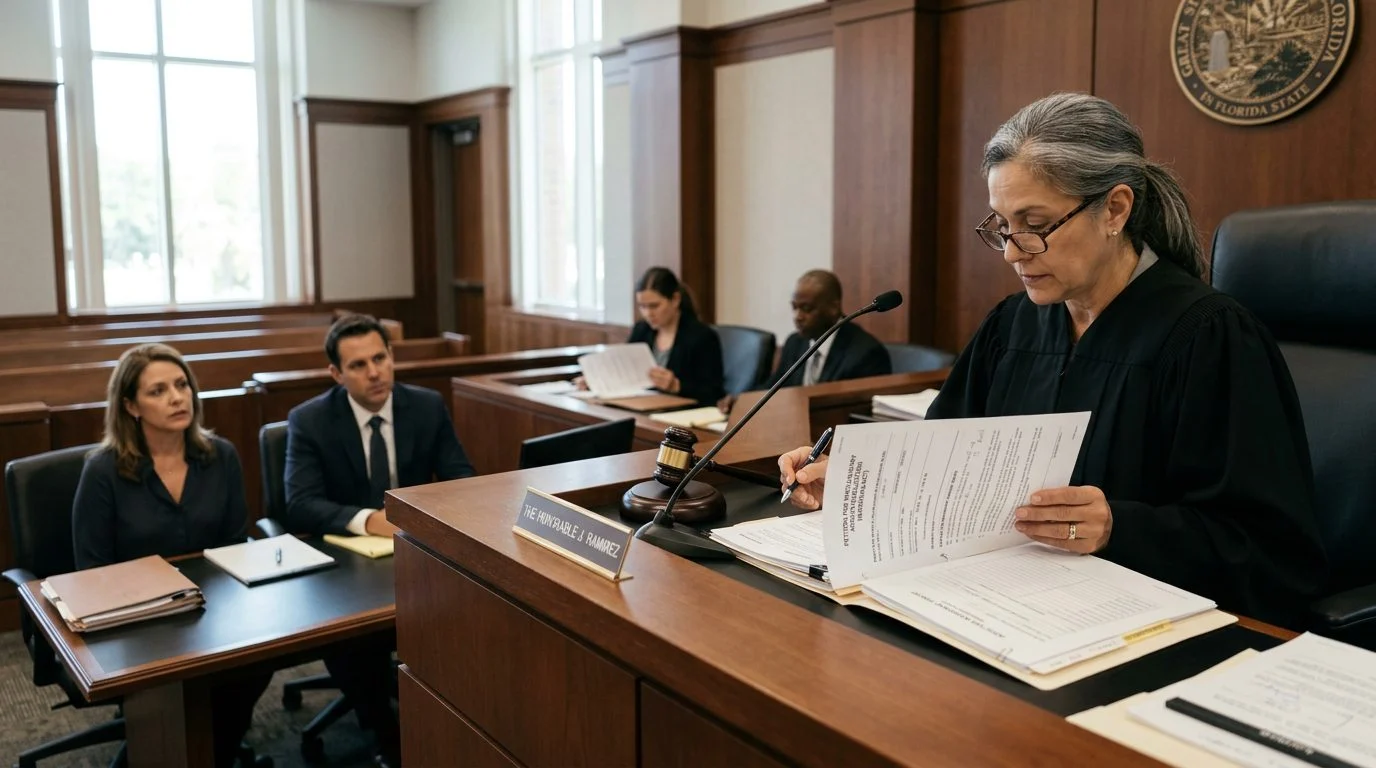
In an emergency, the court may rely on the petition alone and enter an ex parte assessment and stabilization order. The court may enter an emergency ex parte order without appointing an attorney, under § 397.6818(1), although the respondent otherwise has the right to counsel at every stage of a judicial proceeding. The order must be carried out while the treatment hearing is pending. See § 397.6818.
A service provider may not hold the person for more than 72 hours of observation. Some statutory exceptions apply. Those exceptions are listed in the same statute.
Testimony is under oath, and the proceeding is recorded. What happens next depends on the facts of each case.
Common Questions About These Papers
What paperwork is required for the Marchman Act in Florida?
It is filed with the clerk in the county where the person is located.
Who can file a Marchman Act petition? For an adult respondent, a spouse or legal guardian, any relative, a service provider, or an adult who has direct personal knowledge of the respondent’s substance abuse impairment and his or her prior course of assessment and treatment may file.
Is there a filing fee?
The clerk may not charge a fee to file a petition under that section of the Marchman Act.
Not sure what your next step is?
Talk it through with our team — the first consultation is free, confidential, and carries no obligation.

Talk to Robinson Casey About Your Family’s Situation
A consultation can help you sort out which facts and records matter for your family’s case. Start there if you’re unsure what to gather first.
A relative who keeps refusing help after an overdose or repeated crises puts a family under real strain. You may be collecting records while you’re scared, exhausted, or worried about what comes next.
Robinson Casey offers a free first consultation. It is confidential and carries no obligation to continue. Reach out through our contact page or call (561) 849-4149.
How Our Attorneys Help Families Prepare
Organized Petition Paperwork
Our attorneys help families gather and organize the documents a Marchman Act petition requires, so the filing is complete from the start.
Confidential Conversations
Your first consultation is confidential, and there is no obligation to continue after it.
Plain-Language Guidance
We explain each form and filing step in clear terms, so you know what is being asked of your family.
Support for Families
Our team supports families through a difficult process with responsive communication and careful attention to each case.
Incomplete Paperwork Can Cause Delays
Missing or inaccurate documents can slow a petition and add stress at an already difficult time. Call (561) 849-4149 to talk through what your family may need to file.
Matters Robinson Casey Handles
Marchman Act Petitions
Paperwork and guidance for families seeking help for a loved one under the Florida Marchman Act.
Involuntary Commitment for Addiction
Support for families navigating involuntary commitment proceedings related to substance use.
Guardianship Matters
Guardianship filings, including plenary, limited, and mental health guardianship, handled with close attention to each family's needs.
Emergency Temporary Guardianship
Guidance on urgent guardianship petitions when a family needs protection quickly.