
Marchman Act & Involuntary Treatment
Can You Forcefully Put Someone in Rehab in Florida?
Florida's Marchman Act allows a court to order involuntary treatment for substance use, but only through a court process and only when the statute's conditions are proven. Robinson Casey limits its practice to Marchman Act petitions and guardianship matters. Start with a free first consultation: confidential, with no obligation to continue.
By Richard J. Casey III, Esq. · Published October 15, 2026
Can you forcefully put someone in rehab in Florida? Florida’s Marchman Act lets a court order involuntary treatment for substance use. That only happens through a court process, and only when the statute’s conditions are proven. Once an order exists, it is not locked in place. The court can change certain terms, end treatment early, or let the order run out as the statute provides. This guide explains how those changes work. It is general information, not legal advice about your case, and the court decides every matter based on the evidence.
What Is a Marchman Act Order and Why Might You Need to Change It?
A Marchman Act order is a Florida court order for involuntary treatment of a substance use disorder. The person named in the case is called the respondent. When a court finds the required conditions proven by clear and convincing evidence, it may order treatment for up to 90 days (Fla. Stat. § 397.697). A renewal can be requested before that period ends. The statute allows an additional period of up to 90 days (Fla. Stat. § 397.6975).
Families often look at a change for a few reasons. The respondent may have made real progress and may need less intensive care. Life circumstances may have shifted, so the original plan no longer fits. Or the family may feel the order is too narrow or too broad for current needs. Each reason depends on the facts, and the court decides.
It helps to separate two ideas. Modification means changing some terms while the order stays in place. Termination means ending the order. These are different requests, and each one needs its own showing. Make sure you know which law applies to your situation.
If you're weighing a change to a Marchman Act order for someone you love, our team is ready to talk through your options with you. Talk it through with our team — the first consultation is free, confidential, and carries no obligation.

Can a Marchman Act Order Be Modified?
Yes. The statute says the court keeps jurisdiction over these cases and can enter further orders as the circumstances require. Those orders can include changing the treatment modality (Fla. Stat. § 397.697). In plain terms, the type or setting of treatment may be changed if the court agrees.
Changes can touch the kind of treatment, the provider, or the conditions attached to the order. The statute also says that hearings may be set by motion of the parties or on the court’s own authority. So a properly supported request can lead to a hearing. Who may file, and what must be shown, depends on the statute and the case. Other requirements may apply.
Any treatment order must include findings about the respondent’s need for treatment. That means a modification request should address both points. A request is easier for a judge to review when it names the specific term to change and the facts behind it. A general wish for a change is harder to evaluate.
Can a Marchman Act Order Be Terminated?
Yes. An order can end early, or it can end when its scheduled period runs out. Early release is possible when the statute’s conditions apply. The statute says a person may be found eligible for discharge when they no longer meet the criteria for involuntary admission and have given informed consent to move to voluntary treatment (Fla. Stat. § 397.6971). Other listed grounds include a likelihood of harm that no longer exists, or a person who no longer needs treatment services.
Termination can also happen by the statute’s own terms. The statute says that at the end of the 90-day period, the respondent is automatically discharged unless a motion for renewal has been filed (Fla. Stat. § 397.6977). The word “automatically” is in the text.
The respondent has important rights along the way. Florida law says the respondent has the right to counsel at every stage of a proceeding for involuntary treatment for substance abuse impairment (Fla. Stat. § 397.681).
What Legal Grounds Exist for Modification or Termination?
The court asks whether treatment is still needed and whether the criteria for involuntary treatment still apply.
Renewal depends on the same question. The renewal statute allows an extension only if the court finds the person continues to meet the criteria. It says the court may order services for an additional period, not to exceed 90 days (Fla. Stat. § 397.6975).
Chapter 744 guardianship works differently. A suggestion of capacity may be filed by any interested person, including the ward. The statute says the ward has the burden of proving by a preponderance of the evidence that restoration is warranted (Fla. Stat. § 744.464).
Grounds in a particular case depend on the facts and on the court’s findings. The list above is not complete. Other requirements may apply, and the court decides.
How Do You File a Motion to Modify or Terminate a Marchman Act Order?
A request to change an order usually starts with a written motion.
Supporting material helps the court see the issue. Treatment records, progress reports from the provider, and a clear list of the changes requested are common examples.
Notice matters too. For an initial petition, the statute says the respondent, the respondent’s attorney, the petitioner, and others the court directs must receive a copy of the petition and notice of hearing (Fla. Stat. § 397.68151). Notice rules for a later motion may differ, so the court’s directions control.
After filing, the court decides whether to set a hearing. Vague requests and missing documents can make a motion harder to act on. Careful preparation protects the record, but the court controls its own calendar.
What Happens at a Modification or Termination Hearing?
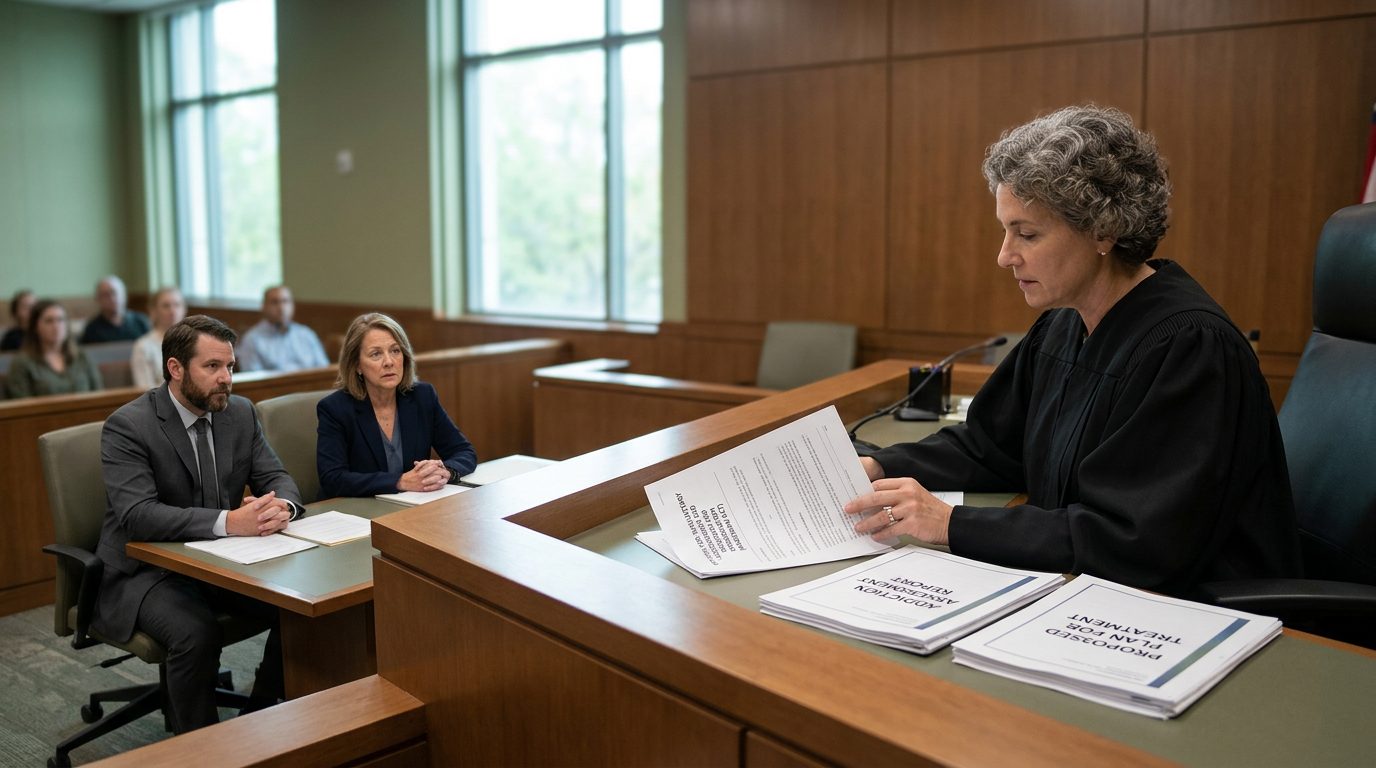
At a Marchman Act hearing, the court looks at evidence about the respondent’s current condition. The statute says the respondent must be present unless the court makes specific findings that allow otherwise, such as a knowing waiver (Fla. Stat. § 397.6957).
The court “shall hear and review all relevant evidence.” That can include testimony from family members who know the respondent’s history. It can also include the results of a professional assessment. The court may order drug tests. Witnesses may testify remotely, under oath, by audio-video technology. A remote witness must give the parties all relevant documents by close of business the day before the hearing.
The statute describes what happens at the end of a treatment hearing. The judge weighs the testimony and records and then decides. Outcomes depend on the evidence and the court’s discretion.
Not sure what your next step is?
Talk it through with our team — the first consultation is free, confidential, and carries no obligation.
Can the Original Petitioner Object to Modification or Termination?
The original petitioner usually has a voice in the process. The renewal statute says a renewal petition may be filed by the service provider, or by the person who filed the initial petition if it comes with supporting documentation from the service provider (Fla. Stat. § 397.6975).
The hearing statute also allows testimony from family members familiar with the respondent’s prior history (Fla. Stat. § 397.6957). A petitioner who objects can share that evidence and explain why the order should stay in place.
An objection does not decide the matter. The court weighs both sides’ evidence and makes its own ruling under the statute. Concrete facts, such as recent treatment participation or specific incidents, are easier for a court to weigh than general worry. The court considers the whole record.
What If the Person Wants to Terminate the Order But the Family Disagrees?
The respondent has rights, and a family’s preference is only one part of the picture. Florida law says each person must be told of the right to counsel.
The statutes focus the court on the respondent’s condition.
Family members can still present evidence and testimony. The court decides what weight to give it. Families may find it useful to get legal information early. That helps them understand what the court may consider and how the process works.
How Long Does the Modification or Termination Process Take?
No single timeline fits every case. The court’s schedule and the facts control the pace. For renewal petitions, the statute says the court shall schedule a hearing within 10 court working days. It also says the hearing is to be held not more than 15 days after the petition is filed (Fla. Stat. § 397.6975). It does not set the timing for every motion.
Treatment periods are also set by statute.
A contested matter usually needs more time than an agreed one. More witnesses, more records, and more scheduling conflicts can extend the case. Whether a hearing happens on a given date depends on the court’s calendar and discretion.
What If the Order Is Terminated and the Person Relapses?
Ending an order does not automatically bring it back. A new petition may be possible, but it depends on the facts and the statutes. For an adult, the statute lists who may petition for involuntary treatment. That includes a spouse or legal guardian, any relative, a service provider, or an adult with direct personal knowledge of the impairment and prior treatment (Fla. Stat. § 397.68112). Other requirements may apply.
A new petition needs its own evidence. Before a court orders treatment, the statute requires that the conditions be proven by clear and convincing evidence (Fla. Stat. § 397.697). Earlier history may come up in a new case. The court decides how much weight it gets.
Key Takeaways
- Marchman Act orders are not permanent. They run for set periods under the statute.
- The court can change certain terms, including the treatment modality, while it keeps jurisdiction.
- Early release and termination depend on the statutory conditions and the court’s findings.
- Requests usually come by written motion, supported by clear evidence, and the court decides after a hearing.
- The respondent has the right to counsel, and the court weighs the evidence from all sides.
Can you forcefully put someone in rehab in Florida? In some cases, yes, under the Marchman Act and through a court process. The court decides based on the evidence (Fla. Stat. § 397.697).
Can a Marchman Act order be changed? Yes, the court can enter further orders as circumstances require, including changing the treatment modality. The court decides.
Does a Marchman Act order last indefinitely? No. Treatment runs for set periods, and a renewal may be ordered as provided in Fla. Stat. § 397.6975, subject to the court’s discretion.
If you're weighing a change to a Marchman Act order for someone you love, our team is ready to talk through your options with you. Talk it through with our team — the first consultation is free, confidential, and carries no obligation.

When You’re Facing a Decision About Modifying or Ending a Marchman Act Order
You may be a parent, spouse, or adult child with a court order in place for someone you love. You may also be the respondent, wondering whether the order still fits your life. Either way, the decision is weighty, and the process has many steps.
Robinson & Casey is a Florida law firm that focuses on Marchman Act petitions and guardianship matters. Richard J. Casey III, Esq., is the lawyer responsible for this page. If you want to talk through your situation, the first consultation is free, confidential, and comes with no obligation to continue. Call (561) 849-4149 or visit our contact page.
How Robinson Casey Can Help
Guardianship Matters
The firm concentrates in guardianship matters, including emergency temporary, limited, plenary, and mental health guardianship.
A Confidential First Conversation
Your free first consultation is confidential and carries no obligation to continue with the firm.
Direct Contact
Call (561) 849-4149 to speak with the firm about your questions and options.
Important: A Court Order Is Not Automatic
Any request for involuntary treatment is decided by the court, based on the evidence presented and the conditions set out in the governing statute. Other requirements may also apply. Nothing on this page predicts how a court will rule in your case.
Key Terms to Know
Involuntary Commitment for Addiction
Court-ordered treatment for substance use, available only through a court proceeding and subject to the statute's conditions.
Guardianship
A court-supervised arrangement in which a judge appoints a guardian to make decisions for a person found to need one. Its scope depends on the court's findings.
Modification or Termination
Once an order exists, the court may change certain terms, end treatment early, or let the order expire, as the statute provides and in the court's discretion.