
Marchman Act Attorney | Miami-Dade
When Your Adult Child Refuses Help, Families Can Take the Next Step
Robinson Casey focuses on Marchman Act petitions and guardianship matters for families in Miami-Dade, South Florida and across the state. Richard J. Casey III, Esq. is the responsible attorney for this page.
By Richard J. Casey III, Esq. · Published October 31, 2026
Your Child Is Home From the Hospital, and Refusing Help
A hospital discharge does not mean treatment has been arranged or accepted. In Florida, a parent can ask a court for help through a Marchman Act petition, even when an adult child says no to rehab.
Discharge papers are in your hand. Your child says they are fine, or says they won’t go back. Every phone call makes you wonder whether the next one will be about another overdose. You have paid for treatment, tried interventions, and set boundaries, and the crisis keeps coming back.
It covers adult family members and is written with Miami-Dade and South Florida families in mind. The statutes discussed apply across Florida, but the county where your child is physically located controls where a petition is filed.
If your adult child is home and refusing help, you don't have to figure out the next step alone. Our team can talk through your options in a free, confidential initial consultation with no obligation to continue. Talk it through with our team — the first consultation is free, confidential, and carries no obligation.

Safety Steps for the Next 24 Hours
Call 911 right away if your child is overdosing, cannot be woken, or talks about hurting themselves or someone else. Don’t wait for a court date in an emergency.
Ask the hospital discharge team for written instructions, follow-up appointments, and the names of the providers who treated your child. Ask whether naloxone (Narcan) should be kept at home, and have someone in the house learn how to use it.
Start a written log today. Record each refusal, relapse, threat, or missed appointment with the date, the time, what was said, and who was there. A petition must state specific reasons, so detailed notes help you and your lawyer.
Keep the log factual. Write what happened, not what you fear will happen. Your child may not agree with your account, so names of witnesses matter. Keep discharge papers together in one folder.
Can a Parent Petition in Florida After an Overdose and Refusal?
Yes, a parent can file. For an adult, Fla. Stat. § 397.68112 allows a petition from a spouse or legal guardian, any relative, a service provider, or an adult with direct personal knowledge of the impairment and prior treatment.
The petition names your child as the respondent and you as the petitioner. It states your relationship and the factual reasons. Under § 397.68141, those reasons include why you believe your child is impaired, why you believe they have lost the power of self-control, and either whether they have harmed or are likely to harm themselves or others, or why you believe their refusal to receive care is based on judgment so impaired by reason of substance abuse that they are incapable of appreciating their need for care and of making a rational decision regarding that need for care.
A petition may include a report from a qualified professional who examined your child within 30 days before filing.
Under § 397.681, the petition goes to the clerk in the county where the person is located. The clerk may not charge a filing fee. In J.P. v. J.N., the Fifth District held that filing in the wrong county was a venue defect, not a loss of jurisdiction. However, the filing of the petition in the wrong county did not divest the circuit court in Putnam County of jurisdiction (J.P. v. J.N.). For the full framework, see our Marchman Act attorney guide.
What Happens After a Marchman Act Petition Is Filed
The court must schedule a hearing within 10 court working days unless a continuance is granted, under § 397.68151. Copies of the petition and the hearing notice go to your child, to you, to your child’s attorney if known, to your child’s spouse or guardian if applicable, and to others the court directs.
Your child has a right to a lawyer at every stage, which your child may waive only if present and the court finds the waiver is made knowingly, intelligently, and voluntarily, under § 397.681. A person who cannot afford one can ask for court-appointed counsel. The Second District has held that due process requires this right in Marchman Act cases, in Hillsborough County v. Albrechta. Expect that your child may have a lawyer.
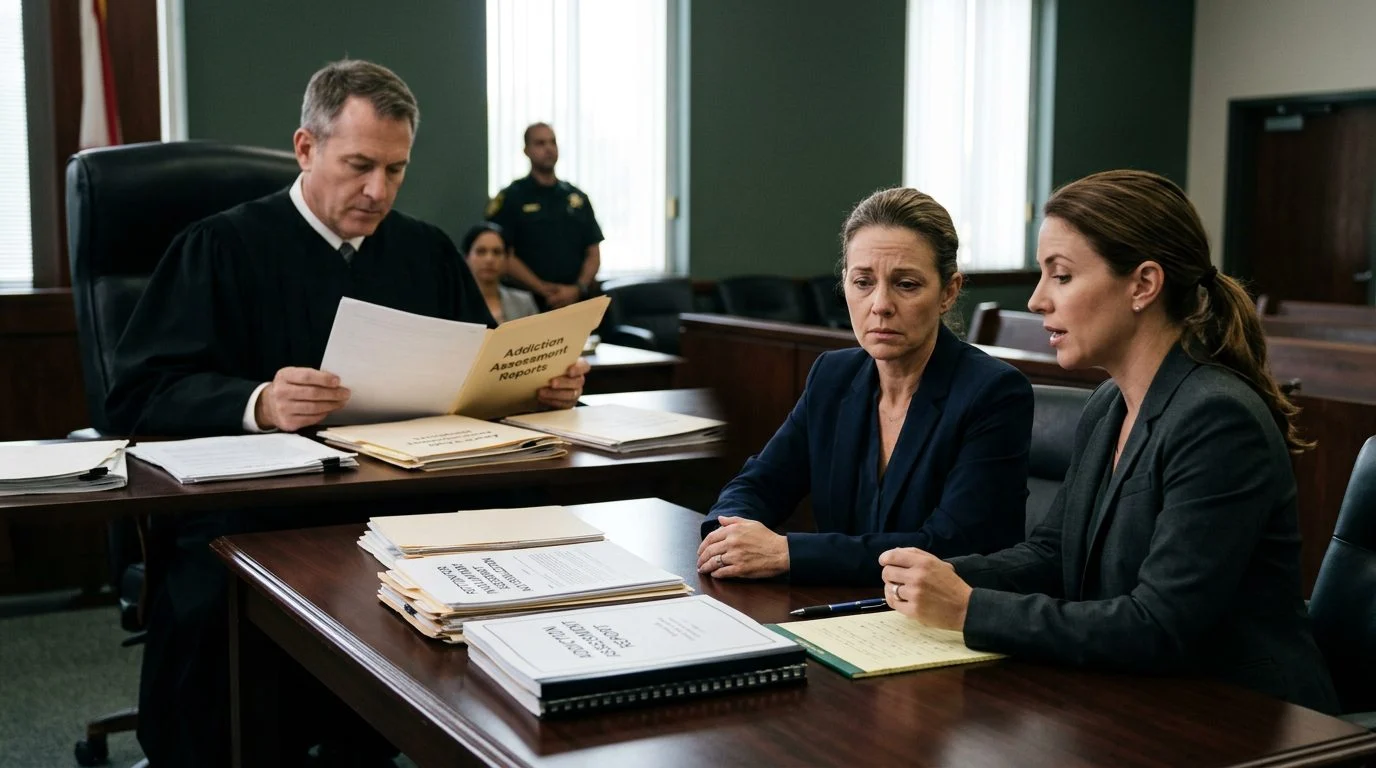
At the hearing, § 397.6957 says the respondent must attend unless the court finds a knowing, intelligent, and voluntary waiver or, after receiving proof of service and evaluating the circumstances, that attendance is inconsistent with the person’s best interests or is likely to be injurious to self or others. The court hears family members who know the history and may order drug tests. Testimony is under oath.
Who presents the case matters. In J.C. v. State, the Fifth District stated: “In doing so, the court failed to follow the applicable statute by essentially functioning as the absent petitioner.” The opinion faults the trial court for having “failed to follow the applicable statute by essentially functioning as the absent petitioner” (J.C. v. State). The Fourth District reached a different result in J.J.J. v. D.G. and certified a conflict. Under Fifth District law, be ready to present your own evidence and witnesses. The court, not the petitioner, decides the outcome, and no result can be promised.
Can You Force Someone Into Rehab in Florida?
A parent cannot order an adult child into a facility without a court process. A court can order an assessment and, if the legal standard is met, involuntary treatment.
The standard appears in § 397.675. The court looks for a good faith reason to believe the person is substance abuse impaired, or has a substance use disorder and a co-occurring mental health disorder, and that because of that impairment or disorder the person has lost the power of self-control. The person must also need services and lack the judgment to make a rational decision about them, or, without care, be likely to neglect themselves in a way that poses a real and present threat of substantial harm that family, friends, or other services cannot avoid; or there is a substantial likelihood that the person has inflicted, threatened, or attempted physical harm on themselves or another, or is likely to inflict it unless admitted.
The statute adds that mere refusal to receive services is not, by itself, evidence of lack of judgment. Fla. Stat. § 397.675 reads: “(b) Without care or treatment, is likely to suffer from neglect or refuse to care for himself or herself; that such neglect or refusal poses a real and present threat of substantial harm to his or her well-being; and that it is not apparent that such harm may be avoided through the help of willing, able, and responsible family members or friends or the provision of other services, or there is substantial likelihood that the person has inflicted, or threatened to or attempted to inflict, or, unless admitted, is likely to inflict, physical harm on himself, herself, or another.” A refusal alone is not enough.
If a court orders treatment, § 397.697 allows up to 90 days, based on clear and convincing evidence. In an emergency, § 397.6818 lets a court enter an ex parte order for assessment and stabilization, without first appointing an attorney.
Involuntary commitment for addiction and mental health guardianship are separate legal tools. They have different requirements. A lawyer can explain which one fits your child’s situation.
Medication-Assisted Treatment and Other Treatment Options
Court-ordered care runs through a licensed service provider. Under § 397.697, the court keeps authority to monitor compliance and change the treatment approach while the order is in place. The type of care a provider recommends is a clinical decision, but once a court orders involuntary treatment, the order also authorizes the licensed service provider to require the person to receive treatment services that will benefit them, including at any licensable service component of the provider.
The Partnership to End Addiction describes CRAFT (Community Reinforcement and Family Training) as an approach. It focuses on communicating positively, reinforcing sober behavior, setting boundaries, and caring for the family while encouraging treatment.
CRAFT is a family skills approach, not a court process.
Not sure what your next step is?
Talk it through with our team — the first consultation is free, confidential, and carries no obligation.
What to Gather Before You Talk With an Attorney
Gather the hospital discharge summary, emergency room records, dates of prior treatment, names of providers, and your written log. Bring copies, not originals.
Under § 397.68141, the petition must include your child’s full name, your relationship, and the factual reasons. Bring your child’s date of birth, the county where they are living now, and any pending criminal or family court matters. Include the name of your child’s attorney if you know it.
Write a timeline in order, starting with the most recent events. Stress makes people lose track of sequence, so write it down while it’s fresh.
A lawyer can review these records and explain the petition process. Bring your questions too, such as where to file and what the hearing will look like.
If Your Child Lives Out of State or Has Other Legal Issues
Where your child is physically located matters. Under § 397.681, the petition goes to the clerk in the county where the person is located. In J.P. v. J.N., the filing of a petition in the wrong county did not divest the circuit court in Putnam County of jurisdiction.
If your child is staying in another state, tell your lawyer the exact location right away. Location decides the county for filing, so accurate details help from the start.
Pending criminal charges, probation, or a family court case can change the timing and the court involved. Share every court record you have. Keep your notes factual and bring them to your first conversation.

Talk to Robinson Casey About Your Child’s Situation
If your adult child came home from the hospital and refuses help, you may be wondering whether a court can step in before the next crisis. Robinson Casey offers a free, confidential initial consultation with no obligation to continue. Call (561) 849-4149 or contact us online to talk through your situation.
Richard J. Casey III, Esq. is the responsible attorney for this page. The firm focuses on Marchman Act petitions and guardianship matters, serving families across South Florida and statewide.
Results depend on the facts of each case. No outcome can be promised, and a prospective client may not obtain the same or similar results.
Can a parent file a Marchman Act petition for an adult child?
Yes. Under § 397.68112, a relative of an adult may file for involuntary treatment services.
Does a Marchman Act petition cost money to file?
The clerk may not charge a filing fee under § 397.681.
Does refusing treatment alone justify a court order?
No. Under § 397.675, mere refusal to receive services is not by itself evidence of lack of judgment. Fla. Stat. § 397.675 reads: “(b) Without care or treatment, is likely to suffer from neglect or refuse to care for himself or herself; that such neglect or refusal poses a real and present threat of substantial harm to his or her well-being; and that it is not apparent that such harm may be avoided through the help of willing, able, and responsible family members or friends or the provision of other services, or there is substantial likelihood that the person has inflicted, or threatened to or attempted to inflict, or, unless admitted, is likely to inflict, physical harm on himself, herself, or another.”
Why Families Bring Their Concerns to Robinson Casey
A Free, Confidential First Consultation
Your first consultation is free, confidential and carries no obligation to continue. It is a chance to talk through your situation and ask questions.
Support Staff Who Help Families Through the Process
Our team, including assistants and office staff, helps families stay organized and informed as their matter moves forward.
Miami-Dade, South Florida and Statewide
We represent families across South Florida and throughout Florida, with a focus on the needs of Miami-Dade households.
Don't Wait for a Crisis to Ask for Guidance
Waiting until a situation becomes an emergency can narrow the options available to your family. A conversation with a Marchman Act attorney early on can help you understand what steps may be available.
Matters Robinson Casey Handles
Marchman Act Petitions
Petitions for involuntary treatment services for an adult family member struggling with substance use, filed under Florida's Marchman Act.
Involuntary Commitment for Addiction
Guidance for families seeking court-ordered treatment when an adult loved one refuses voluntary help for addiction.
Guardianship and Mental Health Guardianship
Plenary, limited and mental health guardianship matters, each tailored to the needs of the person and the family involved.
Talk With Robinson Casey Today. Call (561) 849-4149 for a free, confidential first consultation with no obligation to continue.
Related practice areas
- Marchman Act Attorney After Overdose Florida