

Marchman Act & Guardianship | Miami-Dade and South Florida
Talking to an Adult Child Who Denies Addiction
Practical steps for approaching the conversation with care, and a clear look at the legal options Florida families can consider when a loved one refuses help. Robinson Casey focuses on Marchman Act petitions and guardianship matters.
Casey III, Esq. · Published November 5, 2026
If you are searching for how to talk to adult child who denies addiction in Florida, you have likely run out of easy options. Start with a calm, private conversation. Describe specific events, and ask your child what would make getting help feel safe. If talking is not enough, Florida’s Marchman Act may open a legal path to court-ordered treatment.
When Your Adult Child Says There Is Nothing Wrong
When your child insists nothing is wrong, stay calm and stop arguing about the label. You have heard “I’m fine” after an overdose, a relapse, a hospital stay, or a stretch when nobody knew where your child was. You have paid for treatment, tried interventions, and set boundaries. The same denial keeps coming back, and each talk can feel like the last one that failed.
This page covers how to prepare, what to say, and what to write down. It also explains when a Marchman Act petition becomes a question to bring to a lawyer. Many parents reach this point after carrying the crisis alone for years, and that weight is real. The steps below are written for you, the parent.
If your child keeps denying the problem after another overdose or hospital stay, you do not have to plan the legal path alone, and Robinson Casey can talk it through with you. Talk it through with our team — the first consultation is free, confidential, and carries no obligation.
Prepare Before You Talk
Choose a quiet moment when your child is calm and sober, and when you are calm too. Avoid the hours right after a crisis, and never talk while either of you is intoxicated. A private room with no audience works best, along with enough time to end the talk without rushing.
Decide the one or two things you most need your child to hear. Write them on a card and keep it nearby. If the talk turns into a debate about every problem in your child’s life, the main point gets lost.
Agree with other family members before the talk. Pick one person to speak first, and agree on one shared message: you love your child, you are worried, and you want a medical or professional assessment. Mixed messages give a struggling person an easy reason to dismiss all of them.
Plan how the talk will end. If your child walks away, let them go without chasing or yelling. Then plan to try again another day.
What to Say When Your Child Denies the Problem
Describe what you have seen and how it has affected you, using dates and facts. For example, you might say, “Last month you went to the emergency room after an overdose. I was terrified, and I need you to know how much that scared me.”
Avoid labels such as “addict” or “liar.” A label gives your child something to fight, and the talk becomes about your word choice instead of their health.
Do not argue about whether there is a problem. Ask instead, “What would you need to feel safe getting help?” Listen to the answer, even when you disagree with it.
Offer small, specific steps. A medical checkup or one assessment is easier to agree to than a long program. Accept that a first conversation may not end in agreement.
Close by saying you love your child and will keep talking. Avoid threats you will not carry out. A broken promise teaches your child that your words do not count.
What to Document Before You Go Further
Keep a dated log of overdoses, emergency room visits, hospital admissions, arrests, missed work or school, and money spent on treatment. Write each entry on the day it happens, while the details are clear.
Record the exact words your child used when denying the problem. Save written statements from doctors, police officers, or treatment staff, along with discharge papers and bills.
Keep the log factual and in one secure place, arranged by date. Stick to what happened, who saw it, and how you learned it.
This matters because the court weighs evidence. Under § 397.6957, the judge must hear and review all relevant evidence, including testimony from family members who know your child’s history.
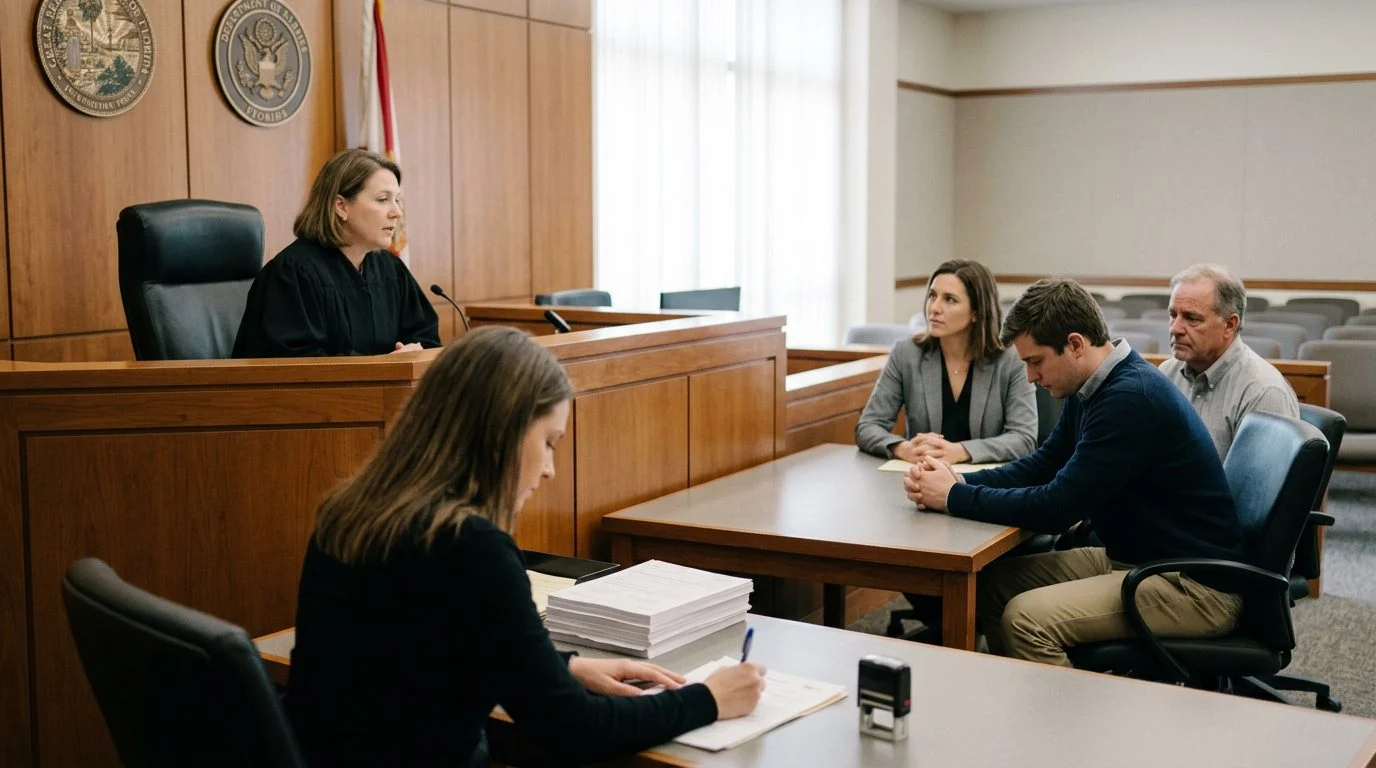
When a Conversation Is Not Enough
A Marchman Act petition becomes a question for a lawyer when talking has not led to care and the facts may fit Florida’s criteria. The Marchman Act sits in Chapter 397, Florida Statutes.
Who may file? Under § 397.68112, for an adult, a petition may be filed by a spouse or legal guardian, any relative, a service provider, or an adult with direct personal knowledge of the substance abuse impairment and prior treatment.
What must be shown?
The petition itself must name both people, state their relationship, and lay out the facts. Under § 397.68141, a report from a qualified professional who examined your child within 30 days may be attached. If there was no assessment, the petition must say so.
File in the county where your child is located. The Miami-Dade Clerk of Court directs adult petitions to its Probate Court. The petitioner carries the burden of proof. In J.C. v. State, the Fifth District reversed an order where the trial court questioned the only witness after the petitioner was absent.
Whether a petition fits your child’s situation depends on the facts. The court, not the family, decides.
Can a parent file a Marchman Act petition for an adult child?
Yes.
Does it cost money to file?
No filing fee applies. Under § 397.681, the clerk may not charge a fee to file the petition.
Does my adult child have a right to a lawyer?
Yes.
Facing the Fears: Overdose, Jail and Homelessness
Your fears are real, and no one can promise how a case will turn out. Overdose, jail, and homelessness are heavy fears, and waiting can feel like the riskiest choice.
The process also has set limits and steps. A hearing must be scheduled within 10 court working days unless it is continued, under § 397.68151. Fla. Stat. § 397.68151 reads: “(2) The court shall schedule a hearing to be held on the petition within 10 court working days unless a continuance is granted.” An emergency order lets a provider hold a person for no more than 72 hours of observation, with listed exceptions, under § 397.6818. A court order for involuntary services may last up to 90 days, and if the conditions are expected to continue after 90 days, a renewal of the order may be requested under § 397.6975 before the 90-day period ends, under § 397.697. A person may be released early once the conditions no longer exist, under § 397.6971.
Losing hope after years of this is understandable. A lawyer can walk you through each step and what the law requires at that point. No lawyer can promise a result, and the judge decides the case on the evidence.
Not sure what your next step is?
Talk it through with our team — the first consultation is free, confidential, and carries no obligation.
Talk Through Your Situation With Robinson Casey
If your child denies the problem after a recent overdose, relapse, hospital stay, arrest, or disappearance, and you want a legal way to get them proper treatment, you do not have to work out the next step alone. Robinson Casey limits its practice to Marchman Act and guardianship matters, serving families across South Florida and statewide. Richard J. Casey III, Esq. is the responsible lawyer for this page.
Call (561) 849-4700 for a free, confidential first consultation, with no obligation to continue. You can also reach out through the contact page.
How Robinson Casey Can Help
Focused Practice
Robinson Casey focuses on Marchman Act petitions and guardianship matters, helping families across South Florida understand their options.
Clear Explanations
We explain each step of the process in plain language so you know what to expect before you decide on a course of action.
Support for Families
Our team works with families facing difficult decisions about a loved one's health and safety, with respect for everyone involved.
Confidential Consultation
Your first consultation is free, confidential, and carries no obligation to continue.
Avoid Ultimatums in the First Conversation
Threats, pressure, and ultimatums often make a loved one more defensive. Choose a calm moment, speak from concern, and focus on specific behaviors rather than labels. If the conversation stalls, a lawyer can help you understand the options available before the next step.
Steps for a Difficult Conversation
Choose the Right Moment
Pick a time when your child is sober, rested, and not under immediate stress. Avoid holidays, arguments, or moments of crisis.
Listen Before You Respond
Let your child share their view. Acknowledging their perspective often opens the door to a more honest discussion.
Describe Specific Concerns
Point to concrete events, such as missed work, money problems, or changes in health, rather than debating whether addiction is the right word.
Know Your Legal Options
Speaking with a lawyer early helps you weigh them.