
Marchman Act & Guardianship | South Florida
Facing a Marchman Act petition? Start with this checklist.
Robinson Casey limits practice to Marchman Act petitions and guardianship matters for families in Miami-Dade, across South Florida, and statewide. Use this checklist to organize what you know before you call.
Casey III, Esq. · Published November 5, 2026
A Marchman Act petition asks a Florida court to order assessment and treatment for an adult whose substance use puts the household at risk. A spouse can file one. This Marchman Act checklist for spouses in Florida helps you sort your facts before you decide what comes next.
Where you are right now, and what you are afraid of
You are living with a situation you did not choose, and you are trying to hold your home together while it shifts under you.
Maybe you have been covering for your spouse’s drinking or drug use, hiding bills, or waiting for the next bad night. Maybe a recent overdose, a hospital stay, or a psychiatric crisis made you realize things cannot go on this way.
Your fears are real. You worry about harm to your children. You worry the money will run out. You worry that if nothing changes, your spouse will get worse and the marriage and family will not survive it.
Feeling like you carry everything alone is common in homes like this. This page is not a verdict on your marriage. It is a checklist for sorting facts and options under Florida’s Marchman Act and guardianship law.
If your spouse's addiction has made home unsafe for your children, you don't have to work through the options alone. Call (561) 849-4700 to talk it through. Talk it through with our team — the first consultation is free, confidential, and carries no obligation.

What the Marchman Act is and who may file a petition
The Marchman Act is Florida’s court process for involuntary assessment and treatment of an adult with substance abuse impairment. A spouse may file the petition.
Under § 397.68112, for an adult respondent, the petition may be filed by the respondent’s spouse or legal guardian, any relative, a service provider, or an adult who has direct personal knowledge of the respondent’s substance abuse impairment and his or her prior course of assessment and treatment. The respondent is the person the petition is about.
The court checks the criteria in § 397.675. The criteria also reach a person with a substance use disorder and a co-occurring mental health disorder.
The statute also says mere refusal to accept services does not, by itself, show lack of judgment. Under Fla. Stat. § 397.675, the person must have lost the power of self-control with respect to substance abuse. In addition, either they must need substance abuse services and their judgment must be so impaired that they cannot appreciate that need or make a rational decision about it, or, without care, they must be likely to suffer from neglect that poses a real and present threat of substantial harm, where it is not apparent that willing, able, and responsible family members or friends or other services could help them avoid that harm, or there must be a substantial likelihood that they have inflicted, threatened or attempted to inflict, or, unless admitted, are likely to inflict physical harm on themselves or another. The court looks at more than refusal.
Checklist: Is a Marchman Act petition a possible next step?
Answer these six yes-or-no questions about your household. Then bring your answers to a consultation.
- Has there been a recent serious incident? Yes or no: an overdose, a hospital stay, or a dangerous episode in the past few months? Specific, recent events give the court facts to review. If yes, write down the dates and what happened.
- Has your spouse refused treatment? Yes or no: has your spouse refused help, or started treatment and left it? The key question is whether they can make a rational decision about getting care. If yes, note each refusal.
- Are the children exposed? Yes or no: are the children around intoxication, unpredictable anger, or missed school and medical care? Child safety affects how urgently the situation should be reviewed. If yes, write specifics.
- Is money being drained? Yes or no: are savings, bills, or paychecks being lost to your spouse’s behavior? Financial harm is part of the picture. If yes, keep receipts and statements.
- Has anyone been threatened or hurt? Yes or no: has your spouse harmed themselves or threatened someone? Threats and self-harm need immediate help. If yes, call 911 or a crisis line now, before anything else on this list.
- Can they no longer manage basic decisions? Yes or no: can your spouse no longer handle money, medicine, or daily needs safely? This may point toward guardianship, alone or alongside a petition. If yes, note examples.
What to do with your results: If most answers are yes, write a one-page timeline and schedule a consultation. If only a few are yes, keep the timeline current and ask about your options anyway. Nothing on this list predicts how a court will rule.
Evidence to gather before you call
Before your first meeting, gather a dated incident log, the records you already hold, and a list of people who saw the behavior.
- Incident log: what happened, when, where, who was there, and what you did afterward.
- Medical and emergency records: discharge papers, ambulance or police report numbers, and pharmacy printouts.
- Messages, voicemails, or photos: keep originals, not retyped or edited copies.
- Bank and card statements: for the months with missing funds or unpaid bills.
- Notes on the children: school absences, behavior changes, and any time they were left with someone intoxicated.
- Witness list: names and contact details for relatives, neighbors, or clergy.
The court can hear testimony from family members who know the person’s history. It may also order drug tests. § 397.6957
A petition must name both of you, state your relationship, and set out the facts showing why help is needed. § 397.68141 If the person was never assessed, or refused an evaluation, the petition must say so.
How the process generally works, step by step
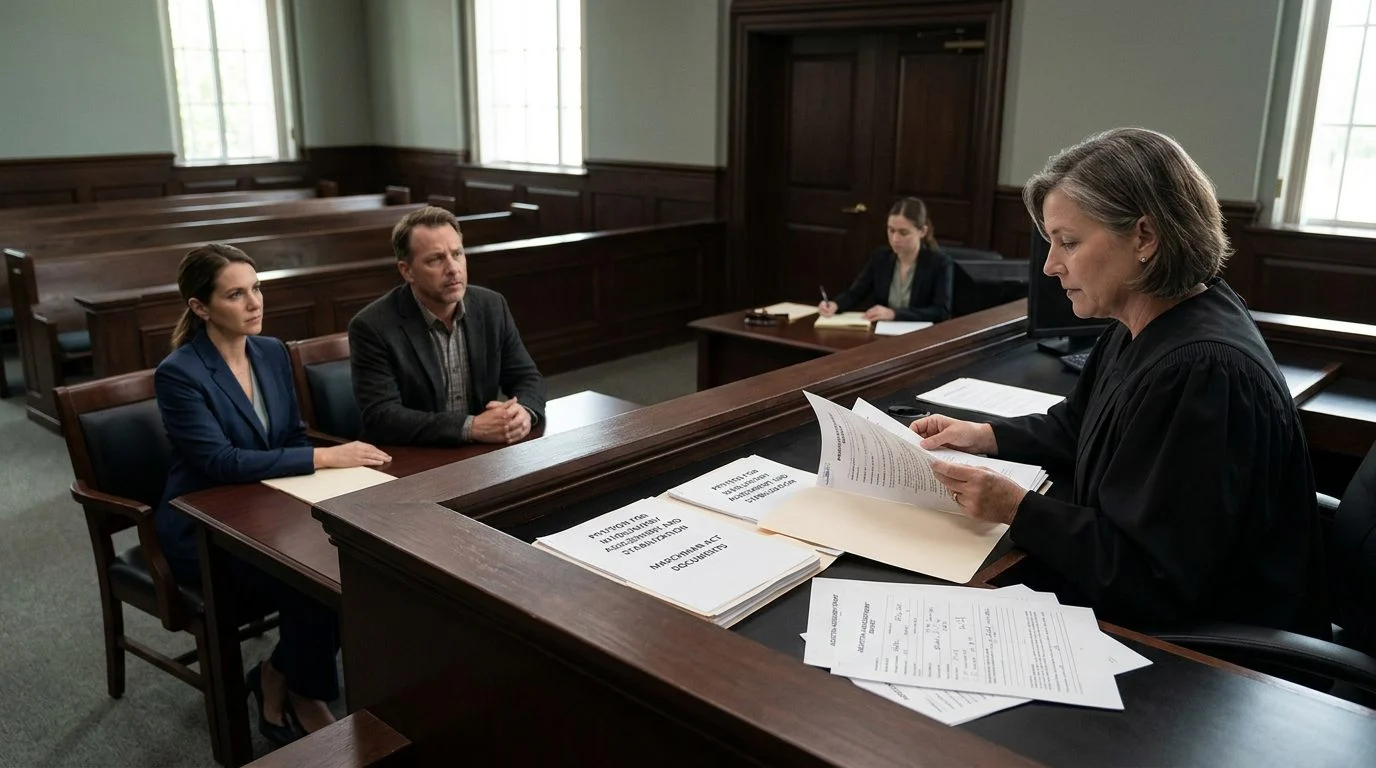
A Marchman Act case moves from a filed petition to a court hearing. The court may order treatment only if it finds the conditions proved by clear and convincing evidence.
- Consultation. You describe the situation, review your evidence, and get a read on which options fit your facts.
- Filing. The petition goes to the clerk of the court in the county where the person is located. The clerk may not charge a filing fee. § 397.681
- Second District Court of Appeal ruling
- Hearing. The court schedules a hearing within 10 court working days unless a continuance is granted (§ 397.68151).
- Order and follow-up. If the conditions are proved, the court may order treatment for up to 90 days and keeps jurisdiction to monitor compliance. § 397.697
Timing turns on the court calendar and each case’s facts, so no timeline can be promised in advance.
When guardianship may apply instead of, or alongside, a Marchman Act petition
Guardianship is a court process for an adult who cannot safely make personal or financial decisions. It can apply instead of, or alongside, a Marchman Act petition.
A guardianship case starts with a verified petition to determine incapacity. § 744.331
Emergency temporary guardianship is the fast option. § 744.3031 The court may appoint an emergency temporary guardian only after a petition to determine incapacity has been filed and before a guardian is appointed. It must find imminent danger to the person’s health or safety, or to property. Fla. Stat. § 744.3031 reads: “The court must specifically find that there appears to be imminent danger that the physical or mental health or safety of the person will be seriously impaired or that the person’s property is in danger of being wasted, misappropriated, or lost unless immediate action is taken.”
Robinson Casey handles limited, plenary, and mental health guardianship, plus emergency temporary guardianship. Which tool fits depends on the facts.
Not sure what your next step is?
Talk it through with our team — the first consultation is free, confidential, and carries no obligation.
Why spouses bring these matters to Robinson Casey
Robinson Casey is a Florida law firm that limits its practice to Marchman Act petitions and guardianship matters. It serves families in Miami-Dade, South Florida, and statewide.
Richard J. Casey III, Esq. is the responsible lawyer for this page. The firm’s lawyers work with support staff who handle scheduling and document intake.
Because the work centers on these matters, a consultation covers the petition, the evidence, the hearing, and follow-up orders. Bring your checklist and your incident log.
A free, confidential first consultation, with no obligation to continue, is available. You can ask questions before you decide anything.
A matter may sometimes be referred to another lawyer or firm. If that happens, we would tell you so directly.

Questions spouses ask before they call
Yes, Florida law lets a spouse file a Marchman Act petition.
Can I file if my spouse does not want help?
Yes. The court decides based on all relevant evidence, including testimony from family members familiar with the respondent’s prior history and the results of the assessment by the qualified professional.
Does my spouse get a lawyer?
Yes. A respondent has the right to counsel at every stage and may waive it if present and the court finds the waiver is knowing, intelligent, and voluntary; a respondent who wants counsel and cannot afford it is entitled to a court-appointed lawyer. § 397.681 § 397.681
Does filing cost anything?
The clerk may not charge a fee to file a Marchman petition. § 397.681
You are carrying your children’s safety, the household money, and your marriage on your own right now. You don’t have to work out your options alone. To talk through your checklist, call (561) 849-4700 or use our contact page.
Your Marchman Act checklist
1. Write down the facts
Record recent incidents, dates, places, and who was present. Clear notes make it easier to explain your concerns to an attorney.
2. Gather family history
Note any prior treatment, hospitalizations, or earlier attempts at help, along with the names of providers if you know them.
3. Collect key documents
Bring identification, marriage records, medical or treatment paperwork, and any court papers you have already received.
4. Identify witnesses
List family members, friends, or others who have seen your spouse's condition firsthand and can describe it.
How we work with families
Confidential first consultation
Your free first consultation is confidential and comes with no obligation to continue.
Organized next steps
We help you sort your notes and documents so you know what to bring and what comes next.
Focused practice
Our attorneys concentrate on Marchman Act and guardianship matters, so your case is handled by lawyers who work in these areas every day.
Direct access
Call (561) 849-4700 to speak with our team about your family's situation.
Do not handle this alone
Every family's situation is different. Use this checklist to prepare, then speak with an attorney about your specific circumstances before making decisions.
Prepared to talk?
Your free first consultation is confidential and comes with no obligation to continue. Richard J. Casey III, Esq. is the responsible attorney for this page.
Related practice areas
- Marchman Act Attorney | Florida Involuntary Commitment for Addiction
- Legal Options After Repeated Overdoses in Florida