
Marchman Act Attorney · Miami-Dade & South Florida
Worried About a Loved One? Here Is What Florida Parents Need to Know
Robinson Casey focuses on Marchman Act petitions and guardianship matters for families across Miami-Dade, South Florida and statewide. Learn the process step by step, then talk with our team.
Casey III, Esq. · Published November 7, 2026
Where You Are Right Now, and Why a Step-by-Step Path Helps
A Marchman Act petition starts when an eligible family member files it with the clerk of court in the county where the adult child is physically located. A judge then decides what happens next.
You have probably spent years paying for treatment, trying interventions, and holding firm boundaries. Then a recent overdose, relapse, hospital visit, arrest, or disappearance forced a new question. Now you may be managing this crisis alone, afraid your child will die, end up in jail, or lose a home.
That fear makes sense. A clear order of steps helps. This Marchman Act step by step for parents Florida guide shows who acts, what each step needs, and what comes next. It explains how Chapter 397 of the Florida Statutes handles these cases. For the broader picture, see our Marchman Act overview.
If you are watching your adult child get worse and don't want to carry this alone, we can talk through your options in a free, confidential first consultation. Talk it through with our team — the first consultation is free, confidential, and carries no obligation.

Step 1: Write Down the Facts Before You Do Anything Else
Start with a dated record of what has happened. The petition has to rest on facts, so your notes are the foundation.
Who acts: You, the parent.
What it needs: Dates, places, and plain descriptions of recent overdoses, dangerous episodes, missed medications, emergency visits, arrests, and times your child was missing. Add names of people who saw these events, such as family members, treatment staff, or officers. Keep copies of any records you already have.
What comes next: These notes become the factual basis for the petition in Step 3.
For example, write “I found him unresponsive and an ambulance took him to the hospital.” That is stronger than “He keeps getting worse.”
Step 2: Confirm That You Can Bring the Petition
A parent can file, because Florida law lets a relative of an adult file. Florida law controls who may file a petition for involuntary treatment services for an adult, so before you file for your son or daughter, it is wise to confirm with our attorneys that you qualify as a petitioner under the current statute.
Who acts: You, after confirming your standing and your child’s details.
What it needs: Proof of your relationship to your child, such as a birth certificate, and your child’s current county.
What comes next: Once you are sure you qualify, you prepare the petition. A lawyer can review your facts before you file, since the details shape what the court sees.
Step 3: Prepare the Petition and Supporting Evidence
The petition must name both sides and state the facts that justify court-ordered help. Under § 397.68141, it must include your child’s name, your name, your relationship, your child’s attorney if known, and the facts.
Under Fla. Stat. § 397.68141, the factual allegations must demonstrate:
- Your child is substance abuse impaired.
- The impairment has taken away your child’s power of self-control over substance use.
If a professional examined your child within 30 days before filing, the report can be attached. If your child was not assessed or refused an evaluation, the petition must say so.
In an emergency, the petition can request an ex parte order, which a judge may enter based on the petition alone (§ 397.6818). The Second District held that such an order must rest on a good-faith reason to believe the criteria are met, in D.H. v. K.J.R..
Florida also allows a written declaration of truth. A person who knowingly makes a false declaration is guilty of perjury by false written declaration, a felony of the third degree (§ 92.525).
Step 4: File the Petition With the Clerk of Court
You file the petition with the clerk of the court in the county where your adult child is located.
Who acts: You or your lawyer.
What it needs: The signed petition, supporting papers, and an accurate account of where your child is at filing. The clerk may not charge a fee for filing the petition (§ 397.681).
Location matters. Under § 397.681, the petition must be filed with the clerk of the court in the county where your child is located. However, in J.P. v. J.N., the filing of the petition in the wrong county did not divest the circuit court in Putnam County of jurisdiction.
What comes next: Under § 397.681, if the court believes your child needs or wants a lawyer, the judge must appoint one, without regard to your child’s wishes.
Step 5: The Judge’s Review and the Assessment Process
The judge must schedule the hearing within 10 court working days, unless a continuance is granted (§ 397.68151).
Who acts: The judge and clerk. Law enforcement may serve your child with the summons.
Copies of the petition and hearing notice must go to your child, your child’s attorney if known, the petitioner, your child’s spouse or guardian if applicable, and others the court directs. Because the case concerns your adult child directly, he or she also receives copies of the filings.
Your child has a right to counsel at every stage. An adult who cannot afford a lawyer may ask for appointed counsel (§ 397.681). The Second District has said that due process supports this right in Hillsborough County v. Albrechta.
A provider may hold your child for no more than 72 hours of observation, unless an exception applies, such as a court-granted extension or signs of withdrawal (§ 397.6818). Your child’s assessment by a qualified professional must occur within 72 hours after arrival at a licensed service provider, unless signs of withdrawal or a need for detox or medical treatment extend that time, and no later than the scheduled hearing date absent a court-approved extension (§ 397.6957).
What comes next: The professional must file the clinical assessment with the clerk by the close of business the day before the hearing.
Not sure what your next step is?
Talk it through with our team — the first consultation is free, confidential, and carries no obligation.
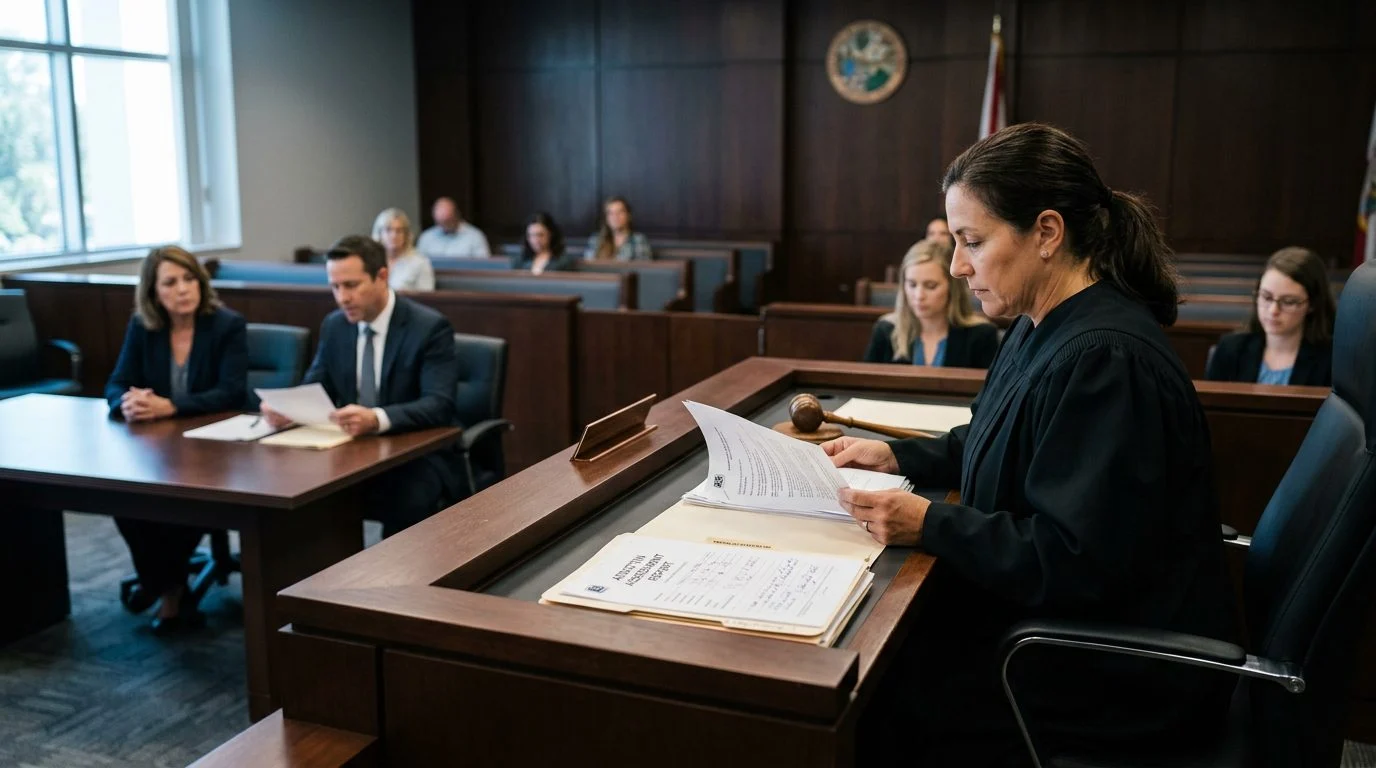
Step 6: The Hearing and What Happens to Your Child
The judge hears the evidence and decides whether the legal criteria are met.
Who acts: The judge presides. You and your lawyer present the petition and evidence. Your child may attend and may refuse to testify.
What it needs: Witnesses and records that support the facts. The court hears all relevant evidence, including testimony from family members who know your child’s history, and may order drug tests (§ 397.6957). Testimony in the hearing is taken under oath and the proceedings are recorded, and your child may refuse to testify at the hearing (§ 397.6957).
The statute asks whether there is a good-faith reason to believe your child is impaired and has lost self-control. The statute asks whether your child has lost the power of self-control and also whether judgment is so impaired that your child cannot appreciate the need for services and make a rational decision about them, or whether, without care, your child is likely to neglect self-care in a way that poses a real and present threat of substantial harm, with no apparent way to avoid that harm through willing, able, and responsible family members or friends or other services, or there is a substantial likelihood of physical harm to self or others (§ 397.675). Mere refusal of services is not, by itself, evidence of impaired judgment. Fla. Stat. § 397.675 reads: “(b) Without care or treatment, is likely to suffer from neglect or refuse to care for himself or herself; that such neglect or refusal poses a real and present threat of substantial harm to his or her well-being; and that it is not apparent that such harm may be avoided through the help of willing, able, and responsible family members or friends or the provision of other services, or there is substantial likelihood that the person has inflicted, or threatened to or attempted to inflict, or, unless admitted, is likely to inflict, physical harm on himself, herself, or another.” The court must find the conditions proven by clear and convincing evidence (§ 397.697).
The petitioner carries the burden. The Fifth District held in C.W.R.K. v. Stewart Marchman Act Behavioral Healthcare that a trial court erred by questioning the professional when the petitioner was absent. The Fourth District reached a different result in J.J.J. v. D.G.. As the court explained in C.W.R.K. v. Stewart Marchman Act Behavioral Healthcare, the trial court failed to follow the governing statute when, in the absence of the petitioner, it called and questioned the health care professional who executed the involuntary services certificate.

Step 7: After the Court Order, and Talking With Robinson Casey
If the court orders involuntary treatment, the order can last up to 90 days. If the conditions are expected to continue after 90 days of treatment, the service provider, or you as the original petitioner with supporting documentation from the provider, may petition for renewal under § 397.6975 before the 90-day period ends (§ 397.697).
Who acts: The treatment provider carries out the order, and if the court finds it necessary, it may direct the sheriff to take your child into custody and deliver him or her to the provider (§ 397.697). The court keeps jurisdiction and can monitor compliance or act for contempt if an order is violated (§ 397.697).
What it needs: Understanding of the order’s terms, the provider’s contact information, and a record of follow-up. Provider records are confidential and generally need your child’s written consent before disclosure (§ 397.501). A parent may also petition for habeas corpus on the child’s behalf to question the retention (§ 397.501).
Common Questions
Does the clerk charge to file?
No. The clerk may not charge a fee for filing the petition.
Can my adult child have a lawyer?
Yes. The statute says an individual must be told of the right to counsel in any judicial proceeding for involuntary treatment services, and an adult who cannot afford an attorney may apply immediately to the court to have one appointed (§ 397.501).
How soon is the hearing?
The court schedules it within 10 court working days, unless a continuance is granted.
If you are watching your child get worse and don’t want to carry this alone, Robinson Casey limits its practice to Marchman Act petitions and guardianship matters. The free first consultation is confidential and carries no obligation to continue. Call (561) 849-4700 or request a consultation. Richard J. Casey III, Esq. is the responsible attorney for this page.
How Robinson Casey Supports Your Family
Clear Explanations
We explain each stage of a Marchman Act case in plain language so you know what to expect before you take the next step.
Focused Practice Area
Our firm focuses on Marchman Act petitions and guardianship matters, the areas where families most often need steady guidance.
Compassion Under Pressure
A family crisis is hard enough. We aim to handle your case with patience, respect and careful attention to your loved one's dignity.
Confidential Conversations
Your first consultation is confidential, and you are under no obligation to continue after it.
Do Not Wait Until the Situation Becomes an Emergency
Families often reach out only after a crisis peaks. Speaking with a lawyer early gives you time to understand your options, gather information and plan your next steps calmly.
Your Next Steps
1. Gather the Facts
Write down recent events, names of treating providers and any documents you already have. Clear notes make your first conversation more productive.
2. Talk With a Lawyer
Contact Robinson Casey to describe your situation. Your first consultation is free, confidential and carries no obligation to continue.
3. Understand the Petition
Your attorney reviews the petition, explains the proceedings and discusses what the court will need to hear from your family.
4. Prepare for Court
We help you prepare for hearings, including what to say, what to bring and how to support your loved one through the process.