
Guardianship Matters | Miami-Dade and South Florida
Facing an Emergency Involving Your Adult Child? Get Guidance Now.
Robinson Casey focuses on guardianship and Marchman Act matters for families across South Florida and statewide. Call (561) 849-4149 or schedule a free, confidential first consultation.
By Richard J. Casey III, Esq. · Published October 24, 2026
The appointment is short. It ends 90 days after appointment, or sooner if a guardian is appointed first, but it may be extended for an additional 90 days upon a showing that the emergency conditions still exist. Fla. Stat. § 744.3031 sets these limits: authority expires 90 days after appointment or when a guardian is appointed, whichever occurs first, and may be extended for an additional 90 days upon a showing that the emergency conditions still exist.
This page explains emergency guardianship for an adult child in Florida. It covers who can ask, what the court must find, and what happens next. Robinson Casey limits its practice to guardianship and Marchman Act matters, serving families in Miami-Dade, across South Florida, and statewide.
Who Emergency Guardianship for an Adult Child Is For
Emergency guardianship is for an adult where there is imminent danger that the adult’s physical or mental health or safety will be seriously impaired, or that the adult’s property is in danger of being wasted, misappropriated, or lost, unless immediate action is taken. Families often have questions about which court steps may come first in these matters.
Common situations include:
- A hospital discharge where no one is clearly authorized to make decisions for the adult.
- A crisis tied to addiction or mental illness, where the adult needs care right away.
- An unsafe living situation, or a risk that someone is taking or wasting the adult’s money.
The law lets the adult or “any adult interested in the welfare of that person” ask the court for help. A parent, sibling, or other close adult can therefore start the process. The court makes the appointment, not the family. This page covers adult children, not minors.
Your adult child keeps important rights. The court shall appoint counsel to represent the alleged incapacitated person during any such summary proceedings. The rights a person found incapacitated keeps are listed in Fla. Stat. § 744.3215. They also keep the right to be treated with dignity and respect. Fla. Stat. § 744.3215 lists these rights.
If your adult child is in danger right now, you don't have to sort out the court process alone. Our team is ready to talk through your situation with you. Talk it through with our team — the first consultation is free, confidential, and carries no obligation.

When a Florida Court Can Appoint an Emergency Temporary Guardian
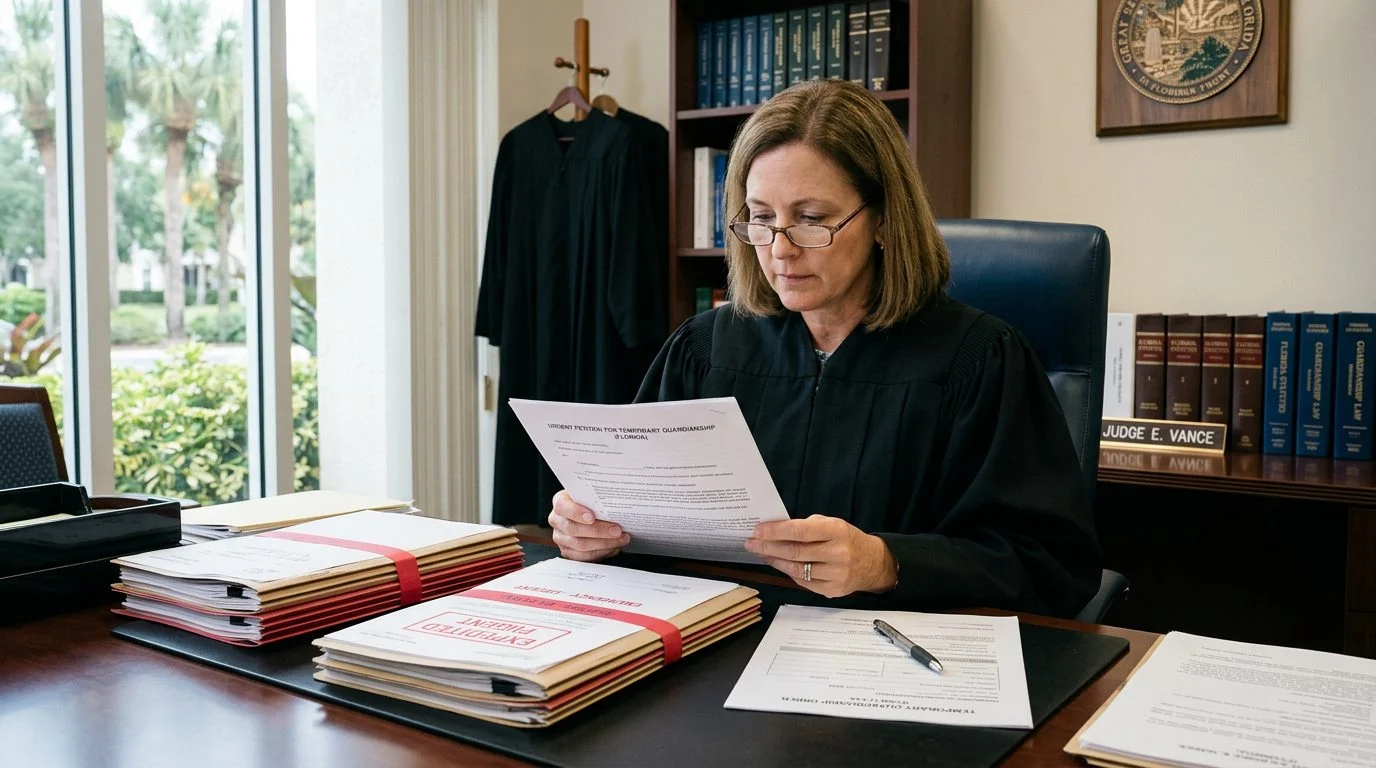
A court can make this appointment only after a petition to determine incapacity has been filed. The court must also find imminent danger. The judge must find that health or safety will be seriously impaired, or that property is at risk of being wasted, misappropriated, or lost, unless immediate action is taken.
Here is what the court process requires, in plain terms:
- A verified petition. Verified means signed under penalty of perjury. The petition must describe the emergency and explain why immediate action is needed. It must also say whether a willing and qualified emergency guardian has been found. Fla. Prob. R. 5.648 sets these contents.
- Notice. The adult and the adult’s attorney must receive notice at least 24 hours before the hearing. The only exception is when the petitioner shows that substantial harm would occur.
- Venue. For a Florida resident, the case is generally filed in the county where the adult lives. If the adult is found in another county, Fla. Stat. § 744.1097 allows filing where the adult is found.
Families often ask how a longer-term guardianship differs from emergency relief. Emergency authority is a bridge, not a permanent arrangement.
What an Emergency Temporary Guardian Can and Cannot Do
The guardian can act only within the powers the court lists in its order. The court must spell out those powers. Read the order closely, because it sets the limits.
Within those limits, a guardian acts as a fiduciary, which means a person trusted to act for someone else. Fla. Stat. § 744.361 requires the guardian to act within the court’s authority. The guardian must also act in good faith and never against the ward’s best interests. For property, the guardian must follow the standard a prudent person would use with another person’s money.
Some decisions need more than the emergency order. Fla. Stat. § 744.3215 sets this rule.
The guardian also has reporting duties. An emergency temporary guardian must file a final report within 30 days after the emergency term ends. The court cannot approve the guardian’s final fees, or the attorney’s final fees, until that report is filed. Fla. Stat. § 744.3031 sets this deadline.
How the Process Runs: Steps and Timeline
The process moves in steps, and each step depends on clear facts. Here is the typical path:
- Consultation and fact gathering. Collect medical, legal, and money details. Identify the immediate risk.
- Petition preparation. Draft the verified petition, the incapacity petition, and a proposed order listing the powers requested.
- Filing. File in the proper county and ask for an expedited hearing.
- Notice and representation. The adult receives notice, and the court appoints counsel for the adult.
- Hearing and order. The judge decides whether the emergency exists. The order sets the powers and the duration.
- Next steps. Before the 90 days end, the family may need a longer-term petition. An extension of up to 90 more days requires a showing that the emergency still exists.
Speed depends on the court calendar and on how fast the emergency facts are documented. No one can promise a hearing date in advance.
What Robinson Casey’s Guardianship Practice Covers
Robinson Casey limits its practice to Marchman Act petitions and guardianship matters. The firm serves families in Miami-Dade, across South Florida, and statewide. The practice covers:
- Emergency temporary guardianship
- Plenary guardianship
- Limited guardianship
- Mental health guardianship
- Guardianship attorney services
- Involuntary commitment for addiction under the Marchman Act
The Marchman Act allows involuntary assessment, stabilization, and treatment for adults and youth severely impaired by substance abuse. Florida Department of Children and Families describes how the law works.
Families sometimes need a different proceeding after an emergency order. Our team can explain how the emergency order fits with a longer-term plan. If a matter may be referred to another lawyer or firm, we will tell you before you decide.
Why Families Bring This Matter to Robinson Casey
Richard J. Casey III, Esq. is the lawyer responsible for this page. Our team includes assistants and office staff who help keep court papers organized.
Families can expect:
- Plain-language explanations of each step, in order.
- Court documents prepared with the deadlines in this guide in view.
- Clear talk about which proceeding fits: emergency, plenary, limited, or a Marchman petition.
The first consultation is free, confidential, and carries no obligation to continue. You can contact Robinson Casey to start that conversation.
Not sure what your next step is?
Talk it through with our team — the first consultation is free, confidential, and carries no obligation.

Frequently Asked Questions About Emergency Guardianship for an Adult Child
How fast can I get guardianship in Florida?
Timing depends on the court calendar and how quickly emergency facts are documented. No one can promise a hearing date.
What are the requirements for emergency guardianship in Florida?
You need a verified petition, facts showing imminent danger, and notice to the adult and their attorney at least 24 hours before the hearing. Fla. Stat. § 744.3031 sets these rules: a petition for determination of incapacity must have been filed, the facts must show imminent danger, and notice must be served on the adult and the adult’s attorney at least 24 hours before the hearing, unless the petitioner demonstrates that substantial harm would occur if the 24-hour notice is given.
What qualifies for emergency guardianship?
The court must find imminent danger to the adult’s health, safety, or property, after a petition to determine incapacity is filed.
Can you get temporary guardianship without going to court?
No. A court appoints a guardian by order, and a private arrangement does not create one. A durable power of attorney is a separate document, and Fla. Stat. § 744.334 lists it as an alternative to guardianship.
Can an adult child object?
Yes. The adult keeps the right to notice and to a lawyer during the proceeding.
If your adult child is in danger right now, you don’t have to work through emergency guardianship alone. Call Robinson Casey at (561) 849-4149 or use the contact page to talk through your situation.
How Robinson Casey Supports Families
Clear Documentation
We help you organize the facts and records that a court needs to understand your adult child's situation.
Direct Communication
You will hear from us in plain language about each step, what to expect, and what we need from you.
Focused Representation
Our practice is built around guardianship and Marchman Act petitions, so your matter is handled by people who work in these areas every day.
Compassionate Approach
We understand that families facing a crisis are under stress, and we treat every case with patience and respect.
Support From Our Team
Our team of assistants and office staff helps keep your paperwork, scheduling, and questions moving forward.
Easy to Reach
Call (561) 849-4149 to talk with our office about your situation and your options.
Emergencies Move Quickly
Court timing depends on the calendar and on how well emergency facts are documented. Gather any records about your adult child's condition and contact us early so we can review your situation with you. No one can promise a hearing date or an outcome.
Matters We Handle
Emergency Temporary Guardianship
Court-ordered protection for an adult child when urgent facts show a need for immediate action.
Plenary and Limited Guardianship
Guardianship petitions covering broad or narrowly defined areas of decision-making for an adult who needs support.
Marchman Act Petitions
Guidance on petitions for an adult child who needs substance use treatment, including involuntary commitment for addiction.
Mental Health Guardianship
Representation for families seeking court oversight when an adult child's mental health affects their safety and daily decisions.