
Marchman Act & Guardianship | Miami-Dade and South Florida
Helping Your Family Get a Loved One Into Treatment for Xanax Use in Florida
Robinson Casey limits its practice to Marchman Act petitions and guardianship matters, serving families in Miami-Dade, South Florida and statewide. Start with a free, confidential first consultation with no obligation to continue.
By Richard J. Casey III, Esq. · Published October 23, 2026
Short Answer: Can Florida Law Require Treatment for Xanax Dependence?
Yes, when the statute’s criteria are met. A court decides whether those criteria are satisfied. A family member or lawyer does not make that call.
If you are asking how to get someone into rehab for Xanax in Florida, the court route is one path. It has clear steps, limits, and rights for the person involved. This page explains each part in plain language.
If a family member's Xanax use has become risky for them or for others, you don't have to sort out the court options alone; call Robinson Casey at (561) 849-4149 to talk it through. Talk it through with our team — the first consultation is free, confidential, and carries no obligation.

What the Marchman Act Covers
The Marchman Act sits in Florida Statutes Chapter 397. It deals with substance abuse impairment. It gives courts a process for assessment and treatment when a person cannot make safe decisions about their own use.
The law uses terms like substance abuse impairment and substance use disorder. It does not list specific drugs. That means a prescription sedative like Xanax can fall within it when the facts fit.
The core test is in Fla. Stat. § 397.675. The court must have a good faith reason to believe the person is substance abuse impaired. Or the person has a substance use disorder along with a co-occurring mental health disorder. Because of that, the person must have lost the power of self-control over substance use.
One more element must also be met. The person needs services and cannot see that need. Or the person, without care or treatment, is likely to neglect themselves or refuse to care for themselves in a way that poses a real and present threat of substantial harm, and it is not apparent that such harm may be avoided through willing, able, and responsible family members or friends or other services. Or the person has hurt, threatened, or tried to hurt themselves or someone else.
Each one runs through the court, not through a family’s own decision.
Who Can File a Petition and What It Must Show
For an adult, Fla. Stat. § 397.68112 lists who may file. That includes a spouse or legal guardian, any relative, a service provider, and an adult with direct personal knowledge of the person’s impairment and prior treatment. A parent, sibling, or adult child may qualify as a relative.
A petition must name the person and the petitioner. It must state how they are related and name the person’s attorney if known. It must also give facts. The statute asks for reasons, not labels. Under Fla. Stat. § 397.68141, the petition must explain why the petitioner believes the person is impaired. It must explain why the person has lost self-control. It must also explain the risk of harm, or why refusing care reflects impaired judgment.
Describe what you saw, when it happened, and what followed.
Judgment is a key idea. A person may be unable to see their need for care and unable to make a rational decision about it. That line matters, because a refusal alone will not carry the case.
A petition may include a report from a qualified professional who examined the person within 30 days before filing. If the person was not assessed, or refused an evaluation, the petition must say so. Fla. Stat. § 397.68111 also allows a petition when the person was recently placed under protective custody or had an emergency admission within the previous 10 days.
How the Court Process Works, Step by Step
Filing starts the case. The petition goes to the clerk of the court in the county where the person is physically located when it is filed, under Fla. Stat. § 397.681. The clerk may not charge a fee to file it. A filing in the wrong county is a venue problem, not a loss of the court’s power. In J.P. v. J.N., the Fifth District held that a petition filed in the wrong county did not divest the circuit court of jurisdiction.
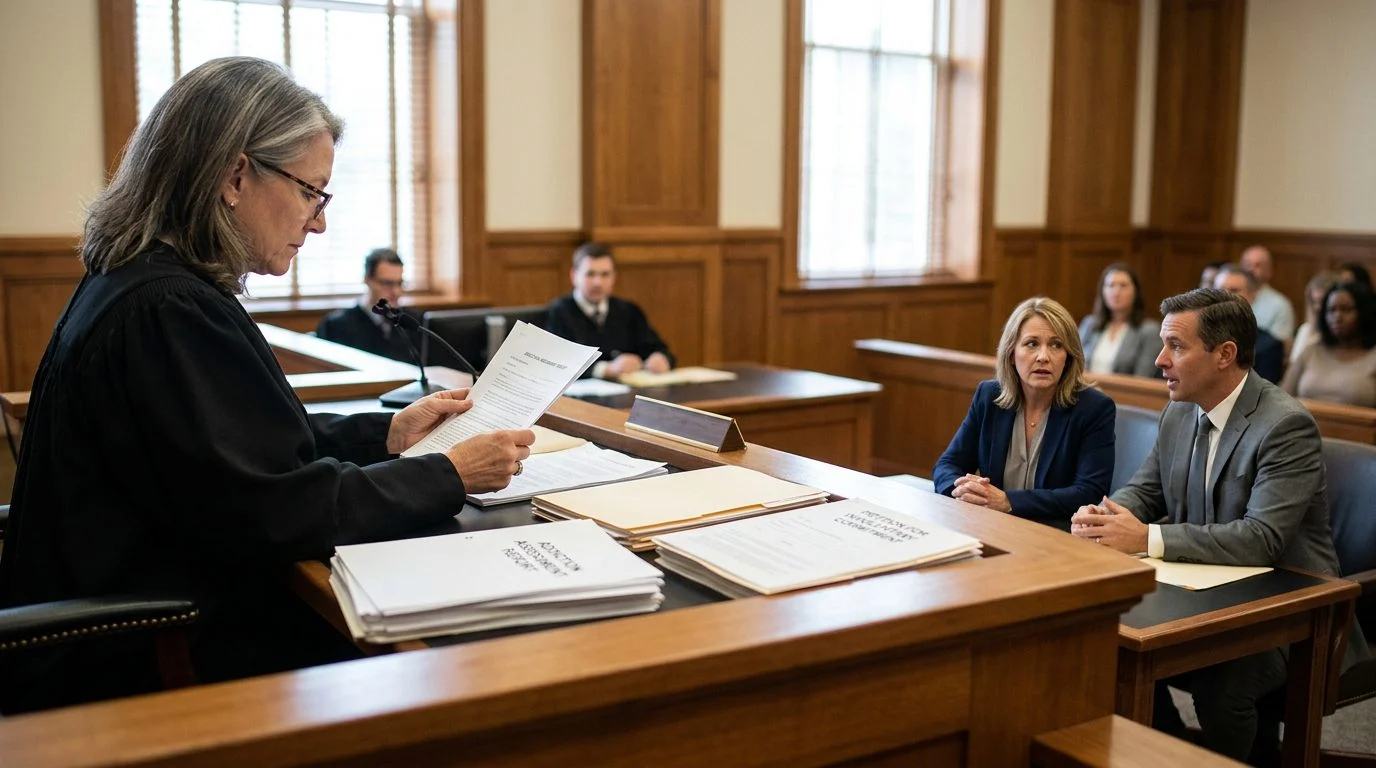
Next, the court checks whether the person has a lawyer or should get one. Under Fla. Stat. § 397.68151, the court sets a hearing within 10 court working days unless a continuance is granted. Notice goes to the person, their attorney if known, the petitioner, a spouse or guardian if one applies, a parent, guardian, or legal custodian if the person is a minor, and anyone else the court directs.
Assessment comes before treatment. Under Fla. Stat. § 397.6957, the court must hear and review all relevant evidence, including the results of the assessment completed by the qualified professional in connection with this chapter, at the hearing. Under Fla. Stat. § 397.6957, the respondent must be present at the hearing unless the court finds he or she knowingly, intelligently, and voluntarily waives the right to be present or, upon receiving proof of service and evaluating the circumstances, that presence is inconsistent with his or her best interests or is likely to be injurious to self or others. The 90-day assessment and stabilization order is governed by a different section, Fla. Stat. § 397.6818, which allows the court to issue or reissue an ex parte order valid for 90 days when the respondent does not appear at the hearing and the court reasonably believes a substance abuse emergency exists.
At the hearing, the court hears and reviews all relevant evidence (§ 397.6957(1)(a)); § 397.6818 instead lets the court rely solely on the petition in an emergency to enter an ex parte order. That can include family members familiar with the person’s history.
In an emergency, the court may act on the petition alone. Under Fla. Stat. § 397.6818, it may enter an ex parte order, meaning one entered without the other side present. A provider may hold the person for no more than 72 hours of observation, unless a listed condition or a court-granted extension applies. In D.H. v. K.J.R., the Second District held that a petition that did not establish a good faith reason to believe D.H. met the statutory criteria for involuntary assessment and stabilization meant the trial court erred in entering the ex parte order. In D.H. v. K.J.R., the Second District held that an ex parte order was improper when the petition did not give a good faith reason to believe the criteria were met.
Why Benzodiazepine Dependence Calls for a Medical Plan
Xanax is a benzodiazepine, a type of sedative. Any plan to stop or reduce it should come from a physician. Don’t plan to stop it on your own. A clinician needs the person’s dose, history, and other medications to make that plan safely.
A court order sets the legal path. It does not replace the medical plan. The court’s assessment process is built to produce a clinical recommendation. Under Fla. Stat. § 397.6957, the report must recommend a level of treatment. It must also note any co-occurring mental health or other treatment needs.
Co-occurring conditions matter. Mental health conditions and substance use can happen together. They are usually best treated at the same time, according to MedlinePlus on dual diagnosis.
One common mistake is to treat the court order as the whole plan. The order gets a person into assessment and possibly treatment. The day-to-day medical care still has to be planned and followed.
What a Petition Can Do and What It Cannot Do
A petition asks the court to order assessment and, if the criteria are met, treatment. Under Fla. Stat. § 397.697, when the court finds that the conditions for involuntary treatment services have been proved by clear and convincing evidence, it may order involuntary treatment from a publicly funded licensed service provider for up to 90 days, or from a privately funded provider if the respondent can pay or if any person on the respondent’s behalf voluntarily demonstrates a willingness and an ability to pay for the treatment. The court keeps jurisdiction to monitor compliance.
Treatment does not always run the full 90 days. Under Fla. Stat. § 397.6971, a person may be discharged early.
A court order does not ensure sobriety. Recovery depends on the person and on the care that follows the order.
The person has rights. Under Fla. Stat. § 397.681, the respondent has the right to counsel at every stage. A respondent who desires counsel and cannot afford a private lawyer has the right to court-appointed counsel.
Fla. Stat. § 397.681 does not state who bears the burden of proof; it provides that such petitions must be filed with the clerk of the court in the county where the person is located. In J.C. v. State, the court held that the trial court failed to follow the applicable statute by essentially functioning as the absent petitioner. The Fourth District reached a different view in J.J.J. v. D.G. and certified conflict. In J.J.J. v. D.G., the Fourth District affirmed and certified conflict with R.S., J.W., and C.W.R.K., for the reasons stated in the opinion.
How any petition turns out depends on the facts of the case and on the court’s findings.
Not sure what your next step is?
Talk it through with our team — the first consultation is free, confidential, and carries no obligation.
Other Paths Florida Families Often Discuss
A court petition is not the only route. Under Fla. Stat. § 397.601, a person may apply to a service provider for voluntary admission. Within the financial and space capabilities of the service provider, the provider must admit the person when there is sufficient evidence of substance abuse impairment and the provider can safely manage the person’s condition. Voluntary admission requires the person’s own agreement.
Outpatient treatment can also be voluntary. It works only when the person agrees to attend and follow the plan.
Guardianship is a separate legal matter. It is not the same as a Marchman Act petition. Robinson & Casey also handles guardianship matters, so a consultation can clarify which route fits.
A Marchman matter can also raise questions about work and professional licensing. Those questions are separate from the petition. They can be discussed at a consultation.
Preparing Information Before You Call an Attorney
Start with a dated timeline. Note when use changed, when incidents happened, and what followed. Include names of prescribing doctors and pharmacies. Gather recent medical records and any prior treatment history. List relatives and others who have direct personal knowledge of the situation.
Specific, dated observations are more useful than general descriptions. The statute asks for facts that show the reason for the belief. A dated note about a missed shift, a pharmacy refill, or a car incident gives a lawyer something to work with.
Quick Answers
Can you get someone into rehab for Xanax in Florida by court order?
Yes, when the Marchman Act criteria are met, a court can order assessment and involuntary treatment. Voluntary admission needs the person’s agreement.
Who can file a Marchman Act petition for an adult?
A spouse, legal guardian, relative, service provider, or an adult with direct personal knowledge may file. The petition must state the facts behind the belief.
Where is the petition filed?
It is filed with the clerk in the county where the person is physically located at filing. The clerk may not charge a filing fee.

Talk With Robinson Casey About Your Family’s Situation
If your family member is taking Xanax in larger amounts than prescribed, or in ways that have put them or others at risk, you may be weighing whether a court-ordered route is right. Robinson & Casey focuses on Marchman Act petitions and guardianship matters for families in Miami-Dade, South Florida, and statewide. Some matters may be referred to another lawyer or firm. Robinson & Casey offers a free first consultation that is confidential and carries no obligation to continue. Call (561) 849-4149 or use the contact form to talk through your family’s situation.
Responsible lawyer: Richard J. Casey III, Esq.
How We Can Help Your Family
Marchman Act Petitions
We help families file petitions under Florida's Marchman Act to seek assessment and treatment for a loved one struggling with substance use, including benzodiazepines such as Xanax.
Involuntary Commitment for Addiction
When a loved one refuses help, we explain the court process for involuntary commitment and what each step involves for your family.
Guardianship Matters
Our guardianship practice covers emergency temporary, plenary, limited and mental health guardianship, so the protection suited to your family's situation can be considered.
Clear Guidance From the Start
We walk you through the paperwork, hearings and timelines in plain language, so you know what to expect before you decide on next steps.
Why Families Contact Robinson Casey
A Focused Practice
Robinson Casey limits its practice to Marchman Act petitions and guardianship matters, so our work centers on these proceedings.
Free First Consultation
Your first consultation is free, confidential and comes with no obligation to continue.
Miami-Dade, South Florida and Statewide
We serve families across South Florida and throughout Florida.
Speak With Us Directly
Call (561) 849-4149 to talk through your situation and learn how we can assist.
Supportive Office Team
Our team supports you with scheduling, paperwork and follow-up, so you are not navigating the process alone.
Don't Wait for a Crisis
Addiction emergencies can escalate quickly. If you are worried about a loved one's safety, contact us early so you can understand the options available before the situation becomes urgent.