
Marchman Act & Guardianship | South Florida
Understanding the Evidence Behind Involuntary Addiction Treatment in Florida
Robinson Casey focuses on Marchman Act petitions and guardianship matters for families in Miami-Dade, across South Florida and statewide. Learn how the evidence is gathered and presented, then talk with us about your family's situation.
By Richard J. Casey III, Esq. · Published October 20, 2026
A Florida court can order involuntary addiction treatment only after the petitioner proves the case by clear and convincing evidence. The proof must show that the person has a substance abuse impairment. It must also show that the impairment has taken away their self-control or their ability to make sound decisions about treatment. Families usually build that proof from a clinical assessment, specific recent events, witness accounts, and the person’s treatment history.
This guide explains what a judge weighs under Florida’s Marchman Act, found in Chapter 397 of the Florida Statutes. It covers Florida law only. It also shows how to organize what your family already has before you talk with a lawyer.
What a Florida Court Is Deciding in an Involuntary Addiction Treatment Case
The court decides whether the person named in the petition meets the Marchman Act criteria. That person is called the respondent. The case starts when someone files a petition with the court.
The core test appears in Florida’s Marchman Act criteria. A person may be admitted involuntarily if there is a good faith reason to believe they are substance abuse impaired. The same rule covers a substance use disorder with a co-occurring mental health disorder. The impairment must also have caused them to lose the power of self-control with respect to substance use.
The statute adds a second step. The person must either need services and lack the judgment to see that need. Fla. Stat. § 397.675 reads: “(b) Without care or treatment, is likely to suffer from neglect or refuse to care for himself or herself; that such neglect or refusal poses a real and present threat of substantial harm to his or her well-being; and that it is not apparent that such harm may be avoided through the help of willing, able, and responsible family members or friends or the provision of other services, or there is substantial likelihood that the person has inflicted, or threatened to or attempted to inflict, or, unless admitted, is likely to inflict, physical harm on himself, herself, or another.” Or they must be likely to neglect themselves in a way that poses a real and present threat of substantial harm. Fla. Stat. § 397.675 reads: “(b) Without care or treatment, is likely to suffer from neglect or refuse to care for himself or herself; that such neglect or refusal poses a real and present threat of substantial harm to his or her well-being; and that it is not apparent that such harm may be avoided through the help of willing, able, and responsible family members or friends or the provision of other services, or there is substantial likelihood that the person has inflicted, or threatened to or attempted to inflict, or, unless admitted, is likely to inflict, physical harm on himself, herself, or another.” The second path also covers a substantial likelihood of harm to self or others. Under the neglect path, the harm must not be avoidable through willing, able and responsible family or friends, or other services. Fla. Stat. § 397.675 reads: “(b) Without care or treatment, is likely to suffer from neglect or refuse to care for himself or herself; that such neglect or refusal poses a real and present threat of substantial harm to his or her well-being; and that it is not apparent that such harm may be avoided through the help of willing, able, and responsible family members or friends or the provision of other services, or there is substantial likelihood that the person has inflicted, or threatened to or attempted to inflict, or, unless admitted, is likely to inflict, physical harm on himself, herself, or another.”
Other states have their own laws on this topic. This guide covers Florida law only.
If you're watching someone you love struggle with alcohol or drugs and wondering whether a court can step in, our team can talk it through with you. Talk it through with our team — the first consultation is free, confidential, and carries no obligation.

The Standard of Proof the Court Applies
The judge may order involuntary treatment only when the conditions are proved by clear and convincing evidence. The court may order involuntary treatment services only when the conditions for them have been proved by clear and convincing evidence.
The petitioner carries the burden of proof. The Fifth District Court of Appeal has said so in J.C. v. State. A family can’t simply describe a problem and expect the court to fill in the gaps.
The judge looks at the whole record together. That can include the professional assessment, witness testimony and documents. If an order for treatment from a publicly funded licensed service provider is entered, it can last up to 90 days. A renewal can be requested before that period ends, and the court may also order drug tests.
Clinical Assessment and Professional Evidence of Impairment
A respondent cannot be ordered into involuntary treatment without a clinical assessment. Florida law provides that a respondent may not be involuntarily ordered into treatment under this chapter without a clinical assessment being performed, unless he or she is present in court and expressly waives the assessment (Fla. Stat. § 397.6957(1)(b)).
The assessment comes from a “qualified professional,” a term defined in Florida’s substance abuse statutes. It includes licensed physicians and certain licensed mental health professionals.
If the person was never assessed or refused one, the petition must say so (Fla. Stat. § 397.68141).
The professional’s report must include findings and a recommendation on the level of treatment, if any. Under § 397.6957(1)(b), if the respondent remains unassessed after 90 days, the court shall dismiss the case. Family observations still matter. They show how the person has acted at home over time. A professional’s findings show who examined the person, when, and what they found. The petition should name both, so the court can check the source.
Evidence That the Person Has Lost Self-Control or Cannot Make Responsible Decisions
The court needs proof about control and judgment, not only proof of drinking or drug use. The petition must state why the petitioner believes the respondent has lost the power of self-control (Fla. Stat. § 397.68141).
Refusing help is not enough by itself. Families need facts that show how the impairment affects decisions.
Examples families often describe include:
- Repeated attempts to stop that failed, with dates
- Turning down help the person accepted in the past
- Statements or actions showing the person does not see a need for care
- Harm to self or others while impaired
- Missed food, medication or safety needs
Avoid summaries like “always” or “for years.” Write each example as a dated event. Note what happened, when, and who saw it. A court can test a specific event. A general pattern is much harder to check.
Documenting Recent Conduct, Harm, and Witnesses
Specific, recent events are easier for a court to test than general statements about someone’s history. A strong file has dated events, records that back them up, and people who saw them.
Records that often help include:
- Emergency room or hospital records
- Police or incident reports
- Work or school notices
- Bank or property records showing harm
- Dated messages or photos showing the person’s condition
Keep copies of originals in one place. Don’t edit or write on original documents. Put your own notes in a separate file and label them as notes.
Witnesses matter too. The court may hear testimony from family members familiar with the respondent’s prior history and current condition (Fla. Stat. § 397.6957). Record each witness’s name, contact details and what they saw firsthand.
Privacy is a common worry. Court petitions and related records filed under this part are confidential and exempt from public records rules, but the clerk may disclose them upon request to listed persons, including the petitioner, the respondent and their attorneys (Fla. Stat. § 397.6760).
Prior Treatment History and Whether Other Options Were Considered
Prior treatment history shows the court how the problem has played out over time. Build a timeline with facility names, admission and discharge dates, and the reason for discharge when you know it.
Timing matters. The same is true of a report: a petition may be accompanied by a certificate or report from a qualified professional who examined the respondent within 30 days before the petition was filed. Note the dates of any recent emergency contact.
Describe any voluntary help that was offered or tried. Include who offered it and how the person responded.
For an adult, a spouse, legal guardian, relative, service provider, or an adult with direct personal knowledge of the person’s prior assessment and treatment may file. If you’re a relative, be ready to describe what you personally know about that history.
Not sure what your next step is?
Talk it through with our team — the first consultation is free, confidential, and carries no obligation.
How the Hearing Works and Who Presents the Evidence
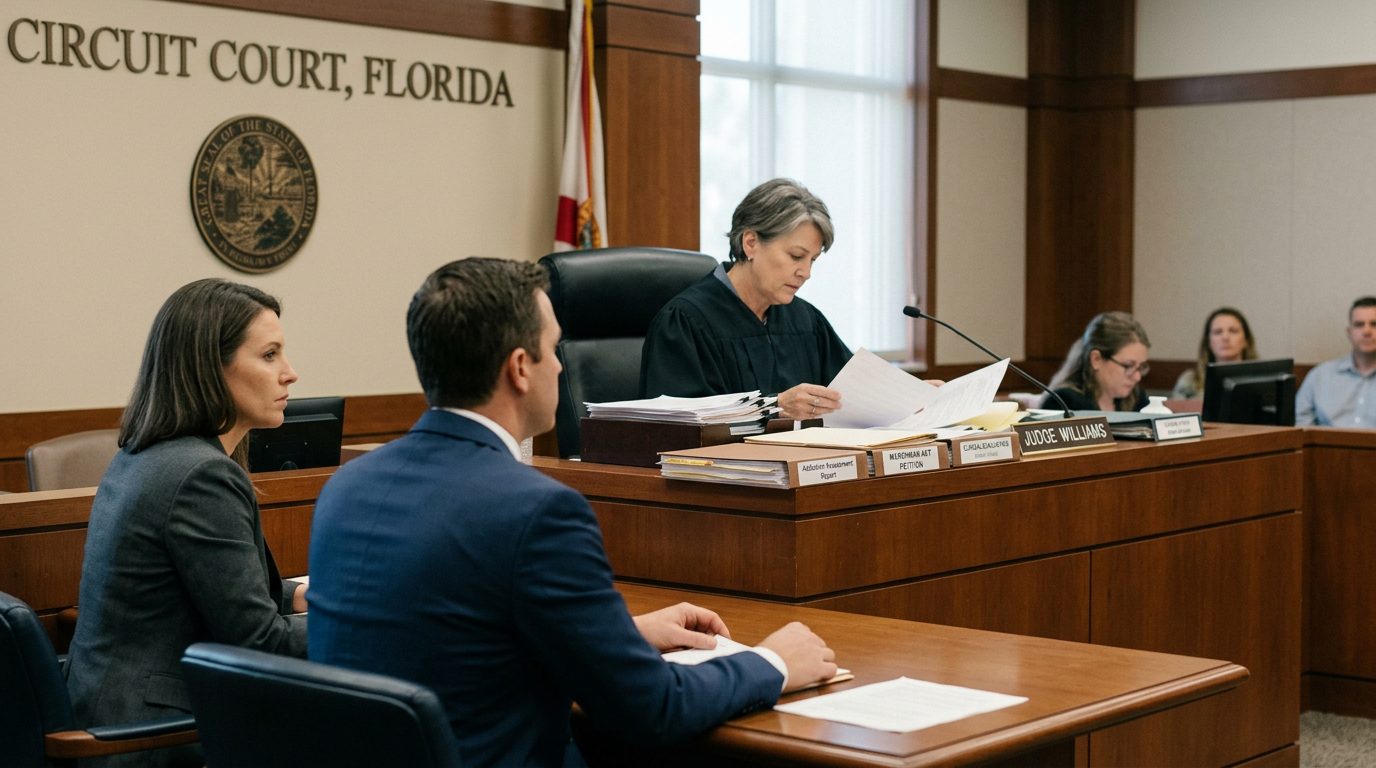
The hearing follows the filing of the petition and notice to the respondent. The court must schedule it within 10 court working days unless a continuance is granted (Fla. Stat. § 397.68151).
Upon the filing of a petition for involuntary services with the clerk of the court, the court must immediately determine whether the respondent is represented by an attorney or whether appointing counsel is appropriate. In Miami-Dade County, the Miami-Dade Clerk’s mental health court page directs adult cases to Probate Court. In Miami-Dade County, the Miami-Dade Clerk’s mental health court page directs adult cases to Probate Court. A wrong-county filing is a venue defect, not a loss of the court’s jurisdiction (J.P. v. J.N.).
The respondent has a right to counsel at every stage. The Second District has held that Marchman respondents have a constitutional right to counsel (Hillsborough County v. Albrechta). Testimony is taken under oath and recorded. The respondent may refuse to testify.
The petitioner must be ready to present the case. In the Fifth District, a court may not call and question the professional when the petitioner is absent (C.W.R.K.). A Fourth District court reached a different result and certified conflict in J.J.J. v. D.G.. So treat the Fifth District rule as Fifth District law, not settled statewide. What happens at any hearing depends on the facts of the case.

Organizing What You Have and Talking With Robinson Casey
Start with a dated timeline, a records list and a witness list. Then add notes on any contact with doctors, counselors or crisis staff.
- A timeline of events, with dates and who saw them
- A list of records, with where each one is kept
- A list of witnesses, with phone numbers and what each saw
- Notes on professional contact, including the professional’s name and the date
Robinson Casey limits its practice to Marchman Act and guardianship matters. Richard J. Casey III, Esq. is the responsible lawyer, and support staff assist the practice.
Who can file a Marchman Act petition for an adult?
A spouse, legal guardian, relative, service provider, or an adult with direct knowledge can file.
What standard of proof applies?
The petitioner has the burden of proving the conditions by clear and convincing evidence.
Does the respondent have a right to a lawyer?
Yes, at every stage, unless the court finds a knowing and voluntary waiver.
If you’re watching someone you love struggle with alcohol or drugs, and you’re wondering whether a court can step in, you don’t have to work it out alone. Our team can walk through your timeline and records with you. The first consultation is free, confidential, and comes with no obligation to continue. Call (561) 849-4149 or reach out through our contact page.
Responsible lawyer: Richard J. Casey III, Esq., Robinson Casey.
Why Families Contact Robinson Casey
Focused Practice
Our practice focuses on Marchman Act petitions and guardianship matters, so your family's case is handled within those areas.
Free, Confidential First Consultation
Your first consultation is free and confidential, with no obligation to continue.
Clear Explanation of the Process
We explain the filings, the evidence and the steps ahead in plain language so you know what to expect.
Support for Families
Our team supports families across South Florida and statewide through difficult and urgent situations.
Don't Wait to Ask Questions
When a loved one's health and safety are at risk, waiting can make a hard situation harder. Contact us early so you understand the evidence, the process and your options.
How We Can Help Your Family
Reviewing Your Situation
We listen to your concerns, review the facts you have and identify the documents and information that matter most.
Preparing the Petition
We help organize the records, observations and testimony that support your petition for involuntary treatment or guardianship.
Guiding You Through Court
We explain each stage of the court process, what to expect at hearings and how to keep your family informed.